Silicon Valley Technology Commentary & Archives · Est. 2006 3,033 Posts · 2006–2026

August 12, 2008

August 12, 2008 · 2 MIN READ · BY LOUIS GRAY

MyBlogLog/FriendFeed Integration Fouling Up Google Vanity Searches

MyBlogLog/FriendFeed Integration Fouling Up Google Vanity Searches

Practically every blogger performs regular "vanity searches" to see if they were mentioned on the Web. Some use Technorati, others, Google Blog Search, or Twitter Search. And Google has made it very easy to get alerted via e-mail if your name has been mentioned out in the blogosphere. But recent efforts by MyBlogLog's "New With Me" feature, integrated with FriendFeed, have resulted in an overflow of useless updates, whether you're searching for yourself, or anybody else active on both sites, adding a flood of noise to what used to be actionable search results.


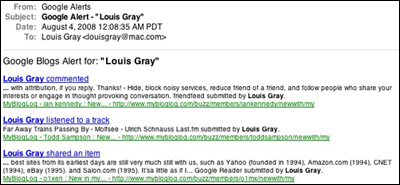
My pre-saved Google Blog Search watches the Web for me.

In February, MyBlogLog made a big move into the lifestreaming space, by doing more than tabulating fans of your content and tagging your blog with keywords, but letting you see your friends' activity around the Web, including their participation on Twitter, Last.fm, Digg and other social sites.

In May, no doubt in response to users' requests, MyBlogLog added the ability to show FriendFeed comments and likes in their lifestream, adding the popular social aggregator as a supported service.

That sounded good on the surface. Now, by going to my MyBlogLog page, I can see activity from my "friends" on FriendFeed, as well as the other previously-supported services.

My Google Blog Search Alerts Stopped Being Useful

But then, Google Blog Search started indexing MyBlogLog's updates as equal to actual individual blog entries. This meant I started to get results in vanity searches, and those sent by e-mail for things as mundane as "Louis Gray commented" or "Louis Gray listened to a track". And it wasn't just my activity, but others. Every few hours, I would get e-mail reporting, "Spullara commented", or "Corvida shared an item", for example. If they were commenting on my items or sharing my items on FriendFeed, MyBlogLog heard about it, and told Google, who then told me.
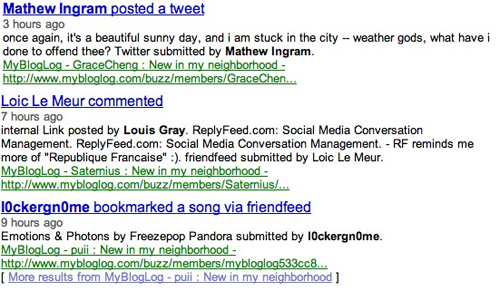

MyBlogLog Delivers FriendFeed Activity to Google Blog Search.

Clearly, this isn't the end of the world. But it's messy, and it's taken what used to be a fairly rock-solid service, in Google Blog Search and Alerts and made it a lot less useable. While I have no doubts that I'm overweighted with this problem, thanks to being more active and visible on FriendFeed, others I tested showed the same issues, including the aforementioned Corvida, Chris Pirillo, Duncan Riley, and Sarah Perez, for example.

Some people have openly expressed concern about how services are auto-populating and aggregating outside activity, creating an echo effect. This is one of the clearest examples of unintended consequences. So what should happen? Should Google Blog Search remove MyBlogLog results, or should MyBlogLog remove FriendFeed entries? Which service should make the first move if any move is needed?

August 12, 2008 · 2 MIN READ · BY LOUIS GRAY

Disqus Takes Commenting to the Next Level

Disqus Takes Commenting to the Next Level

Over the last few months, no blogging comments engine has received as much attention, or gained as much perceived blogger momentum as has Disqus. While alternatives exist, Disqus' clean interface, tracking capabilities and the team's aggressive approach to customer support have begun to make them the alternative to standard blogging comment engines from Blogger, Wordpress and TypePad. As I previously documented, moving to Disqus has greatly improved the interactivity between me and my readers over the last few months, and I remain extremely optimistic about the company's ability to gain market share.

As many other sites have now reported, Disqus rolled out version 2 of their software today, addressing some concerns held by holdouts who believed implementing the engine would hurt their SEO rankings, while also delivering strong platform integration with Wordpress, a new developer API, and a significant reorganization of Disqus.com to deliver immediate access to an individual's comments to track and manage.

On Sunday, prior to today's announcement, I spoke with the company's CEO, Daniel Ha, who said much of today's rollout was targeting those people concerned with their comment data being externally hosted on "the cloud". The service's new API enables full synchronization between Disqus and your local comments database (for Wordpress and Moveable Type only today), which has a side benefit of working well with search engines, such as Google.

Most interesting to me in today's announcement are the changes at Disqus.com. As I've discussed before, comments are often made, and as Disqus comments can flow to e-mail, to FriendFeed, or other lifestreaming services, context becomes crucial. Now, each registered Disqus user has a personal "comment blog", which can show previous comments, as well as replies, to provide context. For example, you can see mine here: http://disqus.com/people/louismg/

Disqus is now installed at more than 30,000 Web sites. When I asked Ha about the service's penetration in markets outside the typically insular tech blogging community, he said, "We have a very great presence in the tech blogger segment, but the most prolific discussions come on political and finance blogs. There is a lot of heavy usage back and forth."

Disqus, which held a party this most recent Saturday at their new office, employs three people full time, with an intern, who will be leaving the company at the end of the summer, much to Daniel's dismay.

The blog comments space is not one where Disqus has a monopoly yet, by any means. SezWho and Intense Debate have a good following, as does WordPress, of course, but today's developments raise the bar yet again for competition as Disqus becomes more entrenched as the standard.

August 11, 2008

August 11, 2008 · 1 MIN READ · BY LOUIS GRAY

GMail and Apple's MobileMe Holding an Outage Contest

GMail and Apple's MobileMe Holding an Outage Contest

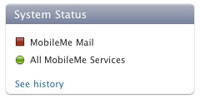
Apple's replacement for .Mac, MobileMe, has been roundly mocked for its spotty uptime since rollout last month, drawing the company's CEO, Steve Jobs to apologize for the lack of quality in an internal memo. But even following an internal reorganization and the public thrashing, users, including me, were unable to access their e-mail for a good portion of the afternoon - even as the company's MobileMe Status page shows no updates since the end of July.

Not to be outdone, the most popularly cited alternative to MobileMe, Google's GMail, has also suffered outages this afternoon, locking its many users out of their e-mail, again, including me.


At the beginning of the issues with MobileMe Mail, Apple famously said the outages were only impacting a small 1 percent of users, despite widespread complaints throughout the Web. Today's outage, which Apple reported lasted about a half hour, cited only that "MobileMe members were unable to access MobileMe mail", so that indicates a full outage.
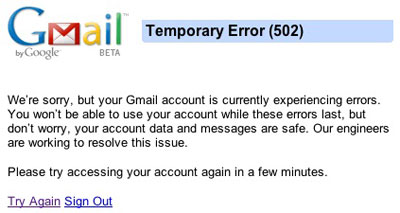
GMail, on the other hand, says, "We’re sorry, but your Gmail account is currently experiencing errors," without going into detail as to how widespread the issues are. GMail even goes the extra mile to promise "your account data and messages are safe." A discussion sparked by Shey Smith on FriendFeed shows the outages don't appear to have hit everyone.


The 1-2 punch of the outages has made discussion of the downtime the top conversation starters on Twitter, even higher than the Beijing Olympics or the Russia/Georgia skirmish. People must really hate having their e-mail interrupted!
August 11, 2008 · 2 MIN READ · BY LOUIS GRAY

AppSpot Spy Follows Social Media for Live Keyword Searching

AppSpot Spy Follows Social Media for Live Keyword Searching


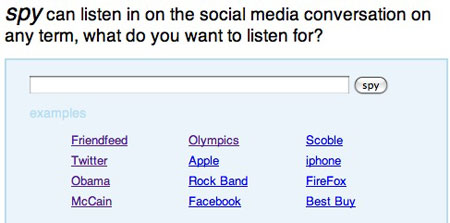
Summize, prior to its acquisition by Twitter, became the unquestioned resource to find out what trends were hot on the service, or to watch for specific keywords. But as good as that product is, it's limited just to the microblogging service. An interesting offering, called "Spy", leveraging Google's App Engine, offers the ability to watch not just Twitter, but also blog posts, Google Reader shares, and FriendFeed.

Spy is a simple visualization of data that flows through Twitter and FriendFeed. You can "spy" on any keyword you choose, looking backwards as little as one hour, or as much as two days. As you would expect, popular topics like "Obama", "McCain" or "iPhone" see updates every minute or so, as do news items, like "Georgia" or "Olympics".


Essentially, Spy becomes a superset, incorporating Twitter Search as well as activity found from the previously mentioned sources, and displays them in near real-time.

The author, Ben Hedrington, explains that he built the service to help as a bridge between the early adopter set and the mainstream when it comes to social media. In his mind, the Spy tool is as simple as sitting back in an armchair and watching TV. Put in a keyword and watch Spy go to work.


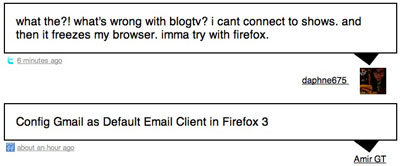
Spy In Action Searching for FireFox Across Twitter and FriendFeed

Spy has already been used by some on Twitter to see news come in around blasts in Bangalore, India, and Spy could likely be a good tool in times of fast-flowing news, be it political change, conflict or natural disasters. Twitter and FriendFeed are becoming places for people to react to news in real time, and Spy is now an option to see those reactions, from disparate sources, in one place.

As Hedrington admits, Spy isn't yet the most robust interface in the world. It's more "developer chic" than polished UI, but he says he's working on it. And it's already received the attention of the Google App Engine team (who can be seen using Spy here). As can be expected, Twitter provides a high percentage of the results in Spy, meaning Twitter Search will be "good enough" for most queries, but Spy will also see discussions taking place elsewhere, giving you a bigger picture.

You can find Spy at http://spy.appspot.com/