Silicon Valley Technology Commentary & Archives · Est. 2006 3,033 Posts · 2006–2026

August 19, 2008

August 19, 2008 · 3 MIN READ · BY LOUIS GRAY

Specialized Perceived Value Trumps Real World Value

Specialized Perceived Value Trumps Real World Value

If you've attended college, or at least know somebody who has, you know that students are willing to pay hundreds of dollars a term for some of the most mind-numbing texts alive. Students will wait in line for hours, or go store to store to acquire these textbooks, which might only be available in one location, knowing that to not pay these exorbitant prices and, therefore, miss out on the texts, could lead to lower marks, and potentially, decreased success in school and just maybe post-school, could be disastrous.

But these same books, worth hundreds of dollars to an individual, are worth absolutely nothing to me. You couldn't get me to take those blasted tomes for free - because to me, they have no value. They would clutter up my house, and I'd probably never open them up. (Of course, I didn't open most of them in college, and that's a different story.)

Outside of the world of publicly traded companies and market caps, the value of a service is very much like these same textbooks. What might have ultimate value to one person may have no value to another.

Just imagine dropping off iPhones in the Amazonian jungle or Sub-Saharan Africa, where 3G is a lot less important than three meals a day. Think about the plans of the last few decades of delivering one computer per classroom, when class capacities were ballooning to nearly forty students. After a while, it's clear, there's a gap between one person's perceived value, and that item's actual value. The same, is of course true with online services.

Ever try to explain social media or social networking services to people who don't rapidly take to putting their lives online? It's a tough road, especially if they don't have friends who use those services, and see keeping their online life updated as a significant time sink. But to someone who is fully engaged and has thousands of followers or friends at some of the popular services, even minutes of downtime are alarming.

Students who buy these overpriced, one time use only textbooks, and actually read them, are doing so with the expectation that their future lives will be bettered through investment today.

Similarly, I believe that taking the time to blog, or read RSS feeds, and engage with peers on Twitter or FriendFeed or SocialMedian can improve my experience today and tomorrow. Through these services, I've learned new things, I've shared ideas, and helped others. I've found new friends and peers.

It's not always clear how investment of time and energy in social media will benefit you in the long run. As Robert Seidman mentioned in a post here over the weekend, activity on social media landed friend Hutch Carpenter a new job. And since engaging on this blog, I've started receiving a good number of opportunities to meet interesting people, to speak at or attend conferences, and to help contribute to some cutting-edge services.

This weekend, I walked my mother through some of the services I use, and while there was some interest, most of the response was "why would I do that?" or "how would I find other friends who use these things?" Not every service is built for every individual. It's likely the Facebook application developers who are finding themselves snapped up for nine-figure sums would never have gained traction with a significant portion of the market, who saw their products had no value. It's likely many of the services I use every day won't be seen as having value to others. But the important thing is that to some portion of the population, they are crucial. The game is finding out which part of the population it is, and working to make that target larger.

August 18, 2008

August 18, 2008 · 3 MIN READ · BY LOUIS GRAY

The iPhone Cannot Be The End. So What's Next?

The iPhone Cannot Be The End. So What's Next?


My Mobile Phone Progression: What's Coming?

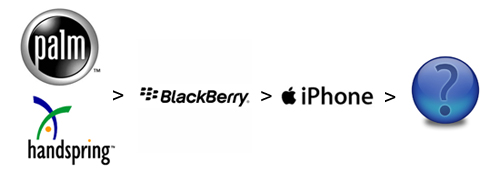
When I go into work on Tuesday, one of the first things I plan to do is turn in my Blackberry, and begin the process of porting my cell phone number over to the iPhone. Within days, I expect I'll be Blackberry free for the first time in about five years. But this isn't the first cell phone product transition, and it certainly won't be the last, for me. While the iPhone, for many today, represents the "ultimate" in cell phones, something will take its place, just as has been played out time and again as technology evolves.

As users, we tend to gravitate to a specific platform and declare it the "best" or the "winner", supporting it fanatically, buying proprietary applications, and demanding everything we use synchronize with it. It's what we're doing today with the iPhone, it's what we did with the Blackberry before it, and previously, the Palm OS. Even today, I could probably write out the alphabet in Graffiti if handed a stylus.

But to pick up a Blackberry today already seems antiquated, and, with luck, even though it's been a great platform, I may not ever have one again. If I were to bring out a Handspring Visor or a Palm III or Palm V, I'd be hearkening back to the days of tech's yesteryear. And God bless those poor souls who would love to show you the capabilities of their Apple Newton. There's just no saving them.

In the fun of going through the iTunes App Store and getting new applications and games with basic features, including a bowling application, Tetris, and Bejewled, it struck me as having something of deja vu to it - as I had downloaded similar games and apps for Blackberry, and for Palm before, and maybe for a Sony Ericsson I owned for a short time. Yes, the applications are getting better, and taking advantage of new technology like multi-touch and GPS or WiFi, but once again, I'm buying apps for a single platform that I think is the best at the time.

So, in three or five years time, as the iPhone has evolved, or been replaced, by Apple or others, will I still be using those applications? Probably not. Will I again be buying the same applications but on a new platform? Probably.

The fact is that there are a finite number of developers and an increasing number of places to deploy these applications. We've heard stories of what Google's Android platform will or won't be, and we've heard how developers are happy, or aren't, or how they're switching instead to write for the iPhone. Where those applications may at one time have been debated to write for Macintosh or Windows, you now also have the option to write for Windows Mobile, for Blackberry, for Android, for the iPhone, for Facebook, for Flash or for Java, to deploy on the Web, or any of the game consoles - the Playstation, the Wii, the XBox, and their portable derivatives.

Evolution always pushes forward, on the desktop, on the Web, or, in this case, in the world of mobile handhelds. And it's very rare for a single company to be the leader for more than three to five years. The Microsoft desktop monopoly has been protected for parts of three decades now, legally and illegally, and they've never achieved the same level of success in the world of handsets, as much as they wish they could. Should we expect that Apple will coddle their lead on the iPhone, as they carefully massaged their leadership with the iPod, or will they rise to this pinnacle, only to see it eroded away by one of the current players, or someone new? It takes more than developing the world's best mobile phone experience. It also takes coddling and rewarding of a vast development community to pick you ahead of all others.

As a consumer, I've won with each move. I won by going from land line to mobile phone. I won by going from a pager to my Hanspring Visor with the VisorPhone. I won by going from the VisorPhone to a Blackberry. And so far, I'm sure moving from the Blackberry to the iPhone. The question is, will my next move, in a few years, be off the iPhone, or simply to a newer model?

August 17, 2008

August 17, 2008 · 5 MIN READ · BY LOUIS GRAY

Google Has Leveled the Internet Playing Field

Google Has Leveled the Internet Playing Field

By Robert Seidman of TVbytheNumbers (Twitter / FriendFeed)

There are many motivations to write something and publish it on the Internet. Some write in hopes of making money, others like Louis, write because they want to be a part of something they enjoy, others like Hutch Carpenter find their next job. But I believe whether it's Duncan Riley, Louis or Hutch the common denominator is this: they want their voices to be heard.

It's a Very Different Landscape Than 1994…
A very low barrier to entry brings with it some blessings and some curses. The more people who participate, the better things are for everyone in the aggregate. But the more people participating, the harder it is to compete and have your voice rise up above the cacophony of all the other voices.

During my first foray into Internet publishing in the fall of 1994, the landscape was dramatically different. I launched a newsletter essentially summarizing the big events of the week in the online/Internet space. At the time of launch, my only competition was for-fee subscription content. There was no freely-available competition and as a result, I gained access to readers and industry insiders very quickly. Fortunately, Robert Scoble was writing about visual basic or something at the time, so I didn't have to compete with his bullhorn either.

I first met Bill Gorman, who I now run TVbytheNumbers with, within two months of launching my 1990s Internet publication. Bill was an executive at AOL, who helped launch America Online's international division. Around the same time, Bill started reading what I was writing, so did the person who was running AOL – Steve Case. Basically within two months of launching I was reaching high-ranking industry insiders.

…But It's Still Possible to Get Your Voice Out There
Today, if you were to launch a blog on social network services and hoping to get Mark Zuckerberg of Facebook to read it, I believe that task would be about 10,000 times more difficult. The likes of Louis, however, are proving that it's not impossible to write about companies you're interested in and gain 'inside' access. It may not be on the scale of Facebook executives for Louis (yet), but gaining insider access is certainly something he's accomplished to the point where he's now taken an advisory role with ReadBurner.

Louis might seem like an 'overnight success' story to many in the blogging circles, but not to me. What I see is a kid who has been plugging away since January 2006 and really started to get some traction by late 2007, which has accelerated greatly during 2008. Thirty-two months of plugging away to get where he is today isn't an overnight success story. It is a success story, but it is a success story that involved a lot of hard work, persistence and determination.

All Good Things…
The other day I brought up my FriendFeed and saw the link "Robert Seidman Quoted in NY Post On Phelps/Olympics" posted by none other than Louis. It was the first I'd heard of it. Although we have talked to reporters from the NY Post (and other publications) I hadn't talked to them about this. They'd just lifted the quote right out of a blog post and I wouldn't have it any other way.

Although getting quoted is nice, especially when quotes are just lifted off blog posts, the thing I was most proud of for the week was seeing this story comparing the minutes of online streaming to the minutes of viewing via traditional television pop-up in my Google Reader. An analyst working at Fox television crunched some numbers on top of some numbers I'd crunched in a blog post and Fox's PR team circulated it, citing our blog as the original source.

It's not lost on me that mostly happened because the song I was singing, "TV is still king", was a tune the people at the television networks really love to hear. But in a world where we're in some ways competing with Variety, Advertising Age, The Hollywood Reporter, Media Week, TV Week, The New York Times and the USA Today, to wind up having my thoughts on the subject heard was extremely gratifying. In some ways I'm in awe that the playing field is still level enough for that to happen.

Thanks Google!


I know a lot in the tech blogging circles will opine on whether Google is good or evil. For now in my mind, Google is still good. It leveled the playing field for us. We have little in the way of expense overhead (almost $0, really) and sure, it may work out that I've made about eight cents per hour, but that's the subject for another blog post. From my perspective, we are allowed to compete, and compete fairly without spending anything on marketing. It's hard for me to find fault with a system that provides that sort of level playing field.

Organic Google search (including Google News) is our number one traffic source. This leads to a lot of referral traffic from other sites and a good bit of the direct traffic.

A level playing field does not mean it's easy to get your voice heard, in fact, one of the best ways to compete in a very level playing field is with a lot of hard work. This may not equate directly to riches or fame, but if those were your goals the odds were already stacked against you before you started and you knew it.

Ultimately though, having your voice heard can lead to other very cool opportunities. Ask Louis, or Hutch, or even me. The best job I ever had, as a Senior Vice President at Charles Schwab running various portions of its online brokerage (from 1998-2003) came at least indirectly, and mostly directly, in my opinion, as a result of having my voice heard on the Internet. That was a lot easier to achieve in those heady pre-Google days, but even in this vastly more competitive era, Google does a great job leveling the playing field.

P.S. because I didn't think many FriendFeeders are interested in TV Metrics, I stopped feeding our blog into my FriendFeed stream and created a separate one here.

August 16, 2008

August 16, 2008 · 2 MIN READ · BY LOUIS GRAY

It Still Has That New iPhone 3G Smell

It Still Has That New iPhone 3G Smell

As promised late last night, this morning started off by finally going out and getting an iPhone. I ignored all the common sense and all the excuses, drank my fanboy Kool-Aid, and made my way to the nearby Apple Retail store, looking to possibly leave my life of Blackberry behind and start anew with the world's most coveted gadget. By the time I left the store, I not only had the iPhone 3G, but also a 500 Gigabyte Time Capsule, a new iPhone 3G case with belt clip, and a line-in adapter for the car. There's no question, at least for one day, Cupertino is happy with me.

As you can imagine, the first few hours of iPhone ownership are less about being functional, and more about syncing data, and trying out all the new widgetry.

Luckily for me, iTunes smartly asked if I wanted to restore the settings and data from my iPod Touch to the iPhone. This set things in motion so all the purchased iTunes App Store programs were moved over, along with my e-mail accounts, photos, and music. In fact, if it wasn't for the iPhone's new shape and the Phone application itself, it'd be pretty easy to forget I made a change.

I haven't yet decided what I'm going to do with my now two phone numbers. It's tempting to get rid of the old number and start new with AT&T, and also tempting to never use the new number, migrating the old to the new phone. That's why, at least for now, I don't plan on giving anybody the number for the iPhone. But that doesn't mean I'm not messing around with it. I found myself taking random photos, and sending useless SMS messages just to prove I could. I sent a photo taken with the iPhone via e-mail, again, just because I could.

In Folsom, where we're staying with my family for an extended weekend, we've had spotty 3G access. Sometimes it's on, and sometimes, Edge shows up, so I haven't been testing speed, but it does exactly as I would expect. The iPhone downloaded all my e-mail from the Mobile Me, GMail and Exchange servers quickly, and Internet browsing is at least as fast as it was on the iPod Touch.

Like any good new toy tool, it's tempting to just find reasons to get it out, or to wear it prominently, just so people know I have one. It's tempting to bring it out in the middle of dinner, to find an answer to a question in conversation, or to use it instead of the laptop, just because I can. It's like having a new car and getting excited just to drive down to the market and pick up milk and eggs. But the necessary transition has occurred. Last night, I went to bed as a non-iPhone owner, and tonight, I have joined the club. Looking forward to moving on from the novice to expert stage.