Silicon Valley Technology Commentary & Archives · Est. 2006 3,033 Posts · 2006–2026

August 16, 2008

August 16, 2008 · 4 MIN READ · BY LOUIS GRAY

Is There Less Funding Or Are Startups Just Cheaper?

Is There Less Funding Or Are Startups Just Cheaper?

By Rob Diana of Regular Geek (Twitter/FriendFeed)


As an early adopter, I have an interest in startups. As a software developer and a developer of Web sites and services, I have additional interest in funding and the whole entrepreneur idea. Because of this, I tend to read a few "business" blogs as well as the usual technical fare. One of these blogs is A VC. Recently, Fred Wilson started writing a series of posts on the venture fund economics that is amazing. If you are trying your hand at a startup, I highly recommend you start looking at these posts. Just getting a fundamental understanding of the VC process is helpful in determining whether VC funding is worthwhile to your startup. In his Venture Fund Economics post he concludes with a very interesting point:
Some will read this and suggest that our business is all about swinging for the fences. But I don't think so. There are hitters in baseball, the best hitters in fact, that hit balls out of the park when they are just trying to make good contact. That's how you have to do it in the venture business. You try to make 20 great investments and you work with them closely in hopes that four years in you have six or seven that have home run potential, and after ten years, you maybe hit one or two out of the park. If you try to hit every one out of the park day one, you'll strike out way too much and the fund won't work out very well.
I think this logic can also be applied to startups in general. If you always try to do something that will turn out to be a home run, you will strike out too much. In the technology world, a home run would be a Google competitor, an iPhone competitor or even a Facebook competitor.

So, what if you are just trying to make contact? We have already heard in various places that venture funding is hard to get in general, and even harder in today's economy. Is this discouraging startups? Or are the startups focusing on the "major" technical hub cities? Paul Kedrosky must have been thinking this recently when he found that California is not a big entrepreneur state. Granted this is just an analysis using Google Insights for Search, but it does yield some interesting information. I was not enamored with the search terms that Paul used, so I tried a different set (entrepreneur, startup, venture capital and funding) and found some really interesting results.
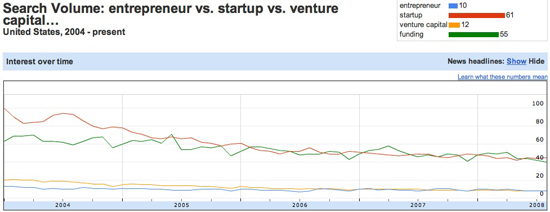

Google Insight: Entrepreneur, Startup, Venture Capital and Funding

Interestingly enough, entrepreneur is not a big search term compare to startup or funding. Initially I thought this could be due to the generic nature of these terms, but the locations tend to match up with significant technical presences. As you can see from the chart, there is an obvious downward trend for all of the search terms. We can assume that this is due to the economy because if you read TechCrunch, Mashable or ReadWriteWeb, you will see plenty of Web sites getting initial startup coverage. In any economy like the one we are in currently, investments suffer and people invest less. Therefore it is likely that venture capitalists are being much more careful regarding what they invest in. Many people wanting to be an entrepreneur are probably taking less risks as well. So, we could be seeing a rise in startups being a weekend job until revenue or major funding becomes a reality.

However, some of these startups do require some significant money in order to operate on a daily basis because cloud computing is not free. Are people getting more angel funding? Following the same logic as the entrepreneur search, I compared the search terms angel investor and angel funding.


Google Insight: Angel Investor and Angel Funding

Here you can see that angel investor and funding have flat or slightly rising trends. Again there is a definite relation to the major technical locations and the "interest" of searches. Given the trend lines for the "angel" search terms and the comparison to the previously explained trends, it does look like there is more interest in angel funding.

Why would we be seeing this difference in trends, besides the economy? Well, many of the newer web services do not require major hardware infrastructure in order to get started. Cloud computing and even cheap hosting make the hardware investment something that can be put off until there is a true need. Using the cloud is also very cost effective initially because you do not need to hire a server or network administrator. This is all handled for you by the cloud provider. The cloud also gives you the ability to handle spikes in traffic signifcantly better than with a traditional hosting provider. Given these reduced costs, a good round of $100,000 of angel financing could fund a startup for two years. At that point, there could be real revenue being generated or even a venture captial funding round. Money is easier to raise when you are a somewhat proven startup compared to when you first start and only have a few thousand page views per month.

It looks like the combination of the economy, cloud computing and the generally lower technical barrier for new services is creating a new environment for startups. People are finding cheaper ways to get started. Startups are also using the existing information on the web to define more interesting services. So, what is coming next and where do we go from here?

August 16, 2008 · 2 MIN READ · BY LOUIS GRAY

YooPlace Captures Twitter's Top Conversations, Lets You Reply

YooPlace Captures Twitter's Top Conversations, Lets You Reply

With Twitter's tweaking its API limits, you've seen a virtual tug of war between the popular microblogging service and the many different sites that have sprung up to capture the most discussed links and topics. In the last few months, we've seen sites like AlphaTwitter and Tweetmeme arrive, each finding middling success. But quietly, a new service called YooPlace is looking to not only show popular discussions, capturing all matter of shortened URL services to resolve back to a single original, but also setting you up to reply, either to the original tweet, or any of those that have followed suit.

On Friday, Jesse Stay highlighted Twitter's ability to enable threaded comments, a feature long desired, and one that could eventually see the disappearance of the omnipresent @ symbol used to connect users. While it might be some time until we see that on Twitter directly, YooPlace has designed their site to make conversations by way of Twitter seem threaded.


YooPlace Is Like Twitter Meets Hacker News.

The YooPlace main site looks a lot like the popular Hacker News, complete with tan background, items showing rank by number, and even a triangle on the left by each item in the same font. Clicking on the triangle, like in Hacker News, votes the story up a point, presumably higher in the rankings. But most of the scoring comes from the tweets themselves, which are shown as "comments". The first Twitter user to post the URL is shown as the originator, even if they are not the blog author themselves. Clicking the "comments" link displays all the following tweets, as well as their avatars, with the ability to respond in line.


A Popular Item from YooPlace

As you would expect, the most popular items ranked by YooPlace are blog posts from popular blogs, including TechCrunch, Engadget, and Mashable. But there are also tweets that call out recent earthquakes, political news, and the Olympics. You can also see the items which hit the top of YooPlace by following YooPlaceTop on Twitter.


You Can Reply From Within YooPlace

The author of YooPlace is Thomas Bikeev, a Belgian, who tips his hat to Hacker News as inspiration for YooPlace, and saying the data is provided by Twitter's API as well as Twitter Search (formerly Summize).

Ranking popular topics on Twitter has been done before, and the magic formula to "get it right" is still eluding folks. But I really like the ability to click on comments and see just who said what about the topic, as well as aggregating the different URL shorteners. With so many new ones cropping up, it can get easy to miss who is talking about your posts or a specific issue. And the fact you can respond in line is very interesting. We'll see if YooPlace can do more than the others have, and get real traction with the new features before Hacker News sues them and wants their interface back.
August 16, 2008 · 2 MIN READ · BY LOUIS GRAY

When it Comes to the iPhone, Never Assume Rationality

When it Comes to the iPhone, Never Assume Rationality

As far as the iPhone is concerned, I have failed in my role as an early adopter. Two generations into Apple's delivering the most talked about cell phone in history, I as an Apple aficionado practically have a legal obligation to not only have one, but to have more than one. But even today, I do not. I've instead slogged along with a previous-generation BlackBerry, and a first-generation iPod Touch, arguing that in combination, the two provide just about everything the iPhone would give me. Add on to that fact that I've had my phone service paid for and the BlackBerry provided for from work, and it makes for enough good excuses not to join the iPhone faithful.

But in hours, it's likely this all comes to an end, despite all my protests.

Armed with a coupon to the Apple Store, courtesy of Social Median, I have every intention to get up at the crack of dawn Saturday, and with my sister, an Apple Store retail employee herself, go in to buy an iPhone 3G. She knows her store has hundreds, and we want to beat the line.

What do I get from the iPhone 3G that the iPod Touch doesn't have? Well, aside from the entire functionality of the phone itself, I also get a camera, and Internet anywhere - not just in range of WiFi. It's this last part that really hits home, to be honest. I know the camera's not the best in the world, though I'll love always having one in my pocket. But I really, really, want "real Internet" with me wherever I go, even though 90+% of the time, I'm within range of WiFi, whether I'm at home, at work or anywhere else. What I really want is the ability to just pick up the iPhone from the supermarket, or from the A's game, or in that small percentage of places where WiFi wasn't enough.

Even with this added functionality, I still have the issue of paying AT&T where to date, I've let work pick up the tab. Maybe I expense my monthly bills, if they go for it. Maybe I say goodbye to my current phone number and start over with a new one. And maybe I transfer my old number to the new iPhone and keep the number that, for now anyway, belongs to the corporation and not little me.

It's not rational, to be honest. I've heard the horror stories of people struggling to get good 3G access, or of battery issues. I've heard rumors of Apple even recalling the iPhone 3G, which would be an unquestioned public relations and business disaster. I'm staring in the face of almost $1,000 in phone bills, where there were none before. Yet... it somehow feels right. It's what I'm supposed to do. I can't take the gift certificate from Social Median, which was intended for a new iPhone 3G and put it toward a Time Capsule, which I'm also thinking of getting. That'd break an unwritten rule. While I held out for so long, for me anyway, the wait will soon be over, as I fling off the shackles of responsibility and head to the Apple Store like a lemming. Can't wait.

August 15, 2008

August 15, 2008 · 1 MIN READ · BY LOUIS GRAY

Twitter Implements Threaded Comments, Sort Of

Twitter Implements Threaded Comments, Sort Of

By Jesse Stay of Stay N' Alive (Identi.ca/FriendFeed)

Today Twitter made a quiet announcement on their developer mailing list that could have profound implications. On the mailing list, Alex Payne, a leading developer at Twitter gave the following announcement:

"I'm happy to announce a minor change to the API that should have a major impact on the Twitter community. The /statuses/update method now takes an optional parameter: in_reply_to_status_id. As you might guess, this allows API clients to specify which status a status to be posted is in reply to, rather than our system assuming that it's in reply to the last message posted by the user specified by "@username". "

What does this mean? Essentially now any Twitter client can now associate another post as a reply to another existing post. This means that Twhirl or TweetDeck can allow a user to post a normal status update, and provide a "+" sign underneath (or "@" similar to the Twhirl FriendFeed client), and a new post can be appended as a reply to the previous post.

What's very interesting though is that Twitter is not requiring "in_reply_to_status_id" requests to have an "@" symbol in them. Therefore, this could very well mean the death of "@'s" on Twitter as more and more clients begin to fully implement the API call. Twitter seems to be breaching FriendFeed territory on this one, if they could just start allowing better aggregation.

I expect to fully see new implementations of this feature very soon - the request is quite simple, and would just take some simple UI enhancements. Twhirl I know has these built in already to their FriendFeed client - they would just need to utilize the same code and they would have it in the Twitter client. Now the question becomes, will Twitter's API limits allow this feature to work? It will be interesting to watch.