Silicon Valley Technology Commentary & Archives · Est. 2006 3,033 Posts · 2006–2026

September 15, 2008

September 15, 2008 · 2 MIN READ · BY LOUIS GRAY

Google Grinds Out Gears for Safari

Google Grinds Out Gears for Safari

I'm still waiting for the day when every Web site and Web application behaves the same, intended, way on every Web browser and operating system. But despite it being more than 15 years since the launch of NCSA Mosaic, and 13 years since the introduction of Java, we're still not there. As a result, just like application developers often have to make the choice to code for Macintosh or Windows, we're seeing Web utilities make their way to Internet Explorer and Firefox before they get to Safari, despite the Mac's recent growth trajectory. Today, one of the laggards, Google Gears, released tools for the Safari browser, 16 months after debuting for other browsers.

At the time of Gears' launch in May of 2007, I frustratingly dismissed it as "Another Utility That Won't Work With Safari". Considering I've managed to go more than a year without Gears on Safari, to be honest, I almost forgot why I would want it in the first place. There's something about being a Mac/Safari user that makes us more hard-headed than the average Web consumer, and I'd already pretty much reached the point where I didn't remember what I could possibly be missing out on.

But with that said, today's announcement on the Google Mac Blog enables us to gain the full functionality of Gears-enabled sites, like Zoho, WordPress and Google Docs offline, in what's our preferred browser.
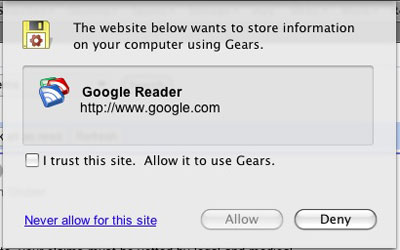

Google Reader: My First Google Gears/Safari-enabled App

With Google Gears installed, the first thing I've noticed is the new ability to take Google Reader offline. So, in the rare event that I'll be out of range of the Internet, but didn't get a chance to clear my Google Reader list first, I can take my favorite feeds with me. (See: Google Reader: Offline Reading)

Today's announcement also holds a hidden wrinkle - that the tool should be easily customized for any browser using WebKit. Without saying so, that certainly means Gears' integration in the Chrome browser is behind getting those of us using Safari will get some trickle-down help.

September 15, 2008 · 3 MIN READ · BY LOUIS GRAY

As Twitter Regains Footing, Competitors' Growth Stalls

As Twitter Regains Footing, Competitors' Growth Stalls

Over the last few months, Twitter's challenges have been well documented, here and elsewhere. Between issues with uptime, occasional data loss, a reduced feature set, and a difficult relationship with its developer community, the microblogging service frustrated many users to the point they were seeking out alternatives - from Plurk, to Identi.ca, Rejaw and FriendFeed. But more recently, as the service has all but eliminated downtime, and put the "Fail Whale" on the Endangered Species list (See: Pingdom's Twitter analysis), it looks like competitive services are losing momentum, and some are bleeding visitors, if Web visit tracker statistics are to be believed.


Twitter.com's Growth Has Returned, According to Compete.com

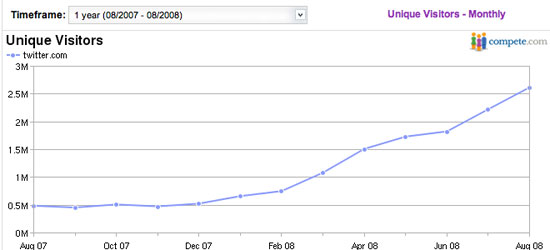
According to Compete.com, Twitter saw more than 2.6 million visitors in the month of August, a 500% increase over its December 2007 number, representing a 17.7% increase month over month. The high level of growth since June for Twitter followed a two-month near plateau from April to June, when the service's struggles were at their peak.


Compete.com Shows Twitter's Competitors Have Stalled

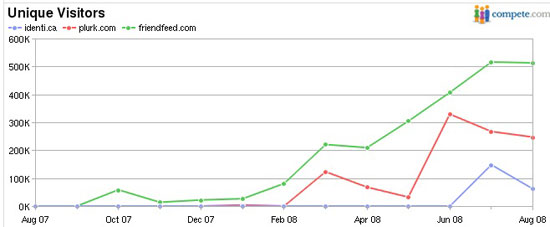
In the same time period, from July to August:
  • Identi.ca fell more than 58%, to 61 thousand visitors, down from more than 140 thousand the prior month.
  • Plurk.com fell to less than 250 thousand visitors, down 7.5% month over month, and down 30 percent from the site's peak, in June.
  • FriendFeed.com visits were flat from July to August, decreasing just under 1 percent, to more than 500 thousand visitors.
(All data from Compete.com)


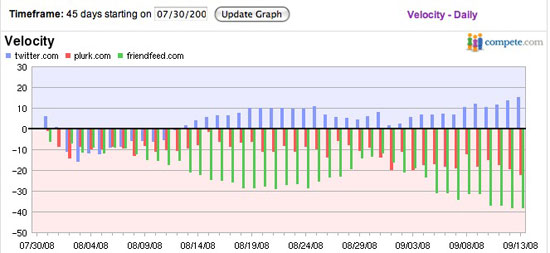
Compete.com Velocity Shows Twitter Extending Its Lead

I can't claim I was an extremely "early" adopter of Twitter, and at times, I haven't been too fond of the service compared to other sites, but when it comes to status updates and "what you are doing", there really is only one game in town, one that's synonymous with the concept of microblogging - Twitter, thanks to it being first on the scene, first to amass a significant user base, and being tied in to other services, like Facebook and FriendFeed.. When Twitter had months of instability, outages, and a reduced feature set, its users didn't make the mass migration to other services that many had expected. And while they're still wrapping their arms around a business model, as services like Yammer claim to have gotten to the financial promised land first, Twitter has got the brand recognition and the massive user base that no other service can claim.

On Saturday, I wrote to Chris Baskind on FriendFeed, regarding Twitter.
"We have huge expectations and therefore, huge frustrations. The site has so much potential, and realistically, they have already won the microblogging battle, so we want them to be great!"
Twitter has the potential to be the conduit for the SMS and text messaging generation to social media. Twitter has already proven to be a great option for news updates, alerts to emergencies, and for using keywords to gauge the temperature of tens of thousands at once. And for anybody looking to the smaller services like Plurk, Rejaw, or Identi.ca, even if those services have incrementally better features or a stronger UI, they would have to expect a smaller user base, becoming an increasingly quiet echo chamber.

Barring disaster or bankruptcy, Twitter's leadership should continue. I've seen increasing examples of late where the site has become more mainstream. Those looking to alternative microblogging services may have had the time to hit at Twitter's weaknesses pass them by, as the site has nearly eliminated downtime, and started again on the growth curve, when others have stalled or seen user traffic decimated.

September 14, 2008

September 14, 2008 · 3 MIN READ · BY LOUIS GRAY

SiteMeter's Attempted Challenge to Google Analytics Falls Flat

SiteMeter's Attempted Challenge to Google Analytics Falls Flat

SiteMeter, one of the most widely-used Web log statistics trackers, has seen itself fall well behind the long, dark, shadow of Google Analytics. And while I've been a happy SiteMeter user for almost three years, its statistical data has at times seemed fairly pedestrian compared to Google's advances, lacking the ability to segment the results by selected dates, to build advanced charts, or even to export the records to Excel or a comma separated value file. This weekend, after months of developing a new version of their product in beta, they finally took a leap forward to better compete, but the roll-out has, so far, been a big disappointment. In fact, on the same day they went live, they had to roll back the launch.

SiteMeter, to date, has featured a free version of its product, and a paid version, to premium subscribers, who, for $89 a year, get expanded insight into referral statistics, user behavior, and their Web browsing setup. Premium users get access to data covering the most recent 4,000 visitors, as well as aggregate data comparing the most recent month's traffic to that of prior months - as far back as you started using the service.
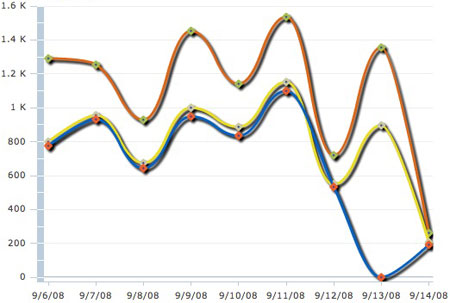


Google Analytics, on the other hand, shows you data from all visitors of your site ever tracked. And instead of being restricted to only one set of users (the last 4,000), you can show visit data from the last day, multiple days, or any date segment. The service also lets you carve up your visitors' history with multiple graph options.

SiteMeter must have been feeling the heat, because their newest version hit the major benefits of Google Analytics. It let you segment results from a date range. It let you export any graph's underlying data. And it definitely expanded the range of graphs available.


The New SiteMeter Tried to Pretty Up Its Visitor Graphs


User Visit Data In the New Site Meter: Basically Raw Code


The New SiteMeter Pulldown Menus: Form or Function?


But what SiteMeter didn't do with their new version was make the data look useful for humans. Instead of a friendly UI, its newest offering felt very raw, with unpolished typefaces, and gaps that showed not all the data was being tracked. It's the same type of feeling most Mac users get when entering Linux for the first time.


Meanwhile, old shortcuts that were familiar to existing users, like recent referrals, popular pages, and summary data, no longer worked, and clickable links were instead replaced with a series of pull-down menus. Essentially, form was chosen over function, and the form wasn't really all that good.


Coming Soon: A SiteMeter Scoreboard?

Should they get more comfortable with their new look and feel at any point in the near future, it's clear SiteMeter is also not only going after Google Analytics, but there was a new feature called "Sitemeter Scoreboard" that showed your site's ranking in terms of total visitors or page views, relative to the service's nearly 1 million installations. Maybe the idea is that we would start showing our SiteMeter ranking on our blogs as many do for Technorati or other services. But it looks like we're not going to know for a while. Today's botched roll-out is another black eye for a company that most recently gained headlines for blocking access to Web sites via Internet Explorer, and has had the occasional outage or two without company comment.

If this is the best SiteMeter had to offer against Google Analytics, Google's really in no trouble at all.

September 13, 2008

September 13, 2008 · 3 MIN READ · BY LOUIS GRAY

Having a Development Platform Doesn't Mean You Stop Competing

Having a Development Platform Doesn't Mean You Stop Competing

When Google's Chrome browser debuted, I openly asked if we ever thought the application would see the light of day on Apple's iTunes App Store, or if Cupertino would keep the door closed, giving Safari a leg up in the new round of browser wars. This weekend, things got clearer, as Apple turned down a tool that could be seen as competing with iTunes. As I had expected, Apple is not going to let the iPhone's development program get in the way of their leading software applications. And you know what? While they could certainly do better to communicate this up front to the development community, they shouldn't have to give competition the keys to the kingdom.

With so much of the Web community's efforts going toward open source programs and open platforms, it's almost become expected that companies are going to stop acting like businesses and start acting like charities. But not all will.

Google's Chrome was launched with promises that its improvements would be given back to the open source community. The browser, which could have come embedded with a load of Google-centric items, actually offers multiple options for search engines, amid some's concern that Google's growing influence in the search and advertising space was making it a monopoly.

In another example, Twitter famously gives its XMPP feed to FriendFeed, a site which many thought could replace the microblogging service outright. They could have instead told FriendFeed to pound sand and get their updates the old-fashioned way, but they didn't, which played a big role in helping FriendFeed grow to the point where it is today.

But neither of these examples typically is how the world works in business. Businesses focused on revenue and profits (which Google Chrome and Twitter aren't yet) don't usually kowtow to the competition and make things easier for them in the name of openness.

While it could be argued that Apple has introduced competition to MobileMe by making it easy to add Yahoo! Mail, GMail and Outlook to the iPhone, we realize they're not fools, and as e-mail access is essential, being flexible has broadly opened the iPhone's opportunity in the business market and with consumers outside of the MobileMe customer list. But there's no real strong reason for Apple to continue this trend and open up to provide iPhone versions of FireFox, Chrome, Opera or Internet Explorer, were Microsoft ever to have a change of plans regarding the Mac platform or the iPhone.

I also wouldn't expect Apple to make room on the iPhone for desktop photo applications that compete with iPhoto, or anything that offers an end-run around AT&T, so long as that business relationship is in place.

And Apple's not the only company to play this way. Jason Goldberg of SocialMedian has mentioned a number of times that he's made no headway in having that service's activity reflected in the aforementioned FriendFeed, which he assumes is due to them being perceived as competition. While I believe it's more likely due to SocialMedian being so new, and the FriendFeed team having other priorities, there's really no reason they should go out of their way to letting a rival service get hooks into its users.

Apple has got to do a better job, in advance, of letting developers know what the limits are for what they can build, and where they need to stop. But this isn't a not-for-profit game. This is business, and it shouldn't be expected that a company's providing developers with the ability to make an application is an open invitation to replace their crown jewels.