Silicon Valley Technology Commentary & Archives · Est. 2006 3,033 Posts · 2006–2026

September 23, 2008

September 23, 2008 · 3 MIN READ · BY LOUIS GRAY

iPhone Application Review: Mobile Fotos

iPhone Application Review: Mobile Fotos

By Phil Glockner of Scribkin (FriendFeed/Twitter)


Author's Note: Louis and I share an interest in the iPhone / iPod Touch platform, and all the new applications being developed for it for release on the iTunes Store. Realizing this, I offered to write a series of 'mini-reviews' on applications I really like, and if applicable, their impact on the social media space. I'm going to start with Mobile Fotos, an application developed by Karl van Randow, a freelance New Zealand developer who has (according to his blog) been actively working on a 'web debugging proxy' called Charles.


Mobile Fotos

Mobile Fotos, like several others in the iTunes store, specializes in connecting the iPhone and iPod Touch to Flickr, a popular photo-sharing web site. While I tried several others but I found Mobile Fotos to be the most feature-complete and easiest to use. The application costs $2.99, and there is no 'free version' available. However, I believe it is well worth this small price, considering its functionality.

Features
  • Mobile Fotos Uses the Flickr API and supports authentication with the Flickr server.
  • Flickr sets, groups, favorites, tags, contacts, photo search and explore by most recent and 'interestingness' are supported. Collections (groups of groups) and historical display are not supported.
  • Uploading from the iPhone 'camera roll' archive and from a live picture are supported.
  • Photos taken from within Mobile Fotos are also stored in the camera roll.
  • Adding a title and description as well as adding a new photo to an existing set (or creating a new set) are supported at time of photo upload.
  • Geotagging of photos after upload is supported, and controllable for each upload.
  • With the 2.1 firmware update, uploading from the camera roll at full resolution (1200x1600) is supported.
  • Easy-to-use interface follows a rigorous 'drill-down' methodology that, once learned, makes navigating through all the different browsing options very easy.
  • Portrait and landscape modes.
  • Searching for nearby photos using GPS is supported.
I should also mention some drawbacks I have encountered.

First, when browsing through photos at full size, the interface does not support 'sliding' a finger to navigate. You must click on a right or left arrow to move forward or back. Second, there is no batch upload feature. Photos can only be uploaded one at a time.

Usage

In practice, the one photo upload is not as much of a limitation as you might think. First, when you are out and about, you generally only need to take a photo, set a description and get it started. By the time you are ready to set up another shot, it is ready.

As for using the application as a mobile gateway to Flickr, the developer has gone to great pains to preserve the sort of free-form exploration that makes Flickr such fun to waste time in. You can search for a tag, for example, then bring up details on the photo, click on the photo's owner and then browse through their photostream, favorites or even their contact's photos. Each level you delve down is pushed on to a stack so that you can back up whenever you like.

Performance on both WiFi and 3G is very snappy. Uploading only takes a few seconds and pulling up photostreams and images is almost instant. If you use the app on the slower GSM network, be prepared to wait a while, especially for full-sized photo uploads.

Upshot

Mobile Fotos has become a valued tool for me when I only have my cell phone on-hand to take a picture and I want to get it on Flickr right away. Sure, there may be a few free apps will do this without geotagging. But, considering all the other features that are in this app, it is worth the three bucks.

Update: The latest version of Mobile Photos (version 1.3) adds support for 'swiping' through a photostream, as well as support for uploading from the full iPhone photo library. There also seems to be double the number of options that can be performed when viewing an image fullsize, and new even on a thumbnail, including assign to contact, open in Safari, email a link, and even Twitter support!

Read more by Phil Glockner at Scribkin.com.

September 23, 2008 · 2 MIN READ · BY LOUIS GRAY

Is There a Long Tail to My iTunes Library? The Stats Tell All.

Is There a Long Tail to My iTunes Library? The Stats Tell All.

Having long ago passed the point where I could realistically listen to all my music on my iTunes library in a matter of days or weeks, I set up a number of smart playlists that help me to rediscover old music, sorted by the most recent time I played the song. (See: iTunes: Old Music Is New Again from March of 2006) By solely listening to this constantly re-generating playlist, I find myself avoiding repeated songs, and am constantly finding great music that's fallen by the wayside.
But as this playist has continued to expand, and I can't keep up, despite avoiding new purchases, for the most part, we now can further break down the list to see if there is a long tail to iTunes. Am I getting to every song, and what percentage of my songs have been listened to over specific time periods? Also, given I only have a finite amount of time, how many of the songs have been listened to only once?

Let's find out.

First: As of Midnight PDT on Tuesday, September 23rd, 2008:
There are 5,773 items, representing 23.7 days and 35.42 GB.


My iTunes Library, Songs Sorted by Last Played

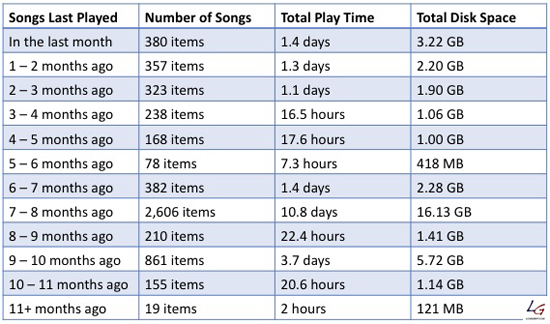
Of these nearly 6,000 songs, I've managed to get to over 1,000 of them in the last three months, and an additional 500 or so in the prior three months (with no overlaps). But that means more than 4,000 songs have not been touched in the last six months, representing more than two and a half weeks of solid music.

While I've tried to get to every song with some regularity, there's still almost a day's worth of music that hasn't been listened to in more than 10 months.


My iTunes Library, Songs Sorted by Play Count

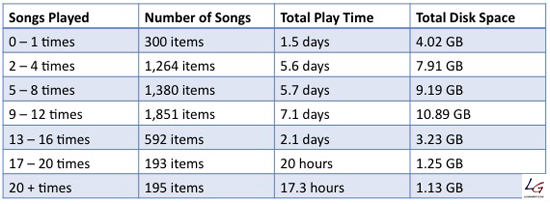
Additionally, of the almost 6,000 songs in my iTunes library, about 1,000 songs have been listened to greater than 12 times each since iTunes started counting. This compares with about 3,200 songs that have been listened to between 5 and 12 times apiece, and more than 1,500 that have been listened to between 1 and 4 times.


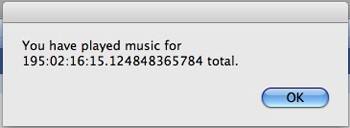
Using a small utility called iTunes Timer, the accumulative play totals for the songs in my library suggest that I've listened to iTunes for more than 195 days and 2 hours. Surely, if I stay connected to the laptop or my iPhone with some good regularity, I can power through those songs I haven't heard in more than six months, or listen to those tracks that haven't gotten enough airplay. But realistically, I shouldn't be letting the statistics drive my listening habits. It's common for people to find their favorite songs and play them a whole lot more than those that don't quite strike their fancy. But with iTunes, and the power of Smart Playlists, I can actually dive in and find out. And to watch me try and catch up, check out my Last.fm page.

What do your iTunes stats show?

September 22, 2008

September 22, 2008 · 1 MIN READ · BY LOUIS GRAY

Social Median Takes Guesswork Out of Online Mentions With Replize

Social Median Takes Guesswork Out of Online Mentions With Replize

As part of the Sunday panel at Blog World Expo, a key piece of the discussion was around whether it made sense to track down every conversation around your content, and whether you could rely on search tools within the major social aggregators to find when your content had been referenced, or if people were having conversations around your data. While the major content discovery sites have done a great job of enabling conversation, less effort, so far, has been made to finding when you've come up in conversation. But Social Median has added a new wrinkle today with a feature they call "replize". Now, if anybody mentions your user name in a post or a comment, with an @ symbol ahead of it, you will be notified by e-mail, taking the guesswork out of tracking your identity online.

Today, FriendFeed is really lacking in their ability to do "vanity searches", essentially, searching your own user name and finding if you've come up. Instead, it will only find your own posted content. But with Social Median's new "replize" feature, you're notified automatically, assuming somebody uses the @ tag and your name.


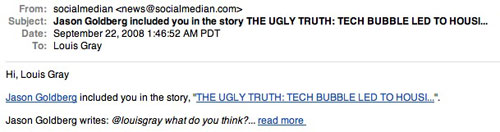
In an example last night, Social Median founder Jason Goldberg, wrote simply, "@louisgray, what do you think?" responding to a story on the financial crisis on Wall Street. That note triggered an e-mail leading me back to the discussion thread on the site.


For people who want to track their mentions online, or to get alerted to conversations where they can engage, the new "replize" feature is a good addition, and Social Median members will likely rapidly adapt it. But if you want to reduce your e-mail message load, this solution probably won't be for you, especially if you're popular. Turning it off is a simple tweak in your Social Median settings.
September 22, 2008 · 4 MIN READ · BY LOUIS GRAY

Just Wishing for Something to Go Mainstream Won't Make It So

Just Wishing for Something to Go Mainstream Won't Make It So

After participating in two panels and seeing others in the three-day Blog World Expo this weekend, there were a number of repeating elements. First, Twitter has recovered from its near-fatal issues and is becoming a must-use tool for more attendees, who are using it for conversation and news discovery. Second, a concern that while we may be using services for microblogging, life streaming, videocasting and news aggregation, that we are the odd ones, and that the services we like are nowhere near the mainstream. But while I continued to hear this chorus of people saying Twitter was either not in the mainstream or just entering it, or declarations that FriendFeed and blog comment engines, like Disqus were not anywhere near the mainstream, I heard very few suggestions on how these products could cross the chasm. It's as if many thought you could, like Dorothy in the Wizard of Oz, click our heels together three times, and find all to be well.

As I mentioned on Sunday afternoon's panel around distributed comments and fragmented conversations, we could very well have been having these same debates about whether other technologies would go mainstream just 10 or 15 years ago. Would AOL ever go mainstream? What about e-mail? Instant messaging? Texting by SMS? GPS? All of these are strong examples of products that may have seemed "out there" on the edge to many at first before becoming part of our every day lives. While Friendster didn't take the world by storm, MySpace did, with Facebook quick to follow. It's possible that the ubiquitous nature we see today with e-mail could be what we see with Twitter, or other similar services, in a few years.

There seems to be a general impatience among the early adopter and fast follower crowds to take the products we all like and use and expand their use to new groups. There's a desire to convert one's friends and colleagues to have the same kind of lust for gadgetry and Web applications as we have, and to adopt them with the same fervor. But we need to understand that with the vast majority of society, change is very hard. Adoption of the unknown is very hard, and it may take multiple incidents of exposure to have something that seems daunting seem comfortable, such that it's accepted and adopted.

On Friday, in my first panel, on micromedia, I was asked what it would take to "take Twitter mainstream", and I only half-jokingly said it would take a scandal involving a well-known celebrity which would lead to the service's exposure in a saturated media environment. Would the market that reads Perez Hilton, People and US Weekly discover Twitter or other similar services if somebody like Britney Spears or Justin Timberlake were using it? What if their tweets were splashed all over E! or Access Hollywood? I bet they would sign up.

In today's panel it was said that the theoretical gap between us "early adopters" and the mainstream isn't really all that much - we just choose to participate in different places. While some of us are Twittering, others are texting. While some of us are blogging, others are Facebooking. While some of us are sharing items and talking on FriendFeed, others are using forums on topics they follow. People have been using technology to form relationships and share news or conversations for years, but the tools to do so are ever-evolving.

I'd venture to say that it's no secret that not every technology we early adopters fall in love with will succeed in the way Google and MySpace have succeeded. But with exceptions made for company viability and competition, there's really no race or timetable to get services to cross the chasm from us on the edge to those later adopters. It takes time. It takes effort, and repeat viewings. Quick demos of products that would have us salivating may simply spark curiosity in those less likely to jump in with two feet.

On Friday, we discussed the dissemination of today's news was to tell 10 who tell 100 who tell 1,000. So it is with these services. If the 1,000 of us continue to tell this same 1,000 about the same items ad infinitum, we will never see growth and adoption outside our little world. The mainstream has proven they can grasp technology like e-mail and IM, texting and Web browsing. With time and ease of use, they can get these newer products as well, but it will take more than us just talking about it to get it done. We need to be patient, and act as guides when that time comes, rather than demanding change overnight and expecting someone else to do the work.