Silicon Valley Technology Commentary & Archives · Est. 2006 3,033 Posts · 2006–2026

September 21, 2008

September 21, 2008 · 4 MIN READ · BY LOUIS GRAY

OpenMicroBlogger Shows Steady Growth in First Month

OpenMicroBlogger Shows Steady Growth in First Month

By Jesse Stay of Stay N' Alive (Identi.ca/FriendFeed)

Last August, on Stay N' Alive, I wrote about a lesser-known open source microblogging tool called OpenMicroblogger. OpenMicroblogger has shown steady growth since my post, and I really think it could be a strong alternative to Laconi.ca in the terms of OpenSource, self-hosted Microblogging solutions.

The Stats

In just one month (August), in raw-traffic alone, it appears, according to Compete.com, that Laconi.ca has taken a sharp drop of almost 50% of their traffic (from near 30k visitors down to near 15k). At the same time, OpenMicroblogger.org, the location to download the OpenMicroblogger code, has seen a sharp increase, from near 0 visitors, to near 2,000 in just a month. While these numbers aren't huge, they show that OpenMicroblogger is quickly becoming a strong alternative, and justly so, to Laconi.ca. According to them, OpenMicroblogger has had near 1,000 downloads in just August alone, with little to no press or exposure.


Compete.com shows Laconi.ca's big drop in traffic month over month.

The working example of the OpenMicroblogger code-base, OpenMicroblogger.com (emphasis on the ".com"), has also shown impressive results in just the one month since launch. Identi.ca has seen an even sharper decline in traffic according to compete.com, losing near 53% of it's traffic, from over 140 thousand visitors down to just over 60 thousand visitors in just the last month. Twit Army, the Leo Laporte founded, laconi.ca-backed implementation, has remained quite steady, but saw a very slight increase since the last month. Leo's site went from near 40,000 to near 50,000 in the last month. Since it only recently started, that too is impressive, but it will be interesting to see if Leo can keep the momentum going. While not near the Identi.ca or Twit Army numbers (yet), OpenMicroblogger.com has gone from near 0 users to almost 2,500 users in just a month, and doesn't seem to be losing momentum - browing the public timeline shows steady, current, and regular use of the service. The recently announced Yammer, a closed, yet internal solution for organizations, has not published any statistics - I see these OpenSource alternatives as a serious competitor against the Laconi.ca and OpenMicroblogger code-base.

OpenMicroblogger as a Platform

The code for OpenMicroblogger is completely Open Source, and supports the OpenMicroblogging (OMB - Emphasis on the "ing") protocol, meaning the software can actually communicate with other OMB-supported software such as Laconi.ca (the software that powers the Twitter-competitor, Identi.ca). This basically means you can subscribe to anyone on an OMB-supported site such as Identi.ca or Twit Army (both Laconi.ca instances), while at the same time users from those sites can subscribe to you as a user of OpenMicroblogger - the horizontal structure of such a large network of "mini-microblogging networks" can be profound. Twitter does not support this, nor does FriendFeed, or even Facebook (but there's nothing stopping them).


Identi.ca similarly has dropped since its initial spike.

What's unique about OpenMicroblogger however is that it hits a mainstream audience of developers that would be implementing the software a little better than Laconi.ca. The code behind OpenMicroblogger understands much of the Wordpress API for plugins and themes, so many Wordpress developers can easily extend the software with little more knowledge than they already have about Wordpress development. In fact, OpenMicroblogger.com, the official working instance of the code runs on the Automattic-written Prologue theme with little to no enhancements.

OpenMicroblogger.com Working Instance

Brian Hendrickson, the developer behind OpenMicroblogger, as mentioned earlier has actually provided a working instance of the OpenMicroblogger code at OpenMicroblogger.com. As I mentioned, it shows continual, current usage, and even has some very interesting features that Identi.ca and even Twitter don't provide. Beyond simple Microblogging capabilities and OMB support, it appears you can also provide links, upload photos, and most impressive, provide tags with your posts. Each Tagged entry gets added in a list of posted tags on the right of OpenMicroblogger.com with the number of posts under that tag allowing you to see the most popular topics and categories of the time.

I have talked before about the power of having meta-tagging with Microblogging services such as Twitter or Identi.ca. Instead of poluting your existing 140 characters with hashtags, you should be able to post them via your client of choice alongside the message so they can easily be categorized. OpenMicroblogger.com actually seems to be the first service to provide this. The only additionaly thing they could add is ability to tag actual users within a post and it would hit what I was talking about exactly.

While still in its infancy having only been around for a month or two, it appears that OpenMicroblogger is becoming a serious contender in the OpenMicroblogging space. Having talked to their developer and knowing a bit about the future of OpenMicroblogger (which I will disclose later when some new features are launched), there is even much more to come. I'll look forward to trying to use the service, and look forward to other organizations trying to implement this innovative software.

Read more by Jesse Stay at Stay N' Alive.

September 21, 2008 · 2 MIN READ · BY LOUIS GRAY

So, By "Overnight" You Mean Something Else Entirely?

So, By "Overnight" You Mean Something Else Entirely?

It may seem trivial, but for me, the biggest disappointment of this year's Blog World Expo is that I didn't come fully prepared. Many of the peers I'm meeting for the first time are handing out fancy custom business cards with their blog URL, Twitter account, and other services, like LinkedIn or FriendFeed. Meanwhile, I'm left handing out my business cards from the office and having to explain the blog address or that my data can all be found online. And the blame squarely falls on my trusting an "overnight" prints service to do exactly what its name implied.

Early last week, knowing the event was coming, I made custom business cards from Moo.com, but quickly saw they weren't going to make it on time. So on the 17th, I went to OvernightPrints.com, and used a template I'd built several months ago. Their site said they would start printing as soon as 20 minutes after the order, and with overnight shipping, there'd be no doubt I'd have the cards by the 19th, when the show started, and when I had my first panel.

But... no. This is what "overnight" means to OvernightPrints.com.
    September 17th: I make an order and get a confirmation.
    September 18th: They print the business cards. (Allegedly)
    September 19th: The cards ship from their headquarters.
    September 20th: The cards arrive in Las Vegas.
    September 21st: It's Sunday, so UPS is taking the day off.
    September 22nd: The cards are expected to arrive.
That would be five days. Meanwhile, the Blog World Expo will have come and gone, ending today, and my cards will show up to the hotel, no doubt confusing the shipping and receiving department, as I'll be back in the Bay Area. And given the OvernightPrints.com cards are of lesser quality than those of Moo.com, I'll never need them, so they should just be destroyed. But it sure is frustrating.

You could argue that I should have been better prepared, and had them ready to go earlier, which is true, but I trusted what OvernightPrints.com said in that it would be "overnight" shipped on "next day air", and they would start almost immediately. Instead, I'm left talking around my cards that having nothing to do with the blog and my online presence. Silly, I know, but really annoying. If you're needing true overnight prints, I don't think I'd ever recommend this company.
September 21, 2008 · 2 MIN READ · BY LOUIS GRAY

Google Says Apple Owns the Letter "i", and Craigslist the "s"

Google Says Apple Owns the Letter "i", and Craigslist the "s"

Search engines work best when they have specific phrases to search for, or better yet, when they have parameters for when the Web page was posted. But if you get more abstract, going to single words or even letters, they typically don't know where to start in terms of finding what you want. Taking a look at Google's first answers for the letters of the Roman alphabet, it's interesting to see what the search index is guessing as the best answers. Google gives its own Gmail the letter "g", cedes Apple the letter "i", and Craigslist the "s", while kindly passing on the "Y" to Yahoo!, effectively dividing the alphabet as cleanly as the many nations who have laid claim to a slice of Antarctica.

For those not given to tech companies, the results weigh heavily with Wikipedia, as might be expected, with explanations of the letters, and periodic table elements. Also interesting, there are a pair of movies from IMDB that take the #1 spot, a pair of obscure scientific journals from the American Physical Society, and what looks like some great SEO by the Massachusetts Boston Transit Authority and Cirque du Soleil. The full list is below. All results were done with my own Google account signed out, so my Web history would not influence the rankings.

As of September 21, 2008:In addition to these results, Google offers up stock quotes for Ford (F) and Qwest (Q) atop the other search results, and provides scientific details like the speed of lightfor "c", "e" as a mathematical constant and Planck's constant for "h".

While Google's search engine is ubiquitous, by some measure around 90% of all searching, it's clearly still got an extreme bent toward academia and science. Apple's capturing the letter "i" is a great feat of marketing, as is Yahoo!'s "y", but should Craigslist get the "s" and Gmail the "g"? Those are more curious.

September 20, 2008

September 20, 2008 · 2 MIN READ · BY LOUIS GRAY

Strands Targets the Mainstream by Going One On One

Strands Targets the Mainstream by Going One On One

One of the most common themes in the blogosphere, and here at the Blog World Expo in Las Vegas, is questioning how Web applications many of us are using will ever reach the mainstream. Will people's parents, relatives and co-workers ever get Twitter the way they finally get e-mail? Will FriendFeed ever get the kind of name recognition that Facebook and MySpace have? Strands, a nascent lifestreaming and content discovery service, is launching a new initiative, starting today, to take the service mainstream, to the masses themselves in a project they call oOo: One on One, or Operation mainSTREAM.
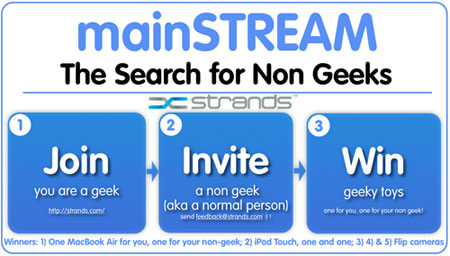
(See their blog for more).

Drew Olanoff, community manager for Strands, says "A lot of what we create is meant to make our lives easier and more entertaining," and that "companies like Pandora deserve to be known outside of our circles," so what the team at Strands is looking to do is to give its users many invites, and will incentive them to invite non-geeks to the service. Those who recruit "nongeek friends" can win geeky prizes, including an Apple MacBook Air for you and your friend, an iPod Touch for you and your friend, or miniature Flip video cameras.


Strands: Operation mainSTREAM

But Strands isn't going to be sitting around, waiting for you to do all the hard work of recruiting by yourself. The team is going one one one (oOo), traveling state to state, to take the story of all these cool Web applications to the masses. As Drew writes, "I'm going to be visiting old folks homes, hanging out with some soccer moms, and hey...maybe some lawyers, to let them know why technology and your personal presence online is important."

Will this work? Will taking something that's considered an edge technology even for those of us in the Silicon Valley, and introducing it to technophobes in North Dakota and South Carolina give services like Pandora, Last.fm, and Twitter that push they need to get into the mainstream? Probably not all by itself. But as part of the micromedia panel I participated in yesterday, we discussed a new rule of marketing. You tell 10, who tell 100, who tell 1,000. If Drew and the Strands team can find the right 10 people in each of these locations around the country, they may be on to something. And just maybe, Web 2.0 applications have found their new evangelist.
DISCLOSURE: Drew Olanoff, the Community Manager at Strands, is also the CTO of ReadBurner, where I am an advisor, and hold a small equity position.