Silicon Valley Technology Commentary & Archives · Est. 2006 3,033 Posts · 2006–2026

September 26, 2008

September 26, 2008 · 2 MIN READ · BY LOUIS GRAY

After Monkeying Around, I'm Not Going Bananas for Chi.mp

After Monkeying Around, I'm Not Going Bananas for Chi.mp

Personal feed aggregators with social elements have been one of the more popular services to gain traction in 2008. With services like FriendFeed, Social Median, Strands, SocialThing, Profilactic and others all finding a niche, some larger than others, it's clear that people are looking to consolidate their online activities, and share the results with friends. One of the more odd attempts is that of chi.mp, which lets you have your own .mp "domain", and helps you build a personal page, connect with friends and add services. While it can be fun to think of interesting names that end with .mp (du.mp, clu.mp, pi.mp, ru.mp, bu.mp, bli.mp, stu.mp, thu.mp, ca.mp, sta.mp, pu.mp and forrestgu.mp all come to mind), the end result isn't all that compelling. Unless we are being measured by the sheer quantity of online services we register for, and by how many places we can connect to the same people, I don't really see the point.

Chi.mp calls itself a content hub and identity management platform. While its site is clean and its marketing well-intended, offering a "dashboard for your digital life", the end result turns out to be much less. While its user profiles look like they borrowed a page from Facebook, and the idea of aggregating feeds sounds like FriendFeed, it ends up instead being a cartoony version of an online business card that calls out only the most basic social services.
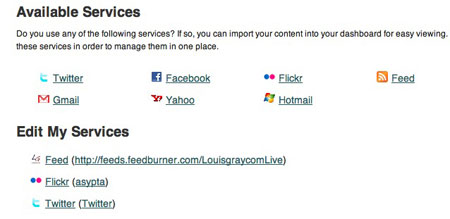

Adding Services Via Chi.mp Is Easy, But Limited

From the chi.mp dashboard, you can add some of the standard services, but not a huge number. And just because you add a service doesn't mean it's pulling in your data. I added Twitter when I signed up, and despite posting a few tweets, my new chi.mp site, hiding at techpu.mp, hasn't figured that out.
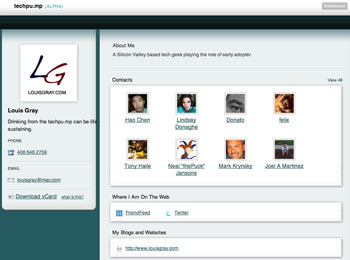
Looking at the chi.mp sites built by others shows pictures from Flickr and Facebook, and headlines of their RSS feeds. But there's no question that the service isn't going to take on the larger players. The pages are static and don't enable discussion. And no matter how many friends you discover on the site, you don't get alerts if you visit their pages. So now, I find myself getting hit with invitation requests from folks to become contacts on the site. It's clear I don't know why I would do it, and just maybe, they don't know either.

No wonder CNET quoted one observer back in April as saying, ""I'll tell you what Chi.mp is. It's venture money getting set on fire." Now, I'm usually happy to give new Web services a chance and see potential, but unless there is a major overhaul here to chi.mp, which would deliver greater service support, faster RSS pulls, and real social interaction, there's just no point. Now I feel like a monkey for even signing up.

September 25, 2008

September 25, 2008 · 2 MIN READ · BY LOUIS GRAY

Google at 10 - a Decade of Innovation - But Challenges Ahead

Google at 10 - a Decade of Innovation - But Challenges Ahead

By Charlie Anzman of SEO and Tech Daily (FriendFeed/Twitter)

Yesterday, Google posted a fascinating timeline of the past ten years.

For those of us that have been around since the days when Yahoo! dominated search (and Google wasn't 'here' yet), the timeline brings back a lot of memories, and also causes some pondering about the future.

Google's juice has always been their corporate culture. I've written about it before. A few weeks ago, Eric Schmidt, Google's CEO, commented that they try not to buy a lot of companies because it's easier to innovate from within, rather than to try and change the way a company does things. (Paraphrased).

Others are complaining about Google's stock price. A careful look at insider trading over two years showed many (current) employees cashing out in the 300's per share. Was 700+ in 2008 ever really in the cards? Did Wall Street expect a little too much?

Now we see Google literally firing on all cylinders. A new Web browser (Chrome), a significant upgrade to Picasa (and Picasaweb), and lots of other upgrades, APIs, additions and announcements made over the past two months.

There's little disputing the fact that Google (and the Internet) have literally created and/or eliminated exisiting business models (or significantly changed them). Not just Internet models but brick and mortar businesses as well. They've also created opportunity for those who continued to read, learn and took advantage of it.

Now, people don't Yahoo-it, or MSN-it (even though they do), the vernacular is Google-it ... and that alone is HUGE.

Interestingly, for you advertising buffs, Google has no tag line. There is no 'what we are' or 'what we do'. Obviously, someone recognized very early on, that the Internet (and the world) was changing so fast, it was difficult to predict exactly where Google's strengths would emerge. That continues to be the case.

I find I now have the same reaction to Google's success that I did to Microsoft's many years ago. Both serve as an example of how just a few people can create something BIG in just a few short years and set an example for those thinking about doing just that.

Like Microsoft, and many others, Google is a role model of sorts for entrepreneurs everywhere.

As they grow and mature, it will be difficult for Google to maintain their corporate culture, but not impossible. The perks of working at the Googleplex make complete and total sense. Help people forget about their mundane day-to-day worries so they can think, be creative, and work.

So …. Happy Birthday Google! One can only imagine (or better yet vision) what the next ten years will bring.

Read more by Charlie Anzman at SEO and Tech Daily.
September 25, 2008 · 2 MIN READ · BY LOUIS GRAY

Outbrain to Extend Blog Recommendations With Third Party Content

Outbrain to Extend Blog Recommendations With Third Party Content

Outbrain is best known for its easy to install blog widget that allows readers to rate posts on a one to five star scale, from "Bad" to "Excellent". I've been running it myself the last few months, and have seen some consistent, if not overwhelming, activity on the widgets each day. Outbrain is looking to extend their service by adding stories they believe you may like in addition to the current post, both from the site you own and from third party sites who are fellow Outbrain users. The idea, in their mind, is to deliver a wider range of content to readers, no matter the source.


Outbrain recommends other posts you might like and lets you rate posts.

Today, those who install Outbrain's blog widget also see stories "You might like", but they are limited to the blog on which the widget is installed. The new extension will, in effect, act like the "Web rings" of old, by syndicating your content on similar sites and extending the potential audience. Outbrain also is a big fan of Scott Karp's recent article on Publishing 2.0, which showed that sites which have the highest reader loyalty also are heavy linkers outside their own blogs.

This change is expected to roll out in the next few weeks, Outbrain told publishers late Tuesday night.

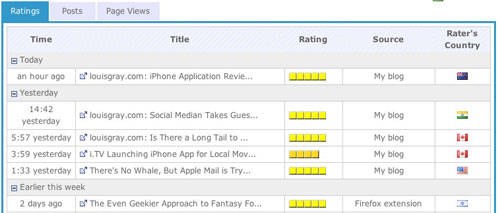
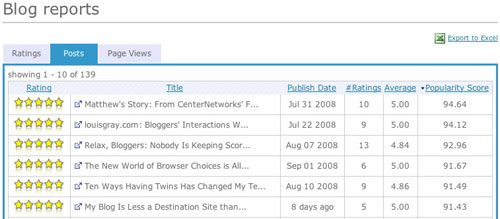
While the most visible aspects of Outbrain are the stars on users' blogs, there is actually a good set of statistics being tracked on the back end today, including a record of all blog post ratings, including the score, the post and the rater's country, the ability to sort all posts by total number of ratings, average rating and total popularity score (tabulated by the number of votes and average rating), and how many page views you have gained from the Outbrain network at large.


The most recent ratings on Outbrain.


The most popular posts, by rating, on Outbrain.

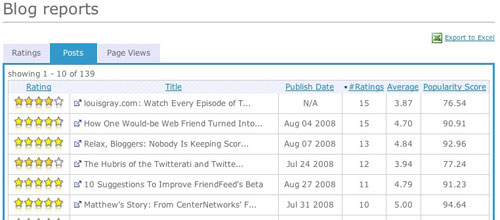
Given I'm not a high-traffic destination site, I doubt I'm exactly lighting up the Outbrain leaderboard. Most of my posts get a couple votes, and the most popular posts have received from 12 to 15 votes apiece. This could be due to people's unfamiliarity with Outbrain, reluctance to use the widget, or my low visibility.


My most active post on Outbrain got 15 votes.

Tonight, I logged in to my Outbrain account, and turned on story recommendations, both from my own site, and from third party sites. Over time, we'll see if Outbrain can deliver customized, quality, suggested links, and if this will increase the reader experience. Keep me posted on your thoughts.

September 24, 2008

September 24, 2008 · 3 MIN READ · BY LOUIS GRAY

Identi.ca Users See Service as Choosing Cause Over Community

Identi.ca Users See Service as Choosing Cause Over Community

With Twitter having largely overcome its many issues that made it a long, hot summer for the leading microblogging service, traffic to smaller competitors has stalled, if not decreased, across the board, at Plurk, Rejaw and Identi.ca, which leverages the open source Laconi.ca microblogging software. But a hard core group of users clings to Identi.ca's mission as an open, developer-friendly alternative to Twitter, with many using both services in parallel. Yesterday, I asked the Identi.ca community to spell out why they were using the service. Some of their responses are below.

Candrews echoed many of those on Identi.ca around the frame of freedom, saying:
    "I'm here for the Freedom. I want my data to be mine, to be able to leave when I chose, hack as I wish, and share all I want."
The issues of "freedom" and "openness" were cited much more than anything about community, which is what I would have expected to get if I polled Twitter.

Csarven wrote, similarly:
    "Universality of the Web. For the collective good, information should be accessible to all."
John Metta wrote:
    "Initially, I focused on Identi.ca because I've been an Open Source Software programmer for nearly 15 years. I appreciate the possibilities of an open, federated system- specifically when it comes to extending that system to work natively with other applications. For those applications to use Twitter, they would have to work around the closed nature of the system."
Jesse Stay, a frequent blogger here, and staunch Identi.ca supporter, wrote, "identi.ca is more of a cause than a community. We're all here to see that more open features are included in micro-service SW. OpenMicroblogging services like this are more about building a horizontal platform of meshed microblogs that all interoperate."

You can see that message echoed through the dozens of responses I received:

Metajack:
    "I use #identica because I believe in the cause. Open trumps walled gardens every time."
danyork:
    "I use Identi.ca mostly because I believe in the promise of a distributed, open source microblogging service and I want to see it."
hochmann:
    "like others, I use #identica because it uses open technologies, and it's open like good net technology always is."
From what I could tell, most of the Identi.ca users hadn't flat-out abandoned Twitter, but instead, added Identica to their outlets. In fact, a good number of the responses I gained on Identi.ca also hit my replies tab in Twitter. This is due, in part, to Identica's enabling you to cross-post to Twitter from the site, but also due to the rise of products that let you post in multiple places at once, including Posty, which I use to hit Twitter and Identica in parallel myself.

As services start to cross-populate, more savvy users are even using Identica as a tool to reach people in a new way. Tibor Holoda of Slovakia wrote to say he planned to use it as his "native language (non-english) channel" that hooked into FriendFeed. As he wrote me, "It's easy for my english-speaking followers to just hide my identi.ca tweets and see everything else i'm posting," adding, "I'm trying to persuade and evangelize the use of microblogging in our country, as its not very common among folks in here yet (just a handful of geeks is using it as of now)."

Metta added, "In the long-term, as better bridges develop allowing more seamless cross-posting and aggregation, I really feel as though Identi.ca federation can excel, and am using the system as a fundamental building block to my next business endeavor's design both in anticipation and in support of that."

Twitter is winning the public microblogging battle because of its large installed base, and its built-up community that has largely forgiven them after months of trials. While the Identi.ca user community isn't the largest today, it is one that clearly believes in its underlying foundation of open source, friendliness with developers, and the hope that through open source and extensibility, that it can make inroads outside of the niche which is using it now, but possibly, be adopted in the enterprise. If you are a big fan of identi.ca, you can of course find me there, at http://identi.ca/louisgray.