Silicon Valley Technology Commentary & Archives · Est. 2006 3,033 Posts · 2006–2026

December 4, 2008

December 4, 2008 · 2 MIN READ · BY LOUIS GRAY

The Dice Line Up for Yahtzee Adventures on the iPhone

The Dice Line Up for Yahtzee Adventures on the iPhone


Seemingly every day, I'm finding new iPhone games through Apple's iTunes App Store that have me reminiscing back to my childhood. Following UNO, which I covered on Friday, I ran into a game called Yahtzee Adventures, from Electronic Arts, which brings the familiar dice game to the iPhone, adding some new wrinkles, letting you play against the phone, clear levels with experience and gain new challenges. And in a sense of near reality, you can even give the phone a quick shake to get the dice rolling.



I Got a Yahtzee! But... So Did My Opponent

Given this is the "official" Yahtzee game, and not some cheap knockoff, gameplay is robust, complete with plastic die-shaking cup, and 3D dice falling on a red felt-covered table. And like the old paper and pencil tracked game, all the rules are the same - you still need to get 63 points to get your 35-point bonus on the top half, and you can score big numbers by getting your full house, large and short straight, and of course, a Yahtzee!. Get more than one Yahtzee!, and you score a 100-point bonus.


New Challenges Open Up With Experience

As your completed games rack up, the Yahtzee! game turns into the rest of the title, the "Adventure". You can win awards and enter challenges against other characters within the game, as you progress from the level of apprentice, to the top level of sensei, beating the opponents along the way. It's all part of taking what could seem like a repetitive game whose rules never change and reducing the potential for fatigue. But to be honest, I've been playing Yahtzee! with my family for a good twenty years under the same rules, and it never gets old.

The game is $4.99 for your iPhone or your iPod Touch. Just promise me you won't jump up and down with your own customized Yahtzee! dance, should you get the much sought after five like dice. I've already got friends who do that, and your iPhone won't care.

December 4, 2008 · 3 MIN READ · BY LOUIS GRAY

Survey Says: Twitter is About Relationships

Survey Says: Twitter is About Relationships

By Jesse Stay of Stay N' Alive (Twitter/FriendFeed)

In a post by Guy Kawasaki recently, he suggested that most Twitter users wanted more followers, and if they weren't, they were lying.  The concept is simple - the more people following you, the more people you have in your network, and the more powerful Twitter becomes for each individual.  I wanted to dive deeper into this so I posted a SocialSurvey on SocialToo.com (my startup), asking why users use Twitter, forcing them to pick just one reason.  The results were interesting.  Here's what I found.  

In answer to the question, "Why do you use Twitter?"
  • 5 said they use it to communicate with friends
  • 19 said they use it as a networking tool
  • 2 said they use it to know what others are doing
  • 1 said he/she was addicted (Admittance is the first step, isn't it?)
  • 4 said it was part of their job
  • 11 said it was to know what others are saying
  • 3 use it as a journal
  • 4 use it to post announcements
  • Only 1 uses it primarily to promote their brand
So, out of a sample of 50 people, over half of them use it either to network (aka get to know new people), or to know what others are saying.  Based on this survey, most people are on Twitter to follow or be followed.  They're in it to meet people.  It's about the relationships and building relationships between people.  Amazingly, business was not near the top of people's minds when it comes to Twitter.

Per the survey, only 1 person uses Twitter to promote their brand as their primary means of being on Twitter.  To me this presents an opportunity.  If such a minority are on Twitter focusing on promoting brands, and there are so many linked relationships, why not figure out how to utilize the existing relationships on Twitter to promote your brand?  Why not be one of the first doing this?

Guy Kawasaki is a genius at this - with his AllTop brand he is getting those fans of AllTop to be the promoters to their own followers.  The old saying goes, "Give a man a fish, feed him for a day", "Teach a man to fish, feed him for a lifetime", but "Teach a man to teach others how to fish, and you'll feed a multitude".  Guy is doing exactly that, by enabling others to do the spreading of the word for him - therefore they are going to be more than willing to take one relationship (them and Guy or them and AllTop), and introduce it to the other relationships they have already established in a respectful way.  Guy isn't forcing this on anyone.  Instead, he's enabling his followers to find ways to present it to their own network of friends.  He's even built out an e-mail list around this cause.

As a business, you have a unique opportunity with Twitter.  There are so many relationships out there - your task is to now figure out how you can get your brand between those relationships.  Social media is about connections - it's about the relationships, no longer just the individuals, and your brand needs to be on the link between those individuals to have the most powerful influence.

Read more by Jesse Stay at Stay N' Alive.
December 4, 2008 · 3 MIN READ · BY LOUIS GRAY

Blogging's Future Is Both Consolidating and Expanding

Blogging's Future Is Both Consolidating and Expanding

By Rob Diana of Regular Geek (Twitter/FriendFeed)


In the microblogging space, there are several players. Twitter is currently king and looks to dominate for quite some time. There are other Twitter-like sites around as well, like Plurk, Identi.ca, Rejaw and others. Identi.ca has not grown significantly since their initial push, but Plurk has shown some interesting growth lately. Then there are some tools that are more than just Twitter-like. Tools like Pownce, Jaiku and Tumblr allow users to share files and other media as well as short bursts of text. Tumblr has seen some very good growth over the past year, but the same cannot be said for Pownce or Jaiku, and of course, Pownce, following its acquisition by Six Apart earlier this week, is on its way to being shut down.

Does this mean there is no future for microblogging besides Twitter? Definitely not. Plurk has shown that a simple differentiating feature (the timeline) could entice people, albeit a smaller audience, to use one service over another. Other services, like Yammer and Presently, are taking a chance on the corporate microblogging audience. Open standards could change the playing field as well. If people can reply to people on another service, then there is more room for smaller services to grow.

So what about the blog platforms? Blogger, WordPress and TypePad seem to be doing well. TypePad released a new comment system and WordPress purchased one in IntenseDebate. In addition, TypePad parent SixApart just bought Pownce and its developers. We all know that microblogging is not going to kill blogging any time soon, but things are definitely changing. It looks like the blogging platforms are looking to integrate more social features and more simple sharing of information similar to Twitter or Tumblr. Long form blogging is not dead, but there is room for shorter form information sharing. The blog platforms are making moves to make this process simpler.

The acquisitions of the recent weeks are just the beginning.

I have a feeling that we will quickly see Pownce features in TypePad or other SixApart platforms. It is also likely that some of the features of I Want Sandy end up as part of Twitter, or even a subscription based feature. SixApart could do that as well with the various media sharing capabilities of Pownce. We will be seeing more sites and founders being acquired for the talent or even just a set of features. There will be a lot of consolidation over the coming year, and that is a good thing. Choices and competition are good, but too many choices gets confusing.

More importantly, the features that are getting added could likely change the way we look at these services. What if Twitter had a subscription service that included features from I Want Sandy and even tighter integration with Remember The Milk? That would absolutely be something that people would pay for. If you have a blog, would you pay money for group management and file sharing capabilities? Granted, you can cobble together the same type of service with a few blog plugins or even various third party Twitter applications, but would you pay $5 per month for the simple and integrated features? I have a feeling that many people would, enough to fund monthly costs at the minimum.

We currently have the base services and platforms that the future will be built on. So start thinking about what you could build on top of Twitter the platform. Start thinking about the features that could be integrated into your blog platform to really make it into a community. What value can be provided on top of the basic services we have now?

Read more by Rob Diana at RegularGeek.com.
December 4, 2008 · 2 MIN READ · BY LOUIS GRAY

Disqus Gets Serious About Growing Comment Spam Problem

Disqus Gets Serious About Growing Comment Spam Problem

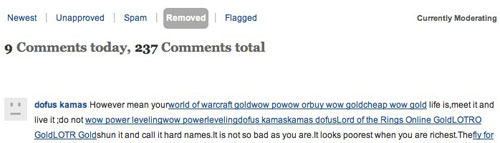
In the months I've had Disqus installed as the comments engine to my blog, I've been lucky enough to see some great engagement with readers of the site. The centralization and tracking of my comments around the Web, in addition to managing my comments in one place, and via e-mail have been a big help also, as has the service's extensibility and tracking via sites like BackType and FriendFeed. But one of the downsides of Disqus' popularity is that it has grown a bigger target for comment spammers aiming to shill for their prescription drug of choice, and all too frequently offering up ridiculous items, like gold for the game World of Warcraft. But as of tonight, Disqus has rolled out some new spam moderation functions that let you help fight the spam battle and, hopefully, reduce the amount of spam going forward.

In July, I suffered my first Disqus comment spam attack. Though it remains the largest flare-up to date, hundreds of spam messages have flowed into my mail box through the blog. Every morning, and at various points during the day, I'm faced with the routine of hitting reply to each e-mail and saying "Delete", to get the offensive gunk off my blog. I'd rather do that than leave the automated barnacles hanging on my posts, but the situation hasn't been getting better of late.


My Archive of Removed Messages Is Expanding

In addition to the 40 real comments I got on the blog today, I also got about 10 fakes - with about three or so a day in recent weeks. The topics themselves don't vary, but the names do.


Disqus Asks for Us to Help Them Fight Spam

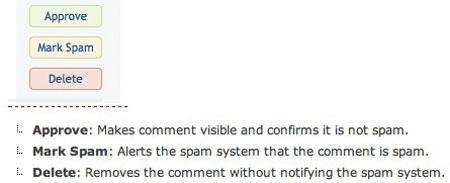
Now, according to the Disqus blog, I can reply back to assumed spam with the simple one word command of "Spam", adding to the service's knowledge and helping them form a blacklist. You can also go into the admin section of your Disqus site and block the comments as spam there.

The war between Web services, e-mail, comments and spammers will never be over, I am afraid, but at this point, the move is yours, spammers. Disqus isn't taking this fight lying down. The service also promises some new features coming soon, including a new interface and internationalization.