Silicon Valley Technology Commentary & Archives · Est. 2006 3,033 Posts · 2006–2026

December 21, 2008

December 21, 2008 · 4 MIN READ · BY LOUIS GRAY

Will Twitter Go Mainstream? The Debate.

Will Twitter Go Mainstream? The Debate.

As is common on early adopter circles, much of the discussion Twitter is about Twitter, and much of the talk on blogs is about blogging. As many of us find value in these services we interact with every day, part of us is rooting for them to exit our little niche and go big. In 2008, one of the services that threatened to break through and tickle the edges of the mainstream was Twitter. (At least when it was up)

Given the expanded roster of writers on louisgray.com, we polled the team and asked for opinions on the pros and cons of whether Twitter would ever cross that chasm. As Rob Diana summarized, Twitter, at times, looks to be on its way to mainstream acceptance, but it still has a way to go:

ProCon
Louis GrayPopular people are on it and it's very similar to text messaging, which is understood.It needs a lot of filtering and searching, and can get too busy. People post a lot of junk.
Rob DianaTwitter is simple to use. It is just like IM so there is not much of a change for most users, and CNN (and others) are talking about it already.Generally, there is too much noise for most people. The other issue is that most people don't want everything to be public.
Jesse StayIt will not go mainstream and there are no pros, unless you consider its current state mainstream. For it to go mainstream it needs direction. Are they trying to hit a professional audience or a personal audience? For it to go mainstream in either (i.e. rival LinkedIn or Facebook in numbers) it needs to decide what it is.They are not making money. It is too public, and it only fits a small niche of the population.
Mona NomuraTwitter is already established, so much so that major publications are picking it up. You KNOW a service has made it, when an "Internet job" lists the service as a required skill. Also, the ease of publishing will make it easier for adoption.Generally, it is unintuitive and 3rd party publishing tools are required. Some people may just not 'get it'.
Phil GlocknerTwitter, or a service very much like it, will go mainstream. When it does, we will see the downfall of SMS and ridiculous SMS charges (currently pricier than printer ink)Twitter will not go mainstream until another service appears that *MAKES* Twitter a cellphone SMS gateway. In other words, you use your cell phone the same way to send a text, but instead of costing money and being sent directly, it goes through Twitter. There will likely be a small monthly fee.
Daniel PritchettDiscovering interesting new people to follow is natural and easy. Your friends communicate with each other via @messages. This means it can keep growing and growing as long as new people are turned on to the service. If you join to follow @ricksanchezcnn you'll soon find yourself following 50 other people that you picked up in conversation.The inability to scale an individual's attention kills twitter once you get past a certain number of subscriptions. Some people do not like the service if they can not keep up with every single tweet that their subs send. Until these problems are better solved many people will be wary.
Mike FruchterIt has gotten a lot of exposure from CNN, and various mainstream press. There are thousands of applications built around it, and more being built. It has brought citizen journalism to new levels.CNN exposure is nice, but I feel it's simply not enough to take it to the next level of mainstream. It is still a tool that is primary used by geeky/tech crowd. The few celebs who use Twitter are the exception. I still can not see my mother, father, or sister using Twitter, at least not yet. It still lacks the features needed to go mainstream, video, images etc. It also needs more exposure to go mainstream. If Google or Facebook bought them it might be a different story.
Eric BerlinIt is intuitive enough that "civilians" can hit the homepage, register, post their first post and add a few friends within a minute. They can also quickly "get it" and see benefits. It is on the fringes of mainstream exposure with CNN, mentions on the Daily Show, Barack Obama and other non-web celebrities.The combination of other services (Facebook, FriendFeed, Yammer, and new ones not quite on radar yet) will steal Twitter's remarkable thunder and leave it behind.

As you can see, there are many different opinions on Twitter. It is somewhat familiar to mainstream users, as it is similar to instant messaging and text messaging. It may be easy to use, but there are some concerns that people will not "get it". You may need to use a third party client to efficiently use Twitter, but there are also many applications built on top of Twitter's API.

Everyone seems to agree that Twitter can be more than a little noisy. In order to counter that problem, Twitter needs more features like groups, filtering and more integrated searching. However, it needs to figure out what it wants to be when it grows up. Does it want to target personal users, and add features like including images, video or other files? Or does it want to make a play for professional users?

It's fun to speculate, and looking at Twitter opened a few thoughts in terms of how each of us interact with the service differently. There's no one right way to use Twitter, or any service. But we're seeing it change under our feet as it grows and gains in popularity. The question is, will it collapse under its own weight, or remain too geeky for it to ever belong in the real world?

December 20, 2008

December 20, 2008 · 2 MIN READ · BY LOUIS GRAY

i.TV Hooks Up With TiVo for iPhone DVR Scheduling

i.TV Hooks Up With TiVo for iPhone DVR Scheduling

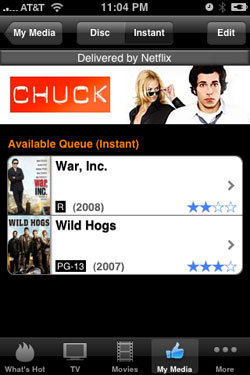
i.TV, the online TV and movie schedule application for the iPhone, which we covered during its launch and subsequent addition to the iTunes store, has added the ability for users to not just see what's on, but to add those items to their TiVo, anywhere they are. Combined with the company's recent addition of synching with Netflix, and another announcement today that you can buy movie tickets, i.TV has become an on the go digital hub connecting you with your entertainment, wherever it may be.

If you're unfamiliar, i.TV is essentially a live guide to your TV schedule, browsable on your iPhone or iPod Touch. Let the application know where you live, and your cable set up, and you can see the current schedule, or choose a future time and see what's coming. You can rate items, or even add a review of a show, directly from the phone, or see other reviews.


i.TV Hooks Up Your iPhone with Netflix and TiVo

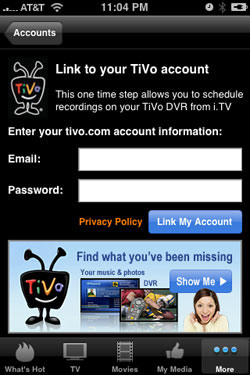
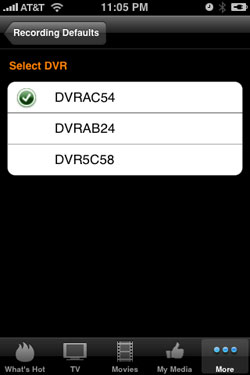
Now, the service has added support for Netflix and TiVo in your settings. Link to your TiVo account, and you can add items to the TiVo DVRs you have registered with TiVo.com.


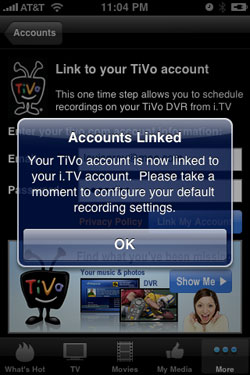
i.TV Links to Your TiVo Account and Registered DVRs

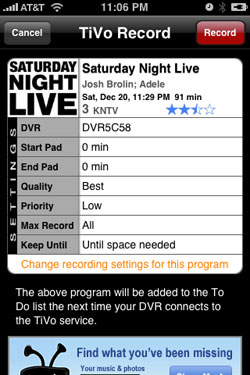
Upon registering, every single show you browse has a little TiVo icon. Click the icon, and you get the option to "Record" the show, and can even add padding before or after the show, if you want to be sure to catch the ending or account for any timing shenanigans with the network.


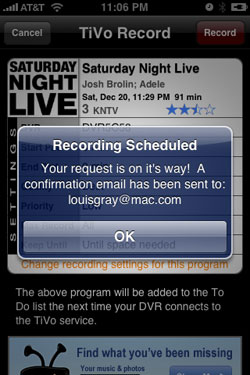
Adding a Show to TiVo Via i.TV, With Confirmation

Once you've registered a recording, an e-mail can be sent to your account and let you know it has been confirmed, just like remote scheduling of your TiVo through TiVo's online site. The addition of TiVo services, given my recent TiVo HD XL purchase, and continued fanboyism of the Alviso company, puts i.TV back in the lead over What's On TV?, who we also covered at the end of November.

The full press release from i.TV can be found here: i.TV Adds DVR Remote Record, Streaming Video and Movie Ticket Purchasing. You can find the i.TV application for free on the iTunes store here.
December 20, 2008 · 3 MIN READ · BY LOUIS GRAY

Terabytes and Terabytes of Data At Home. Petabytes Next.

Terabytes and Terabytes of Data At Home. Petabytes Next.

Depending how old you are, or how early in your life you started using a computer, you can no doubt remember using floppy disks that save data in the kilobytes, hard drives in the megabytes, and squeezing every last byte out of your RAM. With file sizes increasing, and people wanting to store more and more data, not just at the office, but at home, it's not uncommon for people to be amassing hundreds of gigabytes, or even terabytes of data in their homes, for photos, music, television and all their electronic data. With some recent purchases in our home, I'm fairly impressed how much data space we have at our availability - and can't help but wonder what these increasing capacities could mean for the future.

The MacBook Pro I am typing this post on has 200 GB of hard disk space. My wife's MacBook has 80 GB of space, and we have an older MacBook hiding somewhere with its own 30 GB hard drive - assuming it still works. So that gets us to 310 GB right there.

When I purchased my iPhone I also got the Apple Time Capsule, a 500 GB model, racking us up to 810 GB. And in the living room, we have a TiVo HD, with 160 GB hard disk capacity, bringing us to 970 Gigabytes in total.

As of this week, we also just upgraded our old Series 1 TiVo to the new TiVo HD XL, which by XL means a whopping terabyte of disk space, good enough for 150 hours of HD programming, and bringing our running total to 1.97 Terabytes (so far).

Add on to those 1.97 terabytes an older 60 Gigabyte iPod, a 10 Gigabyte iPod, a 16 Gigabyte iPhone, and about 4 iPod Shuffles with a Gigabyte of space each lying around, plus a few digital cameras, and you're easily above 2 terabytes, even when taking into account the fact you'll need 2,048 gigabytes to get there.

The available disk space will absolutely effect my behavior. I won't see any reason to stop taking photos of Matthew and Sarah as they grow older. I don't have any real reason to delete shows from the TiVo I would consider watching again. And I can rest assured knowing that even if I delete a file from my laptop, or that of my wife, that it is backed up on the Time Capsule for later retrieval.

But if I were to take things even further - why not save every voice mail that ever is left on our home phones? Why not make all my calls on Voice Over IP and save every single one for later retrieval? Why not set up video recording so we can watch the kids' every move and just double click to pull up the video in high definition? Why not make a digital copy of every web page, video, and picture I see on the Internet - ever? We're getting to the point that disk space and massive amounts of it are dirt cheap.

Working at a storage company (in the real world), I find myself talking in terabytes and petabytes all the time. Check my about page for more on that. We are living in a world where data and what you do with that data can differentiate your business, and your speed of access to that data, its manipulation and retrieval can set you apart from your rivals. But the terabyte and petabyte advancements have trickled home. I wonder if having massive amounts of storage space can make us better parents, friends and neighbors. It's possible.
December 20, 2008 · 4 MIN READ · BY LOUIS GRAY

Posty Author's Guide to Unfollow Uninteresting Twitterers

Posty Author's Guide to Unfollow Uninteresting Twitterers

Guest Post by Cesare Rocchi of Posty

There are many suggestions on who to follow on Twitter, enabled also by tools like Twubble and Twitdir.

But as far as I know there are much fewer posts about un-following. Here is my take.

Recently I started "cleaning up" my Twitter account. I remember my initial enthusiasm which ended in following more than 1,500 people with no criteria. The only criterion I remember was: "the more, the better." After a while I asked myself: what am I using Twitter for? To stay in touch with people. About what? About my interests.

What are my interests? Adobe Flex/Air programming, Apple, iphone, music, geekness. In the past, when I added people I checked whether her tweets were about one of these topics. Recently I started to watch with more attention the tweets appearing in my home. Posty helped me in this process. Here is a list of questions which helped me filtering Twitterers by looking at their tweets.

What language is this?
When I stumbled upon a tweet with "strange" characters or words I opened that profile and then asked: does she regularly post in this language? If yes then unfollow. Moral: how can I be interested in what is expressed in a language that I don't understand?

Is she active?
I usually remember pictures, even if they are small like stamps, like those of Twitter. I started opening less "popular" avatars appearing in my home to check whether a Twitter was active or not. To check "activness" I asked: how frequently does she post? I ended up with unfollow unfrequent Twitteres, those who did not update the profile in one week, those who posted once in the last month, etc. Moral: follow those who are present and active.

Does she reply?
You might be in front of a very frequent Twitterer but ... does she post, post, post without replying? Try to figure out some replies/post ratio. If it tends to zero you are in front of somebody who just wants to "tell", "be there on the internet", "promote her service", etc.

Moral: try to follow thos who are "interactive". Isn't Twitter a social service? Then it is a matter of relationship, sometimes you say, sometimes you listen and reply. If you always say, sorry but you are not for me.

Is her content interesting?
If the posts of a Twitterer are mainly about knitting and you hate knitting why are you following that Twitterer? (no offense to all the lovers of knitting :). In this case the profile of the Twitterer can help. If she is a html/css programmer it is likely she will post something about that sometimes. To find it out, again, check the last tweet.

Are the graphics the default ones?
If a user does not personalize at least a bit of the layout this might be a symptom of the behavior: "I have Twitter though I do not use it".

Following / Followers ratio
This can be a delicate topic. Without getting into math formulas, it is intuitive that if a user has 23,000 followers, she is famous. If, at the same time, she follows 10 people, this might indicate that she does not care much of following back her audience, or have a look at a fresh home each time she checks in Twitter. It is also likely that she just publishes tweets and replies very rarely.

A more balanced ratio signals a more equilibrated participation to the "life in Twitter".

If, on the contrary, you follow more than you are followed (e.g. follow = 10 and followers = 1), this can be the result of the attitude: "If I follow I get followed". To some extent this is true: there are people who tend to follow back by default. But if you start an account from scratch and follow 2,000 people I bet you get followed back by 200 at most.

How many updates? How frequent?
There are companies out there with a really inactive Twitter account. I think it was created to follow the boom of Twitter, to say "I am there", but with idea in mind probably. If you see that the last update is from six months ago you probably do not want to follow this user unless you know him personally and you are aware she is in a long busy period.

These guidelines have been elaborated with the goal of raising up the Twitter grade of my Twitter accounts. The tools I have found useful are friendorfollow and Posty.

Posty 1.7 was released today, and you can find it here: http://spreadingfunkyness.com/posty/