Guest Post By Adam Singer of The Future Buzz (FriendFeed/Twitter)
image credit: pshabI've written previously that
Facebook and MySpace are the modern AOL and Prodigy. I stick by that. The great walled gardens of the web live on more than a decade later, resurrected by Web 2.0, but just as closed off, spammy and unexciting as before.
I have been thinking about how little time I spend on
Facebook and why the open Web and other social sites are far more interesting. Here are some observations:
There is no interesting content in Facebook itselfPeople who create great content don't do so within Facebook - they know better than to contribute their hard work to an area they don't control. The best content creators do so on the open web because they want to retain the value of their efforts. If you are a content creator (or a marketer) be careful with the amount of time you spend contributing content to a closed network.
I get it, you need to
fish where the fish are - but use Facebook to draw people to a place you control, not one where you have to play by the rules of another network - that is dangerous. They could change the rules at any time, or there could be a mass exodus of users from the network as we have seen time and time again in the social areas of the Web, rendering all your hard work worthless. Use Facebook as a part of your
outpost strategy, but draw visitors back to a unique spot that is yours.
Content sharing on Facebook is far behind the curveI will see something compelling on
Reddit/
Digg, message boards/forums, blogs,
StumbleUpon and other areas of the open web, and then days or even weeks later it ends up on Facebook. Facebook is fine at sharing friend-centric content like pictures of your last social gathering with a group, but it's simply not a place for discovering news, interesting blogs, or other valuable content. The content eventually gets into Facebook via links but by the time this happens, it is old news. In fact, just
use FriendFeed and easily get everything in one place, customized exactly how you want it.
 Facebook wants to keep you on Facebook
Their network is built to keep you on their site, which is something that never sat right with me about walled gardens. Google's
OpenSocial platform and now
Friend Connect are much nicer and I personally like their strategy more - integrating social elements with web properties that already exist and with tools that have real value. They seem more willing to let go and allow users to drive the network, not vice versa, a strategy I agree with.
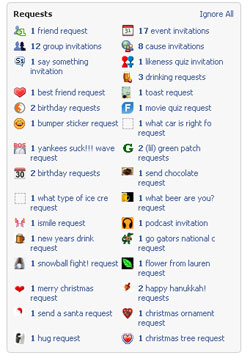
No option to opt out of third party application invitesIt is either all or nothing. You can use apps, but you don't get a choice to opt out of requests from others to add applications. Of course not, because Facebook wants to inspire developers to spend time developing apps purely for their system. It leads to me having to click "ignore all" when the end of every week looks like this:
Why would I want to add any of these apps? I have used Facebook since I was in college and it was a student-only network, and have watched it slowly degrade into a place equally as spam-filled as
MySpace. Just because the layout is cleaner doesn't mean it isn't spam.
 Facebook advertising is broken - both for advertisers and users
Many have reported that Facebook advertising results
have been lukewarm at best. The ads they serve me are pretty terrible as well. I'll give you a quick example: I am single, so Facebook tries to serve me ads for dating sites. I have no interest in using online dating services, thus the ads are irrelevant to me. Facebook has the option of giving feedback on ads, so each time a dating ad is served, I actually take the time to give them feedback that the ad is irrelevant to me and vote it as such.
Concurrently, they serve me ads about marketing and music, things that are of interest to me and actually a good fit. So not only do I click the relevant ads, I go a step further and give them feedback that these are good ads, please serve me more of them. Yet I am continually served dating ads. I have a hard time taking them seriously as a marketer when they clearly have a system in place to improve the user experience but don't bother to use it.
Here are the ads Facebook is serving me (I took a quick screengrab):
Facebook gives you the option to click the "thumbs down" where you can let them know feedback:
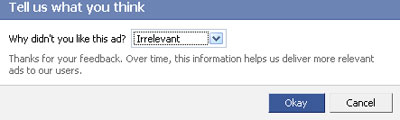
I have been letting them know these ads aren't relevant to me for several months and they are still serving them. But why even bother giving feedback if no one is listening? Their system just doesn't learn.
You don't hear career success stories from time spent on Facebook...Yet we hear great stories about people building their reputations or scoring jobs through LinkedIn or a blog all the time. All we hear about Facebook (and MySpace) is people losing their jobs or not receiving jobs due to inappropriate photos/content on the profiles.
For well-connected individuals, the "people you may know" function is uselessI can't remember the last time I actually knew someone in the "people you may know" section of Facebook. Yet they show these right on the homepage daily to all their users. As an example, I was served this today:
Facebook is offering these people as connections to me merely because we both went to UF (
University of Florida)? That is hardly what I would call a connection, the number of people who went to UF is staggering, and just because we both went to UF doesn't make someone relevant to me. If that is the best they can do, they shouldn't even offer this feature at all. How about instead of people I may know, what about people with similar interests? That would actually be useful.
For example, I list some relatively obscure electronic music artists in my profile under musical preferences. If they connected me with others that have similar taste in music, that would actually be interesting. Also connecting me with other public relations or marketing professionals would be interesting too.
The way they are currently trying to guide my hand in building a network isn't very useful. It just seems like they have so much meta data on all of us but aren't using it in ways that actually would build value and draw us deeper into the network.
Difficult, perhaps impossible to gain critical mass with anything directed outside the Facebook platformAgain, this is by design - Facebook seeks to keep its users on their network as long as possible so they may gain more ad impressions. Applications, pages and groups within Facebook can easily spread within the network, but I haven't seen many ways to easily direct Facebook traffic outside of Facebook. MySpace too. This is all by design of course and why I mentally file Facebook in the "closed off" section of the web. I know Facebook just launched their connect tool, but I'd be interested in seeing what the actual results of that are for site owners. I'm not talking about sites like TechCrunch that already have critical mass, I'd be interested to hear the results from sites in the long tail.
The conversations on FriendFeed, on blogs, on Reddit, Digg, Twitter, etc. are far more interestingThe conversations on Facebook are not even close to the level of the open web, or even other social sites. Do you notice the same thing? Perhaps it is the poking, the cheesy applications, or the general nature that people carry on within the network, but I see far more compelling conversations outside the walled gardens. Perhaps it is because people with deep interests seek out specific networks or build their own, and view the general networks as less specific and relevant to them.
Wrapping up...Facebook is actually useful for things like staying updated on what you're friends from years past are doing, but this doesn't provide any real value other than fleeting entertainment. The people I am interested in staying connected with I am already connected to in more useful ways.
My use of the internet is not to develop fleeting social relationships for entertainment, but to develop more valuable relationships with people to work and collaborate with on projects and ideas we're passionate about.
As it stands right now, Facebook just isn't all that interesting a place to spend time if you are seeking compelling content or looking to build a subscriber base, it is merely an outpost. Your largest opportunity is to build an audience for your brand or yourself in a place that you control. Remember, these monolithic social networks can fall out of favor quite quickly and hemorrhage audiences.
Devoting too much effort to any one platform, especially a social network like Facebook, is far riskier than working on a place you control where you can build multiple traffic streams to. This way if one stops producing you'll still have other options.
It's not that I dislike Facebook, it is just I have found the site to offer a better user experience in years past - and that is the opposite of what I would expect for one of the leaders in social networking. The experience on Facebook should be getting better, not worse. I know from conversations with colleagues I am not the only one who feels this way - hopefully they are listening and will work to improve things in the future.
Read more by Adam Singer at The Future Buzz
 As a Salt Lake City, Utah resident, one of the most prevalent events of the year happens around the Sundance film festival. While not quite an event for Tech Geeks, the festival has become more and more techie as film geeks have begun to converge with computer geeks and find new ways to present the media they are creating. I visited Sundance last night and was amazed at the number of former film geeks trying to create their own web ventures as the economy slims for the film industry.
 You have no doubt seen the posts, the articles, the tweets, the e-mails, and all matter of comment spam around increasing your rank on search engines, and "getting to the top". You might also see people eagerly await tweaks to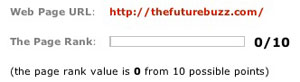
 Internet Explorer doesn't have a monopoly on the browser market like it did nearly a decade ago, as Microsoft systematically suffocated Netscape - speeded by the company's own failings. Today, IE reportedly has just under 70 percent market share, with Firefox owning just over 20 percent and others, including Safari, Google Chrome and Opera, making up the remaining 10 percent. (See: