Silicon Valley Technology Commentary & Archives · Est. 2006 3,033 Posts · 2006–2026

January 29, 2009

January 29, 2009 · 4 MIN READ · BY LOUIS GRAY

Admiring Companies That Don't Blink

Admiring Companies That Don't Blink

It's tempting to run with the mantra that every company must be transparent. With so many ways companies can communicate to us in real-time, we practically expect every single one to respond to our blog posts, our tweets, and our product demands. We find ourselves publicly lauding those developers who show up in our blog comments and promise change. We celebrate those companies whose founders we know on a first-name basis, and whose Twitter handle we have memorized. But there's also a part of us that finds the silence from companies in the tech space who choose not to be as transparent alluring, as it both adds to the mystery in terms of what they have planned, and gives a sense of confidence on their end that they don't have to change their product to match my every whim.

Apple is one of the best examples of a company whose vast wall of silence and secrecy spawns a vast network of rumor-seekers and speculation. Once limited to the dark recesses of the Web, guessing the Cupertino company's next move has practically become an industry tradition. You won't find an official Apple Twitter account. You won't find an official Apple blog either (though the Hot News page is pretty close). And you most definitely won't find an Apple representative in the comments of users' blogs, saying what features they will or won't add to the next release.

You could say the same, on various levels for many companies. What's going on at Google? Despite their many blogs and the ever-present Matt Cutts, it's not all that transparent. Most Google employees don't blog about their at-work exploits, and product development isn't usually that give and take. Microsoft? A different animal altogether. You could argue Microsoft never really understood the Web, and is a full generation behind the true Valley, so maybe they'll get it in the next five years, but they too represent a company that doesn't exactly kowtow to its users.

There are some smaller companies in the Valley that elicit the same kind of respect, because it looks like they are more willing to focus on improving their product than they are shouting down every naysayer, or responding to critics - as tempting as it may be, no doubt. Some of that can come from the founders' previous experiences, if they have grown up in companies where the focus was more on quarterly earnings and shipping product iterations than it was on asking their customer base for product roadmap ideas.

You can see different approaches in terms of how the strong companies respond to criticism, warranted or otherwise. The bad ones will try and shout you down, posting multiple negative comments in response, and might even post on their own blog saying how you are wrong. The good ones might instead say thanks for the advice, or quietly see your input and tuck the advice away for a rainy day.

Some people think I talk too much about Twitter and FriendFeed here, which is fine, but the reason they get so much attention is because we so clearly see their potential, and we use both services a lot. Of course, with high potential comes high expectations, and I have a tendency to want to push them both further faster, whether that makes good business sense or not. You might remember how at the beginning of this month I posted a long item practically begging FriendFeed to work harder at attracting new users. I stated my concerns that too many people were finding the system hard to use. The team could have done a few things - including saying I don't know what I'm talking about, or the reverse, saying I was right and starting to do all I said right away. Instead, Paul Buchheit explained the team's long-term view. His measured, quiet response was respectful and insightful, but didn't blink. My comments and those of others didn't phase him. He and the team quietly kept working. Twitter, in light of recent criticism as to how they've interacted with the developer community, has similar gone back to work and focused on their business. And I respect that. While I'd love to wave a magic wand to push these companies around, or see how closely their plans match my ideas, their focus is to be admired.

Companies like Apple and Google, for the most part, are "above the fray", and don't seemingly need to kowtow to their users in the way that struggling startups or smaller businesses do. So long as both companies, and Microsoft for that matter, continue to push out high-quality products, and grow their business revenues and profits, playing tit for tat on the blogs and Twitter isn't necessary. And they are a special case, in that their mere silence on a topic can stir even more discussion than a clear answer could. If some of the stronger Web 2.0 companies can cross the chasm to that level, thanks to their unceasing focus, then they have made the right choice. I may pound the table for answers, but secretly like it when they don't say a word.

January 29, 2009 · 1 MIN READ · BY LOUIS GRAY

Twitter to Stop Accepting GIF Images as Your Avatar

Twitter to Stop Accepting GIF Images as Your Avatar

By Jesse Stay of Stay N' Alive (Twitter/FriendFeed)

In a last minute e-mail from Matt Sanford, an Engineer on the API Development team at Twitter, he announced that in the next week, Twitter will stop accepting GIF images as user profile images on Twitter. The change comes after a flaw, which I pointed out earlier on LouisGray.com, that enabled users to post animated GIF images, some times in very large sizes, as their Twitter profile image.

Previously, when uploading GIF images to Twitter, it would take several tries and multiple uploads to finally get it to stick on Twitter's end. The resulting image often did not resize, leaving the image in a much larger format, allowing your profile image to stand out in search results with the other profile images on Twitter (why they don't just put a width and height limit on profile images throughout the site is beside me). Sanford states that with GIF images it is difficult to detect problems with the image, as compared with other image formats.

Users like iJustine and many others (including myself) were able to take advantage of this around Christmas, adding animated graphics (as we showed earlier), and much larger than usual profile pictures. (It should be noted that iJustine now has a normal-sized profile image)

Sanford says that users that have already uploaded GIF images as their profile avatars will get to keep them, but moving forward GIF images will not be allowed to be uploaded, both on the Twitter Web site itself and via the API. The change is expected to take place within the next week.

Read more by Jesse Stay at Stay N' Alive.

January 28, 2009

January 28, 2009 · 3 MIN READ · BY LOUIS GRAY

BuzzGain Launches In Beta, Enabling "Do It Yourself PR", Monitoring

BuzzGain Launches In Beta, Enabling "Do It Yourself PR", Monitoring

Just yesterday morning, we were talking about the friction that can arise between bloggers and Public Relations teams, who in theory should be working together, but often find themselves battling, largely due to a lack of understanding of one's goals, or even if they have the right targets. Today, BuzzGain, a small startup I've been helping to advise since March of 2008, is opening up in beta, with a goal of helping companies' service, communications and product teams work with bloggers and social media in a better way - through improved monitoring and outreach tools.
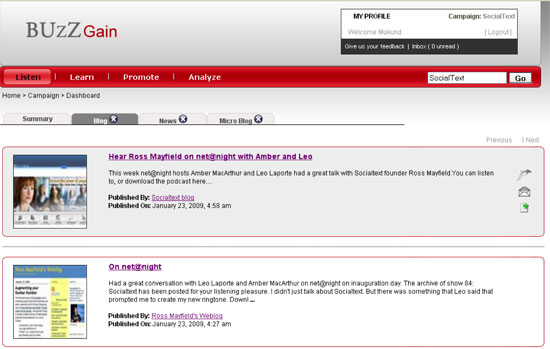
Most companies these days are waking up to the fact that they are going to have a hard time controlling their message and brand reputation online, with so many voices out there watching and reporting on their every move. Be they competitors, customers or partners, people are talking about you online, on blogs, on Twitter, on FriendFeed, YouTube, Flickr and other sites. BuzzGain is looking to start out by offering a set of robust social media monitoring tools, but also help companies get to the next level, and better understand who has influence, and where conversations are taking place, so they can better listen and learn from those who can offer beneficial relationships.


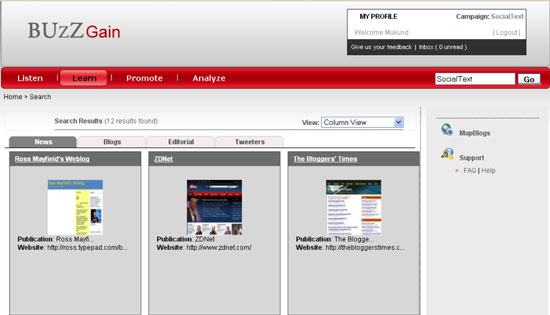
BuzzGain Shows Blogs Relevant to Your Company

In the ten months I have worked with Mukund Mohan and watched the site grow, it has taken tremendous evolutionary steps forward, growing its data base, and making it easier for corporate or PR teams to run campaigns that follow keywords. With time, it could be that BuzzGain would be operated by PR teams in the way Salesforce.com is run by Sales teams in a wide range of industries. And like Salesforce.com, BuzzGain launches with a real revenue strategy, pricing at $99 a month for companies below $100 million in revenue, and rising to $500 a month to those up to $1 billion in revenue, and $1,000 a month for $1 billion+ companies.


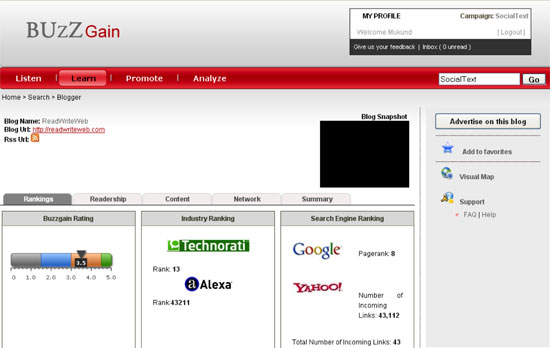
BuzzGain Can Rank Influencers By Authority, Frequency

BuzzGain doesn't operate in isolation. Its data is pulled from popular Web sources, including Technorati, which helps determine sites' influence in terms of external link activity, and Compete.com for estimated traffic. Essentially, as a PR person, if you wanted to find out who the authority was for your company or a set of keywords, you could learn through BuzzGain who mentions those topics most frequently, see how often they do, and whether they reach 500 readers or 500,000.


BuzzGain Can Show Details On Specific Sources

Given the site is in very early beta, there is some work still left to be done when it comes to optimizing the user experience and speeding up time for queries and results, and continued efforts to remove duplication of data, but BuzzGain has developed a one-stop tool for agencies and corporate marketers to get, in a single glance, a barometer for what is happening to their brand on the Web. Mukund and the team call it "Do-It-Yourself PR". The site is currently tracking 150 million different sources of influence, and helps to make some sense of the noise.

You can sign up for the private beta on their Web site, or let me know if you're interested. I just might have some invites and have hopes that these humble beginnings will be the start of something very interesting in the world of PR and brand monitoring.


DISCLOSURE: I am an advisor to BuzzGain.
January 28, 2009 · 4 MIN READ · BY LOUIS GRAY

The Time is Right to Kill Google (If They Don’t Kill Themselves First)

The Time is Right to Kill Google (If They Don’t Kill Themselves First)

Guest Post By Matt Dickman of Techno//Marketer (FriendFeed/Twitter)


In your opinion, what is Google’s differentiator as a company? Can you remember when you switched from Yahoo! to the new, fresh upstart Google? For me, it was seamless. One day I woke up and was just using it. I do, however, remember why I started using it. Google put users at the center of their business. They added value to the search experience by cleaning up the interface and presenting information in a clean, concise manner. They learned early that search was a replacement for the directory-based engine that Yahoo (still) hangs on to, not a supplement.

For the past two years I have written a blog post about the ways that Google attaches itself to my life on a daily basis (here is last year’s version). I’ve welcomed this life-integration with the company because I felt they were adding value. They weren’t doing any evil.

Lately, however I’ve felt a disturbance in the force. I still use all of the same Google products that I mentioned in the post, but something had changed. The company that innovated search by focusing on the user has lost its focus on the user. Here are two examples that you may, or may not, have noticed and I welcome your feedback.

First, Friend Connect. *sigh* This really was my tipping point with Google. (You’ll notice there are common threads between this example and the next one.) Back in mid-December I came across a blog post on this new Google platform extension. On the surface, I liked the idea. Everyone with a Google profile (most of us) could join the site and engage with each other through what Google calls “social gadgets”. My plan was to add ratings at the end of each post, however I ran (and continue to run) into a problem.

The initial set up was cake. I added the community widget to the side of my blog and waited for people to join.

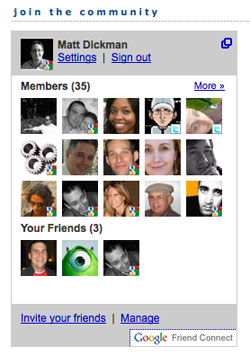
My initial experience with that module was poor. The invite function wouldn’t let me add new users. Actually, I just checked and it still won’t. Worse yet when I tried to invite my friends and the page gave me the error, something weird happened. All of my Gmail chat contacts disappeared. My Google reader contacts as well. Not cool. I’ve been rebuilding this over time, but some people I have been permanently severed from. To add fuel to the fire, when I try to add the social widget to the post, I get the image below where the widget should be. I have everything set up right, it just doesn’t work.

You would think that, upon launching a new platform extension, Google would be all over the support site. Not the case. From when I submitted my post to the next Google rep to answer any questions was about three weeks (and they didn’t answer my question).

Scenario #2, FeedBurner. I think the entire blogosphere has a love/hate relationship with this service. From the time Google acquired the Chicago company until now it has been a rollercoaster. FeedBurner started out with a narrow focus and they executed well. Google acquired them to extend their advertising/analytics offering. However, subscriber stats would often fluctuate wildly, dropping to zero on some days, bouncing back if you were lucky. Google always claimed that they were “working on it”, but I didn’t believe it until a while back when I saw that they were transitioning to the Google platform.

In theory, this is a good thing. More scale, more stability, more happy people. Wrong. The transition was not explained well and I saw a wave of panic slowly crushing the blogosphere. A couple of us took the plunge and made the move (I even recorded a video to help people understand the process). In the process, my subscribers dropped by half. No explanation. Hundreds of posts to the support forum and no replies from Google. My stats did bounce back, but the service’s reputation is shaky now. People use this as a key metric, companies track it and people get paid based on it. Sadly there is no alternative (yet).

Google has lost sight of the user. They have neglected us for too long, concentrating instead on advertising. I get that it is their lifeblood, but what good is an ad that nobody sees because you alienate your community. I think that a company that attacks with the right mission and focus on users could make a dent in Google’s armor. Killer customer service powered by social platforms could allow a new set of players to emerge.

I would love to get your take on this. Have you seen the same trend? What would you do if you were Google to stand up and put your foot down?

Read more by Matt Dickman at Techno//Marketer.