
Silicon Valley Technology Commentary & Archives · Est. 2006 3,033 Posts · 2006–2026

February 6, 2009

February 6, 2009 · 4 MIN READ · BY LOUIS GRAY

Lijit Search Is All About Relevance. Now Go Update Your Widgets!

Lijit Search Is All About Relevance. Now Go Update Your Widgets!

Yesterday, I had the opportunity to fly out to Boulder, Colorado to meet with Lijit's executive leadership team, at the request of Micah Baldwin, the company's friendly tireless and unique evangelist. A happy Lijit badge wearer for the better part of the year, I initially started using the blog search engine thanks to its drop-dead simple integration into my site and associated search tag cloud (see the right column), but yesterday's discussion helped open my eyes to many things about Lijit that I have been missing, and you no doubt have as well.

Under our noses, Lijit has grown from a cute widget play to harnessing one of the most targeted search engine and content archives on the Web - but has done so in a way that's remarkably different than Google. Now, before you go to lijit.com and try to find a search button, let me explain...

Google's goal in life is to find the one right answer that is true for everyone. Search for iPhone, and you should get the same answer I do at the top of the results, blanketed by potentially relevant ads from the company's partners. Lijit's goal in life is to find the one answer that is most accurate, depending on where you are searching. Search for iPhone on my blog, and you will find the most relevant responses that come from my blog and my content from around the Web, including Flickr, Twitter, Delicious, YouTube and other social sites. Search for iPhone on Steven Hodson's blog (also using Lijit), and you should get a different set of responses based on his activity.

There is no one right answer, and there shouldn't be, because we each look at the Web through a prism that is colored by our own activity. Lijit does this well. Google does not - even if they are working on it. Just think about how you search Google today. You almost certainly are searching with multiple keywords, not just one, because a broad search for "bicycle", "train" or "beagle" is going to be way too muddled. But search for "beagle" on my site, and you will get something personal.

Meanwhile, Lijit has also stepped up its game in terms of a more targeted advertising network, around its publishers and its highly targeted search results. The more relevant the search and the more relevant the data around the searcher and the publisher where the search is taking place, the higher the click-through rates. The company showed us details that illustrated significant click through differences between them and Google - the 800 pound gorilla in the space. Publishers who opt in to the Lijit network can set a floor for what they estimate their cost per click should be, and Lijit will work to get that price - promising no less than 10 cents to the publisher per click on an ad.

The company also turned on revenue sharing for publishers, so if you have been running Lijit search on your blog for some time, you should log into your Lijit account and see if you've racked up any earnings. You could have money owed you haven't collected on!
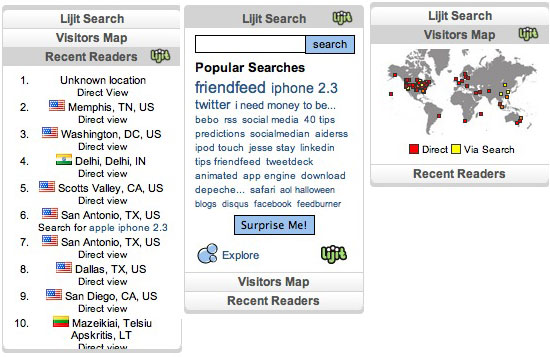
The New Widget's Three Faces

Speaking of updates you probably didn't know about... I learned yesterday that the widget I have been using for Lijit was out of date. They now offer an "all in one" widget that not only shows a search bar and search terms (and reshare when people find your site from a search engine) but also detail on those recent visitors, including geography. At one point I was running a similar script from Feedjit (not Lijit) to get that data, and Lijit gives it to me in one place. To get yours, go to lijit.com, log in, and click "Search Wijit" at the top. On the left side, you can see a checkbox to make yours an "all-in-one Wijit!". There are even new options like a "Surprise Me!" bar that will take you to a random post on the blog you are visiting.

In the past, I have been fairly vocal in terms of saying that blogging is not about the ads and the revenue (at least for me). I believe that when you cross the line from blogging for the experience and for content discovery and move to pro blogging, it becomes all about the money. But Lijit has made strides toward making ads less intrusive and more relevant to you and the visitor, making them "less evil" and likely more rewarding.

The next big step for the company will be to better explain what they do and what they want to be when they grow up. I've already seen big moves, not just between when I first discovered Lijit, and today, but also in terms of how the company is a real business with a real roadmap and big plans. They're not out to take Google head on, or anything crazy like that, but they are about delivering the best, personalized, search results to the publisher and the viewer.

Like I have championed for Disqus to become the standard for blog comments, I would strongly hope Lijit becomes the standard for blog search. It just works, and the team continues to innovate. Now go update your widgets.

February 5, 2009

February 5, 2009 · 2 MIN READ · BY LOUIS GRAY

Are You Right For YouAre?

Are You Right For YouAre?

By Ken Stewart of ChangeForge (Twitter/FriendFeed)

YouAre LogoWith the promise of "making the small things you do every day easier," YouAre announced it was open to the public as of January 27, 2009. Starting in May 2007, YouAre.com sought to get it right before allowing the masses access to what some might call YATC (Yet Another Twitter Clone). But, the YouAre team disagrees (and with just a dash of wit I might add):

When they say that YouAre is just another YATC, our response is clear. Twitter was and still is an inspiration for us. But if YouAre is a Twitter clone, then WordPress and Movable Type are clones of Blogger, Pitas and LiveJournal.

Duncan Riley (Inquisitr) reluctantly labeled YouAre Twitter 2.0. But is it? According to YouAre, the service seeks to combine Twitter, LinkedIn, Tumblr, a dash of Del.icio.us, and (you won't see this coming) innovation...

So what makes YouAre innovative? Let's take a look at what's under the hood.

The concept of YouAre focuses on combining a platform of microblogging (140 characters maximum), with the ability to share video and images as well. Additionally, you can build and share your personal and professional profiles with friends and colleagues, helping you to learn more about those to whom you subscribe and vice versa.YouAre allows you to compliment that mix with the ability to import favorites, much like Del.icio.us, includes their very own link compression publisher, MicURL, as well as support for microformats (XFN).


Unlike the natural comparison to Twitter, YouAre seeks to create a more cohesive and sticky experience, allowing you to create a more involved experience outside of the superficial and overly-simplistic personal billboard experience Twitter trends towards.

However, it's major detractor is the lack of overall population. YouAre opted to "get it right" and launch a more seasoned platform instead of seeing some of the major land mines Twitter has experienced.

Still, as will all social media platforms, the key is being social. Twitter is successful because it is simple to understand and direct in purpose - in spite of it's many shortcomings. The community that surrounds Twitter continues to generate more momentum for that service, and YouAre has the disadvantage of simply being viewed as YASMS (Yet Another Social Media Site). In short, YouAre has an uphill battle selling users why they should give the service a try.

I'm game... but only time will tell whether I will continue use and whether the service will be an ultimate success. Quite plainly put, YouAre depends greatly on whether you are interested, your friends are interested, and their friends are interested.

Ken Stewart’s blog, ChangeForge.com, focuses on the collision between the constantly changing worlds of business and technology. To connect with Ken, you may visit him at DandyID.

February 5, 2009 · 2 MIN READ · BY LOUIS GRAY

Where is Your Focus: Subscribers or Traffic?

Where is Your Focus: Subscribers or Traffic?

By Corvida Raven of SheGeeks.net (FriendFeed/Twitter)

James Duthie of Online Marketing Banter has a really valuable post on 5 important lessons that he learned from his first year of blogging. I think everyone could agree to having learned a lot of the lessons that he listed, myself included. However, his first two lessons really inspired me to think about where my focus is when it comes to my own blog. 

Lesson 1 - Momentum disappears damn quickly.
Lesson 2 - It's not all about the traffic.

With these two lessons in mind, I think that as a blogger begins to evolve they have have to make a decision: you can work overtime to keep up traffic to continuously build momentum or you can stop worrying about the traffic and shift your focus to converting the traffic that you receive into subscribers. Some people focus on both, which can be a daunting task. Getting people to visit your site in the beginning of your blogging career is no easy task, unless you have great connections.My decision was to worry more about subscribers than traffic. I figured that with enough subscribers, you can begin to have consistently decent traffic, without worrying about the momentum that disappears all to quickly for some of us.

Know Your Goals

For me, this was an easy decision because I don't display any ads on SheGeeks, nor do I care to. Though recently I've been dabbling in sponsored links. Being aware of what you plan to do with your site can help you better understand what decision would be best for you. The answer to the aforementioned question is all so dependent upon the focus of your site and what you are attempting to achieve. I want more conversation. With more subscribers I can easily generate more conversation. This is easier for me rather than trying to generate conversation by trying to increase my traffic. And no, high subscribers doesn't necessarily mean high traffic, especially if your content is few and far in between.

Know Your Audience

On another note, I'm aware that the majority of my readers user RSS feeds to access the site. I'm also aware that the majority of my readers are probably "skimmers", meaning they don't read everything in its entirety unless it's truly worth their time. So traffic is just a moot point for me the majority of the time. What does this mean? Be aware of your audience and the tools they use. To me, the aforementioned facts reeks of a low click-through rate. So really, why bother?

What's Your Focus?

Which leads me to ask the rest of you: where is your focus when it comes to your blog: subscribers or traffic?

Read more by Corvida Raven at SheGeeks.net.
February 5, 2009 · 1 MIN READ · BY LOUIS GRAY

Twitter Squats on People Wanting Squatter Usernames

Twitter Squats on People Wanting Squatter Usernames

By Jesse Stay of Stay N' Alive (Twitter/FriendFeed)

On StayNAlive, I recently wrote about how I was able to change my Twitter username from "JesseStay" to just "Jesse", by a new rule, announced recently by Twitter, allowing anyone to obtain the usernames of people who had not updated their account in a long time, and did not appear to be using their accounts. The process was simple - just e-mail "[email protected]", and you could obtain the squatted username of your choice.

The process was so easy that I was able to obtain my first name. Mona Nokamura, who also writes on LouisGray.com, was also able to obtain her first name instead of "@monaaa", and users everywhere were finally able to get the names they have been trying to obtain since they joined Twitter.

Evidently, Twitter's systems must have been overwhelmed with requests, as they appear to be putting the kibosh on the average Joe getting the username they want. Prashanth from Control Enter left a comment on my blog sharing that evidently, Twitter is now responding to requests to "[email protected]" with the following e-mail:
"Due to high ticket volume, Twitter Support is unable to change usernames in cases of inactive accounts. Unless your user name issue involves Terms of Service violations, you’ll have to wait until all inactive user names are released. We’re working on a better long term solution for this."
If there is a blatant copyright violation or impersonation or similar circumstance, it is suggested you contact Twitter's Terms of Service group via Twitter's Web form. It would appear the gold rush for usernames is over for the time being, although it was nice while it lasted.

Read more by Jesse Stay at Stay N' Alive.