Silicon Valley Technology Commentary & Archives · Est. 2006 3,033 Posts · 2006–2026

February 13, 2009

February 13, 2009 · 1 MIN READ · BY LOUIS GRAY

TechBlips Puts Me Under the Spotlight

TechBlips Puts Me Under the Spotlight

When Future US purchased the BallHype and ShowHype properties, there were questions in some corners of the blogosphere in terms of what the company had planned - and if they had overspent. When lacking details, many people tend to jump to the conclusion that there are no plans at all, but in the ensuing months, Future US has stepped on the accelerator in terms of rolling out new vertically-focused communities, covering everything from gadgets and Macintosh, to general tech, marketing, politics and even Wall Street.

TechBlips, the 12th property to be rolled out by the same team behind the "Hype" properties focuses on tech Web sites, big and small. Speaking of small, they made an effort to reach out to me, and delivered a solid Q&A profile, posted to the site this afternoon.

In the post, Douglas C. Perry, who sent me the questions, and does a great job in his intro, we talk about how louisgray.com got started, what sites I read every day, reactions from friends and coworkers, how I use Twitter, and why I blog in the first place, how I make time to do it, and some of my favorite stories. You can find the article here: TechBlips Spotlight on Louis Gray.

As I mentioned yesterday, it's a very unusual thing, still, for me to get the opportunity to speak up, but I very much appreciate TechBlips' interest, and the effort to put the piece together. They also have a very interesting site, much like Digg but with actual class and focus.

And if you like the interview, check out some similar pieces from the past:

Mark Evans: Who’s Louis Gray?
Scribkin: I AM BLOGGER: LOUIS GRAY

February 12, 2009

February 12, 2009 · 2 MIN READ · BY LOUIS GRAY

Christian Science Monitor Covers Twitter's Secret

Christian Science Monitor Covers Twitter's Secret

Twitter hasn't just captured the imagination of the tech blogosphere. Even as debates rage whether to cover every little third-party service that interacts with the service, or every minor service update, more mainstream media is starting to recognize the service's potential - taking Twitter out of our little echo chamber world, and into the national consciousness. It's gotten so I'm not just getting bombarded by questions about Twitter online, but from friends and family as well. Last week, I was approached by Gregory Lamb, Staff Writer for The Christian Science Monitor, who wanted to talk about whether Twitter had gone mainstream, if it was worth $250 million, and even if it would be supplanted by more advanced tools, such as FriendFeed.

Lamb's article posted this morning, titled, "Twitter’s secret: the law of unintended consequences".

While I've gotten more used to fellow bloggers referencing my posts over the last year or two, getting the attention of such a respected paper as the CS Monitor is humbling. Lamb and I talked for only 10 minutes or so last week, as I walked with Erin Kontecki Vest and Micah Baldwin to our meeting at Lijit headquarters. Luckily, I was able to prove I can both talk and walk at the same time.

Quotes worth noting include the pair below:
"Charging a fee to use Twitter isn’t likely. 'Anytime you have a service that is free, customers are going to expect it to stay free,' Mr. Gray says. Advertising would seem to be a logical next step (Twitter has no ads now), but other social networks have found that users find them intrusive."
Twitter is a “disruptive” technology because it is in “real time,” Gray says. With blogging, “there’s still a lag between when they post and [when] you get it…. If you want to find out something that is happening immediately, the place to go is Twitter and not Google anymore. And that’s revolutionary. And that’s why Google, in my opinion, should be watching this closely.”
So... did I get it wrong? Would you pay for Twitter, and should Google not be all that scared of Twitter's growth as part of the real-time Web?

Whether you agree or disagree with my comments, I am glad to see some of the leaders of Web 2.0 surviving and thriving - poised on the verge of breaking out. And Gregory, thanks for reaching out to me. Appreciate it.

February 11, 2009

February 11, 2009 · 1 MIN READ · BY LOUIS GRAY

I Just Marked All Facebook Ads as Offensive. So Should You.

I Just Marked All Facebook Ads as Offensive. So Should You.

The world is still looking for a better way to target customers with ads and products they want to actually learn more about. And the world will have to continue looking, if the offerings on Facebook are any indication. On the rare time I am logging in to the site instead of setting up roost on FriendFeed, Twitter or LinkedIn, I am amused to annoyed by the stupid ads that have absolutely nothing to do with anything I would be interested in - from meeting other singles (not single) to losing weight (unless it involves bacon and donuts) and getting my share of the government's stimulus package.
Facebook, like many other sites, is desperate to bridge the gap from traffic to revenue and profits. Usually that entails filling all available non-content space with ads. And often, that means the filtering process on said ads is beyond miserable.


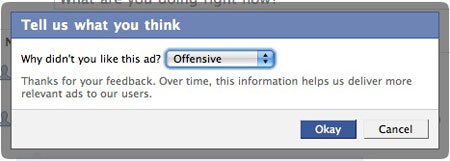
So today, I had enough, and marked all the ads I saw on Facebook as "offensive", as they let you do. But each time I marked one as offensive, a new one popped up. It was a virtual electronic game of whack-a-mole, only it looks like nobody won.

I'm all in favor of seeing ads for things I might be interested in - new tech, sports or political books from Amazon... CDs from artists I like. Apple or TiVo products... you name it. But the run of site crap is just that.

So if you want to send a message about how the ads offend you, if they do, then say so. Facebook will know the difference.


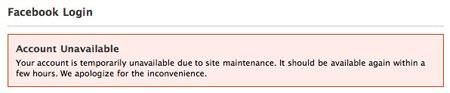
Oh... and I think it was probably a coincidence that Facebook started to go "on maintenance" after my ads feedback. Or was it?
February 11, 2009 · 2 MIN READ · BY LOUIS GRAY

You Don't Need To Know Where This Rant Was Written

You Don't Need To Know Where This Rant Was Written

By Rob Diana of Regular Geek (Twitter/FriendFeed)

Location-based services are all the rage. Mobile computing allows people to work from anywhere. Now, with GMail's new location based signature labs feature, people will know where you were working. Wow! This is fantastic! Now, anyone I e-mail will know that I am working from home or even at the beach! If you can not read the sarcasm, then let me tell you that I just do not understand why we need this. Thankfully, I am not alone in this feeling.

Svetlana Gladkova of Profy worries because email one of the few places you can still hide from people.
"Of course you certainly don’t have to use this feature and since it is in Labs you should be pretty determined to share your location with anyone you send emails to in order to activate it. But experience shows that the ideas that are born at Google first will eventually turn into wildly popular and used applications that many people will rely on for whatever purposes they may and this will make it much more difficult to hide behind your e-mail address in the future."

Even ReadWriteWeb's coverage questions why people would want to use it.
"Why would you want to do this? Maybe you want to highlight your jetsetting lifestyle. Maybe you want to remind the recipient that you're in a different time zone. Or you might just want to use it as a mnemonic device for searching sent e-mail based on the location from where it was sent."

Google is obviously making a very big move into location-based services. They recently launched Latitude, their location sharing service. Their are other location sharing services as well. Brightkite and Loopt seem to be the most popular or at least the most hyped. The real question is why do people feel that sharing their location is helpful?

I can understand that people may want to know who is currently in their city or who lives in the same general location, but that information can typically be found through most social networks or the social event and travel sites like Upcoming and Dopplr.

So, why do we need to know who is near at every moment? Outside of the coolness factor, what problem do these services solve? I can understand that UPS may want to know where their trucks are, but that can be solved using basic GPS hardware and applications. What benefit do people really get by knowing where people in their network may be in their town? I just do not get it, but maybe I am just being too practical.

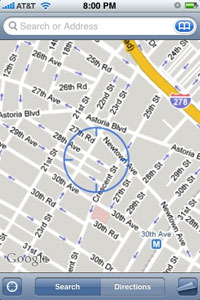
Image by onebutan-iphone
Read more by Rob Diana at RegularGeek.com.