Silicon Valley Technology Commentary & Archives · Est. 2006 3,032 Posts · 2006–2026

March 5, 2009

March 5, 2009 · 2 MIN READ · BY LOUIS GRAY

Technorati's Revenge? The Site Is Beating Google for Blog Reactions

Technorati's Revenge? The Site Is Beating Google for Blog Reactions

To laud Technorati is going against the flow, to say the very least. The once-omnipresent blog search engine has practically been reduced to a state of irrelevancy, thanks to inconsistent uptime, odd product launches and withdrawals, nonsensical redesigns, executive turnover and aggressive competition from others - primarily Google Blog Search. In previous posts on Technorati, I've referred to them as "totally toast" and "fighting off irrelevance". But surprisingly, especially in recent months, the moribund site has consistently beaten Google in terms of finding new and accurate links to my blog or mentions of the site, while Google's results have actually gotten less relevant over time, including false positives from blog rolls and the like. No doubt this had much to do with why Rob Diana, in January, said for the most part, that blog search sucks.

Google is set up to find all of the world's information, and it is doing a fantastic job at that, as we all know, and it is the gold standard for search in practically every regard. But it's maybe too good. The company's over-aggressive spiders are just as likely to trigger false positives in terms of knowing what is a blog and what is not, or what is a blog post or what is simply sidebar information. Last August, I highlighted one issue, when MyBlogLog activity was spawning false positives. On other occasions, I've seen updates from aggregation sites, like Socialmedian, do the same. At this point, my bookmarked blog search from Google to find reactions excludes no fewer than four sites, to try and filter down the accurate results.

And as I'm fighting off false positives with Google, Technorati is quietly finding me mentions that I can't get using Google, which relies on keywords instead of links. Not even the advanced blog search page on Google lets me find links to a site the way most bloggers want to find.

Technorati, for instance, found me links from LivingstonBuzz.com, BlackWeb20.com, and from Regular Geek in the last few days, which were pointing my way, but didn't mention my name or site domain - and I'm finding this to be the rule, rather than the exception. While at one point I'd stopped visiting Technorati, I've now returned to the site on a frequent basis to see responses, and participate in the conversation wherever it may be.

Technorati's benefits over Google Blog Search may no doubt be short lived. Maybe Google Blog Search will solve some of their issues soon, and develop new features, while Technorati has been relatively stagnant. And I'm still waiting for somebody to come up with the "inverse Technorati" idea I floated back in October of 2007. I'm not saying Technorati is perfect, or winning me over as a major force to be reckoned with in innovation, but if I want to know who is linking my way and extending the conversation, they're still doing a good job, and beating Google, which is a significant feat.
March 5, 2009 · 2 MIN READ · BY LOUIS GRAY

The Love/Hate Relationship With My Bluetooth Earpiece

The Love/Hate Relationship With My Bluetooth Earpiece

With the state of California recently making it illegal to drive while using a cell phone that has not been equipped as hands-free, finding a bluetooth earpiece I was happy with was a must. A friend of mine passed along a top name-brand product, thanks to his having one too many. And while when it works, I have few complaints, just getting it to connect to my iPhone and stay connected is a multiple times a day struggle. Sometimes, it even seems like I spend more time getting the two products to talk than I do talking on them myself.

I don't want to throw the vendor under the bus, so I'll leave them out of it. But in my opinion, technologies should be able to auto-recognize one another, stay paired, and then work as expected. Instead, I find that the iPhone and the earpiece drop each other's connections any time I separate them by more than say, 10 feet, at any point, when I connect them they don't always stay paired, and I need to pair and unpair them multiple times a day.

The iPhone's setup for BlueTooth is relatively simple, I would think. Click on the Settings app, choose general, choose Bluetooth, make sure it's on, and then add a device to connect. Got it.

But what I'm finding is that the iPhone is a liar. It says it's connected, but if I try and make a call, it doesn't show the earpiece as an option. And on the flip side, if I pick up the iPhone to speak into it directly, it will flip the audio source to the earpiece without my asking. Grr.

The result is that I find myself charging the earpiece all day at work, overnight, and going through a multi-step process to keep them connected by brute force. Every time before I get into the car, I make sure I have both devices in close proximity. Then I clear whatever connection the iPhone thinks it has, I go back to the home menu and open up the preferences again. Then I force a new connection. And then, I still might find myself driving along the road, close to cursing, doing the dual device reconnection dance.

Given I often want my hands free at home as well - to type and take notes during an interview, or just to take care of the twins, getting the iPhone and earpiece to play well together is critical, and the flakiness is driving me nuts. When it works great, yay, but I'm not exactly set up to write an amazing testimonial.

What experiences have you found? Did I get a bum device? Does the iPhone just not take to Bluetooth all that well? Is it user error? I'm listening (as soon as I can get my earpiece in).

March 4, 2009

March 4, 2009 · 2 MIN READ · BY LOUIS GRAY

Boring May Be Profitable

Boring May Be Profitable

By Rob Diana of Regular Geek (Twitter/FriendFeed)

YAWN. Supposedly, that is what we are looking for in an application. Before you misunderstand me, the idea started with a quote from Fred Wilson's blog, "the great moves are usually greeted by a yawn". I am not commenting on the product in question, Twilio, but the general idea. So, what are the great successes in software and internet businesses? Microsoft, Oracle and Google immediately jump to mind. I am not sure if anyone would have called Microsoft sexy or really interesting like they do with Twitter or FriendFeed. Oracle was never an interesting company, by most standards, because they work in data management, which only data people like myself find interesting. Lastly, Google was mostly greeted with "what do we need search for" questions.

Steven Hodson wonders if the future and Web 3.0 will be very boring:
"There is a hubbub of activity as everyone is rushing around putting all the pieces together... At some point though everything is in place – the building is completed and then everyone sets about to do the day by day business of working in that new building. You know the boring stuff."
Typically, boring means corporate or enterprise systems. Boring means data management. Boring also means stable. However, these things normally translate into large amounts of revenue. Social media and social networking have not really converted mainstream corporations. There are some early adopters using sites like Twitter, but that is not the norm. Social media will take some time to gain adoption because there is very little direct return on investment. Advertising is easy to measure, but using Twitter for customer service has no direct correlation to revenue. So, there needs to be a lot of convincing in order to start using social media in the enterprise.

On the other side of the coin is the semantic web or what many people have been calling Web 3.0. The semantic web will not be what people were originally expecting for quite some time. However, many of the semantic companies are trying to create a bridge to the future. A concept that is being promoted is "linked data" for the web. This is the infrastructure for the semantic web. Once the data is linked, we can query the data. But there is a lot of data management that needs to be completed before we can really take advantage of the semantic nature of the data.

Yeah, all of this sounds boring, but the revenue model is much different. To earn a significant amount of revenue on the internet, you need either a million subscribers paying $5 per month or a ton of traffic in order to generate ad revenue. An enterprise installation of social media software could easily start at $30,000 with yearly maintenance of 25%. Granted, corporate customers can be harder to get and typically require a dedicated sales force, but the revenue can quickly grow.

Yes, it is boring, but it is also profitable.

Read more by Rob Diana at RegularGeek.com.
March 4, 2009 · 3 MIN READ · BY LOUIS GRAY

Likaholix Launches Recommendation Engine Based On Social "Liking"

Likaholix Launches Recommendation Engine Based On Social "Liking"

New services for people to connect to peers and share their interests are cropping up around every Web corner. Some, like Facebook and FriendFeed, have found strong, growing communities, where people find things they care about, and discuss those items. And as FriendFeed has discovered, the simple act of "liking" an item and enabling comments, helped the site differentiate itself from practically every other aggregator out there. This morning, Likaholix, sprung from the minds of some former Googlers, follows suit with a site dedicated to just your likes - whatever they may be, but adds on suggested items, recommendations, and even experts.
(Skip this post and get one of 200 invites: here)

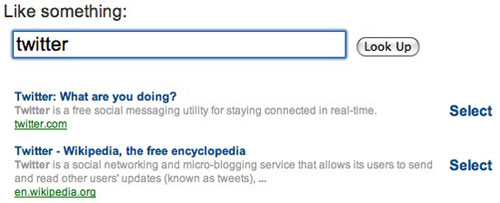
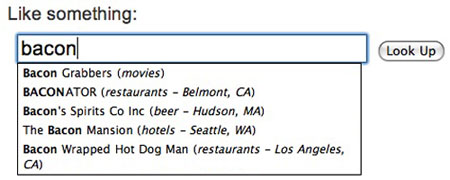
No matter how many new lines of business Google finds itself in these days, its core value has always been search and retrieval of information. That mantra has been seen in sites developed by its former employees, like FriendFeed, with its integrated search, and now, also with Likaholix, who takes things a step further, by not just crawling a database, but auto-competing search terms, as does Google Suggest. And these auto-suggestions come packed with a ton of books, restaurants, and even movies and music - in what may be a vain hope that you won't see the same few dozen self-proclaimed social media experts lauding the latest technology update over and over.


Likaholix's Search Engine Auto-Suggest Feature In Action


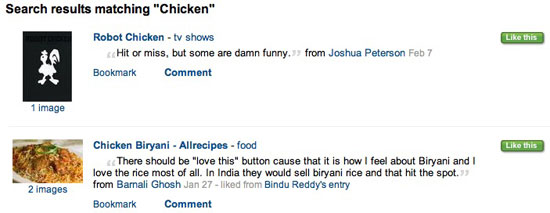
Likaholix's Search Engine Results


Likaholix even suggests items that nobody likes, guessing that somebody will, and eventually, they would be selected.


Surely Somebody Finds South Park Funny?


As Likaholix is all about what you like, you're credited for being the first to like any item. On your profile, not only does it show what things you like, and who you like, but it shows how many times you were the first to like an item, and introduce it to the community.


Searching for Twitter Shows It's Not Yet Been Added


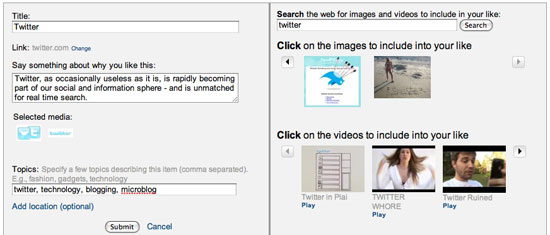
And should you be the first to like something, Likaholix helps you fill out your data profile with a description, and even images or videos pulled from Google to help round out your item.


Introducing a New Like to Likaholix


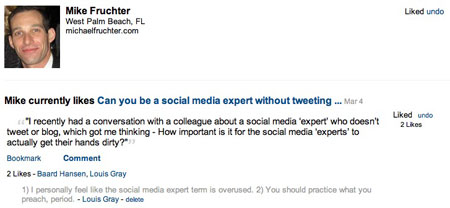
A Friend's Profile on Likaholix

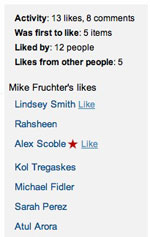
Like with FriendFeed, your stream of likes and comments are found on your profile. You can also see how many different people liked an item, and who they are, and see recommended items based on what you've told the system you like. You can also view how many other users of the service you like, and who likes you.

Find yourself an expert in something? Claim you are with Likaholix - whether you're one of the previously mentioned social media experts, or if you have a love for science fiction, SEO or even art. Claiming expertise puts a star next to your profile, and will display your name with a star beside it anywhere it is mentioned, including on the list of contacts your friends have.


Tudor Bosman - Science Fiction Tastemaker on Likaholix

The core focus of Likaholix is to recommend to you more things you might like, based on things you say you enjoy, and those items your friends do - developing an automatic recommendation engine of sorts. For example, this morning, I was told I probably would like TiVo, because Sanjeev Singh, who I have liked, says he likes TiVo as well. In this case, Likaholix is right. It's not always right of course. I have less of an interest in bebe.com (a fashion Web site) or Downtown Brown beer (considering I don't drink), but I assume that as I like more things, and my friends do as well, this list can get better honed.

And as you like items, you can even share them in the usual places, like Twitter, Facebook and FriendFeed - extending the reach of the site.

Likaholix is opening up today in a private alpha mode, as they say. Existing users, like me, can invite friends to try out the service. The user interface is spartan for now, but the team has no doubt been working on the recommendation engine for starters, and a sharper GUI can come later.

You can find me at: http://likaholix.com/louisgray. Be one of the first 200 to use this code, and you can get in as well: http://burnurl.com/xdB3aH