 It's no secret that I'm a huge proponent of self-hosted Microblogging. I've written numerous times on LouisGray.com and my own blog about the benefits business can see by "rolling their own" microblog with their own brand, look and feel. Not sold on this idea? Read what I wrote earlier about the implications of ESPN running their own sports network, or even the company I advise for, TodaysMama.com and their recently-launched network for Moms, TodaysMama Connect (which has quite a community going now!).
There is something to be said for a brand being able to have full control over the relationships and community they build. Self-hosting is the only way to achieve this full control. This is why I was excited to see the developers of both Laconi.ca (which hosts TodaysMama Connect, Identi.ca, and Leo Laport's Twit Army), and OpenMicroblogger (which we also wrote about before) both come out with their own way to easily set up your own, hosted microblogging environment without the need to even run your own servers. The two services, Status.net, and Twitteronia, I guess you could say are the "Wordpress.com" of the "Wordpress.org-like" self-installed microblog platforms. They provide the complete set up for anyone to have their own branded microblog with just a few clicks of a mouse.
Status.net
Evan Prodromou has been busy since we last heard about Identi.ca and Laconi.ca. As we heard several months back, his company, Control Yourself received funding, and it would appear they're using the money well. They have multiple people working for them now, and in a different scenario than perhaps their biggest competitor, Twitter (that would assume that Twitter even releases their source code like Laconi.ca or communicates with other OMB instances), they have an actual business model.
When I chatted with Rachael Herrscher, CEO of TodaysMama, she told me Evan had given them several hours each month that they were paying for, to help them out with the install of their Laconi.ca instance. Evan and Laconi.ca are working with multiple similar clients to do the same - it's a business model that works because those brands that need some support and can have that guaranteed through payment will pay for the support and extra hand-holding.
It would appear that they are pursuing another business model however with a recent blog post by Evan (and Rob Diana also wrote about it on RegularGeek).
"I’ve been telling people for a few months that one of our plans for commercializing the Identica software and getting more people on the OpenMicroBlogging network is to have a hosted service for new microblogging communities. I wanted to get out some information about the upcoming service — I’m really excited about the prospective launch."Status.net, according to Evan, will provide for both small and larger communities to have a branded environment to host on. It will be a for-pay service, and those with fewer users will pay less. "yoursitename.status.net" will point to your instance, although it wouldn't be that hard to point a CNAME domain record to redirect to that as an alias. All microblog instances set up under Status.net, just like any Laconi.ca instance, will be able to communicate with each other via the OpenMicroBlogging (OMB) protocol, meaning you'll be able to subscribe to a user's updates on another OMB-supported site without ever having to visit that site.
Evan seems to know his users are businesses. He hinted at integration with LDAP in the future, meaning you, as a business, will be able to seamlessly allow your company's employees and your existing company database to easily integrate into the system. Perhaps this means they plan to also go head-to-head with internal communities such as Yammer. I think this has a very strong external benefit as well though, and could give any company the edge to build a community around their brand, both internal and external.
Also hinted-at was the potential to integrate with other 3rd-party aggregation services. Perhaps such integrations will be sites such as FriendFeed, which already integrates Laconi.ca as an option. Such services will also most likely work under other Laconi.ca-supporting clients such as Twhirl. Evan is certainly creating the Wordpress.com for Microblogging platforms.
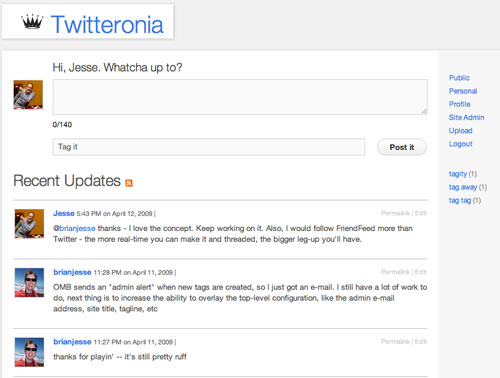
Twitteronia
Alongside Status.net, Brian Hendrickson, the developer behind OpenMicroBlogger, another open-source microblogging platform that also supports the OpenMicroBlogging (OMB) protocol, also has announced a similar hosted microblogging site. His is live currently, in private beta, and enables a very simple registration by just providing your Twitter OAuth credentials (however I'm a little unsure what would happen if one were ever to leave Twitter). OpenID is also a work in progress which will be supported shortly.
A site based on Shaq's own term for Twitter, Twitteronia calls each instance a "Twitter". Whether that's just a code-name for now (I can see Twitter's lawyers getting hungry over Trademark dispute, although I'm not sure "Twitter" is even a registered Trademark at the moment) or something they'll keep for the future is yet to be determined, but the terminology is interesting. Essentially, any user can create their own "Twitter", using their Twitter credentials, with just the click of a button.
Several sample "themes" are given for the site administrator to choose from in order to customize your implementation. I imagine many more will be added, as Brian Hendrickson's OpenMicroBlogger platform previously supported Wordpress themes natively. I am guessing this will eventually do the same, so maybe you'll even be able to create your own in a very familiar fashion to what any Wordpress developer could create.
In addition, with the ability to upload photos to each "Twitter" instance, you can also provide an Amazon S3 key which will enable those photos to go to your Amazon S3 storage. The site also supports Zeep Mobile 2-Way SMS integration.
The OpenMicroBlogging Revolution
The move to more open platforms is starting. I predicted this at the beginning of the year, stating that we would see more open source platforms delve into microblogging, and this is just the start. Status.net and Twitteronia are both sites with great potential to be leaders in this space. How large will they become before Facebook or FriendFeed, or Twitter follow suite? Will it even matter at that point, if companies can then pick and choose the platform of their choice where all platforms can talk back and forth with each other? It will certainly be interesting to watch - I certainly hope the major players are watching, as this will be where brands turn to as they need stronger control over their community.
You can check out my Stay N' Alive Twitteronia instance at http://twitteronia.com/twitter/staynalive - leave me a message and let me know what you think!
Read more by Jesse Stay at Stay N' Alive.
 This evening, I got
  The process is fairly straight forward.
 For fun, and just to see if I could tweak

 I have tried to avoid the newspaper crisis, and the AP's comments for as long as possible. Today, a
  Digg's new