
Silicon Valley Technology Commentary & Archives · Est. 2006 3,032 Posts · 2006–2026

May 6, 2009

May 6, 2009 · 2 MIN READ · BY LOUIS GRAY

FriendFeed Simplifies Joining Process from Twitter, Enhances Syncing

FriendFeed Simplifies Joining Process from Twitter, Enhances Syncing

Twitter's rapid growth alongside increased adoption by public figures, celebrities and practically anyone who wants their message heard has not come in a vacuum. Many of the millions of tweets being sent each week are flowing downstream to various social networks, including Facebook and FriendFeed - both of which offer a more diverse content sharing set, including photos and video. But despite the expanded options by both networks, including the ability to "like" items and participate in threaded conversations, some Twitter users have balked - citing complexity. On Tuesday, FriendFeed took a major step to simplify the joining process for Twitter users, giving them a much-needed kick-start into what many people, including me, are using as their central nervous system for social activity.

Twitter users who are don't yet have FriendFeed accounts can head to www.friendfeed.com, and by leveraging Twitter's new adoption of OAuth to let third party applications connect with users while not demanding they turn over their password, can join FriendFeed almost instantly by clicking the Twitter icon. Once granted access, FriendFeed will automatically find all your Twitter contacts already using FriendFeed, and will import your Twitter profile and avatar - essentially replicating the personal elements of your Twitter account, but in a new place with more flexibility.
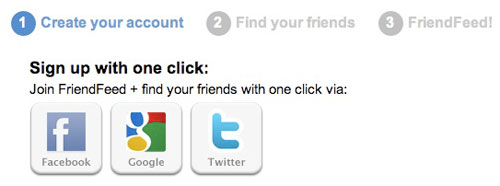

The New Joining Page Features a Twitter Icon
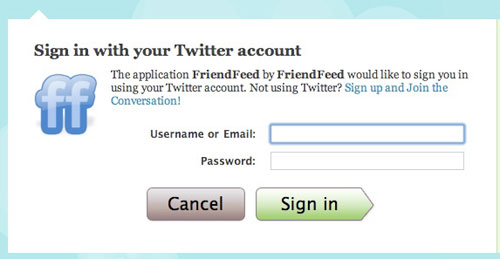

OAuth Connects Your Twitter to FriendFeed
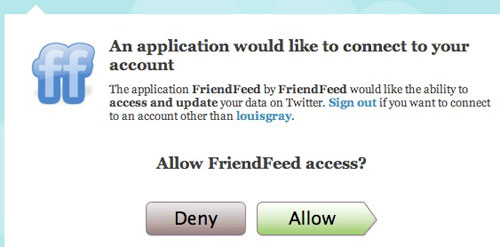

Just Say Yes to Get Connected

Meanwhile, for existing FriendFeed users, their remains the option to find friends who are connected on other services, from Facebook, as has been in place since FriendFeed's debut, Twitter, Yahoo!, Hotmail and GMail, by using the "Find Your Friends" option.

A few months ago, when the company first introduced synchronization capabilities with Twitter, I had added more than 2,000 new contacts. But as both services have grown, I found more than 1,000 more of my new Twitter followers were already using FriendFeed, and I synched up again this evening, adding them to a group I call "Twitter Clone".
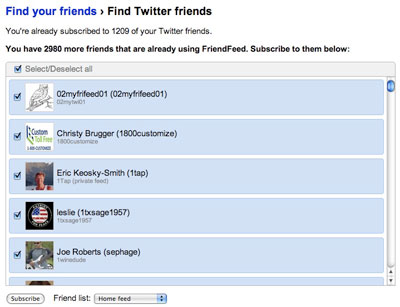

See Those Friends of Yours From Twitter on FriendFeed

As of this evening, of my 8,932 Twitter followers, 3,974 are using FriendFeed - good for about 45% of the total. I somewhat jokingly told the other nearly 5,000 that they are either bots or too stubborn to get on a site that has become a major hub for information discovery, sharing and discussion.


I Get All Synched Up

While it's fun to talk about who is going to buy who, or which service is going to kill the other, the fewer barriers that are there to help novice users transition between the two sites, the greater the adoption will be. FriendFeed is not naive enough to fight Twitter head on, but they are doing a solid effort to capitalize on the total growth of social media - of which they are playing an increasing role.

See also Zee's earlier coverage of the announcement on TheNextWeb:
With 1 click Friendfeed introduces the art of conversation to Twitter


May 5, 2009

May 5, 2009 · 5 MIN READ · BY LOUIS GRAY

Online Transparency Leads to New World of Group Dating

Online Transparency Leads to New World of Group Dating

Guest Post By Micah Baldwin of Learn To Duck (Twitter/FriendFeed)

Like most everything, even dating has been changed by social media.

Before the explosion of the Internet, a man (or woman) had to find a woman (or man) that they were interested in spending more time with, then ask them out on a first date. The two of them would spend the time over dinner and maybe drinks learning about each other and figuring out whether there was enough interest to continue dating.

It was such a time-honored tradition, that books were written about the practice, and even movies were produced around the subject. Entire professions were created to help people overcome the difficulties of a first date.

Then the Internet came around.

Dating sites such as Match.com, eHarmony and others helped people get to know one other through online interaction prior to meeting. For many people, this was an amazing step forward. No longer were the first dates awkward. Now each party knew a lot about the other from all their interactions online. Pictures were exchanged; stories were shared; and likes and dislikes were enumerated. The first date became almost the triumphant conclusion of the online courtship.

Match.com (15 million users), eHarmony (17 million users) and PlentyofFish (30 million users) thrived in the pre-social network / pre-recession Internet. Even younger users (40% of Match.com, 40% of eHarmony and 35% of of PlentyofFish users are under 35 years old).

Enter social networks.

Now we have entered a world of "hyper-transparency." Most everyone between the ages of 25-35 has a Facebook, MySpace, LinkedIn, Flickr, Twitter and a million different social network profiles. Not to mention Google itself. With a simple name search so much information on an individual can be surfaced, that the awkwardness of first dates has returned. "What do they know about me? Did they see that picture from college?" often runs through people's minds. "How did you know that? Oh, you saw that blog post."

While many stories have been written about folks who have lost jobs or potential jobs (see: Cisco Fatty - www.ciscofatty.com) because of tweets or Facebook photos, how many relationships have been ruined by out-of-context tweets or photos?

As an example, the game "Shots in the Dark," where kids get together and drink shots in a darkened closet to ensure that no photos exist of their hijinks, has become common place in today's high schools and colleges.

As transparency becomes a required part of interaction, especially among people under the age of 35, paid dating sites such as Match.com and eHarmony are finding it difficult to hang on to their users, especially those under 35. Jupiter Research indicates that only about 10% of the online population uses paid dating sites, which is a decrease of 6% since 2006. Match.com's largest growing segment is users over 50, seeing a 300% increase since 2000.

Spark Networks, owner of sites such as JDate.com, has seen annual sales drop to $14mm from $15.8mm a year ago. Free sites such as OkCupid, which appeal to the under 35 crowd, have seen new user signups increase 60 percent since September, from 110,000 per month to 180,000 per month.

Younger Internet users demand greater transparency among their online (and offline) interactions. "As a recent grad, it's expected that I will know more about the people I hang out with, " said Grace Boyle, 23. "With all the social media tools available, why would I use something like Match.com?"

Now dating sites such as Ignighter, TeamDating and Mixtt have created the concept of "group dating," where groups meet each other eliminating the pressure of the first date. Now there is no focus on the one-on-one interaction of dating sites, but rather on finding compatibility among groups.

Ignighter, the largest among the group dating sites (They were a Techstars company and recently announced $1.2 million in funding), believes that the group dynamic removes the stigma of having to perform on the first date. On Ignighter small groups create profiles and match to other small groups based on geography and interest area. Mixtt, who launched at TechCrunch 50 in 2008, has a similar format to Ignighter, with the group profile and matching concept. (Mixtt has received no funding to date, and their last blog post was in October. http://mixtt.wordpress.com).

Jacqueline Malan, 25, remarked "It's much easier to go out with a group of friends, since it removes all the pressures of the first date. Of course, if there is someone interesting, we certainly can connect on Facebook and Twitter. Erica Prather, 24, added, "and if there isn't anyone interesting, it removes the awkwardness of the goodbye."

The hyper-transparency of today's social network remove the fear of not knowing most of a person's "dirty little secrets."

For the traditional dating sites, it will be imperative for them to allow users to interact outside of their walled gardens in ways that could potentially reduce the amount of time spent on the sites.

Since everything is out in the open, it increases the difficulty of the first date and the strangeness of matching to someone online and building a rapport that can end up being misleading. Group dating is clearly the 2.0 answer to online dating. By allowing people to see potential relationships interact in the real world and among their friends, there is additional insight into real personalities.

Online dating has to evolve into a collaborative, transparent activity, much like most online interactions have become, to make the fake phone call from a dying mother obsolete, and the drink in the face a relic of yesteryear.

Resources:Read more by Micah Baldwin at LearnToDuck.com.

May 4, 2009

May 4, 2009 · 1 MIN READ · BY LOUIS GRAY

The Great Debate: Is College the Right Path to Succeed?

The Great Debate: Is College the Right Path to Succeed?

In my family, college wasn't so much an option, but an expectation. That was no surprise, given my dad had an M.D. and my mother got her doctorate in educational technology, alongside more than a decade's teaching experience at primary and secondary levels. In fact, my own decision, thus far, to not attend graduate school or get an MBA has been a greater source of internal debate. So when I saw at the end of last week that Daniel Brusilovsky, a 16-year-old friend of mine who operates the Teens In Tech service, which I advise for, was thinking of not going to college altogether, I considered him out of his mind.

Of course, mine was not the only opinion. With the very public examples of tech leaders such as Steve Jobs, Mark Zuckerberg, Bill Gates and others who have not completed their degrees, it can be tempting for an aggressive entrepreneur to point their way for leadership. And yes, some college courses, like high school, seem to have almost no value for whatever you may eventually choose as your career. I personally know I derived as much benefit from working at the college newspaper as I believe I ever did from my college courses at UC Berkeley. But if I had tried to jump straight from high school to Silicon Valley, I would have been dead on arrival.

Rob Diana touched on some of these points this morning in his article on the reputation economy, but even if you're not a huge fan of FriendFeed, you should see the debate that has been raging the last few days, embedded here. Enjoy, and participate here or there. Up to you.

May 4, 2009 · 3 MIN READ · BY LOUIS GRAY

Adobe: Our Products Are Expensive - And Don't Buy the Downloads

Adobe: Our Products Are Expensive - And Don't Buy the Downloads

Last night I told you that Adobe failed my expectations for an instant download experience of their Creative Suite, looking like the company preferred to review every single software download manually. Now more than 15 hours later, I'm no closer to having access to the product I purchased, and if their support infrastructure is any indication, it might be some time before this gets resolved.

Along the way, I learned the company still has a long way to go before embracing true e-commerce and satisfying savvy customers.

Support Experience #1

Having seen my order still labeled as "Pending" in the Adobe Online Store, I called their "Purchase by Phone" toll-free number listed on the site, to see if I could push the order forward. After exchanging pleasantries with the support personnel on the line, I explained this morning...
Me: "I ordered the download version of Creative Suite last night, and the order shows as Pending. Can you see if it can be fulfilled or canceled, or what I have to do to get it moving forward?"

Them: "Has it been more than 2 hours?"

Me: "Yes. I ordered it last night, and it still shows pending."

Them: "Then the order is dead. I've seen that a few times today."

Me: "Dead? So what do you recommend?"

Them: "Well, first I would recommend never buying the download version. Always get the disks. You get an authentication code, can install on two computers, and can uninstall from the disk. I would never get the download."

Me: "But the disks and the box take up a lot of space."

Them: "No they don't."

Me: "Well, I would prefer the download version. What should I do?"

Them: "I don't deal with the online store. Let me transfer you."
Support Experience #2

I get transferred to a main customer service line. The quality of the call noticeably decreases, and a man named "Jerry", with a clear Indian accent, picks up.
Me: "I made an order on the Adobe Online Store last night, and it is showing as pending. I can give you the order number."

Them: (takes number... puts me on hold)

Them: "Your bank probably stopped the order. It was a big order - more than $1,000."

Me: "That's what your products cost. And I don't think it's the bank. I used my credit card."

Them: "Let me check while it is still pending." (puts me on hold again)

(Hold music warbles in with more static than notes)

Them: "Sir, it is your bank. We have released it. You should call your bank."

Me: "That doesn't make any sense."

Them: "Is there anything else I can help you with?"

Me: "No."
According to Adobe Online, my order is still pending. In theory, it could resolve this afternoon, or tomorrow, or next week. I can't cancel it. I can't move it forward. I can maybe call the credit card company, but I expect to get nowhere. But what I have learned (again) is that big companies that let bureaucracy get in the way of their customers will never win the customer service game.

Hey Adobe, I have the money. If you think this order is too big, lower your prices. If you think I shouldn't download your product, don't offer it. And if your phone sales team can't see the online side, you should find a way to get them talking.