Silicon Valley Technology Commentary & Archives · Est. 2006 3,032 Posts · 2006–2026

May 8, 2009

May 8, 2009 · 4 MIN READ · BY LOUIS GRAY

How Microsoft Views Holes In Today's Search Process

How Microsoft Views Holes In Today's Search Process

As I mentioned on Wednesday, I attended an update from Microsoft's Powerset team in San Francisco, to gain insight into how the Redmond machine was viewing what's considered to be a mature search market - seeing just what opportunity they believed they had in a space where Google is the king and Microsoft's offerings, whatever they are called these days, usually are viewed in a role similar to court jester, fairly or not. And while the team aimed not to drown us in a well-known ritual called "Death By PowerPoint", they offered us a background presentation to take home on USB keys, chock full of statistics. We were sworn not to distribute the slides, but permitted to use any and all data from within. Maybe it's a style thing.

After looking at the provided materials a few ways, it's clear that the Powerset team at Microsoft is looking at massive amounts of data, citing that search engine users report high levels of satisfaction with their current search provider, but waste an incredible amount of time honing search queries to find the perfect result. Amidst a digital content information explosion rich with links and an ever-growing number of Web sites, Microsoft believes that better tools are needed to help users find their answers more quickly and get on with their solution.

Their statistics, which cited Pew Internet, Comscore and Harris, among others, state:
  • 49% of people perform Web searches each day
  • Users are searching 23% more frequently per person, year over year from 2008 to 2009
  • Satisfaction with search is at approximately 65%
So yes, search is critical, but the data speaks to a somewhat frustrated universe of users, who are spending upwards of 10 minutes on average per Web search, making anywhere from 4 to 6 search queries apiece before coming to a decision. Interestingly, Microsoft's presentation differentiates between standard searches and those that are used simply for navigation (such as finding a Web site domain), as those need only one or two queries per session to complete.

Assuming the data is correct, and Web searchers are taking multiple queries to find an acceptable action, Microsoft found that even after users come to a decision, ostensibly by clicking a search result, almost half the time the user will end up searching for the query again, with 19% performing the exact query, and an additional 30% being a partial repeat of that query, signifying they weren't satisfied with the link they had selected.

The end result, as Microsoft lays out, is that despite users saying they are happy with their search engine experience, about half say they do not expect their queries to be successful. They cited success expectations ranging from 53% to 57% in the categories of Product Purchase, Local Activity, Specific Facts and Finding Information. While more than two thirds of users say search is frequently part of their decision making process, half they time they anticipate being disappointed.

As with any Marketing-driven presentation, Microsoft tries to summarize their to do list with three buckets:
  • Opportunity: Better Results
  • Opportunity: Organized Experience
  • Opportunity: Powerful Decision Tools
Taken in aggregate, the opportunity is as it always has been - help users find their data in a simple way that delivers a successful action, in a cleanly delivered fashion.

Searching through the deck doesn't mention Kumo, or Live Search, or Powerset or MSN, or any of the many names Microsoft has tossed around. It simply says there are issues to be solved, and suggests the opportunity is out there to create something better that helps customers and delivers a higher level of satisfaction. From the discussion on Tuesday, it seemed the Powerset guys believed they had a more relevant approach to delivering better results, and possibly in a better organized way. The struggles, of course, will be in how they can search out new customers who will find a better experience with their product against well-respected competition. Can they better optimize their results to reduce the number of times you execute a query?

I would believe that much of the blame lies not with the search engines, but the links themselves downstream. Until Microsoft, Google, Yahoo! or anybody else can be held accountable for the whole content of the Web, at the end of the day, they are passing you off to a third party, who may or may not have the answer you are looking for. It's possible to continue tweaking the algorithms to and fro, and making the search experience easier, but there will always be room for error, with the exception of fact-based searches (which may explain why Powerset started with Wikipedia as its data set).

Additionally, every search engine is working with a set of users that could be improved. While it's a faux pas to blame the user, there is a very high chance, in my opinion, that users are not really sure what it is they are looking for, and their own search methodologies could be improved. It's likely the Web has reached a stage where "good enough" is "good enough", and multiple queries or keyword tweaking will be the norm for some time.

May 7, 2009

May 7, 2009 · 5 MIN READ · BY LOUIS GRAY

Social Media Outposts: Maintenance

Social Media Outposts: Maintenance

By Mike Fruchter of MichaelFruchter.com (Twitter/FriendFeed)


This is a continuation of last week's post regarding creating social media outposts. The first part was creating outposts or as I refer to them, tollbooths. The core objective is for organic search engine traffic, and reserving the brand's identity on the given social networks I have chosen. It's no secret anymore that social media optimization works and it works well with regards to search engines. In the previous post, I outlined my reasons for choosing the social media platforms, today I will delve into maintenance, which is basically updating the outposts.

Maintenance starts with automation:

Automation is key to making this work. My outpost task is for commercial use, so it's not a viable option for me to manually update all of these outposts. Some of the outposts will have to be manually updated, but the majority of them will be automated. I will be covering some of the tools and features for automation that I use in this post.

Blogger:

Since I will be using multiple Blogger.com accounts for this task, and updating the majority of these blogs at the same time, the solution is post by email. This works because the blogs I will be updating are going to be receiving the same content. This also works with Wordpress blogs.


I simply create a mail list with all the distribution blogs post to email addresses. Using Outlook or Gmail, I compose the blog content. The subject of your email letters will be the titles of your posts, and the body of the emails will be the posts themselves. To include an image in your post, you can attach an image to your email. You can also use plain text or HTML when composing your posts via email.

Twitter:

To send status updates to Twitter, I will be using TweetDeck. I prefer TweetDeck because of the ability to group my followers, and because nothing comes close to it, at least for a Windows client. TweetDeck also allows you to post status updates to Facebook. There is one drawback though, presently you can not use multiple Twitter accounts on TweetDeck. This is a major hurdle as I will need to be updating multiple Twitter accounts at the same time. Seesmic would be better off for this task because it supports multiple Twitter accounts and grouping. Both of these are desktop AIR apps and are memory hogs, so there are plenty of other solutions for posting to Twitter. Eventually the clients will be taking over these Twitter accounts and will have their own preferences on how to post to Twitter. Most of these clients are not too tech savvy, and in speaking with them, the majority of them are used to using a browser for everything. Using Twitter.com to post will probably be the road they take.


Facebook:

For updating the Facebook fan pages I will be using a few of the built in options as well as using a few applications. For my objectives, I'm only concerned with automation for videos, status updates and notes. There are a ton of Facebook applications you can use for customizing your Facebook fan pages. Read this Mashable post for a good starting point. Spend some time browsing the application directory for a full sampling of all the current Facebook applications.

Status updates:

There are a few Facebook applications that will do this using your Twitter account's RSS feed. One that I have been testing out is RSS Connect. You can also use ping.fm to update your fan pages too. There are a few other tricks to do this, but either one that I mentioned should be suffice.

Notes:

This will be done by using RSS. Simply add your blog's RSS feed, set it and forget it.


Importing video:

Videos for the fan page will be imported in from our YouTube channel. You can either upload them manually to your page or use YouTube Video Box or YouTube Box for automation.


Importing photos:

I do this manually, as I want to be selective on what photos I add to the fan page. I suspect there is probably an application for this. I also allow on the the fan pages for tagging and adding of photos by fans.


Create custom boxes:

With basic HTML knowledge you can use Static FBML to create custom boxes to cater to your fan page needs.


MySpace:

This outpost will be pretty much bare-bones. Its only purpose will be for branding and vanity url purposes. I will customize the layout, upload a few target videos, link back to my central hub, fill in some profile data and that's all. The application gallery is very weak. While there is an option to export blog postings made on Myspace, I did not find an application to import RSS feeds into Myspace. MySpace is the weakest link in my outpost strategy, again only being used as a branded outpost and that's all. Set this one and forget it.

YouTube:

YouTube will be used for the main video hub. All videos are uploaded to YouTube through YouTube.com first, then distributed to all the outposts. There are tools to create videos and upload them to YouTube directly, I prefer using their website to do this. With our YouTube channels, the first thing we did was customize our channels.

  1. Log into your YouTube account. Click the yellow "Edit Channel" button.
  2. Set up your channel information - website URL, profile picture (88x88) and description.
  3. Within Channel Design scroll down to "Advanced Design Customization". Set background, link and border colors.


If you are looking to automate the YouTube upload process, a good site to use for this is TubeMogul.com. TubeMogul will allow you to send videos to YouTube as well as Viddler, Vimeo , and a whole slew of other video sites.


One tool that does it all is ping.fm:

You can use ping.fm to pretty much update all of your social networks. Ping.fm supports over 40 social networking platforms. I have tried it out in the past and it works pretty well. One word of advice is not to cross your streams. The last thing you want to do is have double or triple updates of the same message broadcasted across your social networks.


That's pretty much the tools of the trade that I recommend and or use for updating my outposts. I'm still pretty much old fashioned and prefer manually updating the majority of my content, but when it comes to bulk and that's what this project is, these tools, once set up, save a lot of time and effort. In the end, it's all about working smarter not harder.

The next post, part three, is not necessarily about outposts, but more on brand monitoring and a big part of that is monitoring the social media networks for brand mentions. Stay tuned...

Image by Rejar under Flickr CC

Read more by Mike Fruchter at MichaelFruchter.com.

May 6, 2009

May 6, 2009 · 2 MIN READ · BY LOUIS GRAY

Twitter Launches Enhanced New Follower E-mails

Twitter Launches Enhanced New Follower E-mails

By Jesse Stay of Stay N' Alive (Facebook/FriendFeed)

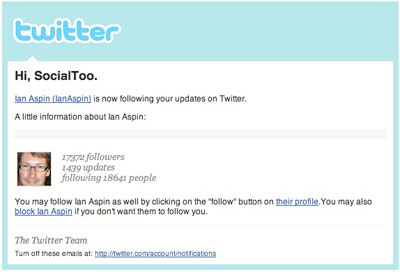
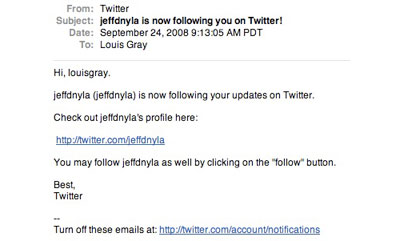
It would appear that Twitter has launched a brand new format for their new follower notification E-mails they send out to users opting to be alerted to new followers. The e-mails are now in a prettier HTML format and include the new follower's name, Twitter username, and picture. They also include the number of updates, number of people they follow, and number of followers they have. While users aren't given the option to follow straight from the e-mail, you can block the user by clicking on a link in the e-mail.

It would appear as though Twitter is now competing head-to-head to the recently sold business, Twimailer and another popular e-mail service, Topify.  Both services provide similar data, and, in addition, show recent Tweets and other related data to the user to help in deciding whether one should follow or not.  These service also do the same with DMs a user receives through Twitter.  It will be interesting to see if Twitter decides to venture further into this area or if these other services will still be able to thrive.


The New Look for Twitter E-mail Notifications

With the current lack of API for new follows on Twitter (besides these e-mails), it will remain hard for any service to scale to mass proportions for free and afford to add new servers to meet Twitter's API limit demands and simple load for communicating with the API.  This will become even harder as advertisers cut back more and more on spending for these types of applications.


The Old Look for Twitter E-mail Notifications

It was for this same reason that (full disclosure), my own service, SocialToo recently launched a new prioritized e-mail service that you can receive bulk updates of your new followers, as well as unfollowers, along with information about each one. We just announced a new pricing model that you can purchase these daily e-mails for a one-time $20 fee.  Such a model was necessary to pay for a scalable architecture, and you can likely expect the same from many other Twitter apps in the near future.

As Twitter grows, with no known roadmap or business model, developers and businesses should use caution that their businesses can scale and adapt as Twitter, or Facebook, or any other social network or API they are building on top of has the threat to venture into their territory.  There is no word from Twitter yet on these new changes.

Read more by Jesse Stay at Stay N' Alive.
May 6, 2009 · 3 MIN READ · BY LOUIS GRAY

Microsoft Live Search Employee Says Search Engine Analysis Flawed

Microsoft Live Search Employee Says Search Engine Analysis Flawed

On Tuesday evening, I attended a get-together with some of the minds behind Powerset, the $100 million natural language search engine acquisition slowly being integrated into Microsoft's Live Search engine. The goal? To keep the San Francisco startup natives feeling still connected to their roots, and not detached as part of the Redmond software monolith, while also giving interested tech reporters and bloggers an opportunity to see why Microsoft has any chance in the search market against its primary foe, Google. While I'll talk later about some of the statistics they offered, there was a conveyed perception that traditional reviews of search engines are flawed in their simplicity, in their context, and are not in depth enough to gain a clear knowledge of what's complex subject matter.

Discussed in detail on Senior Program Manager Mark Johnson's blog, Deliberate Ambiguity (See: "How *not* to rate a search engine"), the feeling is that reviewers commonly perform three queries before rating an engine "good" or "bad" - their own name, a hot topic of the day, and then something completely random. If the engine being tested doesn't match expectations, then it's off to the woodshed. (See: Cuil, Searchme, and other engines that have not been embraced for such examples)


Is Live Search Feeling Lucky? They Say Try It for a Week.

Instead of a simple Live Search vs. Google three query test, Mark recommended users try out Live Search for a full week, arguing that their own experiences would trump any simple demo. And as we discussed yesterday, one person's experience could be wildly different from another's, people primarily focus on the first search result, ignoring the bulk of the iceberg, and that it can be extremely difficult to infer intent and importance of results.

For example, as we discussed yesterday, assuming the working set of a search engine is Wikipedia, as Powerset's search engine prototype was, the web crawler will incorrectly determine that years associated with entries are of incredible importance, given how often they are referenced. As a result, rather than World War Two events rising to the top in importance, computers are more likely to trust results labeled '1944' or '1942' - so how do you teach computers to think like humans and correctly rate influence and importance? He adds, concluding his post, "this is rocket science."

At the quick meetup, questions around Microsoft's potential to dethrone Google were plentiful. We talked about how the once-mighty Alta Vista had once had a significant lead, and even after Google's debut, it held a corner in image search and language translation, before those too were eroded. Could Microsoft find a position that Google just doesn't do well? Could Microsoft start to be good enough such that if people tried to use Live Search for a full week, that Google would seem 'less good'? I even overheard a comment at the event that said in user groups, those surveyed preferred results that displayed a Google logo, even if the results shown were from Live Search.

The Google brand just means trusted search for many people, and even the Microsoft monolith is finding competition to be incredibly difficult. Google managed to find a market space that didn't need Microsoft, and could compete on its own revenue terms, without being frozen out by a competitor who could offer a parallel offer for free, a la Netscape. Even if Microsoft has built a better mousetrap, it is going to need to find a way to communicate that to users and deliver them a compelling reason to make a switch - and if Mark's words are to be believed, users and press aren't doing the needed research to help communicate their progress.