
Silicon Valley Technology Commentary & Archives · Est. 2006 3,031 Posts · 2006–2026

July 27, 2009

July 27, 2009 · 3 MIN READ · BY LOUIS GRAY

Locking Customers to Your Product? It’s Probably Not Good Then.

Locking Customers to Your Product? It’s Probably Not Good Then.

Although the world of business development partnerships can be complex, rife with epic contracts with tie-ins and promises, expirations and penalties for all parties, when relationships are struck that reduce customer choice, it is a telltale sign that the product or service being provided is well below acceptable standards. You see, customers aren’t stupid. They will be your product and company’s loudest advocates, more than willing to spread the word on your behalf, if you have a game-changing offering. But if you have to rely on bundling and exclusive contracts just to rope customers in, you probably don’t have something they want all that much anyway.

The recent flare-up of seething and complaining about the quality of AT&T, and the gnashing of teeth for Apple to shed itself of its telecom overlord partner handcuffs is only the latest example of business development contracts and exclusive rights being offered at the harm of customer choice. And any time you are forced to restrict choice, there’s obviously a reason you would – a very real threat that the alternative, your competition, is good enough to take your business away if it were to be played on an even field.

The dichotomy between how Apple’s products are much sought after and AT&T’s services are much loathed could not be more clear. Although I have yet to find a consistent voice of people who enjoy their long distance provider, AT&T’s failings are well-documented, from its frequent shoddy service, to its bungling of feature rollouts, failure to provision for peak loads, and general malfeasance. Meanwhile, in contrast, Apple’s product introductions may have fans sleeping outside their retail stores for days on end, just to say they did.

There’s a reason it’s called lock-in. Because customers are trapped. And being trapped is never a good thing.

Remember the brouhaha only a decade or so ago about how Microsoft manipulated its monopoly position, forcing OEM partners to carry its Internet Explorer browser as the default, over the largely-deemed superior Netscape Navigator? At a time when very few would have selected IE as the technology leader or feature leader, it became the market leader through brute force, trickery and customer handcuffs.

When businesses have a high-quality product, they don’t fear competition the way the mediocre guys do, but instead, compete on their merits. But when threatened, that’s when you can expect the ridiculous contracts to fly – from automated renewals and multi-year contracts, to early exit penalties. And when exclusivity is not threatened, but is instead encouraged, that is when you see a relaxed approach to improvements, and of course, a scale in prices. It’s the very reason there are anti-trust laws and precedents set to stop monopolies in their tracks.

It is one thing to compete through innovation, and quite another to compete through bundling and exclusivity. And even though Apple largely is seen as the better of the two players here, recent developments in Cupertino have us wondering if they too are becoming protective of their accrued market position. One only has to look so far as their recent quashing of Google Voice, their forcing of Google Latitude to be a broken-down Web application, and rumors are now flying that the Spotify application will also face a steep task to make it onto the iPhone, as it potentially competes against iTunes.

I don’t want to sound like a hippy-dippy free markets advocate. But if customers don’t like your product, the last thing you really want them doing is sticking around and bad-mouthing you to everyone they know. If you want to compete in the market, you should not be afraid to let your products win on their merits, on their price, and on their differentiation. If you have to instead do a backroom deal that makes you the default, and there are no other options, maybe you’ve got a lot more work to do in the R&D space instead of in BD.

July 27, 2009 · 3 MIN READ · BY LOUIS GRAY

CrunchPad or Apple Tablet? Why I’m Leaning CrunchPad…

CrunchPad or Apple Tablet? Why I’m Leaning CrunchPad…

Something odd must be in Silicon Valley’s drinking water these days. Not only did I tell you two months ago that I didn’t care what operating system you used, and not only am I typing this on the work-issued Dell laptop, but when thinking about the potential release of Apple’s long-rumored iTouch tablet, I’m not yet saving up my greenbacks and lining up at my nearest Apple Store. In fact, despite the almost equal lack of information, I just might be more likely to buy a CrunchPad, despite its not having Steve Jobs’ official seal of approval.
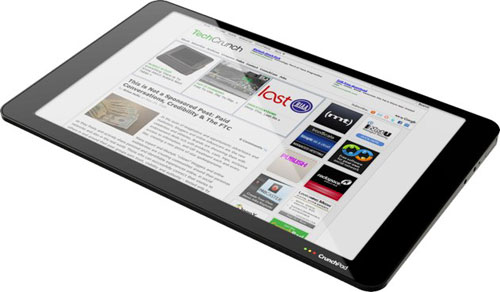
First of all, in order to purchase a tablet PC (or tablet Mac), I would need to find a use case for it. At times, in fact, the entire tablet market at times seems more of a solution in pursuit of a problem. With my iPhone being such an amazing device, getting me my phone calls, e-mail and mobile Web on the go, and my laptop running all my needed apps, making room for a third “in between” device seems a bit over the top.

That Apple has finally turned the corner on getting its tablet out the door, having met the demanding eye of Jobs, is very interesting. I can see benefits of going with an Apple machine immediately of having the standard Apple look and feel, industrial design, and synchronization of my data, including with the iPhone and iTunes. That’s all good stuff. But I also believe that it would be more expensive than the CrunchPad, which is rumored to be about $200-$300 less per unit, and the early concepts making it look like a giant iPod Touch make it seem as fragile as a china plate. If you thought you got scratches on your iPhone now, or you thought there was an uproar when the G4 Cube got cracks, just wait until your iTouch Grande gets split like a windshield nailed with a rock on the freeway.

So what of the CrunchPad? First of all, its industrial design mockups are equal to, if not better, than the ones I have seen allegedly from Apple so far. The CrunchPad also promises to be lower cost, and forces a new paradigm of being 100% a Web device. Yes, that sounds odd, to praise a machine for effectively limiting what I can do with it. But through those limitations, it makes us think differently (like Apple did) about how we use our electronics gadgets and consume the Web. And it has a side benefit of being from somebody I consider a peer, who is stepping outside of his comfort zone and taking a risk.

Betting on the CrunchPad is a bet for the small upstart challenger, in the same way that betting on Apple once was against Microsoft. And the CrunchPad doesn’t look like it’s going to shatter on impact.

If it’s very simple to use, I could see this low-cost Web-only device (or at least its third version) quite possibly being the first computer for my twins, who may not ever need the suites from Adobe and Microsoft like I have my entire computer-using tenure. A bet on the CrunchPad rewards the idea that bloggers can grow from simply reporting on the news to making the news. Yes, I recognize that Mike Arrington and TechCrunch are already among the most well-known blog networks out there, and have to be considered a success on their own as is, not suffering for dollars, but can you imagine bumping into the guy at a meetup in the Valley, holding the tablet from Apple when his CrunchPad offers the same specs for half the price?

While much has yet to be revealed about both devices, we just might be on the verge of seeing a market-changing event, where there are multiple serious alternatives both arriving at the same time, ostensibly for different buyers. It is quite possible that even if the CrunchPad is a superior, less expensive device, that Apple’s marketing could eat it alive. It’s also quite possible that both could fall short of expectations, or that by choosing one or the other, I could be left with a short-termed albatross. But if I can find a great reason to get a tablet, and both deliver to the specs I’ve seen today, we’re going to be saving a few hundred bucks and buying a CrunchPad. Let my iPhone be my phone and my Mac be my real computer experience, but for this new space, I’m looking for something really new.

July 26, 2009

July 26, 2009 · 1 MIN READ · BY LOUIS GRAY

Appsfire Wants to Make Sharing Your iPhone Apps Social

Appsfire Wants to Make Sharing Your iPhone Apps Social

With tens of thousands of different iPhone applications out there, it's doubtful that many iPhones have the same array of programs. Each time I see a friend page through their loaded iPhone apps, I discover new ones I had never heard of, and they too find surprises from what I have loaded. Appsfire, a new service from Ouriel Ohayon, creator of Topify, lets you share your favorite iPhone apps on the Web, making the iTunes App Store more social.
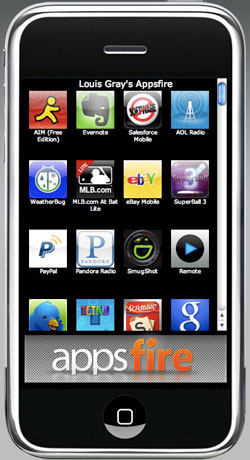
The service, currently available for Mac OS X clients, with a Windows version planned to debut soon, scans your iTunes library for installed applications, presents them on the Web in a faux iPhone interface, and encourages you to share your library with friends by way of social networks, including Twitter and Facebook.

The purpose? Helping solve the discovery of relevant applications - a process Ouriel says is "ignoring".

The service is in closed alpha now, but we have 50 invites available, first come, first serve to Mac OS X users. http://bit.ly/appsfireLG

You can see some example Appsfire libraries here:Each icon from the virtual iPhone is clickable to the iTunes application store. Lest you think this is a solely charitable effort, you can safely assume that Ouriel will be gaining a piece of any potential purchases, through affiliate links. If this takes off, it could be a great way to not only share new apps with friends, but a good way to send Ouriel a little bit of cash.

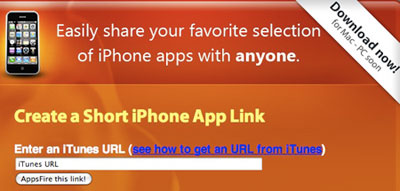
Also part of Appsfire? A new link shortener for iPhone developers and bloggers, who all know the usual links to the iTunes Store are a complete pain. You can find that here.


An intro to the service can also be found on YouTube.
July 26, 2009 · 6 MIN READ · BY LOUIS GRAY

10 People To Follow On FriendFeed For The Month Of July 2009

10 People To Follow On FriendFeed For The Month Of July 2009

By Mike Fruchter of MichaelFruchter.com (Twitter/FriendFeed)

This is the eleventh edition of the monthly FriendFeed to follow member list. Louis Gray has done a superb job covering for me for the past three months, and has kept the tradition alive. That's one of the reasons I naturally invited Louis to partner with me on it many months ago, and to keep the list going on his blog instead of mine. While I have been a FriendFeed evangelist since the day I joined, Louis is an even a bigger one. This list is intended for new members of FriendFeed as well as veterans, as a guideline to follow unique and contributing members of the FriendFeed community. It's these people and the ones previously highlighted that you can find below who truly make FriendFeed what it is, a vibrant social community.

Previous FriendFeed members to follow lists can be found for the 2008 months of, July, September, November and December. You can find the 2009 follow lists for the months of, January, February, March, April, May, June.

1) Amani

Short Bio: Amani is currently the Director of Sales & Marketing at Marina del Rey Marriott in Marina del Rey, California. With over 12 years of hands on experience and industry expertise in hospitality, sales, marketing, e-commerce, web 2.0, blogging, micro-blogging, technology and social media, he can propel any company to the next level. He is currently seeking a Director of Social Media/Online Community Manager role, any companies hiring?
FriendFeed: Subscribe | What they like | What they comment on | Blog

2) Bruce Lewis

Short Bio: Bruce is a Boston resident and software developer. He has been playing with code since his MIT days going back to 1997, possible earlier, but thats all I could track down in research. He is also the creator of the hybrid blogging/photo-sharing site OurDoings.com, a site I gave a glowing review to back in January. Bruce will be speaking about OurDoings at the upcoming Boston Lisp Meeting on July 27, 2009.

FriendFeed: Subscribe | What they like | What they comment on | Blog

3) Jason Pollock

Short Bio: Jason is a filmmaker, writer, and activist who currently lives in my old hometown of Brooklyn, NY. I first came across Jason on Twitter or FriendFeed, and shortly thereafter discovered his story. Jason is the definition of grass roots marketing, he is using Twitter to spread awareness about his current film The Youngest Candidate with the hopes of getting the film picked up and distributed, something I'm confident will happen any day now. He is a key influencer on Twitter with close to 60,000 followers. He also adds a significant amount of value on Twitter by re-tweeting informative and resourceful links. Jason extends himself to quite a few social platforms, but always makes time for Friendfeed.

FriendFeed: Subscribe | What they like | What they comment on | Blog

4) Jeff Douglass

Short Bio: Jeff is a Washington DC resident, who I believe spends quite a bit of time in Japan for work. I assume ths based on his feed. Jeff is a unique FriendFeeder, although a mysterious one as I could not locate hardly any bio info on him. Jeff would make a great double agent, he could already be working for the CIA and we just don't know it. All kidding aside, I have been following Jeff on FriendFeed I believe since I have been a member. He always shares interesting and useful content. I particularliy like the photos of the Japanese food he takes when in Japan. Who doesn't love Sushi?

FriendFeed: Subscribe | What they like | What they comment on | Blog (NA)

5) Jeff Henderson

Short Bio: Jeff is a Sr. Mechanical Engineer at KLA-Tencor who resides in San Jose, California. Jeff is also a semi-professional photographer. His feed is one that never gets boring. Where else on FriendFeed could you find a Matchstick Oil Rig? Jeff has some fantastic photographs on his blog linked below, but I would like to start seeing them shared more on FriendFeed!

FriendFeed: Subscribe | What they like | What they comment on | Blog

6) Michael Hocter

Short Bio: Michael is VP of Application Development at Countrywide Financial Corp in Los Angeles, California. I have been following Michael ever since I joined FriendFeed. Just like Jeff mentioned above, Michael is an avid photographer, he takes black and white photography to a new level. I think that if he could make money from it, it would be his first profession. Michael and his wife are also expecting a baby boy in November, congrats! We cant wait to start seeing baby pics on FriendFeed.

FriendFeed:Subscribe | What they like | What they comment on | Blog


7) Owen Greaves

Short Bio
: Owen runs his own company, Owen Greaves Consulting. He resides in British Columbia, Canada. Owen has a passion for technology and uses it to his advantage when consulting with clients. With over 15 years in management and technology consulting, Mr. Greaves is an I.T. professional who is a jack of all trades. He blogs about technology and social media and its impact on businesses. He is passionate about what he does, something I admire and respect.

FriendFeed:Subscribe | What they like | What they comment on | Blog

8) LAG

Short Bio: LAG aka Lawrence ("Larry") Green is the Corporate Web Director at Landor Associates in San Francisco, California. LAG is a web developer and writer, he is also a jack of all trades when it comes to web development and web marketing. Creativity is LAG's middle name, the clients at Landor are privileged to have this guy working on their creative and digital strategies.

FriendFeed: Subscribe | What they like | What they comment on | Blog

9) Madhav Tripathi

Short Bio: Madhav is a college student residing in Ahmedabad, India. He also blogs about technology and social media at techshali.com. I don't know that Madhav ever sleeps, because as soon as I share content into FriendFeed, he is usually the first to like it. He has become a great filter to finding informative content on Friendfeed. He hasn't been blogging long, but he is consistent, and has the drive to blog every day, that's to be respected. I expect him for him to be a top tech blogger in India someday, keep with it!

FriendFeed: Subscribe | What they like | What they comment on | Blog

10) Wayne Sutton

Short Bio: Wayne is a social media rock star. The definition of social media in the dictionary is Wayne Sutton. Wayne is an active blogger, podcaster, and overall technology evangelist. Wayne has a respected following on all the social media networks, including Twitter with close to 27,000 followers. Wayne spends a tremendous amount of time involved with social media and community building. He attends numerous Tweet-ups and he blogs daily about new social media applications, and hosts a weekly podcast show with his partner in crime Kipp Bodnar. If you are not following Wayne, you are missing a lot, that I can guarantee.

FriendFeed:Subscribe | What they like | What they comment on | Blog

Read more by Mike Fruchter at MichaelFruchter.com.