

Monday's news that
Facebook had acquired
FriendFeed for an undisclosed sum took many people by surprise, not the least of whom were the site's most-active users, many of whom have made the social sharing and aggregation platform their central nervous system for online activity and community. Initial reactions to the announcement had many people asking questions, extremely concerned that the site - as we know it - was doomed to close, and a lack of immediate denials from the company's leadership was seen by many as an implicit acceptance that yes, the end was near. But in the days following, from what I've seen and heard, it is clear to me that FriendFeed is not going away, that the company's being part of Facebook isn't the end of the world, and that after nearly two years of going it alone, the time had come to make a change.
Since the site launched in beta
in October of 2007, and
opened up in February of 2008 to the world, FriendFeed has become known for many things. The company's sharp engineers have promoted the site to be at the forefront of innovation on the real-time Web, showcasing advanced search functionality, information discovery and an active, loyal, community. But with the site's wide array of features came a not to be unexpected downside - complexity, which had many wondering how it could attract a user base on the scale of less sophisticated but more popular competitors, like
Twitter and Facebook. While even as recently as January, we saw the company's leadership advising us that
growth "takes time", this week's move was a clear recognition that in order for FriendFeed to achieve its vision, it needed to team up with a bigger partner - one that had been courting them for years - and it was Facebook who filled the dance card.
FriendFeed Was Always PursuedNot too long after FriendFeed launched, Facebook called, as did many other companies over time. And while Facebook is known by many as a closed walled garden, where you find yourself reconnecting to people long since forgotten, in sharp contrast with FriendFeed's open nature where you connect to people you've just met, the two companies, through conversations over the last two years, found that they shared a common vision and direction. While the company's dozen or so employees could have kept saying no, stubbornly going it alone, they came to realize that teaming with Facebook made the most sense - giving them an opportunity to take the vision they had and push it within a company that had users in the hundreds of millions, not the hundreds of thousands, which would have been practically impossible given their slow growth rates and other companies' encroaching on their feature set.
More Than Just a Talent GrabFollowing news of the acquisition, some have labeled the buy as a "talent grab", with Facebook looking to gain a dozen or so respected engineers. But it was not a talent grab just for the sake of getting good people, but instead, getting good people who were focused on the exact things Facebook needed - including real-time search, aggregation, community, and social messaging. And while it's not exactly clear what the two companies have in mind over the next six, twelve or twenty-four months, as a combined team, the first steps don't involve blowing up the existing community, which should come as a relief to many who thought that was imminent. FriendFeed's leadership has expressed the desire to not only keep the site open and active, but to preserve all the data that has been posted. In fact, just in the last few days, FriendFeed saw the addition of new features, including customizable backgrounds, and small UI enhancements around comments.
Some of the reticence for FriendFeed to loudly proclaim the site and its users' data is safe has come down to the fact that in a sale like this, the acquired company won't always have full say over the future roadmap. Just take a look at any number of recent acquisitions by
Yahoo! and
Google to see how that has evolved. But the company will soon start to talk about the future of the site, and these announcements will hopefully assuage some of the concerns and fears voiced by many FriendFeed users, who either despise the idea of Facebook, or just expect to be deleted.
So What Happens Next?The truth is that not even the FriendFeed team has a perfect roadmap in front of them, saying what is next, as part of Facebook. And that has got them nervous too, of course. It took a long time for them talking with Facebook to become comfortable with the idea of an acquisition, and the same gut-level reaction many FriendFeed users had to the news, myself included, was shared at the company's Mountain View headquarters, and their families, or at least it was until they moved out by the end of the week. Their long-discussed plans of developing a unique engineering team and environment at FriendFeed, and about "not being for sale", as we often heard when they were asked, were up-ended, as reality set in, with them turning off their computers, packing up boxes and moving into Facebook headquarters in Palo Alto.
Incredibly, even as many declared the site dead, or swore they were leaving FriendFeed forever, on the news, this past week has seen a renewed spike in terms of new signups and user activity. As the Facebook and FriendFeed news flowed through the Web and got mentioned on the radio or TV broadcasts, user mailboxes have been pummeled with a wave of new connections. And it practically goes without saying that the people who have left FriendFeed due to the announcement are not any more than the number that would have left had FriendFeed needed to dramatically change its focus to finally get that hockey-stick user growth seen by networks like Twitter and Facebook, just like there was a wave of people who left the network when they revamped their user interface this spring to make real-time the default view.
In February 2008, in an e-mail exchange I had with Bret Taylor and Paul Buchheit, two of FriendFeed's cofounders and the public faces of the network, I was eager to let them know a high-profile user had signed up. Paul responded, simply: "One down, 6,652,865,239 to go :)" keeping with his belief that FriendFeed was for everyone, not just the relatively small number of users who made the site their home on the Web. As many of the employees at FriendFeed hail from Google, it's not unlikely they see Facebook's current position as they did Google at an earlier age - having both significant momentum and share, but also much more room for growth, letting them bring FriendFeed a lot closer to that elusive 6,652,865,239 user number.
As the Dust Settles...In the last two years, I have optimized my online activity for FriendFeed. I have used FriendFeed as my information filter and distribution channel, as it both takes in my activity around the Web, but spits out a subset to Twitter and Facebook. While I don't know if all this information will be on friendfeed.com per se for the rest of eternity, I am confident in saying that all my existing links, data, photos, and files are secure. I believe that the vast majority of things that have attracted FriendFeed's users to participating on the community will start to show up in Facebook as well - if not taking over the site, but being shown in different areas of the network. And while over the years, Facebook has gained a not-so-spotless reputation on the Web for being closed (among other things) partnering with FriendFeed could have a major impact on the company's ability to adjust on the fly and keep growing.
For those people who are very concerned about their data and preserving what they have invested into the site, activity on FriendFeed, like Twitter, is centralized, and therefore, there is not yet a perfect solution to extracting the data and moving it elsewhere. But
a new project called CloneFeed is looking to help, and FriendFeed's founders have always trended toward standards and openness. Meanwhile, if you expected them to stop using the site, they haven't. After a few busy days following a practically sleepless weekend prior to the deal's completion, the founders have started posting again. They're not going away, and neither are we. Hopefully, they will talk a lot more about what the acquisition means - as much as they are able - soon. But for now, I'm going to keep using FriendFeed, while also expanding my use of Facebook (just in case), and would welcome that you do also - for now, the little company that could just got some tremendous financial backing and a huge endorsement from one of the leaders on the Web who is growing faster than anyone else.
As always, you can find me at
http://www.friendfeed.com/louisgray, or on Facebook at
http://www.facebook.com/louisgray.
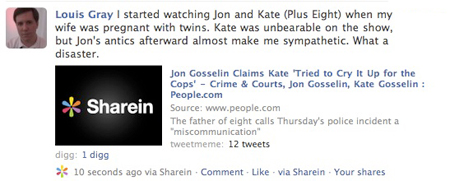
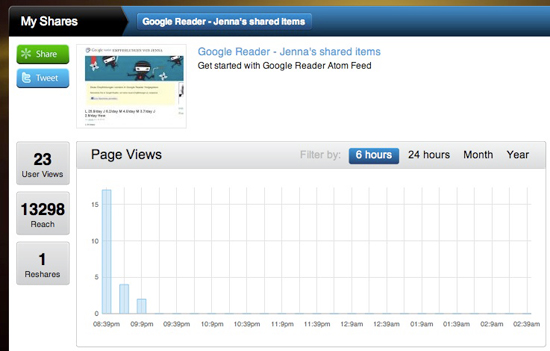
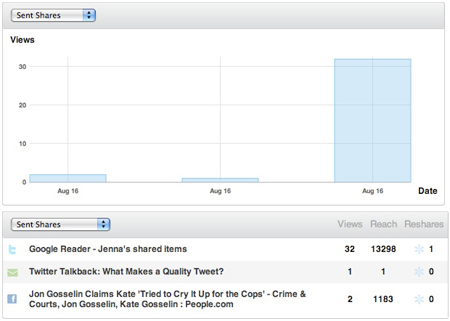
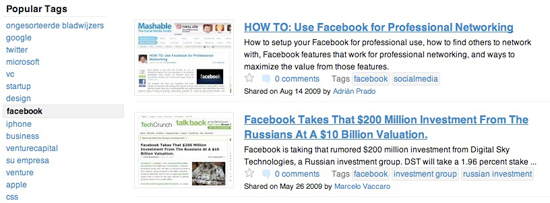
 You can hardly walk through a few pages on the Web these days without bumping into some variety of URL shortener, sharing bookmarklet, or aggregation site that tries to show the most popular data. Bit.ly has become the shortener of choice for Twitter, with StumbleUpon and Digg having their own offerings in sharebar land. A lesser-known alternative is Sharein.com, which launched a while back, and hasn't had a whole lot of pickup, so far as I can tell. But in looking at the service, I see that ShareIn.com combines the information I've always liked about bit.ly, including statistics, with benefits I've liked on other sites, including individual user history and total share popularity across the network.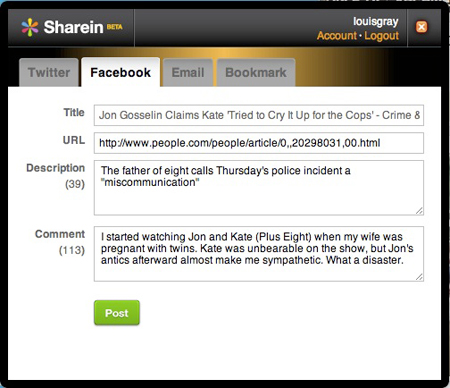
 For many people using
 My favorite RSS feed reader and jumping off point for information discovery and sharing,