Silicon Valley Technology Commentary & Archives · Est. 2006 3,031 Posts · 2006–2026

October 17, 2009

October 17, 2009 · 2 MIN READ · BY LOUIS GRAY

At 5:04 P.M. On October 17, 1989, The Earth Moved

At 5:04 P.M. On October 17, 1989, The Earth Moved

20 years ago today, a 6.9 magnitude earthquake hit the San Francisco Bay Area, taking 63 lives, postponing the World Series featuring the San Francisco Giants and the Oakland A's, and putting the entire region into disarray. Over time, the community rebuilt itself, and the entire Bay Area continued to produce world-leading technology in Silicon Valley and training top students at Stanford, UC Berkeley and other area schools, helping to accelerate the digital age we live in now.

Nobody knows when the next big earthquake will happen, but practically everyone believes that we're due. Last year, I wondered aloud how the world might react to an earthquake that hit the Valley, perceived to be full of upper-class egocentric folks, not the more sympathetic low-income victims hit by natural disasters around the world. But there's no doubt that if there were a disaster to hit the Bay Area, again the region would need help.

Everybody in the area has their own story. "Where were you when the earthquake hit?"

At the time of the earthquake, I was only 12 years old, and on my way to soccer practice. I lived in Northern California, but far away from the damage of the quake. An A's fan, I had looked forward to seeing the 3rd game of the World Series, but soccer practice had been on the calendar, so off I went.

On the way to practice, the only bumps and shakes we felt were the result of the coach's rickety van going down the semi-paved roads. We didn't know about the quake, and practice was set to start at 5.

Midway through the practice, as we were scrimmaging, one of the other kid's moms pulled up and said there had been a massive earthquake in San Francisco, saying that anybody who had family or friends in San Francisco could come with her, and she would take them home. The rest of the scrimmage, as we listlessly kicked the ball, our thoughts were somewhere else.

At the end of the practice, we went home and watched the news roll in on the TV, and we learned more over the next hours and days. The Bay Bridge had collapsed. The Marina was on fire. The World Series was being postponed. Everything had stopped. The ensuing days were full of statistics and stories of individual heroism. The community rallied together and rebuilt.

Eventually, the A's came back and won the World Series. They swept. It's the last time they won, so it's been 20 years for that too. And even though it has been twenty years, I always remember the day of the big quake. October 17th, 1989. I remember the time. 5:04 p.m. If you were in the Bay Area, what was your story? What do you remember?

October 17, 2009 · 2 MIN READ · BY LOUIS GRAY

Gary Burd Exits Facebook Two Months After FriendFeed Acquisition

Gary Burd Exits Facebook Two Months After FriendFeed Acquisition


Following the August acquisition of FriendFeed by Facebook, the site's loyal users are still waiting for news about whether the social network and aggregator has a future, or barring that, when elements of the site will start populating Facebook. But for the most part, there has been little news, and some are pointing to reduced traffic and engagement there as signs the product will just fade away - even as I hear rumors that's not the case. But this week, we learned of the first high-profile defection from the FriendFeed ranks at Facebook, as highly-respected engineer Gary Burd, who also counts Google and Microsoft on his resume, quit the social networking giant this Wednesday.


Burd, who helped develop the Trident HTML rendering engine, a main ingredient in Microsoft's Internet Explorer 4, during his seven years at the Redmond monolith, and also contributed to Google projects including Google Talk during his four-year stint in Mountain View, joined FriendFeed in June of 2008 after he had independently developed a service that let users update the site via e-mail, called Mail2FF. Following his hire, the company rebranded it as "FriendFeed by e-mail" and made it an official feature of the service.

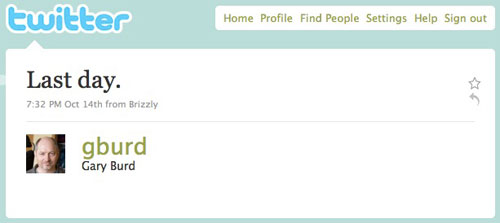
After seeing a tweet by Gary that said simply, "Last day.", Gary wrote me to confirm he had left Facebook, because he does not enjoy telecommuting. He lives in the Seattle, Washington area, and will be looking for projects locally, after telecommuting with FriendFeed for nearly a year and a half. Not coincidentally, Gary also posted a tweet that read "Last Day!" when leaving Google in March of 2008. (By the way, don't read too much into his tweet mentioning a new MySpace profile, assuming he'll go there next.)

During his time at FriendFeed, Gary worked on projects including the service's real-time API, a dedicated IM client, the Simple Update Protocol (SUP) and most notably, real-time search by topic, a fix for the much-desired Twitter tool, Track.

Gary's track record should no doubt make him an extremely valuable recruit for companies in the Seattle area, and his leaving is absolutely Facebook's loss. While not as visible a defection as if any of FriendFeed's cofounders opted out of Facebook, it does tend to raise more questions in a time when many people are still looking for answers.
October 17, 2009 · 3 MIN READ · BY LOUIS GRAY

Proposed Salmon Protocol Aims To Unify Conversations on the Web

Proposed Salmon Protocol Aims To Unify Conversations on the Web


As comments on the Web become fragmented, conversations that occur on downstream aggregation sites often are taking place in a silo, disjointed from parallel discussions on the originating Web site. Over the last two years, many people have found this evolution controversial, hoping to unify the conversations in a central location - and some services, including JS-Kit's Echo and Disqus, have taken the first step by pulling external discussions to the source. But a brand new proposal, authored by John Panzer of Blogger, called the Salmon Protocol, is looking to take advantage of Pubsubhubbub to unify the conversations in all places, both upstream and downstream. And yes... the name of Salmon comes because those fish manage to swim upstream, just like the comments.


An Initial Presentation on the Salmon Protocol

As discussed in Friday's panel at Blog World Expo on technology and the real-time Web, Pubsubhubbub essentially works as a middle-man conduit, taking information from a data's source passing along changed data to downstream destination sites. The proposed Salmon Protocol would similarly watch both source and destination sites for comments, and upon discovering new comments, it would send the new comments to the site which is lacking the full conversation. If multiple downstream destinations are designated, the Salmon Protocol will also populate these multiple sites.

In conjunction with Pubsubhubbub, the Salmon Protocol leverages the newest iteration of webfinger, enabling publishers to receive comments and verify subscribers - as a form of true identity recognition, similar to how both Disqus and JS-Kit have you register for individual accounts with either service. An additional side benefit to leveraging Webfinger would be to dramatically reduce the potential for spam, assuming each individual has a unique ID.

The debate over fractured conversations has risen and fallen over the last two years. In September, I essentially said I was done listening to people complain about the issue after hearing complaints regarding Google SideWiki - as I believe people will want to have conversations where they are comfortable, and that they shouldn't be forced to come back to a single source. This is a point I have been hammering since the first major flareup back in April of 2008. (See: Should Fractured Feed Reader Comments Raise Blog Owners' Ire?)

Many people believe that transporting comments from one site to another and making the conversations one could cause confusion, or even make potential commenters uncomfortable. With this in mind, John has suggested that users "be made aware of the publishing scope of the comments they leave," adding "For some aggregators, this may be implied (all data is public), for others a warning or a checkbox may be necessary." (See: Salmon Protocol (Draft) Protocol Summary)


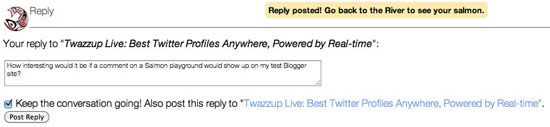
A Test Comment from the Aggregator Via Salmon


The Resulting Comment Back On the Blog Via Salmon

There is a test playground for the Salmon Protocol, and I can verify that it already works. If you want to test it, one option is to take a testbed Blogger account and point the Salmon Protocol your way. It occurs automatically, and comments that happen on the downstream aggregator will make it back to the blog immediately, thanks to Pubsubhubbub. Now, the quest becomes to turn this brand-new protocol into a new standard - one that could pose a serious challenge to services like JS-Kit Echo and Disqus, even including threaded replies. If done well, the long debate over unified conversations could soon be over.

Learn more at: http://www.salmon-protocol.org/.

October 16, 2009

October 16, 2009 · 3 MIN READ · BY LOUIS GRAY

The Blog's Place In A World of Microblogging: Not Dead Yet!

The Blog's Place In A World of Microblogging: Not Dead Yet!

Even as the microblogging space seems to be white hot these days, the world of longer-form blogging is still seeing impressive growth, with all major blogging platforms showing greater than 20 to 40 percent growth year over year, and record users, blogs and total readers, according to Compete.com data and a presentation from Google's Rick Klau, product manager for Blogger, who spoke at Blog World Expo this afternoon. Rick reported that his platform, Blogger, which I use, is now seeing nearly 300,000 words per minute, scaling to 417 million words per month, from more than 10 million content creators.

Yet, despite this high usage, many have challenged the platform, saying "blogging is dead". There are more than 360,000 results on Google saying that "blogging is dead", with many high profile articles saying that disparate social networks like Facebook, FriendFeed and Twitter should be where people's attention are. But Rick said that the rise of microblogging didn't necessarily come at the expense of traditional blogging. In fact, he said these third party sites actually served to drive even more attention and traffic to the core blog content.

"Microblogs are complementary, not competitive," Rick said. "It is a driver of attention and engagement back to the blog."

For Rick, who has run his own personal blog (at tins.rklau.com) and has been active since 2001, he reported that Twitter has become the highest traffic generator for his site outside of search, and in that list, so also are Facebook and FriendFeed. He suggested rather than trying to fight against the flow on microblogging, to embrace it, and make sure your content is available to these disparate networks, while remembering to engage where it lands.

"The blog tends to be visited by people interested in what you are saying, and the people on Twitter and Facebook are interested in you, and by proxy, what you are saying," he said. "I happen to believe that based on what I have seen with my blog for eight years, people are comfortable communicating in the environment they have chosen. If I force the conversation back to the blog, I will lose the audience who have the eagerness to engage, comfortable where they live."

Rick suggested that if you are a Facebook user, to pull your blog content into Facebook, making it available to this new audience, who may leave comments much different than those which are native to your site. He also recommended that you utilize tools like bit.ly to track statistics and click-throughs to your site from those links you send through Twitter, to help you understand how much the microblogs are impacting your own blog.

Given his background at Google, Rick made it clear that the company's data-driven nature forced decisions, and the company continues to see serious growth in traditional blogs.

"There are very few questions that get asked at Google when I don't have the data to back up an answer," Rick said. "You don't get many opportunities to say "I feel" or "it seems" at Google."

But in his experience, Rick suggested that bloggers not get locked into writing posts for specific statistics, including page views. He said that as you are a multi-faceted person, you should be confident writing about more than just one thing, so one should feel comfortable covering more than just the single topic.

"Don't become a slave to the focus of your blog at the expense of having fun.You can be passionate about a wide variety of subjects," he added.

Blogging and micro-blogging are not a zero-sum game, but can be complimentary. Sending blog content to downstream networks makes that content available to those connections who are more comfortable in their own environment. As I have mentioned many times, your blog is your brand - which Rick echoed by saying that on your blog, you control every pixel, and therefore, the end user experience.

Bloggers need to adapt to the new world, but aren't antiquated in this new world. It makes sense to participate wherever the content lands and wherever your readers are, without pushing to centralize the conversation on your site, but there is no substitute for long-form conversations and being passionate. Rick communicated a simple formula: "Content + Passion + Engagement". And that will make the blog go, even in a world of change.