Guest Post by Chris Saad (@chrissaad | Blog)Vice President, Strategy, EchoI like
the Synaptic Web because it's different. Unlike other projects or initiatives I've been involved with, the Synaptic Web is not an open standard, advocacy group or business. It is not even something
Khris Loux,
Eric Blantz or I invented. It is not even something we are advocating for or developing. It is simply something we observed and wrote down.
We wrote it down because we needed a framework from which to design, develop and refine our own product. We then shared it at SynapticWeb.org because others seemed interested in learning more about it. Since then we have continued to refine it and collect examples of other people taking our observations and expanding upon them. We hope this post is just another step in continuing the discussion here in the comments, and across the Web.
The Synaptic Web is not new. It is not a recent trend. It is something that started before the advent of HTTP and HTML gave birth to the actual Web and will continue long after the boom of 'real-time' fades away. It is a simple observation that the most interesting aspect of the Internet generally and the Web specifically is not the nodes on the network, but the type, density and flexibility of the connection between them.
We use the metaphor of the Synapse (the connection between brain cells) as a way to try to relate this idea to the real world - a literal mental model if you will, and over the years, we've observed these connections have morphed in surprising ways. Nodes have atomized (i.e. nodes are now more granular and there are more of them) and the nature of the connections are changing at an accelerating rate.
This new-found density of nodes and the rapidly changing nature of the connections between them has made the SynapticWeb easier to observe and document, not to mention more important to pay attention to.
What are the nodes?Nodes used to be computers on the network. They then expanded to include documents on the web. Then pieces of content became nodes in their own right and now, even pieces of data - people, places, photos, videos, status updates, geo data - can be considered self contained single units.
Every single one of these things now has a canonical URI allowing us to uniquely reference them and to connect them together in new and novel ways.
What are the connections?Connections used to be TCP/IP connections between computers. They then expanded to include hyperlinks between pages, then 'friendships' between people and now include real-time streams between all sorts of objects. Soon the implicit inferences made from those streams will increasingly become visible and viable connections in their own right.
Synaptic WebOur premise is that while most have observed the changes in the nodes, the more interesting opportunity for innovation is to observe the change in the connections and how those changes might produce new user experiences.
In the age of social media, we asked ourselves 'what objects can become more social'. The result was vertical social networks that focused on these social objects. Obvious examples include
Flickr for photos,
YouTube for video,
MySpace for Music and
Facebook for Friends.
The fact of the matter, though, is that being social is only one kind of connection. An interesting and important one, but not the only one.
Links between 'social objects' and people are fantastic but what about the connection between you and your interests, your interests and products, products and ratings, ratings and pricing, pricing and quality, quality and availability?
These type of connections used to be made in private, carefully curated databases. In some cases there were algorithms placed on top to try to make rudimentary recommendations but the connections rarely spanned these closed systems much less allowed for curation at 'Internet Scale'. The connections were too brittle, controlled and insular.
Now, with an abundance of real-time gesture data, the growing trend to map everything to a URI, the availability of semantic technologies, the game like crowd-sourcing of tags and more, these connections are becoming far more rich and interesting.
An example of a great Synaptic application is
Microsoft Photosynth.
Its predecessor,
Quicktime VR, allowed one user to create a single continuous photo and then allowed viewers to scroll across that image like being inside a kind of 3D sphere.
Instead, Photosynth allows hundreds of people with thousands of photos (atomized nodes) to, acting independently, automatically generate a 3D mesh of the scene they were capturing. The connections between the photos are totally organic. The authors had no idea about this potential application when taking the photo, the photos were not arranged in a special way and the 3D mesh on which they are placed was totally generated by connecting previously disconnected nodes together and looking for the patterns.
Another very visual example is Augmented Reality. Where once we might have looked at the Yellow Pages, which only connected two types of data (zip code + business type) to create a static list of directory entries. Instead, the latest Augmented Reality app can take Location, Orientation, Directory information, Personal Interests and Business Type to layer meta data on the real world through a camera lense (typically a mobile phone).
As you can see by these two examples, just by adding just a few more nodes to the equation, and connecting those nodes more organically, the result is a dramatically different experience.
These are very real, and very current, examples of the synaptic density of the web becoming far more complex and powerful.
Real-time is perhaps the hyped aspect of the Synaptic Web. To me, the 'real-time web' is analogous to Synapsis firing in the brain. The rate, route and repetition of real-time data between nodes (usually people) has introduced countless new user experiences and content discovery opportunities.
Obviously Real-time is is just one way that connections between our nodes are changing and we have yet to scratch the surface on the possibilities.
What's NextThe goal of this post is simply to introduce the idea of the Synaptic Web and highlight the value of paying attention to the connections between nodes. There are countless ways in which this thinking might impact product design, user behavior and business models so it would be impossible to provide exhaustive coverage in one piece.
I encourage you to read the SynapticWeb strawman and continue the conversation in the comments, on your own posts, at conferences and in your own products. Who knows where it might take us!
ConclusionSo in summary, the Synaptic Web is not something that necessarily needs our support or conscious development - it is happening with or without us. It has been happening for a long time and its continuation is inevitable.
People might refer to it as different things, they might focus on various smaller aspects of the broader theme, but in the end the notion is the same - it is the connection between the nodes - and the way they are becoming more dense, more flexible, more implicit, more visible and more open - that is truly exciting and will continue to make an impact on people's lives through the Web.
I can't wait to see where it goes next.
Learn more about other people's take or to contribute to this theme please check out
SynapticWeb.org. You can find Chris Saad at his blog,
Paying Attention, and
on Twitter. Chris is also
Vice President, Strategy at Echo.
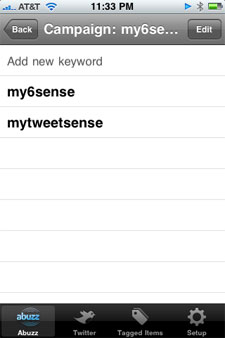
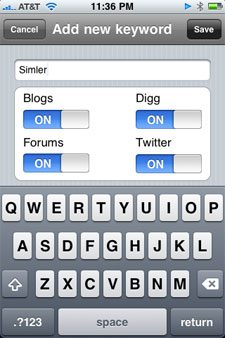
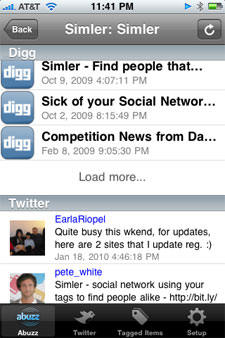
 As social media activity becomes an increasing portion of companies' marketing focus, including finding new clients and tracking company brands or product mentions across the Web, a virtual industry of reputation and analytics firms have sprung up to try and derive value from the noise. A simple application called Abuzz just hit the iTunes store with a goal of making these social media searches simple and mobile. The result is a lightweight client that tracks keywords across multiple outlets and even lets you respond to mentions from within the application.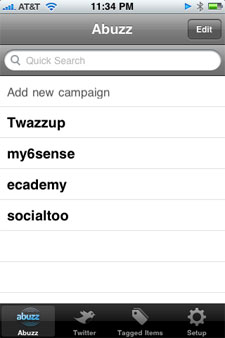


 It seems a bit redundant to talk about how much the Web has impacted my life and the way we communicate on a blog, but with the advent of the World Wide Web's recent 20th anniversary, I took some time last week to speak with
  Last April,