Silicon Valley Technology Commentary & Archives · Est. 2006 3,031 Posts · 2006–2026

January 15, 2010

January 15, 2010 · 3 MIN READ · BY LOUIS GRAY

Forget Oversharing, Blippy Just Proves I'm Boring

Forget Oversharing, Blippy Just Proves I'm Boring

When first introduced to Twitter, I couldn't get over the banality and minutiae people were willing to share. Their food. Their location. Their thoughts. Just mind-numbing half-sentences, LOLspeak and link after link of news I had probably read somewhere else. But over time, the service seems to have evolved, and its success has led to derivatives which provide us new ways to share slices of our lives, even if the revelation proves not to be some dark secret, but instead, the dark truth that we aren't really all that exciting to be following in the first place. Blippy, the service that lets you stream your purchases online, which opened up this week, takes this feeling to a new level.

After first having a mental block on the entire concept of Blippy, I realized it could be interesting to share my iTunes purchases and my Netflix rentals with friends, and see what they were buying online. After all, if we are so willing to share those things that we like (See MyLikes for that) or things we are a fan of (try Facebook), it makes more sense to take a step upward and show what we actually spent money on.

So I joined. You can find me here: http://blippy.com/louisgray
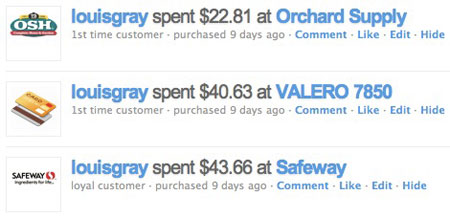

See How Boring My Life Is? Blippy Knows.

With a goal of erring on the side of transparency, I added iTunes and Netflix and Amazon, and even added the family credit card that both my wife and I use. This way, when I have a mundane task like filling up the car with gas, or she gets diapers at Safeway or buys the kids something new from Toys R Us, you will get the opportunity to know about it. You can follow each update, and I can follow you, or others who have joined, seeing my every purchase, and discussing them. Did I buy the right thing? Do you have this product too?

The interface is a lot like Friendfeed than Twitter, to be honest. You can make in-line comments to every purchase, or "Like" items, just as you can in FriendFeed and Facebook. Obviously, this appeals to me, and using the product is self-explanatory.
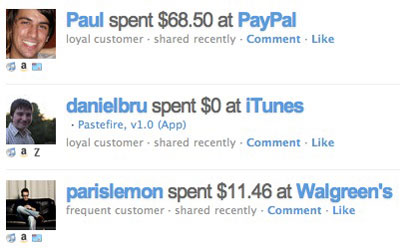

You Guys Are a Thrill A Minute Too...

But for every so-called "fun" update, where you see I bought an iPhone app that may appeal to you, or a restaurant I visited, or a Netflix movie I rented, you're going to need to sift through my routine updates, like paying Homeowner's Dues on our condo, stopping for fuel at Valero, getting food at Safeway, and on and on. The truth is, it soon becomes as exciting as reading a bank statement. There may be the occasional eyebrow raised as you see someone's update with a big dollar amount, or an amusing venue, but more often than not, at this point, I am simply exposing to you what I've long known to be true. The daily minutiae of my life is not interesting. That's why there aren't blogs dedicated to my comings and goings, and why I am often writing about other people and what they do instead.

Following on to yesterday's post about being "open", am I worried about revealing something I shouldn't? Something that might embarrass me? Not really. It may show that my wife and I go to the dentist or doctor and may have to spend money. And I can always delete individual items at any time if I want them out of my stream, if I remember to. Blippy essentially is a lot like Mint.com, which I also like, but instead of keeping all my data internal to me, it opens it to the world for discussion. The service is actually pretty cool, and can be amusing, if the people you follow are interesting. I just don't anticipate a lot of excitement on my feed.

See also an interview in the Wall Street Journal from today of Philip Kaplan (@pud): Philip Kaplan On Blippy: People Are Loosening Up Online. He's thinking along the same lines I am, adding, "The biggest risk is that their purchases are totally mundane and you’re really super boring." Sorry, Pud.

January 14, 2010

January 14, 2010 · 5 MIN READ · BY LOUIS GRAY

Can We Live In Private and Demand Companies Be Open?

Can We Live In Private and Demand Companies Be Open?

The growth of social services enables us to share an ever-increasing granularity of our lives with complete strangers who opt in to sample our updates. From traditional blogging to Twitter to location sharing services, and now, Blippy (which displays my purchases online and lets me follow others' spending habits), I can live my life open and transparent, letting you know what I like, what I do, where I go, and how I spend my time. In parallel, we are also asking businesses to be more open. Thanks to SEC regulations and Sarbanes-Oxley, as well as best practices, we expect public companies to tell us how much money they have, how much profit they made, where they made that money, how many employees they have, how much they intend to make next quarter, and a blizzard of other things that fall under the guise of information.

Now, we're even asking some companies to open up their kimono and blog themselves, to respond on a personal level with Twitter and other social networks, or open source their code, and let us know who their investors and partners are, lest we find they may have some bias. So yes, it's easy to see that open, open, open, is the word of the day.

This Week's Target: Facebook

Looking at these trends, it seems clear to me that the overriding move in both personal and business is to remove barriers and enable more visibility into activity. Yet, there are still pockets on the Web who see the data they share as needing to be under lock and key. The most recent kerfuffle was flamed by the often independent Marshall Kirkpatrick, who slammed Facebook's CEO Mark Zuckerberg for moving the once-closed social network toward increased openness, and reduction of what he termed "privacy". While others, notably TechCrunch's Mike Arrington, thought that argument to be overblown, Kirkpatrick followed that post with another line of questioning, asking how we would react if, for example, Google revealed our contacts in GMail and our subscriptions in Google Reader.

In the non-connected life, one was always taught that there were a few things one does not ask about in polite company - including politics, one's salary, and sex. Yet, the Web has made finding out most of those things very obvious for public members of society. We know what the vice presidents of many companies make, and we know the dollar amounts on contracts. We can do searches online and discover what political parties people are registered to, and where they put their money in the last elections and fundraising cycles.

Forget Location. Who Have You Slept With?

Although I was only joking, somewhat, I suggested to a friend this week that a new social networking service should be introduced that updates your stream with your sexual partners, and encounters, complete with their partner history and total number of partners. Given some's willingness to post all their data online, and the rising casual nature of some behavior, this isn't so far out of reach to be completely ridiculous. Just think of what message that would send if you were the "mayor" of multiple places on that particular network?

Yet, before that level of debauchery occurs, we still have to recognize that the trend Zuckerberg and his team are recognizing is true. The first rule of sharing things online is to expect that they will be discoverable by search engines and viewable by anyone. Even the closed, secure, password-only sites are usually potential victims for copy/paste, and are always susceptible to screenshots.

From Anonymous to Open. We're Getting There.

I understand the Internet's roots require a level of privacy, and you see many people still clinging to the antiquated hope of anonymity, assuming one can hide behind a user name and avatar to mask their true identity. I understand the concerns some have that the more data which is shared online makes them more vulnerable offline. But I am seeing prominent people talk out of both sides of their mouth when they claim to push companies to get more open and more transparent, while at the same time, clinging to the hope that we can push our content into a safe place on the Web and consider it "private".

During the week's discussions around Facebook and privacy, Marshall had some solid points, in his comments on TechCrunch, saying that people were joining groups and "fan pages" on the social network that had to deal with sensitive personal issues, such as infertility or friends of same-sex couples. His concern was that this data would be surfaced and revealed in a way that was not desired. In a week of drum-banging and emotion, I thought those examples to be the most reasoned. It makes sense, then, that sites like Facebook make the ability to hide certain affiliations from public view if so desired. If I chose to sign up and follow Fox News, and not want my left-leaning friends on Facebook to know, then I should have that option to hide the details from my page. But to fight against the tide of open in our own lives while demanding the tide of open be ever loosened when it comes to the companies we engage with seems bizarrely silly. Let's pick one and stick with it. If you don't trust the companies, then why should we trust you? What are you hiding?

Of note, and I mentioned this in comments to ReadWriteWeb, the notion of Facebook data being private is in itself the exception rather than the rule. You can see my Twitter stream and who I follow or don't, just as you can with FriendFeed and other networks. I have chosen to share my Google Reader feeds with you on Toluu and encourage others to do the same. The world is trending open and transparent, and you can embrace that or you can fight until you are blue in the face. But choose a side.

January 12, 2010

January 12, 2010 · 5 MIN READ · BY LOUIS GRAY

Technorati, Once Near Death, Focuses On Quality

Technorati, Once Near Death, Focuses On Quality

When Technorati CEO Richard Jalichandra joined the company near the end of 2007, he found the blog search engine in "a lot of trouble". Technorati was bleeding cash, with an expensive infrastructure based on "incredibly complicated technologies", and was losing the war on fighting spammers, who were threatening to render the company's deep index and authority measurements completely useless. In parallel, the struggles came at a time when expanded competition from formidable players, including Google, made staying on top almost impossible, even as the company's formidable task to index the fast-growing live Web expanded.

"Please Put On Your Oxygen Mask First..."

The situation looked dire, one Jalichandra compared to when the oxygen masks fall from a depressurized airplane, saying you can't save the passenger next to you, until you save yourself.

"The first thing I had to make sure of was that we didn't go out of business," Jalichandra said in an interview Monday at the company's San Francisco headquarters. "In the fall of 2007, it all came to a head, and we knew we had to do something or there wouldn't be anything left."

Since 2003, Technorati was among the first leaders of the Web 2.0 wave, recognizing the imminent growth of the live Web, encompassing blogs and other social media activities. Not just comfortable with blog search, Technorati also enabled site owners to claim blogs, track backlinks to their content, measure authority, ranked by unique site backlinks over time, to ping the site with new updates, chart changes in content distribution on the Web, and present Technorati widgets on their blogs. Add on a few fun features, including popular pages, and the always quizzical "Where's the Fire", best known as "WTF?", and Technorati had its focuses widely diversified.

Near Death By a Thousand Cuts...

The 2007 crisis forced the company to revisit everything and make some very painful decisions, cutting costs, headcount and features - many of which had been treasured by the blogosphere.

"(Previous CEO David) Sifry came up withe great idea of boiling the ocean of the live Web and it grew like crazy," Jalichandra said. "But there are a couple of problems with boiling the ocean when people are looking for a cup of coffee."

Technorati, once known as the go-to site for data on the blogosphere, had soon found itself eclipsed by more nimble competitors, such as Google Blog Search, and while many bloggers, including myself, grew frustrated with the site's rapidly killing features we liked, and the not too unfamiliar appearance of site downtime, which would happen multiple times a week, for several hours at a time, the site came incredibly close to going away altogether without drastic change.

"The first six months (of my term as CEO) was all about stabilizing the company," Jalichandra said. "At some point you have to keep the lights on, particularly the kind of company that is venture funded. It has to get revenue, and has to make a profit. We had to write the plan for growth, a two-pronged plan, to grow the site and launch the ad network. We are still dedicated and committed to growing Technorati.com."

One Must Have Revenue to Invest Back In the Company

The company's focus on the advertising network seems like a dramatic change in course for what was instead seen as a technology service company, but it was a move aimed to leverage the existing database in the site, while also driving revenue into the company. It was suggested that, as revenue grew, it could be reinvested back into Technorati's site, quite possibly to start replacing some of the lost or deprecated services much beloved by the blogosphere.

In October of 2009, Technorati revamped its Web site, and while gone were many of the dedicated pages for topics and individual blog posts, which I had liked, in its place was a detailed directory with top blogs ranked by category, with a new ranking of authority, and a higher focus on relevancy. While the old Technorati would highlight the most recent updates as they flowed in, the new Technorati tries to deliver recent updates from the most authoritative sources - a move that's not without its controversy, of course.

"Search is not a democracy," said Jalichandra. "There is always an editorial choice in search. It may be an algorithmic choice, but it's a choice."

Look Mom, No Spam and No Downtime!

The new site relaunch led not just to new content and a new look, but the elimination of downtime, as the company says they have not experienced any appearances of the Technorati Monster having escaped since the introduction, adding it is believed the the issue of spam is practically non-existant. Despite so many headaches and a popular perception that the site is irrelevant or archaic, the company's leadership thinks the two years needed to bring the site back to the point where innovation can occur has been both necessary and worth it.

David White, vice president of publishing, says that working for Technorati has been a "really interesting challenge", but one that has changed as the mainstream is not just aware of blogs, but is embracing the live Web in their daily lives, as Technorati plays less of a role as evangelist for the blogosphere, but instead one that focuses on finding quality content.

"Technorati started by indexing all the blogs," White said. "Our job is different now, and that is to find the quality. Technorati is an important site, and it has made an impact on how we interact with the blogosphere, which has had a huge impact on media as a whole."

Will It Be Enough? Can I Have My Widgets Back Now?

As the move to quality infiltrates the company's blog directory, Technorati promises many of the tools that have gone away are coming back. The company fixed blog claiming last week, and promised Monday to bring back authority over time charts, as well as introducing new widgets, which had long since obsoleted.

Many bloggers, including the visible futurist Stowe Boyd, have already given up on Technorati, after seeing the company's early promise seem to crash and burn, through a confusing product strategy, spam-filled results, poor uptime, and bad news followed by no news. It seems the darkest times are behind them, and the company will have to make good on its promises before many bloggers learn to trust them again. But in my meeting with them Monday, they clearly said they're not done fighting.

To hear Jalichandra in his own words, listen to the 8 minute clip I recorded on Cinch:

January 12, 2010 · 1 MIN READ · BY LOUIS GRAY

Thing Labs Reports Brizzly's Growth Exceeded Targets

Thing Labs Reports Brizzly's Growth Exceeded Targets

With such a wide number of Twitter clients out there, from dedicated Web clients to iPhone or Android applications or still others for desktop operating systems, each that has gained traction has done so thanks to its unique features and innovation, which attract loyal users. Brizzly, a popular Web client which supports multiple accounts for both Facebook and Twitter, has gained traction thanks to inline display of videos and images, a new approach to direct messages, and integrated definitions for trending topics.

As interesting to me as the product itself, among my favorite Twitter apps, is Thing Labs, the team behind Brizzly. The majority of those on the company's small engineering team hail from Google, most visibly headed by CEO Jason Shellen and co-founder Chris Wetherell, who were among the creators and champions for Google Reader, the RSS reader where I spend much of my time online taking on the data firehose. With Jason and Chris turning their attention toward social services, the company has been pleasantly surprised by gaining more users than originally anticipated, and is now working to scale the service without the benefits of a massive organization like the one they enjoyed at Google.

In a candid, yet casual, interview I held with Jason and Chris on Monday at their San Francisco headquarters, the pair walk us through Brizzly and its place within Thing Labs, how they view their product, and how their experience growing Google Reader, and in Jason's case, Blogger, prior to its acquisition by Google, have help set the stage for their new startup's growth. After a series of incremental changes in the last few months, it sounds like Brizzly is heading for some large introductions in the next quarter, probably before the SXSW conference, which will have everyone who has ever looked at the product to revisit it and see what's new. The full interview, about 10 minutes in length, is embedded below: