Silicon Valley Technology Commentary & Archives · Est. 2006 3,031 Posts · 2006–2026

March 23, 2010

March 23, 2010 · 3 MIN READ · BY LOUIS GRAY

FriendFeed Data Joins Its Coders At Facebook

FriendFeed Data Joins Its Coders At Facebook

Despite not achieving the lofty position in the social media stratosphere many of us had hoped it would as an independent company, FriendFeed played a significant piece for a mid-size community that has, for the most part, felt adrift and abandoned in the seven months since the once-perky startup was acquired and absorbed into Facebook. When parts of the site started to creak over the last few weeks, with features breaking or slowing, some thought it spelled yet more bad news. But after some considerable effort, the site and all its data has been migrated to the more robust Facebook data centers, which should hopefully keep the site going for those who have stuck around, even when others have said their last goodbye.

Moving all data on a live site as complex as FriendFeed's to another is no trivial feat, made even more challenging by differing hosting environments or code nuances.

On Thursday, after some of the site's more dedicated users complained the network's search engine was broken beyond repair, FriendFeed co-founder Jim Norris explained:
"We're working on moving the FriendFeed servers to the Facebook data center, which will have significantly more speed and capacity and (we hope) more reliable hardware. There are a bunch of difficulties we've run into though: FF has been running on Ubuntu Linux distributions whereas FB is based on various (old but stable) Fedora Core and Centos versions, so the package management is completely different."
Paul Buchheit, also a co-founder, best known for his work on creating GMail while at Google, and a successful angel investor besides, gained the unenviable task of compiling the code and building it on the new machines. As Jim added in a throw-away line, "I don't know the exact timeline but if when I see Paul I'll beat it out of him."

It turns out that timeline was for late Monday night and early Tuesday morning, as Bret Taylor, director of products at Facebook, announced the successful transfer of FriendFeed's data to the Facebook datacenter, adding, that it "fixed many of the ongoing performance problems we have had with the site and will provide us more room to grow."

Whether FriendFeed is growing, stagnant or decreasing depends on one's point of view. No longer a gem in Silicon Valley early adopter corners, the site did bounce off traffic lows last month (at least according to Compete.com) to rise more than 80 percent - even as new challengers including Google Buzz gained attention. FriendFeed has said the United States is no longer the most active country on the site, as that honor falls to Turkey. So somebody's using the site, and while figuring out the site's future and how it maps to Facebook requires either a divining rod or root access to Mark Zuckerberg's laptop, it doesn't look like the site is being allowed to gather dust and fade into the shadows.

As the move took place, users on the site are already thanking the team for improved speed, and lower errors. And as FriendFeed never quite let me export all my data I'd piled into the site since October of 2007, that's a good thing. If they had a way to export it all, that'd be a very interesting offer, but it's a battle for another day.

March 22, 2010

March 22, 2010 · 4 MIN READ · BY LOUIS GRAY

My6sense Intros Attention API for Hyper-Relevant Web

My6sense Intros Attention API for Hyper-Relevant Web

Content is coming at us from every direction in the form of streams, from blogs to tweets to social networks. These streams are combining to become information waterfalls of noise from practically every direction - noise because they are all shouting for our attention and demanding we choose them over updates from somewhere else. For some, this crashing sound has become information overload, as the demands from our data exceed the time we have available to give everything its appropriate attention. For the last nine months, I have been talking to you about my6sense's application for the iPhone, which watches my activity and senses what is most relevant to me, from my RSS feeds and my social streams. At the end of the last year, they became a Paladin client, and I have been working with them closely as they improve their digital intuition. Today, at the DEMO conference, they announce their new Attention API, which lets developers and service providers capture personalized relevance - and this, the ability to see my6sense-like sorting and impact throughout the Web, is what I have been waiting for. It is this Attention API that will help quiet the noise and start delivering clear signal from new places.

my6sense Promises Personalized Streams Across the Web

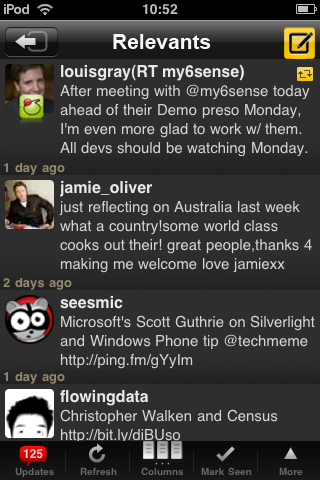
As you know from my prior coverage of my6sense, and likely your own experience with the application, my6sense's intention is to surface the highest quality, most relevant information, not from the crowd, but for you. It watches what you read, and what you don't read. It watches what you share, and what you don't. It watches how long you read, what articles you open, and what you skip. And over time, effortlessly, you will find the content getting better and better. Now, one of my first stops on my iPhone after time away from the desktop is to my6sense, so I can just scan a handful of headlines and know I didn't miss anything. The introduction of the Attention API from my6sense promises to take that personalization to the Web at large, should software engineers and content publishers be interested in delivering personalized streams to their users, no matter the type of content, without requiring them to fill out detailed surveys, or explicitly indicate what they like, and what they don't.


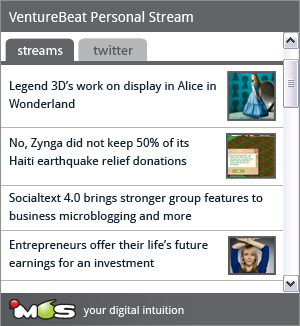
Examples of Prioritized Streams on VentureBeat and the WSJ

In the past few months, you have seen increased focus on relevance. Google Reader has made significant steps forward with their addition of "Magic", both on their desktop client and most recently on the mobile phone. Google's search engine has started to personalize results for you, including links from your social circle. Cascaad also talked about personalization of their social media application for the iPhone, and Twitter client Twazzup is trying to find "highlights" for you based on who you interact with the most, and other factors. But my6sense doesn't see attention and relevance as simply features - but instead as the core mission of their product. That other services are also trying to solve this issue speaks well to the need for publishers to provide better user experience to their customers and make their products even more appealing.

As I introduce my6sense to people, the most common requested product features are for its running in other environments than the iPhone. The company has promised new platforms are in the works, but the addition of the Attention API does more than bring my6sense benefits to new handsets, but to new environments altogether. While the company already made a big step to start filtering Twitter and Facebook streams by relevance in the application, you can imagine how content publishers, from vertical sites to industry news, new social networking clients and blogs could offer personalized streams, based on relevance, without having users jump through complicated hoops - or simple annoyances, with "more like this" buttons, thumbs up and down, likes and dislikes.


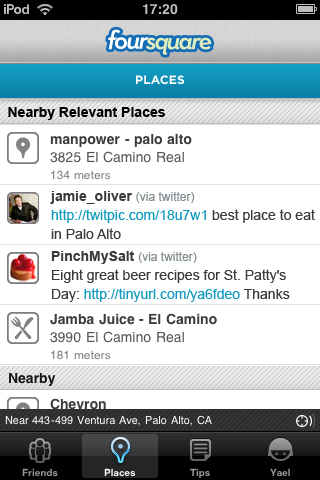
Examples of Apps That Could be Impacted by an Attention API

As my6sense promises today with their announcement, partners looking to offer tailored, personalized streams would connect my6sense's digital intuition engine to the streams they wish to personalize, and then let my6sense know how users are expected to interact with the streams. My6sense would then return personalized streams for each user, regardless of feed type. If partners sign up, the silos of unfocused, unprioritized data that we live in today should change - into a more focused Web that delivers content ranked for every visitor. With more people tapping into social services, and trying to follow more people in more places, the opportunity to cut through the noise and find the important information, taking it to the top, could be a critical competitive advantage. With today's launch, I look forward to seeing which applications and sites will step up first.

Disclosure: my6sense is a client of Paladin Advisors Group, where I am Managing Editor of New Media. My comments on the company's product are always independent, and do not pass their way in advance.

March 21, 2010

March 21, 2010 · 1 MIN READ · BY LOUIS GRAY

Branded Site Aggregator Nombray to Shut Down April 5th

Branded Site Aggregator Nombray to Shut Down April 5th

Nombray, the project which looked to showcase all your individual or brand's destinations at a single URL, navigable by tabs, looks like it is going to find itself extinct as soon as April 5th, after the CEO was unable to complete the site's sale to a potential buyer at the end of 2009. Despite coverage from CNET, Lifehacker, Killer Startups and others upon its launch, the product apparently never gained the traction necessary to keep it going, although emphasis was on paid accounts with monthly subscriptions.

CEO Chris Lunt sent an e-mail today to users notifying them of the impending closure, saying the site was to shut down on Monday, April 5th, adding he wished "there was a different ending".

Nombray Will Be Gone for All Soon...

As I mentioned in my April 2009 coverage of Nombray, the site was very flexible, importing content from my various social media outposts along the Web and presenting them in one place - a site, which at least for the next two weeks, can be found here: http://www.nombray.com/users/305.

Lunt's note to customers spoke quickly of a potential buy that simply didn't pan out:
"I had arranged a buyer for Nombray in November, but after a long delay, they were unable to complete the deal. They could not marshal the necessary resources to run the business, and I find myself in the same position."
In the wake of Nombray's closing, Lunt pointed to alternatives, including Chi.mp and GizaPage.com. (Of note, I wasn't that big a fan of Chi.mp upon first glance at the end of 2008)

Sites come and go. Nombray no doubt had a hard time selling people on the benefits of a single site managed by their engine. The site is still up here: http://www.nombray.com/
March 21, 2010 · 2 MIN READ · BY LOUIS GRAY

Google Buzz Stats Now Available Via App Engine Project

Google Buzz Stats Now Available Via App Engine Project

With Google Buzz still being considered very new, just a little over a month after its introduction, it has been interesting to see users adapt to the new aggregation engine - seeing some use it to pull in their content and others using it as a self-contained blogging platform. Some people see lots of activity on their feeds, while others get significantly less. Now, as we have seen with products like TweetStats for Twitter and a multitude of packages for blog statistics, we now have the first entry (of many, no doubt) aimed at showing your activity on Buzz, and how much traction your feed is getting, along with details on who is commenting, and how much they are saying.

The new project, hosted on Google App Engine, authored by Siegfried Hirsch, analyzes your last 100 entries to Buzz, from any source, shows their origin, counts up the words, characters and replies, and displays the people interacting with your feed.

My Top Level Statistics for the Last 100 Buzz Entries

As Buzz does not yet have an official API, there is a lot of information hiding from the initial cut, such as the total number of "likes" for your feed, who is liking your content, and any data beyond the first 100 posts. It also does not analyze your own personal activity - trying to find just where you are commenting and liking through your own network (although Google's Dashboard can give you some top-level stats).

Who Is Engaging On My Buzz (and how often)

As I ran the numbers for a number of people on Buzz, from the highly prominent Googler DeWitt Clinton (whose script was the inspiration for this project) to Twitter's John Kalucki, Jesse Stay and myself, it seemed that those who posted natively to Buzz gained the most engagement, while those who piped in activity from third party services - such as Twitter - got less.

DeWitt's Unique Set of Data from Buzz

DeWitt, who has 76 native Buzz entries, saw responses from more than 430 unique authors, with 12 different people (him and myself included) making more than 25 comments on those entries. In contrast, 156 different authors made comments in my last 100 entries, the overwhelming majority of which have been shares from Google Reader.

DeWitt's Engaged Buzz Followers

Not unsurprisingly, DeWitt's native entries into Buzz are much longer than my shares, which are often excerpted. While my 100 posts totaled 4,228 words, the 76 posts he provided were a whopping 18,380 words, or more than 240 apiece. The attention to length resulted in nearly 2,200 comments on his items, with an average of 61 words per reply. The nearly 400 comments I received had a similar 57 words pre reply over the last 100 entries.

The Buzz-Statistics engine is billed as version 0.1, and has some work to do. I found it often lagged with larger accounts (my own included), but it's an intriguing first step into getting analytics data out of the new platform. You can check out your data by going to http://buzz-stats.appspot.com/ and entering your Google user ID.