Silicon Valley Technology Commentary & Archives · Est. 2006 3,045 Posts · 2006–2026
Showing posts from June 2011 (28 posts). Show all posts

June 30, 2011

June 30, 2011 · 1 MIN READ · BY LOUIS GRAY

Search Results on Google Now Highlight Content Authors

Search Results on Google Now Highlight Content Authors

Author Pictures Are Now In Google Search Results

There's a small chance you might have bumped into my omnipresent avatar in some new places lately - including search results, assuming you use Google. The company on Tuesday, which turned out to be an extremely busy day for them, introduced a nice feature that lets content authors claim ownership of their work and display their photo next to the appropriate search results when they match a query. This brings more personality to Google's content results, and if you are aware of the author's other work, may be yet another draw to why you would select one link over another.

My Picture Alongside Zillow Price History Results

The initiative is an extension of the authorship markup code released by the company a few weeks ago. It works by the author selecting a page on their Web site as their "About Me" page, like I have here, listing it on their Google Profile, and designating it through the appropriate HTML code in their site template.

My Picture Alongside Searches for the CR-48 Experience

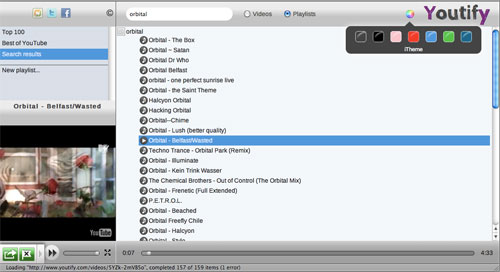
Results with authors' mugs such as mine went live on Google.com today, meaning that when you search on topics like Youtify or Zillow home prices or anything else I've covered in the past, my photo from my Google Profile is next to the link. The same goes for the dozens of other blog authors who were part of the initial launch program, and more are coming. The team promises simple guides on how you too can be listed shortly, but for now, watch for photos in your results, and promise the quality of my photo won't make you click less. See also Frederic Lardinois of SiliconFilter's take.

June 29, 2011

June 29, 2011 · 1 MIN READ · BY LOUIS GRAY

Google IO Chromebooks To Reach Attendees In August

Google IO Chromebooks To Reach Attendees In August


In May, to cheers, Google's Sundar Pichai announced that all attendees of the company's developer conference would be the recipients of free Samsung Series 5 Chromebooks, one of the two launch OEM partners, alongside Acer. Unlike other giveaways at the event, and unlike Oprah's traditional "look under the chair" showmanship, the devices were not immediately available, but would be coming soon. General availability was highlighted as June 15th. Now, as many of us have started to see via email notifications from Amazon, the promised Chromebooks won't be making it to eager recipients until early to mid August.

Last week, I got a note from Amazon with two codes - one for the free notebook and one for free shipping. But availability of product was in question as it is displayed as sold out on the merchant's site. Last night, I finally got a note with a delivery date of "August 03 2011 - August 10 2011". Checking with other attendees, they too heard either that date or even a bit later.

For those who don't already have a CR-48 lying around, as I do, and need to get their hands on a Chromebook ahead of August, BestBuy.com and Amazon might have some for purchase. Either way, once they arrive, it's an interesting reset on what you've come to expect from a laptop. I've rapidly grown accustomed to always on Internet and battery life that goes all day with my Chromebook. My fellow Google IO attendees will need to wait another month to see the same.
June 29, 2011 · 2 MIN READ · BY LOUIS GRAY

Aggregation Is Invisible In Google+. Thank Goodness.

Aggregation Is Invisible In Google+. Thank Goodness.


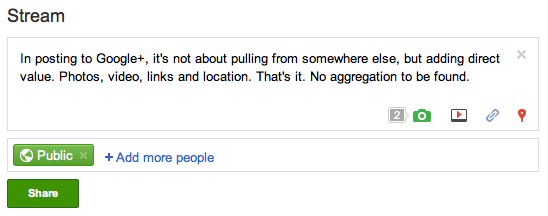
The true value of a social network is the product of the people participating and the content being shared. There's no doubt some sort of mathematical program smarter geeks can compile to show just how that works, but it's true. You will participate on one service or another because of what is said and who is saying it. If the content doesn't match your interests, or the people aren't those you care about, there's little pull for you to be there. One corollary to this which evolved over the last three-plus years is that social networks gain power through being the originator of the content. While I once was a major proponent of aggregation products that pulled from many corners of the Web, the value downstream is vastly diluted, and adds to noise. This was a major problem for late adopters of FriendFeed, was immediately a problem for Google Buzz on day one, and is an ongoing problem for Facebook users, who often struggle to find ways to delete specific services' access to their feed and wall.

Google+, at least on day one, has absolutely no way to push content into the site from a third party network. This means you don't see a stream of people's Twitter updates, you don't see their blog posts automatically added, you don't see their Foursquare checkins, their Instagram photos, TurnTable spins or any of the other various update virii that flood most streams. Instead, the site is an open whiteboard for status updates, link sharing and photos, all requiring manual input. The inference, and correct assumption, is that those updates on Google+, were written by the person with specific intent for a specific audience. You don't get that feeling that they posted elsewhere and aren't participating locally - a common complaint on other services, like FriendFeed and Buzz.

At the end of 2009, my two-year fascination with aggregation-centric parlays coming to a close, I said aggregation was better in theory, arguing cross-posting should be reduced. This didn't stop Google Buzz from launching with aggregation at its core a few months later. Unfortunately, the ease at which you could pull in content from third party networks like Twitter meant many people, including Google employees, added these feeds and didn't return. It made for a subpar experience, and initial requests for updates included the ability to mute these services as a whole or from specific users.

I would bet that in time as the Google+ API is completed and released, we could soon see the opportunity for mobile and desktop clients (like Seesmic for example) to write to Google+ as a new service. I am betting Seesmic's Ping.fm is already thinking of how they can make Google+ yet another supported service. But I would push for caution in this. I've seen how the deluge of activity from sites like Twitter (and Facebook if they opened up) can drown the downstream aggregator and help it lose its identity.

Some first users of Google+ today commented about the similarities of it to FriendFeed, with nested comments, lists and real time at the core. But honestly, it's the opposite. FriendFeed launched as a major aggregator, supporting dozens of sites. Google+ starts with just one. It's refreshing.

June 28, 2011

June 28, 2011 · 4 MIN READ · BY LOUIS GRAY

Google+ Breaks Out of the Social Box, Ready to Score Users

Google+ Breaks Out of the Social Box, Ready to Score Users

More than a year after the launch of Google Buzz, rumors have been tossed about on most tech news sites about just what Google has been up to in the world of social to ebb the flow of activity that has migrated to Facebook and to a lesser extent, Twitter, over the last few years. With users spending significant time participating in social activity on the Web, it's made Google sometimes seem like the last era's winner, with it being thought the future of discovery is through friends. So long as another company owned the social graph, Google has been pushed to an unfamiliar role, as challenger. With today's launch of Google Plus (nee Google+), you can see they haven't taken the role of backup lightly - delivering a fun and engaging place that brings many of the benefits of existing social sites, but learns from their mistakes. In time, the package of Google+ could be a serious alternative for people's attention.

As a longtime Google ecosystem power user with Google Reader and Buzz, both of which I continue to use even as they've fallen in others' eyes, gaining access to Google+ today was practically second nature. Within minutes, I had started to reassemble a brand new social graph into explicit "Circles", their equivalent of lists, and could share status updates, links, and photos. The vast majority of content in Google+ feeds into a centralized stream of all friends' updates, with additional product features including built-in chat, powered by Google Talk, "Sparks", much like saved searches to surface interesting articles, "Hangouts" for instant video chats with other users, and at least on mobile, "Huddle" for group chat and instant photo uploading.

Circles, Hangouts and Sparks - All Part of Google+.

Clearly, this is no small undertaking - one Google has thought through in the year since Buzz's launch and initial privacy hiccups, and one where they have given an unprecedented (for them) amount of effort in making sure the user experience was top notch. While we've grown accustomed to helping Google test out their first iterations of beta software, Google+ is well designed out of the box, and has seen positive kudos from all corners of the Web, so far as I can tell. There are bugs, of course, but nothing dramatic.

Separating Friends By Circles In Google+

Most of us power users on various social networks, from Facebook and Twitter to lesser successes, like FriendFeed, have been reticent to adopt lists for sharing out of our corpus of friends. FriendFeed and Twitter's lists have primarily been read-only, letting you organize what you consume, and Facebook's selective filters for sharing are underutilized and challenging. The Circles in Google+ are easy, backed by starting from scratch on the social graph for the most part, and being easy enough to drag and drop to new circles, complete with old-school rotary phone like animation. I managed to set up connections with more than 400 different people on Google+ today without getting carpal tunnel syndrome. I can choose to share each post of mine with the world, or a subset of folks in each Circle.

Google + In Action With a Share from Ben Parr

The integration with Picasa and especially automatic uploading has increased the visibility and vitality of the photo service, which has similarly played second fiddle to sites like Flickr for the masses and hip apps like Instagram and Path for the geeks. Albums on Picasa are available for featuring in Google+, and photo sharing is quite simple. You can also tag any Google+ user on any photo, one of the major reasons Facebook Photos became so wildly popular - along with notifications that you'd been tagged.

Many Different Types of Notifications, All Clear In Google+

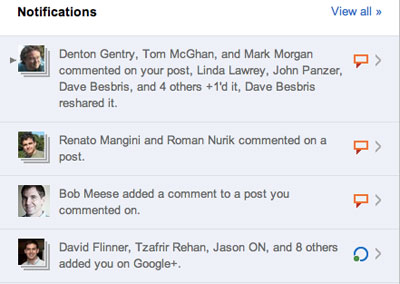
Speaking of notifications, they're nothing if not thorough. Thankfully, unlike other networks, you get follow notifications in bulk. After a certain amount of time (not exactly clear), you can get emails saying how many new people are now following your account. On the fun of day one, I got a handful with dozens apiece, rather than hundreds of separate emails. In the site itself, you can see a small number in a square highlighting the number of notifications that beg for your attention, including new connections, comments on your posts, whether someone has tagged you in Google+, or if comments have happened on a thread where you've commented. Of course, if you don't want an email or phone push notification each time that happens, you can just disable those in your settings, and reduce the amount of bacn in your life.

Congrats! You're Followed On Google+ By Lots of People!

The biggest and most exciting piece of newness with Google+ over Buzz for me, though the services are vastly different, is that Google broke out of the Gmail box on this one. While I understood the desire to automatically create one's friend graph in Gmail and embed it in a popular app, the mere act of having to head to Gmail every time I used Buzz was a real detractor for me. Google+ is its own dedicated URL and it looks great in every browser and mobile device I've tried before, even the Galaxy Tab 10 on Honeycomb.

Sparks Bring News on Topics You Choose to Google+

Right now the service is invite only, and I don't have any invites to spare - trust me, I'd pass them around like candy, because I think this is a service you just might want to enjoy. Google has invited some skepticism for false starts in the past, but from what I've seen today, especially the excitement and wholescale adoption of the launch from prominent Googlers, this time they are absolutely serious and we'll be seeing some noise from this team. Their URL is plus.google.com and you can find me here: https://profiles.google.com/louisgray/posts.

June 27, 2011

June 27, 2011 · 4 MIN READ · BY LOUIS GRAY

Not All Roads to the Public Markets Are Smooth Ones

Not All Roads to the Public Markets Are Smooth Ones

In Silicon Valley, we fall in love with and memorialize success stories. Leaders of successful companies can be seen as pop culture heroes, and their decisions during times of challenge or opportunity can be told and retold as legend. The first years of companies like Apple, Microsoft, Sun, and Oracle in one era, Netscape and Yahoo! in another, Google and LinkedIn in a third, and in today's evolving present history, including Facebook, Foursquare, Groupon and more, are possibly going to be reviewed and dissected in the same way we look back on innovations from the turn of the 20th century with the assembly line, and the Industrial Revolution in centuries past.

The opportunity to grow fast, get big and get rich drives many people to flock here and try their own hand at catapulting an idea into a passion that could see millions or tens of millions of users. But, if nine of ten startups fail, for every big name I just mentioned, there are carcasses of many others that never make it. And for every rocketship IPO that has people clamoring for updates, there are others that take a longer path. (See all of the S-1 filings on the SEC)

Friday saw the second filing of an S-1 by BlueArc, my employer from early 2001 to Spring of 2009. The company is looking to raise $100 million by entering the public markets on the heels of rising revenue and reduced losses. I know the story well as I helped author the first version of this same document when we filed to go public in 2007 and was there when we withdrew the filing in 2008.

(You can safely assume I own shares, though not a significant number, and it's in my best interest if they do eventually go public. Given the company's sensitive position, I'm reticent to mention particulars, so this article is painted with a broad brush, and is as neutral as possible. Rather than ignore the news, I'm offering the filing as an example of a company that has not seen overnight success.)

The company was founded in the late 1990s, and raised more than $200 million, the most recent round completed last fall. In my time there, we signed some amazing customers, got some powerful OEM and reseller deals, and sold to new territories. We learned where our products were a great fit, and where we had challenges. We hired lots of great people, and saw others struggle. CEOs were changed a few times. We had layoffs a few times. The company and its customers made the front page of trade magazines and the business sections of the New York Times and Wall Street Journal. Other times, rumors flew about the company's viability. At one point, the noise got so bad, a leading industry analyst wrote an entire column about how he'd heard so many rumors on the company, fed by tough competitors, that he recommended anybody hearing such rumors to just ignore them.

The result of a company that has a few years under its belt, with many funding rounds, some happy investors and some unhappy, some happy employees, and some unhappy former employees, is a body of work that tells a story. For financial junkies and tech watchers, or just the curious, poring over the details of BlueArc's S-1 is interesting. There are no funny numbers like those from Groupon, who quite visibly took money off the table for its founders and key employees. There is no meteoric financial windfall like those seen at Google and assumed at Facebook. Just a growing, challenging, business in a tough market that has seen competitors purchased by industry heavyweights for billions of dollars and others, failing, just go out of business or sold for scrap.

While most of the tech press is enamored with consumer Internet plays and mobile apps, the enterprise market has its own unfair share of intrigue - often harder to grok, but just as aggressive. The South Bay especially, the world of Milpitas and San Jose, is dotted with networking firms, semiconductor firms, storage and switching companies in the shadows of NetApp and Cisco. Having lived that world for most of the last decade, coming from the position of a challenger with unique technology, I'm hoping that the colleagues of mine still at the company find a positive exit for the decade-plus some have put into the effort, or lesser tenures for the more recent arrivals. But for those of us who seem to have attention deficit disorder when it comes to watching companies start and flourish, or to our own job-hopping resumes, this is an interesting case study of one company that didn't take the easy route.

Disclosures: I was employed in the Marketing department at BlueArc from 2001 to 2009 and own a small amount of the company's common stock.

June 25, 2011

June 25, 2011 · 2 MIN READ · BY LOUIS GRAY

Zillow Rewrites Home Price History, Invalidates Old Data

Zillow Rewrites Home Price History, Invalidates Old Data

Many people look to Zillow for third party estimates of property values, whether homes are on the market or not. One can turn to Zillow to gain property information on homes, including home features, property tax data, and previous sales. The more data-hungry or curious may even watch their own homes or target properties to see fluctuations, due to a number of factors, and get a good idea of whether homes' prices are rising or declining.

Two weeks ago, the company recalibrated its systems, and has pretty much thrown all previous years' data out the window, replacing it with new histories. So if you were using the site to get a good picture of your neighborhood, they're hoping you'll ignore what you already know and start fresh.

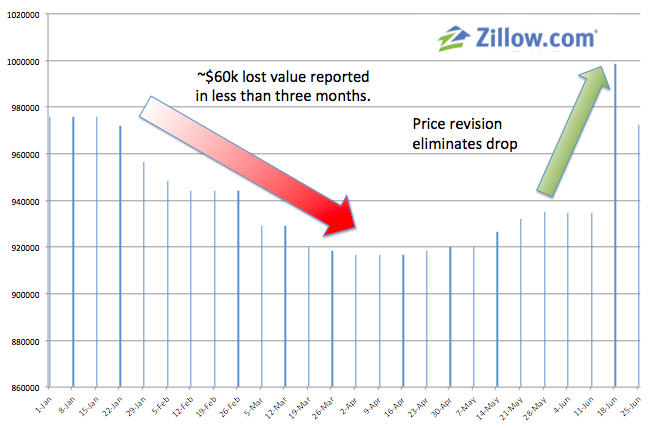
Coming up on the one year mark in our home which we purchased last summer, I've kept an eye on the surrounding market, both on Zillow and Redfin, to not only watch our own home's data, but seeing new sales come and go. In an economy which is by no means perfect, the weekly data coming from Zillow from its frequent "Zestimates", and tagged on my weekly Mint.com emails was pretty bad all Spring. My email archive shows eight separate consecutive downward revisions of our own home value, shaving off sixty thousand dollars in equity. While I have no intention of moving again any time soon, it was hardly reassuring.

Zillow Told Us Our Home Price Was Crashing, Then Changed Its Data

Zillow's New Data Is Smoother, Doesn't Show Crash

I even complained about the continued drops and negative feedback I saw through Zillow on one of my less-trafficked Twitter accounts, citing the $67k drop of almost 10 percent in just under three months.

Clearly the Reported Price Drops Were Weighing On Me

But on June 13th, Zillow wiped the slate clean and the year's data doesn't show such a steep decline after all, showing a comparatively straight line with a near-static value and a minimum of variance. Instead of a sharp downfall I had assumed was true this Spring, the gap between highest Zestimate and lowest is only about $20k, less than a third of the bloodbath I was seeing.

Pricing one's home for sale or financing is a delicate one, a dance of recent area sales, market trends, and all manner of comparables. But Zillow's move has me questioning not just our own home's value, and the year's graph, but all estimates I bump into, and of course, their own projections for values in years' past.

In an FAQ on Zillow's site related to "Zestimate Improvements", they mention that you "Possibly" could see changes in history, thanks to algorithm edits going back to 2006, arguing for improved "current accuracy" and "historical accuracy" - adding "We are now working on re-doing all the history."

An Excerpt from Zillow's FAQ

It's likely they know what they are doing, and with more data, they were losing confidence in both their current and historical values. But it sure didn't seem like the company was unsure about its competence before the move, and I'm not sure they're confident about their current data any more.

June 23, 2011

June 23, 2011 · 3 MIN READ · BY LOUIS GRAY

YouTube, Android Offer Alternative to iTunes Film Rentals

YouTube, Android Offer Alternative to iTunes Film Rentals

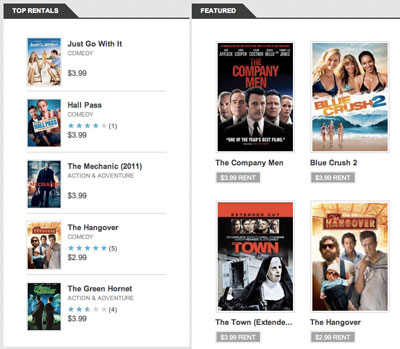
One of the new product announcements at Google IO in May was the introduction of movie rentals from the Android Market. Following the path beaten by Apple with its iTunes and Apple TV pairing, popular movie rentals can be picked up for the typical price of $2.99 or $3.99 each, are watchable in the next month and playable for 24 hours after you start. It's familiar, but new for Google, who added the option to their marketplace a month ago, making one less reason one has to be shackled to iTunes. The video rental service is powered by YouTube, who has clearly shown they know how to push Web video content to hundreds of millions of homes worldwide, and is ready to try longer-length content.

As mentioned frequently here, I've been a longtime iTunes user, and have slowly migrated away from the platform, thanks to increased use of Spotify and Google Music on one side, NOOK on the other, and now, movies, by way of Android Market, on top of Netflix Instant. The focus is not so much an anti-Apple vendetta, but just finding new ways to consume rich media on my changing array of devices. The more Android and Chrome I have in my house, the less iTunes is an option - until Apple changes its mind.

Some Top Titles On Android Market (Powered by YouTube)

The promise of the Android Market offering is to play these movies right in your Web browser, on any of your Google account-enabled devices. There's no need to download the movie (as iTunes does), but you instead start streaming after an extremely minimal amount of buffering, at either 320p or 480p. Purchases are sent to the account you have registered with Google Checkout, and the item shows in your Android Market purchase history. All straight forward.

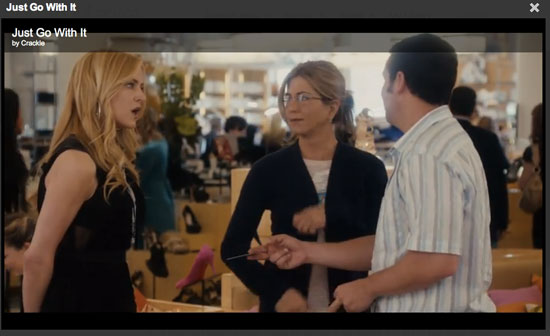
Streaming "Just Go With It" On Chrome Via Android Market

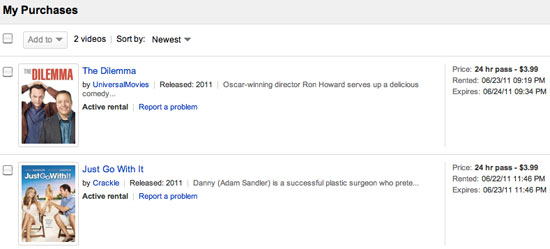
In the last two days, I pulled down Adam Sandler's romantic comedy "Just Go With It" and Vince Vaughn's "The Dilemma". Both $3.99, I can play these videos on the Web (and even Google TV's Chrome App) and expand to full screen. In our on demand world, the experience is on par with Apple TV or Netflix Instant, and your service preference depends on the device you're using or the title you want. Using the Android Market interface is actually just a front end for YouTube's full-length feature movie rentals (see all of them here), including films like The Hangover, Harry Potter and The Deathly Hallows, The King's Speech, Knocked Up and many others. It's yet another example of Google trying to push to the browser what traditionally has been handled with desktop client software.

YouTube Reminds Me to Watch The Movie I Rented

My Rented Films Visible on YouTube

I tested the video rentals on my Mac, in both Chrome and Safari and on the CR-48, as well as on Google TV. Essentially, if the app can play YouTube videos and you can sign in with you're Google credentials, you're good to go.

My Receipt Delivered Via Email, Like Any Other Google Checkout Purchase

At Google I/O, it was promised that ChromeOS (and these rentals specifically) would bring more offline access for those outside of broadband streaming. I assume those will come soon, to solve for the poor souls stuck on airplanes who still want access, and might still be going to Apple to shell out three or four bucks at a time.

June 22, 2011

June 22, 2011 · 2 MIN READ · BY LOUIS GRAY

Social.com Goes for $2.6M to Secret Ukrainian Buyer

Social.com Goes for $2.6M to Secret Ukrainian Buyer

Last month, Social.com announced the lucrative domain name was going up for sale after Scott Carter, owner of the URL for more than 15 years, could no longer justify trying to throw business models at it that would stick. Following a false-start auction process two weeks ago, the domain received multiple bids by competing parties vying for the URL, including a bid for exactly $2.5 million on June 6th. The eventual purchase price of $2.6 million was reached on Monday, and just hours ago, Carter received payment. The buyer so far is uncertain, described only as a "Fortune 500 company in the Ukraine", which still leaves us guessing.

Reports of the sale reached DN Journal, a domain name industry site yesterday, saying the purchaser was a company based in the UK (United Kingdom), but Carter said multiple e-mail messages during the process referred to the buyer "as being in the Ukraine", even though not even he knows the identity of the purchaser.

Carter, who says he got the first email from the buyer's broker after they connected via Twitter, reported that message simply stated, "Good to connect. My client who is based in Ukraine is interested to purchase the domain: social.com for $2.5m."

As is common in the odd high-value domain name sales business, other bidders for the name are similarly cloaked in secrecy. Carter acknowledges that he does know their identiites, including multiple US-based Fortune 500 companies, but is unable to reveal them. Final negotiations were only conducted with the eventual buyer after the initial $2.5 million bid, and not against the other parties.

Through the process, until now, Carter has remained silent, waiting for the sale to complete, and become official. His reason for doing so is obvious, sitting on a domain name that eventually sold in the seven figure range.

"I was waiting for the sale to finally close before I said anything," he wrote me this afternoon. "As of about 3 hours ago, the payment finally arrived and the sale is now concluded. What everyone is wondering is who the buyer is? I do not know. Negotiations between the parties involved another broker working for the buyer. Moniker worked directly with the buyer's broker. Moniker has told me that they also do not know who the buyer is."

That a company based in the Ukraine would be interested in the Social.com is another wrinkle in the odd story of this domain name which could be the basis for a new service, a rebranding of one we already know, or just a valuable domain for another player who has some big ideas. The Global 500 Fortune list does not have any Ukrainian companies, and the six Russian companies on the list don't exactly scream out Web tech. So either Carter's contact is not from a Fortune 500 company in the Ukraine, or its a Fortune 500 company based elsewhere with a contact in the Ukraine... or something. Eventually, no doubt, we'll find out.
June 22, 2011 · 3 MIN READ · BY LOUIS GRAY

NewsDrink Preps Next Generation Social Web RSS Reader

NewsDrink Preps Next Generation Social Web RSS Reader

While some noisy Web pundits have declared RSS dead, smart developers see expanded social sharing and connections as an opportunity to rethink news consumption, leveraging RSS as a utility and making it the backbone for new services. Amidst the rise of Twitter, Facebook and other networks, we've seen the launch and rapid adoption of products like Pulse, Feedly, Ninua, Flipboard and others who have taken the geeky parts out of RSS and presented new ways to consume news.

A new site you've never seen, which I've been watching since January, has finally cracked open the door with exclusive invites to its own take on RSS with social connections. The name is NewsDrink, which starts on the Web and will soon follow on with dedicated applications for mobile phones and tablets.

(Get in now at http://www.newsdrink.com with the invite code of "louis")

Scanning Recent News on NewsDrink from My Sources


Based in Bangalore, India, NewsDrink, like other RSS readers, can import an OPML file, synchronize with Google Reader, have you add feeds one by one, or select from their extensive topic-driven directory. Content can be viewed by individual source, or sorted for recency, with newest items at the top.

Reading louisgray.com on NewsDrink

Unlike Google Reader, which is biased toward full feeds, and has a wide array of sharing functionality and statistics for your own activity as well as the blog feeds themselves, NewsDrink favors a more minimalist approach, with feed items truncated to give you a glimpse into the story, but push for downstream views if interested. That said, you can make comments or likes directly on items that flow through your view in NewsDrink, and this site activity is collected on your central profile - which also displays feeds you add or delete.

Adding New Feeds, By Category, On NewsDrink

NewsDrink goes beyond Google Reader when it comes to social, reminding me a lot of RSS projects gone by, including AssetBar in 2008 and the follow-on Shyftr, best known for its aggregation of comments on full feeds, which in my view got them in an unfair share of trouble. You can follow friends on NewsDrink, find friends from Twitter and Facebook who are using the service, and see their activity. Find a feed they are reading that you like but don't have? Add it to your NewsDrink. You can also see people they follow and have an opportunity to discover new people with similar interests - much like the promise of Toluu, another 2008 debut that has seen its founder move on to new projects.

My NewsDrink Profile With Recent Activity On Feeds

Does the world need another RSS reader besides Google Reader, or does the world need RSS at a time when it seems that social sharing is king? I still think there is a place, absolutely. One that is built from the start to be social, but also allows you that solitary approach to get in and read your feeds, could be a solid alternative. NewsDrink is a just starting, so if there are some UI bugs that are not your favorite, or missing functionality, be sure to let them know. It's all part of the fun of beta products.

To get into NewsDrink, use the invite code of "louis", without quotes. There should be enough invites for everyone. You can find NewsDrink at http://www.newsdrink.com.
June 22, 2011 · 1 MIN READ · BY LOUIS GRAY

Texty Rebrands as MightyText, Adds Call Info to Chrome

Texty Rebrands as MightyText, Adds Call Info to Chrome

In late March, I introduced you to a great Chrome add-on that interfaces with Android to let you send and receive texts from the Web browser. I use it constantly, sending messages to friends and family from my computer without having to pick up the phone. It's extremely convenient. Today, the extension added some great new features, expanding from texting to call information, and has rebranded as MightyText.

If you don't remember, the initial attraction to Texty was getting instant notification of incoming texts on the computer, and getting the option to respond from the desktop interface, including viewing text history and integration with Google contacts to reveal true names of senders instead of phone numbers. There are some similarities to Google Voice in this regard, but the extension works for users regardless of their status with Google Voice, and is always at the forefront, assuming you have Chrome open. Of course, performance on ChromeOS is great as well.

A recent text conversation via the browser using MightyText.

Today the company moves beyond just text, with two major features - first being a live "Calling Now" notification, which gives you a popup notification on the desktop showing who is calling and the timestamp. You can respond from the desktop via SMS to say "call me back later" or dismiss the notification and pick up the phone. The second addition is missed call notifications, where popup notifications will immediately display on the desktop showing who the missed call was from and the timestamp, again with the option to follow up by SMS.

For those who like to put their phones to the side and work on their desktops without interruption or switching to a different device, MightyText's duplication of phone functionality is very useful. Since launch, the extension reports more than 12,000 users, and a 4 1/2 star rating on the Chrome store. It's one of my must-have extensions on all computers.

June 21, 2011

June 21, 2011 · 2 MIN READ · BY LOUIS GRAY

Matthew and Sarah Turn Three Years Old

Matthew and Sarah Turn Three Years Old


Excuse the temporary non-tech focus of this post - but yesterday marked the third birthday for Matthew and Sarah, Silicon Valley's favorite set of twins, who were pre-announced on this blog, arrived on June 20th, 2008, wore their unfair share of tech onesies from companies that have succeeded and failed, and celebrated two other birthdays in the interim. Last year, they even welcomed baby number three to the midst and have continued with their mostly upbeat spirits, inviting Braden as part of the family.

Living where we do, in Sunnyvale, just by 85 and 280, the twins live right between the headquarters of two of the world's most successful companies, Apple and Google. Some nights, we drive by Cupertino headquarters and point out all the Apple signs in their various colors... "Look daddy! Pink apple!" or we'll head the other way and have the kids play among the Android robots by Building 44 on the Google campus. The twins have mastered Netflix and YouTube on the iPad, and live in a world when they expect any show they want to be on demand immediately to any device. They refer to my 7-inch Samsung Galaxy Tab as "baby iPad", and the 10 inch Galaxy Tab as "robot iPad".

How deep is their tech immersion? I swear to you the only word Sarah can read is "Google", regardless of colors or font. She can read Google on a page, on a shirt, on a sign and on the Web. "Daddy! Google!"

So yes, two geeks destined for a life of electronics and gadgetry. Could be much worse. As for us, despite the occasional challenges presented by a houseful of little ones, I don't have (m)any complaints. They're delightful and funny, helpful and curious. At times, it seems we've had them in our lives forever, and other times, it seems there's no way they're already three. But they are. Next thing I know, they'll be in kindergarten, and we'll be on our way.

Happy Birthday (+1) to Matthew and Sarah.

June 17, 2011

June 17, 2011 · 3 MIN READ · BY LOUIS GRAY

Regator Introduces Streaming Breaking News App

Regator Introduces Streaming Breaking News App

Regator has had its eyes on the social media and blogging trends space for the last three years, following the introduction of their blog search engine in 2008, expansion to mobile the following year, and expanding to display global trends just last year. A week ago, the company introduced a new application, reminiscent of TweetDeck and LazyScope, which they are targeting at newsrooms and bloggers who don't want to miss stories in their field as they break. The company believes that its ability to closely follow social media channels gives them the ability to deliver alerts to top stories long before they arrive on traditional sites, helping writers get their stories out ahead of competition.

Meanwhile, if you're not shackled by the AOL Way or at a post mill like some of the major blogs, as a consumer, the new app can simply be a fun way to stay on top of the top news on topics you care about, cascading down your stream in a multi-column Adobe AIR app, with Growl alerts bringing new additions to your attention immediately.

Regator's Breaking News Service on My Desktop

With TweetDeck nearly three years old, the environment of a chronologically-ordered multi-column AIR app is very familiar to most. Regator mines its content repository, surfacing alerts from many different fields, including Entertainment, Sports, Politics, Fashion, Travel, Food, Tech and more, and more specifically, trending topics for all of the above, including subcategories like Social Media, Gadgets and Hardware for Tech, or Astronomy, Chemistry and Physics for Academia. You can also add columns for search terms of your choosing, and with the pro application, a Notes tab, intended for journalists sculpting stories discovered in the program.

To get the best handle on the app, I'd recommend starting with top trends in a major area of your interest. For example, my "Trends: Technology" column shows news of the day, from Research In Motion and LulzSec to more consistent updates from the world of iPhone, Android, Yahoo!, and yes, Angry Birds. Clicking any of these specific topics opens it up in a new column, so if you've got a beat that is interested in three or four major topics, you can just leave this app open and let the stories flow.

Top Stories on Samsung Galaxy Tab and Apple in Regator

In years past, I got excited about products like Lazyfeed, which did more than just follow individual blogs you had subscribed to or friends you followed, but topics you selected, and its partner, LazyScope, which combined quasi-RSS subscriptions to the Twitter experience. Regator has delivered an app that uses social as its content repository, but presents it in a way that is much more like a news wire than a social service. So you won't see which social media personality made a story popular, or any traditional social actions, like retweeting or favoriting. Just raw content with links to the source. It's a great way to get caught up on the news you like without having to suffer through all the topics you don't.

A limited Web version of the service can be seen at http://breakingnews.regator.com/recent/, showing breaking news in the topics you select or more global content.You can also get the app on the site by going to https://breakingnews.regator.com/manage/ and clicking "Download Desktop App".
June 17, 2011 · 2 MIN READ · BY LOUIS GRAY

OneTrueFan Introduces Friend Ranks, Improves Badging

OneTrueFan Introduces Friend Ranks, Improves Badging

If you've been running the OneTrueFan bar to follow your activity around the Web, as I've long extolled and done myself, you've gotten used to the ease of sharing great content downstream and racking up achievements, as you work your way to the top of sites' leaderboard. Today, the service introduced an array of visual enhancements which makes advancement more apparent, but more importantly, connects with your external social networks to find how you rank, not just globally, but against your friends as you travel through the Internet.

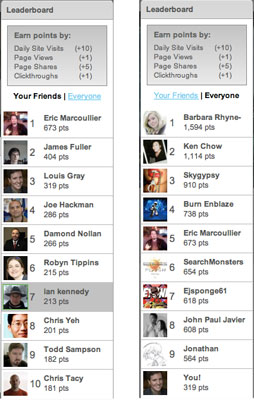
Now, instead of simply seeing the global OneTrueFan leaderboard for any site, you can now toggle between this ranking and a "Friends" ranking, which taps the connections you have made on Twitter or Facebook, surfacing the avatars of your buddies, giving you an even better idea of just what your friends are doing online, and what sites they find valuable. This way, even if you're a house hermit, you're never truly browsing alone. You can also now, for the first time, invite friends from Twitter and Facebook to join you on that site via the leaderboard, with a few clicks.

OneTrueFan Now Divides Friends From the World's Rankings

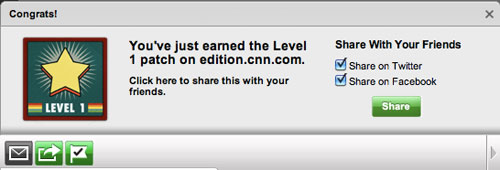
In addition to the friend segmentation, OneTrueFan also made a number of visual tweaks, most apparent to frequent users. Instead of a one-time bar flash that updates you on achievements, the message icon now glows red. When clicked, your most recent accomplishment, from the "Thanks for Sharing!" badge to achieving multiple levels from engagement, to achieving the much-desired OneTrueFan status, will be displayed in a larger, rectangular window, attached to the OTF bar.

The New Badging System on OneTrueFan

The enhancements are pretty slick and welcome for all existing users. It's always fun for me to find which sites my friends visit, and I'm often surprised when I find unexpected people in unanticipated places. The OTF team, on the heels of their excellent analytics package I discussed last Friday, continues to roll out useful updates.

June 15, 2011

June 15, 2011 · 4 MIN READ · BY LOUIS GRAY

Tech Leaders Don't Win By Saying They'll Crush Somebody

Tech Leaders Don't Win By Saying They'll Crush Somebody

The best technology companies in the world, be they in hardware, software or Web services, didn't get there by brashly saying they were going to take out #1, kill them or stomp on their grave. If you think about it, or do your share of reading up on Web history, you'll find that for the most part, the companies who we associate with leadership, be it through quality, market share or traffic stats, reached their position with a near purity of thought on their ability to deliver something new and differentiated. So when you read about company X targeting company Y or setting up to take them down, you can almost guarantee they either won't make it, or company Y is going to change the game again.

In the last few weeks, I've been doing a lot of reading on Silicon Valley history - away from the day to day news releases and rumor mongering, but a few years to a decade back in the past. I enjoyed reading "In the Plex" by Steven Levy, which walks through the rise of Google, and am nearing the end of "The Facebook Effect" by David Kirkpatrick, which goes beyond The Social Network's fight with the Winklevii and walks along Mark Zuckerberg and team as they try to change the world. In years past I've enjoyed plenty of books on Apple, Oracle, Microsoft, AOL and other tech titans, with similar paths.

In the recent cases of Google and Facebook, what you don't see is a lot of crowing about how they plan to "take down" Alta Vista, Yahoo! and Excite for the first, or to crush Friendster and MySpace for the second. In fact, as Levy points out, Google tried to sell itself to Excite in the early days, only to be turned down due to the engine's accuracy being so high it would reduce pages for ads to be displayed. Facebook quickly morphed from a single university system to a march on openness and increased social connections.

In Facebook's case, the failure of Friendster helped the company focus on system reliability to avoid issues that badly damaged the social pioneer, and contrasts with MySpace were common during the network's growth. But you don't see Zuckerberg targeting number one. Instead, he wanted to build a new platform with a higher mission.

Extend this to the world of mobile phones. If you remember the initial launch of the iPhone, Apple didn't talk about being the majority leader in market share. Instead, Steve Jobs set a target of one percent market share by 2008. Sure enough, in 2008, they reached 1.1 percent. (See: Ars Technica) They clearly beat that 1 percent goal, and kept going.

So when I read about challengers taking on big targets and swearing they will surpass them, I can't help but be skeptical. For example:
There are many many examples like this where the hubris outweighs the reality (all deference to the hardworking folks trying to make this happen). In 2008, I wrote that those talking about taking down leaders like TechCrunch and Techmeme only further proved how hard it is to be on top. In January of this year, I said there were no iPad killers, only alternatives. Don't get me wrong. Our iPads seemingly exist just so my kids can watch videos, while I'm much more open to using the Galaxy Tab, but I don't expect iPad sales to go anywhere but up for a while.

Look at who is on top today in whatever category makes sense for you. Social networking. Search. Mobile OS. Tablets. Storage systems. Operating systems. Printers. You name it. You would be hard-pressed to see those companies having talked big about taking down number one when they were on their pathway to success. They probably didn't do it at all.

I never saw Google commercials mocking Yahoo!. I never saw Facebook taking potshots at MySpace. Those throwing stones now should do what the big guys did to get here - focus on their business and do a fantastic job executing on something users really want. If they do, and they get a chance to get noticed, then they will get a chance to be number one. While bravado is fun for internal sales rallies and personal goals, it's probably not the best for a public press position. And those companies who are going to be the next Google, Facebook, Linkedin, Apple or who knows what... they're probably going to creep up on us and not tell the world they're going to do it. Just watch.

June 10, 2011

June 10, 2011 · 1 MIN READ · BY LOUIS GRAY

Quora Hits the Shuffle Button for Q&A Randomness

Quora Hits the Shuffle Button for Q&A Randomness

The stickiness of Quora for engaged users has been the ability to rapidly find discussions of interest on topics you've selected to follow, or from people you've connected with on the network. But while that alone can provide you with plenty of both information and entertainment, the question and answer service took a queue from services like iTunes, Tumblr and StumbleUpon by adding a Shuffle function tonight, which brings you to random pages within the site. Let the hilarity ensue.

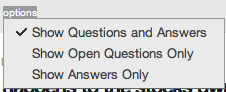
The Shuffle button, which appears at the bottom of any question and answer page, has three options, including showing both questions and answers, showing only open questions which lack answers, or just showing answers. You can also get to a random Quora page by going to the dedicated URL: http://quora.com/shuffle. Quora cofounder Charlie Cheever credited the new feature to two Quora employees, Shu Uesugi and Tracy Chou.

Quora's New Shuffle Button In Action

You Can Select What to See When You Shuffle On Quora

Using the Shuffle feature brings you to a random page on Quora, on any topic, be they posted by friends of yours or not, in topics you may follow or those you don't. Like StumbleUpon, there's certain to be a high bounce rate of people scanning quickly and hitting the "Next" button to get the next Shuffle. But it does have the option to spring people out of a self-reinforcing echo chamber and being exposed to more serendipity. No doubt Marc Bodnick loves it. Start shuffling at http://quora.com/shuffle.
June 10, 2011 · 5 MIN READ · BY LOUIS GRAY

Chromebooks Poised for First Look Under the Microscope

Chromebooks Poised for First Look Under the Microscope

Google's browser-centric Chrome OS will be getting its first reviews from those outside of the company's beta program starting this week as units from Samsung and Acer reach the first buyers on OEM hardware. Already, reviews have started flowing in, with the first observations offering a mixed set of feedback, as many struggle to find a way to assess the products - either comparing them to traditional OS-based laptops, or thanks to the pricepoint, against low end netbooks.

Unsurprisingly, the responses are typically positive about the ease of use and access, but eyes are quickly drawn to what's missing, namely, the host of traditional software applications that live beyond the browser today.

Browsing my Mac Mail on Chrome OS With Google Music Playing


When launching a new product into a very crowded space with tons of history, a new challenger needs to determine a few things, including:
  • Does the product accomplish something altogether new, never done before?
  • Does the product improve upon existing systems in capability or performance?
  • Does the product save people money while offering similar capability?
For those curious about ChromeOS or iOS or Android or any new technology, the basic questions revolve around whether the new product will help them achieve more, or avoid problems with what's already in place. In my initial review of the beta CR-48 unit, I said the browser lock-in felt like I "had been placed on house arrest," adding "serious efforts will need to be taken to convince people why putting everything in the cloud, and abandoning (for the most part) applications they know well, will help their lives." This is the age-old conundrum of marketing in general - tell us why it's better, not just that you've introduced something, but why this will help me.

In the ensuing months, I have increasingly been using my ChromeOS notebook (and am writing this post on it now, while streaming tunes on Google Music). The device's built-in 3G connection, thanks to Verizon, and incomparable battery life has made it a must for events and practically any time I leave the house. I've taken to calling it my "car computer", much like the carphones of old, as instead of lugging a heavy laptop bag complete with power cords, I just put the CR-48 under my arm and then place it on the passenger seat. I'm often stopping before or after meetings to use the laptop from the parking lot, or catching up on email before I drive to the next place. It's incredibly convenient. That said, it's still playing the role of the "second computer" for me and will likely for most people until they get more accustomed to cloud-based Web apps, and as those apps increase in number and quality.

Google's team hasn't said ChromeOS is for everyone. For designers bound to Final Cut Pro and PhotoShop, abandoning those apps is a practical impossibility. At Google IO the company instead spoke to the worker bees who primarily use their company laptops for email, Web access and word processing, all of which can be done on ChromeOS with solid quality, even if Google Docs still takes some getting used to for the Microsoft Office whiz. The company's initial marketing forays speak to fast boot up (which is yes, very fast), the elimination of viruses so common on Windows (but don't scare most Mac users), and the future being the Web. As I wrote on Tuesday, the definition of cloud differs between tech companies these days, but Google's approach, where all user data is on the Web, and the hardware is interchangeable, seems the most pure.

My Current Array of Browser Apps Is a Start for ChromeOS

A Web centric world is one that takes some getting used to, but once you've gotten used to having 3G networking everywhere, and battery that goes all day, typical limitations seem substandard. My wife borrowed my CR-48 to take with her to a meeting at church (which has no WiFi) and while on 3G, she was able to download the membership directory and edit a spreadsheet for upcoming meeting schedules. On the CR-48, all we had to do was make a new user for her on my machine, tied to her own Google account, and her activity didn't get in the way of my own.

Initial feedback on the CR-48's flaws, including the much-maligned trackpad and perceived pokiness, have pretty much been eliminated after months of quick driver updates over the air. I now routinely have Google Music running in one browser window, Seesmic or Twitter in another, and in a third, multiple tabs open to my multiple email accounts. Instead of a cluttered interface, however, Chrome OS has adopted to let me quickly rotate screens, either from a dedicated key for "Next Window" or the familiar alt-tab, used more commonly to switch apps in Mac or Windows. And knowing what I know about Samsung's high quality hardware, which is behind my Android tablets, my Android phone and the TVs in our house, I am looking forward to seeing what they do with their first Chromebooks.

With this first volley, you can anticipate media reaction, which will no doubt be eager to claim success or failure of the project, with box counters and trend spotters alike looking for initial sales numbers and market share penetration. My bet is you won't get sales numbers from Google directly, while Samsung, Acer and others will give insight into the results, or Best Buy might report the data from their online store. It's also extremely likely that Google is in this game for the long haul. Chrome is one of the pillars of the company, so if there is anything resembling slowness, they'll listen and iterate fast, as they're known to. Meanwhile, you can look forward to headlines like those from PC World who eagerly said Chromebooks are "doomed to fail". Everybody wants their bets in early, in the chance they might be right.

What I know is that after initially relying on MacBook Air for more than 90 percent of what I do with my laptops, the Chromebook is taking more and more of my time and it's liberating to take it with me to the park or anywhere I need to go and know my data and my Web will be with me. I look forward to apps I've had to leave behind, like Spotify and others, making the leap to the Web and away from the desktop metaphor. I'd bet, just like the transition from Mac OS 9 to Mac OS X a decade ago, those laggards will get there. And you just might see people increasingly taking to Chromebooks for low-cost access to the Web.
June 10, 2011 · 2 MIN READ · BY LOUIS GRAY

OneTrueFan Unveils Fan Engagement Analytics for Blogs

OneTrueFan Unveils Fan Engagement Analytics for Blogs

Even if you run the most sophisticated visitor analytics software, connecting impersonal IP address data and browsing history to real people can be a challenge. Only through external activity on social networks, or through blog comments can you get a real picture of the people who take in your content. OneTrueFan, which I've happily sported on this blog practically since the product's launch, continues to try and eliminate the mystery, helping content providers connect with their community, and for the visitors, find others with similar interests across the Web. In that vein, OneTrueFan has introduced detailed fan engagement analytics that go a step beyond traditional visit statistics, helping you get an idea of which of your regular readers' took in a specific story, or shared it downstream. In time, you can get a great picture of what stories resonate with which readers, making the impersonal personal.

OneTrueFan Fan Analytics for ReadWriteWeb

On launch of the new fan engagement analytics, OneTrueFan has also unveiled a list of the top 25 tech sites as measured by fan engagement - giving you a look into these site's live statistics, day over day changes, and a live scrolling of all the content being shared downstream.

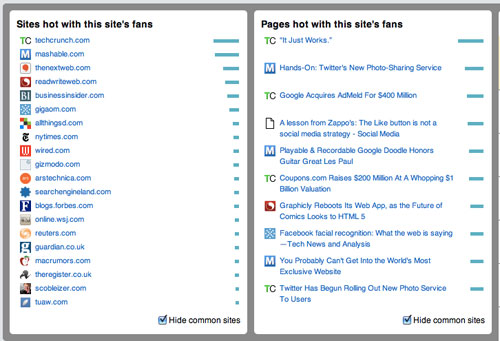
Top Pages Visited by LouisGray.com Fans In the Last Day

The stats, which you can preview for these top 25 properties, highlight the most popular pages in the last 24 hours, along with avatars of these top fans who engaged with the content, and shows which sites are popular with that site's fans. Unsurprisingly, especially in the world of tech, you can see many people are fans of multiple sources. For those running the OneTrueFan bar, you can dive deeper into the data, seeing impressions, fan reach, new users, shares and even data on how the bar is being used or hidden.

Sites Popular With LouisGray.com Readers and Top Pages

OneTrueFan is a lot more than a simple bar that shows you the top ten fans of the site. I make the bar a must install on all my browsers on all my computers to help me share content downstream and track my browsing history. There's value to the viewer, and now, increasing value to the content provider who gets a real live look in to what their most engaged fans are doing with site content.

For months, I've gotten questions about why I've given OneTrueFan such prominent space on this site, all free of charge. I've done it not just because I like the team, who brought MyBlogLog to the world seemingly ages ago, but because I like seeing real faces and encouraging sharing of my content. The world may be built on ones and zeros, but it doesn't have to look like it.

If you have a blog, I would encourage you to add their bar and start getting real fan analytics. If you browse the Web, check out the browser extension, and find out what people like you have been sharing. It's a thinly spread social network for the entire Internet. OneTrueFan, as always, is here: http://www.onetruefan.com/

June 9, 2011

June 9, 2011 · 2 MIN READ · BY LOUIS GRAY

Graphicly Expands Website With HTML5 Comics, Sharing

Graphicly Expands Website With HTML5 Comics, Sharing

Boulder based Graphicly, best known for its comics reading and purchasing platform on mobile devices, desktop and the iPad, is expanding its reach to the Web with the relaunch of a brand new Web site which brings comic book reading to the browser, along with expanded community features and the new option to share comics and stories around the Web for fellow fans. The Web launch, on the foundation of HTML5, hopes to not sacrifice any of the user experience while making access to all the digital media independent of the device.

Graphicly, whose most visible advocate is well known social Web personality Micah Baldwin, the cofounder who has led the charge for the company since officially joining at the start of 2010, has doubled its user base over the last six months, and is now seeing a new comic book downloaded every minute. True to form, Graphicly reports every social action taken by a member of the community is viewed more than 400 separate times. This tight connection with community and inherent virality of comics is a major reason the company has doubled down on sharing capabilities with its new site, which goes live today.

An HTML5 Comic With Sharing Features on Graphicly

Starting today, comics and other Graphicly content can be shared across the Web, putting publisher content in front of more viewers, all of whom can convert to paying Graphicly users with some effort. Graphicly's approach has been to bring the same consumption, buying, social and sharing experience across all screens.

A Standard Graphicly Profile With Purchase History and Connections

“With our focus on HTML5, storytelling, collaboration and sharing that you can be done anywhere online or mobile, Graphicly’s full vision is becoming a reality," said Baldwin. "over the past year, we have met a lot of awesome fans, creators and stories, and they have no place to truly interact online. This release is the first move towards allowing all that awesome to connect in one place."

Sharing Functionality on Graphicly

The Graphicly Chrome Web App

With the battle over the definition of the cloud raging between the major Web giants, Graphicly has sided with both approaches - building dedicated apps and even being featured at Google IO for its Chrome Web app, but now moving into the full Web, backed by HTML 5. This sets them up nicely for reaching any mobile or desktop device its users want to leverage to read content. In fact, they promise in a release today to help bring author content to Kindle, Barnes and Noble Nook, or "any platform they choose".

You can find the new Graphicly at http://www.graphicly.com, or just search for Graphicly in practically any app store.

June 8, 2011

June 8, 2011 · 2 MIN READ · BY LOUIS GRAY

Social.com Auction Postponed Due to "Technical Issues"

Social.com Auction Postponed Due to "Technical Issues"

A little over two weeks ago, I told you the Social.com domain was going up for bid to any company looking to obtain the premium URL. The auction was set to take place today, along with other premium domains, including Fares.com, SUV.com and Data.com, but has been postponed, due to technical issues with the domain sellers themselves. So while many are curious if Social.com will go for less than seven figures, or if its high $5 million reserve will be hit, that answer will have to wait until another day - tentatively scheduled for next Wednesday, June 15th.

In the meantime, the Data.com URL actually did sell, ahead of the auction, to Salesforce.com, for more than the $1.5 million reserve set at the auction house. Scott Carter, owner of Social.com, said the deal closed Friday, and that "domains are sold prior to the start of a live auction if the buyer is willing to pay a premium over the reserve."

As Erick Schonfeld of TechCrunch noted in his coverage of the Social.com sale last week, Scott put the domain up for sale in 1997 for $50,000, but for two years, nobody bid and he pulled it off the table. By late 2004, Scott again was asking around to the value of the domain, with domain watchers quoting high five figures to low six figures.

In that September 2004 thread, Scott wrote, "I appreciate all the replies. The range was anywhere from $x,xxx to $xx,xxx. I must admit that I had expected it would be valued closer to the 7 figure range but of course I'm a little biased. I'm going to hold onto the name for now..."

Following 2004, we saw the social media and social networking explosion, so much of the world assumes Scott will get much more than the estimates from seven years ago, even if reactions to today's canceled auction brought out skeptics, claiming today's "technical issues" were a cover for buyers not meeting the high reserves. The world loves a conspiracy.

"I'm still waiting for details on why their systems went down today," Scott wrote me in an e-mail this afternoon, adding, "Not a great day."

With Data.com selling above its reserve, it shows there is interest at the 7-figure level for premium names. We're going to have to wait another week to see if Social.com is one of those companies, or if it ends up going for a lower amount.
June 8, 2011 · 4 MIN READ · BY LOUIS GRAY

Cliqset Cofounder Preps Distributed Social Platform Glow

Cliqset Cofounder Preps Distributed Social Platform Glow


For those who believe strongly in a future of federated social networking, not owned by the large Web brands, the perceived lack of success from existing social projects, including Diaspora, Status.net and others has been extremely frustrating. Darren Bounds, cofounder of the ahead of its time social Web pioneer Cliqset, aims to do something about it, working hard on his second act, called Glow, a distributed social infrastructure aimed at closing the usability and feature gaps in today's federated systems. The launch of this new system is only a few weeks away.

As he describes it, federated protocols and standards often get in the way of building a pleasant user experience, which makes supporting important features like global people discovery, global content search and anti-spam practically impossible, as no information exists in a single place that's easily analyzed. The goal of Glow is to deliver a distributed alternative to Twitter or Facebook, while still delivering full support of their feature set, with no sacrifice to the user experience, while still keeping data ownership in their hands.

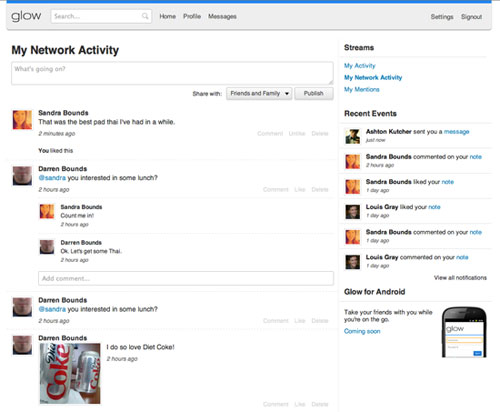
An Early Glow Instance With Sharing, Photos, Comments

Glow looks much like existing platforms, from FriendFeed to Facebook and Twitter, consisting of aggregate network activity, status updates, and nested comments. When creating content, users are able to organize their followers into a number of predefined groups, and you can dictate which group will receive it, keeping the content private to only those on the intended recipient list, unlike Twitter's all public or all private approach, and more similar to Facebook's select distribution and lists, which have proven difficult for most users.

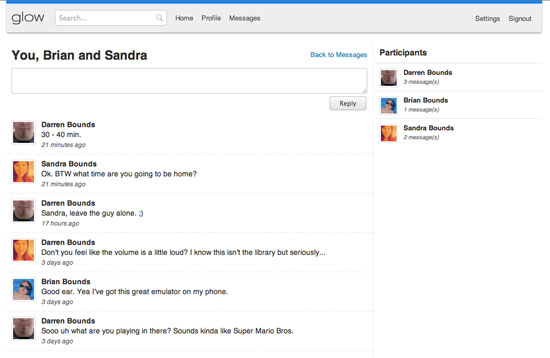
A Private Group Message on Glow With 3 People

At launch, Glow will offer a centralized option, as well as the opportunity for you to launch your own dedicated node, the equivalent of running your own single user copy of Twitter that looked and felt just like it does on Twitter.com, with the same users and experience.

From a feature perspective, Glow will support all the features of a modern social network, with the usual status updates, photo and video sharing, implementing the "follow" model, along with likes, mentions and comments. Additionally, the service is location-aware, which brings forward its own opportunities. What it does not do is aggregate content, a hallmark of Cliqset and other sites, like FriendFeed.

"Glow is an attempt get us a few steps closer by created a system that behaves as users have come to expect while increasing privacy and user control in the process," Darren wrote me in an e-mail. "Glow itself is not a federated system, it is a hybrid architecture combining aspects of centralization with that of decentralization."

True to Darren's background, which featured early implementation of Web standards like Pubsubhubbub and Salmon with his Cliqset effort, Glow will come with a robust API for developers to create applications on to, assuming user authorization. One example Darren gives is the option for users to provide access to their data in exchange for more personalized advertisements (which we've discussed often).

While Darren says Glow itself is not a federated system, those looking to set up their own Glow nodes can do so - much like Status.net, giving them full and complete control over the content. Glow is heavily tied to the Amazon cloud, helping keep costs free to users and low to Darren.

"Basically, if Twitter and Facebook had a great looking and highly intelligent child together who grew up to solve world hunger, it would be Glow," jokes Darren, who says that the product is still in the realm of personal experiment, more than an actual business. The project is being completely self-built, and Bounds hasn't yet taken any funding.

While Status.net and Diaspora have made new in the past for their approach, most federated systems have put technology ahead of the user experience, and have suffered in adoption. Glow is hoping to achieve the benefits of federation without sacrifice of technology features or user experience.

"I've taken many of the best features of Facebook and Twitter and combined them with some of my own special sauce," Darren says, "The result is a reinvention of social network architecture with none of the user complexity of systems that have come before."

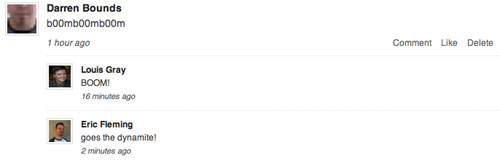
A Simple Nested Comment Stream With Option to Like or Delete

In future enhancements, after initial launch, Glow content will be organized into two types - user content and publisher content. Its architecture ensures that user content is created by people and not bots, and a publisher marketplace is being designed so organizations can push content and build community. Publishers will be organized much like Apple's App store, with categories and featured communities.

Darren is nothing if not ambitious. Cliqset, while it didn't attract massive the massive user base it deserved for all the work put into it and pioneering of leading-edge technologies, was always well respected for its forward thinking. Glow, marinating at http://glow.io, should be just as forward thinking, but instead of pushing people into a single domain, it's allows people to create their own instance, run it anywhere and own their own data. It's all about putting the power of social networking back in the users' hands, with real privacy controls and simplicity.

June 7, 2011

June 7, 2011 · 2 MIN READ · BY LOUIS GRAY

Steve Jobs Proposes Spaceship-like Future Apple Campus

Steve Jobs Proposes Spaceship-like Future Apple Campus

Sitting where I do in Sunnyvale, driving ten minutes South can have me on the Apple campus, and driving ten minutes North lands me at Google in Mountain View. With both companies hiring like mad and buying up the surrounding real estate in their respective communities, it's likely that I'll be surrounded by Goople in just a few years. As far as I'm concerned, that's great. More money for the area, more jobs, and more innovation, even if the two companies are occasionally not the biggest fans of one another.

Tonight, Steve Jobs stepped down from the lofty pedestal most of us hold in our heads for him and presented at Cupertino's City Council meeting to offer his vision for a much-needed second Apple Campus, a futuristic flying saucer like building which he said could hold upwards of 12,000 employees, up from the less than 4,000 who inhabit the company's headquarters at 1 Infinite Loop. As he told the council tonight, Apple has been buying or renting all the surrounding office space they can in the city, and some of it just isn't good.

The Proposed New Apple Campus (via Video Still)

Like Apple's hardware and software, this proposal has a distinct design - one that borrows from the company's experience in building its hundreds of retail stores. Job says there is no straight piece of glass in the entire building, which makes a continuous circle, with its innermost part being a central courtyard. "We know how to make the biggest pieces of glass in the world for architectural use, and we want to make the glass, specifically for this building, curve all the way around the building."


Much like the beautiful, if not commercially successful, G4 Cube, Jobs' says this design "is pretty cool." His approach to the council is humble, one of storytelling, a position where he says Apple is "growing like a weed", and wants very much to continue being part of the city. It's an incredibly human presentation from a man who does this better than pretty much anyone - taking his story to the people he needs to help. I can't imagine Larry Ellison of Oracle or Steve Ballmer of Microsoft not only doing this, but doing so in such a compelling way that makes you want to help.

No matter your computer or mobile preferences, or thoughts on Apple's approaches in other markets, you can learn a lot from the way Steve Jobs does business. Even this presentation to the council is worth watching. I hope that we see this campus built practically in our backyard.
June 7, 2011 · 4 MIN READ · BY LOUIS GRAY

The Split Definition of Cloud Suits Those Speaking

The Split Definition of Cloud Suits Those Speaking

Like any good Mac user and tech fan, I absorbed yesterday's announcements with Apple with great interest - knowing the OS updates will be hitting my laptop in a few months' time, and the iOS feature bumps will reach our array of iPod Touch and iPads at home - eventually seeing the best of these new features trickle out to non-Apple systems (including our Androids) thanks to the continued leapfrogging we see in this closely followed industry. But where Apple struck was where one would expect them to - in a manner that suited their interests. It's not necessarily always best for the future, but what's best for them. All money-driven companies would love to shape the future to meet their needs.

The most heavily anticipated updates from Steve Jobs and crew yesterday pertained to their introduction of iCloud, the next generation of MobileMe and iTunes. With Google and Amazon having announced music lockers, and streaming services like Spotify, MOG and Rdio in the mix, Apple's big move into the cloud was much-discussed, as news items followed each label, signature by signature, and watched the tea leaves to try and anticipate what Apple would deliver.

Apple used the term iCloud to represent the near-synchronization of digital media between a host of devices, from music to movies, books and photos. Buy once and play anywhere was the idea. No more moving of data back and forth. That's good stuff - and much was made of the $25 a year iTunes Match, which would push all your music, purchased on iTunes or not, to your other devices. Very clean, but oddly misrepresented, I believe. Apple says that iCloud stores your music, and its description page strictly states "your music is stored in iCloud", while the music automatically appears on your registered devices. But it's not streaming, and it's not as if when you are playing your music that you are doing so from their cloud. You're still doing it from your local device.

In contrast, we have seen two major business models from more acceptably-labeled cloud music services. The first, like Google Music, has you upload all your tracks (which can take a while) and then you can play them in a Web browser, any Web browser with your Google credentials, and play any time you like. The music is hosted in the cloud and streamed to you. The second, like Spotify and others, lets you tap into their available tracks, including playlists you've made from that library, and stream it to you.

Apple did not announce either of those approaches yesterday. They kept with their device-centric model which is making them billions of dollars and quite honestly, simplifying the Web and applications for millions of people. As I joked with one ardent Apple fan yesterday, Apple makes other people's inventions beautiful. They do quite a bit of innovation on their own, of course, but they sure do know how to take other people's ideas and make them look fantastic. But they didn't turn their back on their devices, despite talk of making them second-class citizens.

Google's approach on being truly Web-centric, and not tied down to specific devices, supports their business model, of course. They are making money from Web services (and associated advertising) while commoditizing hardware, which we will see with a big kickoff in a few weeks with the launch of the first ChromeBooks. The ChromeBooks, including the CR-48 which I've been using since December, bring you the Web and nothing but the Web. Sign in with your ID and get your content. Sign in with somebody else's ID and get their content. It's a fantastic idea and one that clearly supports their own business strategy. Their cloud interpretation supports what makes sense for them.

The divergence between these two players' strategies was in clear display yesterday. As a Mac user who has multiple Apple devices and a host of iTunes files, having them everywhere is cool. But I did also make the move to put them in the cloud (Google's version) and love the fact I can get to them from anywhere. Having used the CR-48 a ton lately, it's eye-opening to think of how the hardware is practically disposable. Assume you're logged out and it gets stolen. So what? Go buy a new one. For the price of a high-end iPod, you get everything back. No lost data or preferences. Google's interpretation of the cloud, which matches their interests, has some kind of real value to the user, and so does that with Apple.

If I was looking for a big announcement from Apple yesterday to keep me on iTunes instead of Spotify, it didn't come yesterday. I didn't see a major reason to stick with MobileMe/iCloud instead of Gmail and Google Docs either. But I absolutely see real value in their introductions, and anytime you see major companies slugging it out on quality for their users, everybody wins. But don't expect them to tell you what the future holds, unless you know that their projections are directly in line with what they can sell you today.

June 6, 2011

June 6, 2011 · 1 MIN READ · BY LOUIS GRAY

Bebo CTO & Hi-5 Cofounder Akash Garg Heads to Twitter

Bebo CTO & Hi-5 Cofounder Akash Garg Heads to Twitter

While the rest of the tech world is focused on dueling announcements from Apple at WWDC and Microsoft at E3, Twitter quietly picked up one of the technical pioneers of the Web 2.0 movement, Akash Garg, a cofounder of Hi5.com in 2002, who most recently held the position of CTO at Bebo, where he worked for almost a year, starting in July of 2010. Upon joining Bebo, he was quoted as thinking of the company "as a startup". Now at Twitter, he's got one that more closely fits the label.

Credited with developing the technology behind Hi5's growth to more than 250 million registered members (per LinkedIn), Akash paralleled decisions made by other fast-growing companies of the time, including SixApart, Google and others by leveraging low cost commodity hardware to deliver a highly scalable, highly available system - something Twitter is getting increasingly better at after years of spotty uptime.

Twitter's communications team confirmed his hire, saying only that he is an engineer on the Platform team at the company. Last Friday, a colleague, Sabrina Bruning, in community management at Bebo, posted a photo from a goodbye on his last day at Bebo (See the tweet along with Foursquare photo) and he was added to Twitter's Team list this morning, an informal way to track the comings and goings of Twitter's fast-expanding roster.

In addition to his work at Bebo and Hi5, Akash is a mentor to 500startups and i/o Ventures.
June 6, 2011 · 2 MIN READ · BY LOUIS GRAY

Zerply Opens to the Public, Adds an Array of Features

Zerply Opens to the Public, Adds an Array of Features


At the end of last month, I highlighted Zerply as an intriguing alternative to About.me or LinkedIn. The professional-looking personal profile network, then in invite-only beta, is now open to the public, so anybody can join and start adding business contacts. While still retaining the beta tag, the site's founders have added a whole list of features that should aid in expanding one's network, seeing site activity, and serendipitous discovery.

While the company is billing the upgrade as a redesign, the improvements are more about function over form in this round.


New Stats and Notifications on Zerply


As any business network is more powerful with connections to others, the site, like many others, offers the option to connect to Facebook and Twitter to find friends elsewhere on the site, where you can easily save people from these search results to your network/address book. You can now search based on the location of other members, and can click on others' listed location to see additional users in a radius of 50 kilometers, wrote cofounder Christofer Karltop in an email to me last night.

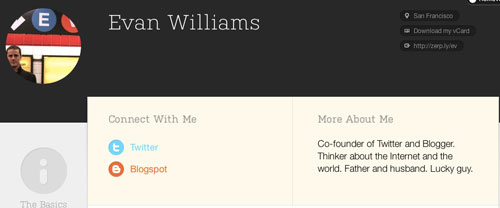
Ev Williams' Zerply Profile: http://www.zerply.com/profile/ev

One of the twists to Zerply upon registration is self-tagging with keywords that describe your background. Users can endorse your tags, and these updates are now shown in a notifications tab upon logging into the site. Coming soon, possibly even in the next 24 hours, is the option to receive email notifications when others endorse you or your profile is saved to another's network.

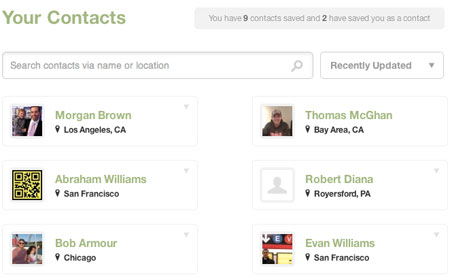
The Zerply Contacts List/Address Book

True to practically every social network, casual or business, is the craving for statistics. Zerply now tees this up as well, letting you see how many unique profile visits you have received in the last calendar month or all time, and how many clickthroughs your listed services (such as your downstream social networks) have received.

I liked Zerply enough that I made it my personal profile link on Twitter and you can find me here: http://www.zerply.com/profile/louisgray. If you didn't get an account the last time I wrote up the site, now's the time. The door's open at http://www.zerply.com/.

June 5, 2011

June 5, 2011 · 2 MIN READ · BY LOUIS GRAY

New Chrome Extension Lets You +1 Tweets on Twitter

New Chrome Extension Lets You +1 Tweets on Twitter

Following the release of the Google +1 button for Web sites (such as this one) last week, the search giant's answer to the Facebook Like button is popping up everywhere. Seth Ladd, a developer advocate for Google, has gone the extra mile, posting a Chrome extension that adds the +1 functionality to Twitter.com, so you can +1 tweets you like, and have them displayed on your Google Profile. This is a lot like Jesse Stay's hack with Kynetx which added a Like button to tweets late last year.

As Twitter's Web site becomes more versatile, Twitter.com has become a target for innovative development for developers looking to bring more functionality to users, including my6sense's relevance tab which we introduced in February, and the word filter posted by Mike Grace, tapping the Kynetx platform. Seth's proximity to the +1 launch as well as his fondness for Google Chrome and HTML 5 (he's one of the more ardent advocates and presented at Google IO this year) no doubt made the interest to bring +1's to Twitter a must-do.

+1 Buttons and Share Counts In the Twitter Stream

The +1 extension for Twitter not only displays +1 next to tweets in the stream, letting you +1 them, but also shows how many other people across the platform have also done so. It's a lot like seeing how many people have favorited or retweeted a tweet within the tweet itself, data which can be harder to find. The extension itself is open source.

Seth's Tweet has Been +1'd 3 Times

Tweets I +1 Show on My Google Profile


The extension itself is JavaScript-based and only is active when on the Twitter.com domain. Seth goes into detail on his post explaining how the +1 extension works, and how he needs to wait for the entire Twitter page to load before displaying the +1 buttons, while also explaining some shortcomings that apply to polling for new tweets in the timeline. Surely beyond version 1.0, those tweaks will come. Luckily, for those who have already grabbed the extension, it should update automatically. Go get it.

June 4, 2011

June 4, 2011 · 5 MIN READ · BY LOUIS GRAY

A Scorched Data Policy Is Bad for Web, Bad for History

A Scorched Data Policy Is Bad for Web, Bad for History

In a world where the cost of storage is practically zero, and the incentive to delete data declines, I'm befuddled by the lack of prioritization for some companies to focus on a complete search history, and in parallel, an intentional erasure of information by more prominent content producers, who seem to arbitrarily decide that the long tail of the Web, and the interest of future readers is less important than being seen as participating in the latest hip wave.

Even as I've changed technologies, blog providers and structures, I make extra effort to not lose historical archives and keep comment streams intact, not for ego purposes or for SEO, but because it's the right thing to do.

Steve Rubel, an executive vice president of global strategy for Edelman, a longtime blogger who was among the first to espouse the benefits of blogging, social media and was often at the leading edge of tech only a few years ago, has more recently swayed to and fro based on the hot startup of the day, leaving thousands of broken links in the process. After running out of time to update his blog regularly, back in 2009 he ditched the blog to run a lifestream, based on Posterous. (Google cache). Last month, he pivoted again (another hot thing to do in the Valley these days for those with unsuccessful ideas) and now is the proud owner of a Tumblr-powered blog.

Pivot Number One Saw Steve Go to Posterous

Pivot Number Two Saw Steve Go to Tumblr, and Delete Everything

But instead of leaving the older sites open, he deleted everything, proudly stating:
"With just two clicks of a mouse I rid the web of literally thousands of blog posts, some of which I am proud of - others less so - and redirected the URLs to the new site."
While no doubt many of his older posts (like mine) have limited or no value to today's readers or those in the future, they are an insightful historical record of one of the more visible bloggers of a specific period, one who is now in the process of erasing his tracks.

With more than five years of blogging myself here, the blog archives now take on their own role as a personal reference desk. When Kevin Rose left Digg, I was able to go back to my comments on Digg in 2006 to see my thoughts at the time. When TweetDeck was sold to Twitter, I could go back to 2008 and see my first thoughts on the service. With PostRank selling to Google yesterday, I found a post I made two years ago that had comments on it from people who now work at Google. If I didn't manage to keep the posts alive and the comment threads as well, this would not be possible.

Steve's Community Is Very Unhappy With the Deletions, Calling it "Nutty"

Others Say Erasing "A Bit Much", Want Their Comments Out

For those of you who don't consume my blog exclusively by RSS, you might have noticed some recent changes to the look and feel (Go ahead and look). It's not a major change, but an upgrade nonetheless. Part of the reason for my slow migration was the criticality for me to not lose the existing posts, structure, external links and attached discussions. I know some comments from a few years ago are still out of reach, but I'm hoping to bring them back.

Of all the Web content I have produced or managed in the last fifteen years, one of my biggest regrets is the complete void from my time in college, both from my own personal home page, and from the student newspaper where I was the online editor and also wrote hundreds of posts, most on the front page. Current Valleywag editor Ryan Tate, who picked up the online editor job at the paper after I had left, struggled with a series of malicious hacks, and all our collective work was gone, erased from the Web like a bad memory. Whenever we trade emails or talk in person, we both lament this loss.

Steve's Original Micro Persuasion Blog, Pre-Deletion

This data obliteration is something that really is avoidable now, and yet, we let it happen on a near-constant basis. Most newspaper stories from the terrorist attacks in 2001 come up as 404s, beyond the reaches of the Archive.org project, or Google's search engine cache.

What I would like to see is a proposal from Google, or some other well-intended Web entity, such as Amazon, to offer a solution, embedded in today's modern browsers, as an option, that solves for intentional or unintentional content deletion. All those links that I provided back to Steve Rubel's MicroPersuasion blog from 2006 to 2009 should automatically be detected as dead, and then presented, to the best of the tech's ability, as they originally were, using Google cache or S3, Archive.org or something. And yes, I'd love it if somebody like Google or Microsoft would also give Twitter or Facebook a helping hand to get their own search archives into something useful.

Steve Thinks The World Won't Care About His Old Posts.

The issues I have with Steve's approach to pouring gasoline on his past and then lighting it on fire is not one of a choice of platforms. While seeing him join Tumblr is about as hip as your dad trying to snowboard with the cool kids, the more important part is that it eliminates the choice for readers, present and future, to ever get that data, and fill in the blanks. It's not his call to decide what has value for others, even if he sent me a tweet saying "we're foolish if we think the world really cares."

The world should care about walking through the historical record - be it on Steve's blog, or Dave's blog, or Robert's blog, or Mike's blog, or Penelope's, or any of the people who have been chronicling the world they see around them. I wish we had full archives from newspapers for years and decades backward, or the personal journals of people famous and ordinary from centuries past. What they might have found mundane is intriguing to others of us - maybe not massive populations, but to one person, they could contain serious insight. The Web is supposed to cater to the long tail, and the history of what we've produced should be there when they come looking for it.

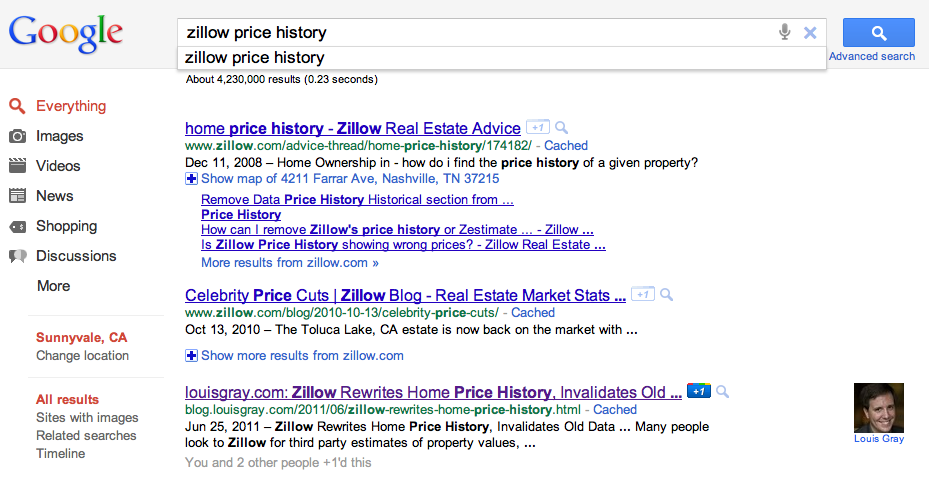
June 2, 2011

June 2, 2011 · 2 MIN READ · BY LOUIS GRAY

Record Labels Yank Videos from Youtify Over Syndication

Record Labels Yank Videos from Youtify Over Syndication

Saturday night, I introduced the service Youtify, a neat service which helps find top music videos and playlists from YouTube, and organizes them in a browser app that looks much like iTunes. Though I published late on a weekend, the story was quickly distributed, especially on Twitter, with nearly 150 shares of the story. But the fast rise to visibility has hit a wall for the service, thanks to problems that started late Tuesday night, when almost all the top videos from YouTube simply stopped playing.

It turns out the rights owners for the music videos themselves, primarily record labels, put a stop to their content being played on the site, with Youtify specifically being blocked.

Per Thulin, one of the cofounders of the project, along with Karl Tannergard, initially thought he had somehow run afoul of YouTube's API rules, as users found the video player was rendered almost completely useless. But after reaching YouTube, they confirmed it was the record labels, and not they, who had stopped access.
Youtify Ground to a Halt Thanks to Record Labels' Intervention

That the record labels aren't immediately excited about yet another cool and innovative way to showcase their artists' content is no surprise. They've been late to the game and backward in practically every opportunity over the last 20 years. As Thulin wrote me in an email, the action caught them by surprise, especially as nobody made any attempt to contact Youtify directly.

Youtify's Playlists Show Holes Thanks to Rights Management

"Our new plan is to embrace and reward the artists and labels still allowing us to play their videos," he wrote. "We will let those artists and labels put ads in our application for free, and also let our community help spread these videos, generate good ratings, viewcounts, shout-outs on Twitter, etc. We hope that our growing community will generate enough noise for them to reconsider!"

Other Songs Not Impacted Play As They Always Have

Unless the record labels change their mind, the most likely culprit being VEVO, who owns a large portion of the videos that aren't working, Youtify, for the time being, is somewhat hobbled. A small fraction of the Top 100 songs play, while amateur content from "Best of YouTube" still runs as will many searched for playlists that don't intersect by the resistant labels.

The concept for Youtify is great. Even the user interface got a revamp in the last few days following the initial post. But the content is what it's all about, and if they are starved for content, users will probably not be made loyal. The question is will the labels let this one go, or will they remain obtuse?
June 2, 2011 · 4 MIN READ · BY LOUIS GRAY

Apple's Missed Identity Play: "Sign In With Apple"

Apple's Missed Identity Play: "Sign In With Apple"

One of the greatest tug of wars amidst leading Web companies today is that for ownership of your identity, through your personal profile, or pushing you to "Sign in with" their credentials. You may sign in with Twitter, Facebook, Google or OpenID, and enable those services to certify it's you. One of the most successful tech companies out there who never comes up in this conversation is Apple, and it's incredible to think how easily they could have converted its army of Mac loyalists (myself included) to "Sign in With Mac", carrying the Apple flag forward as a badge of honor. More than a decade after getting my .Mac e-mail account (and later signing up my wife to do the same), I am splitting my email activity fifty-fifty with GMail and haven't gained much reason on Apple's side to double down on Cupertino.

When Steve Jobs unveiled iTools at MacWorld San Francisco in 2000, one of the primary offerings of the then-free product was an e-mail address ending in Mac.com. Fresh off success with the 1998 launch of iMac, and still a year away from the debut of the iPod, the company still had its most loyal followers "Thinking Different", and sending people messages with my Mac.com account was cool. It told everybody who would get a note from me that I had chosen Apple. Even when I would have to spell out my e-mail address on the phone, I'd always tell people... "M.A.C. As in Macintosh" in case it wasn't obvious.


Steve Jobs Introducing iTools (MWSF 2000)


But for a variety of reasons, the Mac.com address wasn't especially capitalized on. The service, initially free of charge, controversially converted to an annual paid service by 2002, alongside tools such as iDisk and .Mac home pages, and later rebranded as MobileMe in mid-2008, pushing people even further away from the allegiance with Apple but instead to theoretically more personal Me.com address.

When Apple initially made the move away from free Mac.com addresses for all, the message was that the free mail service was being abused, which no doubt cost them money and headaches - on top of costs for iDisk storage. But of course it also decimated the potential audience of users, most of whom already had free email accounts from somewhere else, be it Hotmail, Yahoo, Netscape or their ISP. Using a Mac.com account almost seems like an artifact unless you're a clear Apple loyalist.

In parallel, while Apple put MobileMe/iTools/Mac.com/whatever on the backburner, the company experienced incredible success with the iTunes ecosystem. Every iTunes customer has an Apple ID (or signs in with AOL), and has trusted Apple with their credit card details, as iTunes expanded from its initial offering of music to music videos, TV shows, movies, books, and of course, mobile applications for iPhone, iPod Touch and iPad. So Apple's effectively sitting on one of the most actively spending user databases in the world, but one that isn't leveraged elsewhere on the Web. There's no "Sign in With Apple" on major sites like the New York Times or CNN. There's no "Sign in With Apple" on Amazon.com or eBay.
iTunes Knows My Apple ID, but the Rest of the Web Doesn't

The fight for identity relevance between the major players of the Web, including Facebook, Google, Twitter, LinkedIn and others is critical, especially as signing in with one's identity brings additional privileges. Signing in with Facebook brings you your social graph and their history as you find what articles are popular. Signing in with Google is starting to bear fruit with their +1 initiative, but it's early days. Signing in with Twitter gives you the option to follow people on downstream sites if they have Twitter @Anywhere installed. But Apple's not playing in a place where they absolutely could have an impact.

Much has been made of Apple's perceived struggles when it comes to Web services. Those of us who have been watching Apple seemingly forever recall the false start of iReviews, where people could review Web sites on the Internet, the aborted launch of iCards for greeting cards through iTools, the lukewarm approach to .Mac Home pages, and the constant renaming of the email service. This is by no means discounting their fantastic success in hardware and some software, but they could be my identity. I, and many others like me, at one time and even today, want to tell the world we are Mac people, and we could sign in with Apple. But we aren't.

With iCloud to be presented at WWDC this next week, we're moving even further away from the naming of .Mac and what it meant to be a Mac person, especially if this product suite gets its fourth name in a decade or so. No doubt they'll keep shipping some great stuff, but even we Mac people are going to sign in with somebody else all around the Web.