
There is a friend of mine on Facebook who is just three weeks younger than me. He's interested in women, single, and is looking for friendship, dating, or a relationship, should things progress. He says he's an Orthodox Christian, and graduated college the same year I did, in 1999. But there's one thing different about Michael's profile from most of my other connections online. You see, Michael passed away in January and was laid to rest after a six month public battle with lung cancer, which he shared on his Facebook, Twitter and FriendFeed profiles. While he may have left us, his memory lives on - and Facebook continues to ask me to "reconnect" with him or to "suggest friends". It's something algorithms don't understand.
The first time Facebook suggested I "reconnect" with Michael, or suggest friends, I was a little annoyed. But despite the fact I have almost 1,800 connections, the reminders have come at an increasing rate. Whatever algorithm Facebook has going, it no doubt looks for frequency of updates or adds from that person, and the fact that Michael's Wall and friends have stayed steady has flagged the account. Brilliant.
So what should happen? We all talk about using Twitter and Facebook for "status updates", but one can't exactly post an update saying they have passed. Should Facebook have an option to change one's status to "Deceased" if they have passed on, and remove them from the algorithm?
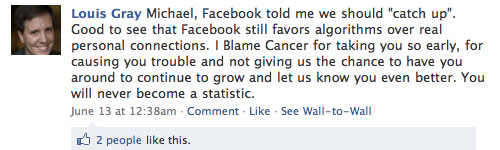
Michael Passed On, But His Wall Still Lives
For people like Michael who shared their trials with illness with the community, their profiles have become something of a shrine to their memory. As their birthday rolls around, connected friends drop in and wish happy birthdays, like they would anybody else, and when Facebook said to reconnect, I went and wrote on his wall. But there's something odd about the whole thing.
Today's leading social networks might do fantastic work for connecting people at various stages of their lives. They can find friends from high school and college, or link up colleagues from your work history. They might find you new dates or even spouses. But it looks like they stink when it comes to dealing with one's data when they actually pass on. Is it too morbid for them to think about? Would it be too nuts if there was a "Report Person as Deceased" button on the account? Should it be treated with an editorial process, similar to Wikipedia, where you have to cite a source and show an obituary?
Either way, the way we just leave things hanging in a position of suspended animation doesn't work for me. If social networks are to celebrate births, celebrate life's milestones and mark bad news as well, they should be ready for the final passage to whatever's next. I welcome good ideas.
20 Comments
I think it's great that his profile is still there. I like the Wall Post that you did, have others gone there and posted other things?
I agree Louis. There is something not quite right about what occurs to all our social networking sites once we die. I saw this occur with a friend of mine who passed away a few years back. No one could shut her blog down because no one else knew her password, and so the blog sort of lived on. Luckily she wasn't a Facebook fan, so we friends did not keep getting those prompts that you are receiving. There really needs to be some kind of 'internet protocol' regarding when a user leaves this mortal coil in my opinion. Although saying that, if its a blog that they wrote (diary type) the family might like to keep it available as a sort of 'memorial' to their memory.
This is such a great post, and relevant. I have had two acquaintances pass away whose Facebook pages became memorials, and even a place for the family to share news about services, etc. One of the deaths was violent, which (of course) garnered local media coverage. The activity on the person's Facebook page was so significant that many news outlets mentioned it.
I think you're right...the pages should live on, but FB should allow a "report as deceased" somehow. I wonder if they already have a behind-the-scenes policy like that, because I know Facebook offices were contacted as part of the investigation. Curious. Please post again if/when you find out more.
Louis, he would be proud of your concern. I had a similar thought recently as an extended family member quickly passed away after a very brief battle with cancer. You should get with his family and organize to have his account "memorialized". Facebook has a process for that: http://blog.facebook.com/bl...
Thanks for the link, sir.
I had a good friend who passed away about a year ago. She had no close family - only some 2nd cousins. However, I followed FB's process for "memorializing" an account, explaining the situation that there are no surviving family members to place the request. That was several months ago, and I've never gotten a response from them. My friend's profile remains active and unchanged. All of her friends agree that it's a terribly sad thing to see it, as though she's still reading her wall posts or waiting for friend requests.
I've heard several people mention Facebook's "memorializing" process, but I've never heard of a case where someone actually used it successfully. If anyone has, maybe they could post some information about how they did it.
Monkfishy, make sure you let @allnick or @justinsmith or @ericeldon know
about that. I think all 3 of those wrote about the memorialization process
and I'm sure they'd love to know Facebook isn't doing anything about it.
(Maybe I'll write about it too if I can get some time)
A terrific post and so timely as families gather for summer holidays. Is it possible this is an issue that, when preparing one's will, should be acknowledged and addressed, providing instructions as to whether their social profiles should remain, and will social networks comply with those wishes?
You don't pay much attention to Facebook's blog do you?
They covered this a couple months back and have a way to memorialize profiles.
http://blog.facebook.com/bl...
Jesse linked to this post as well. I read lots of things and remember most. If a profile is not memorialized, like this one, the algorithm continues to suggest finding friends and reconnecting, and friends can do nothing.
Thats also incorrect. Friends have the same power as anyone else to tell Facebook that their friend has passed on.
http://www.facebook.com/hel...
Please see my post above. Have you used this process? If so, how long was it before you got a response from Facebook?
A former colleague passed away almost three years ago, and as soon as I read about the option to have an account "memorialized", I contacted Facebook. It only took a couple of days for them to reply, and the "Info" tab on his profile is no longer there, but the wall, photos and boxes tabs are still present. The response from Facebook, which I can't find for some reason, was courteous and correct.
Actually, Facebook is one of the few social networks to have some semblance of a policy. Most other networks have no policy on death, though they might on "inactive" accounts. Email accounts have better policies around accessing a loved one's data, but they'll never hand over control of the account to the family.
I've been researching and speaking on this topic for 18 months. There is a disconnect between online services' policies and the realities of life. Building online businesses is about using your resources toward growth and acquisition of new users to drive revenue. Having resources dedicated to termination of accounts and verification of a person's alive/deceased status is not a top priority because it doesn't produce revenue.
And let's face it, most online services, especially free ones, are not known for providing individualized customer service. They just don't have the staff. (Facebook has almost 500 million users and just 500 staff.)
Thanks for writing on this important issue. I'm glad to see more people giving it some thought. I've included more about Facebook's memorialization in a post on my topic-dedicated blog, here: http://www.deathanddigitallegacy.com/2010/07/04/gray-questions-deceased-social-profiles/
I just looked at the pages that Navarr and Jesse shared. It's interesting to see WHY Facebook decided to set this up - it occurred after a Facebook employee died. Part of the issue is that many startups are populated with relatively young people (and are often also used by relatively young people, at least initially), so statistically death is not an issue that the companies encounter all that much.
I, too, think it's important to be able to memorialize friends and family when they pass. But, over the long term, but what should be the responsibility of a business like Facebook to maintain memorialized accounts? For instance, imagine Facebook is still active as a business 100 years from now. Every user alive today will have passed away, along with more generations. By that point, their user database will be more like Ancestry.com than the Facebook we know. Yet, to future users, the ability to research who knew who in the past might be important data. So, the question is, should a service like Facebook be required to maintain social data after a user passes away? If, how long? Does that social connection knowledge become more valuable over time? And, what of the privacy implications to the descendants of that person?
http://www.facebook.com/hel...
The family can report the account to get it memorialized. That (afaik) prevents it from appearing in your recommendations, removes the "Add as friend" button, etc.
Wow! What an amazing topic that will definitely gain some attention. I never really thought about this before; at least not in this sort of light. For once, I don't know exactly what I think. Personally, I think its great for profiles to live on in memory however on the other hand I think it might disturb some people. If the person were very close to them, they may be offended if they are asked to reconnect. Good Topic! Thanks for sharing and getting the mind juices flowing.
I submitted a good friend's page to be memorialized about 6 months ago. Easy process, I believe they contacted a family member for confirmation.
It has turned into a priceless collection of memories shared by her friends and family. Well done, Facebook.
And - watch this easy way of recording your legacy in facebook, that will be posted on your wall if you die!
http://apps.facebook.com/if...