 When I was in 1st grade (back in 1983-84), we had breaks in the middle of class, that rotated so a small group of kids had a few minutes of recreation. I distinctly remember at one point heading to a hanging easel which was nothing more than a chalkboard with some chalk. Being a math nerd even then, I wrote up a 1 followed by 100 zeros.
At the age of six, I was writing a googol. (It would be decades before Google came about, of course). I remember writing the 1 with 100 zeros, pausing to make sure I had gotten it right... and then writing 100 more. The numbers filled the chalkboard. By the time I'd written the 1 with 200 zeros, and commas appropriately placed, "playtime" was over and it was back to my desk. But I remember the words googol, googolplex and googolplexplex being thrown around with my friends to represent the biggest possible things imaginable. Fun to know that word (slightly changed) would mean so much more now.
Showing posts with label Personal (323 posts). Show all posts
September 30, 2011
September 16, 2011
Is There a Digital Divide In Your Family?
Is There a Digital Divide In Your Family?

In my family, I have two brothers and two sisters, so our nuclear unit is made up of seven people, four men and three women. It has been interesting to watch how my parents and my brothers and sisters have approached and adopted technology - to see if they are early adopters, fast followers, laggards or simply opt out. No matter the tech, be it new gadgets or new Web services, the pattern is pretty standard in our home.
After me, I can expect my mother and youngest sister will try a product. They may not get deep into every single one and want to tell the world, like I do, but they form an opinion and generally know their stuff. In fact, at one point or another, both my mom and sister have worked for Apple. My mom worked for PowerSchool, which was part of Apple at one point, and my sister works in Apple Retail as an Apple Genius.
Beyond those two, however, there is a gap. My second sister and my oldest brother may get accounts, but participation is pretty slim. And if you go further down the line, my dad and youngest brother are the least like to have any accounts or gadgets. Neither one of them has a Google+ account, and neither one has a Facebook account either. I remember years ago my dad wouldn't even sign up to the company newsletter I wrote until he had read through the company's privacy policy to ensure I wasn't going to give his email address away.
If you read much of the press, you'll come away thinking that men are the overwhelming early adopters. We're certainly the loudest. But on Google+, my wife, mother and sister are here, and the rest of the family will need a small push. In extended family, I have aunts and female cousins who are here, but again, the men need a push. It's quite interesting to me to see that.
What is your experience? Does your family have the same digital divide, and how are you seeing geekiness spread by gender in your home?
November 17, 2018
Technology Designed to Help You Breathe More Easily
Technology Designed to Help You Breathe More Easily
 Silicon Valley has been the leader in many things for decades, but rarely has the region's first place position been for something as undesirable as air quality. Following the record-setting disaster that has wiped out my one-time hometown of Paradise, Bay Area residents are choking on the resulting downwind smoke, seeking answers as to how unsafe it is, and how they can gain relief. And while I know that a week-plus of uncomfortable air is hardly the worst outcome of these climate change fueled infernos, it's something that needs to be addressed.
After last year's record-breaking California fire season that saw unthinkable damage burn through Napa county, I expected we would have bad air days this summer. Planning ahead, I bought two sleeves of N95 air filter masks from Amazon and stowed them in my garage for a not so rainy day. After a summer that saw fires rack up acreage, but air quality stay within range, I wondered if it was another foolish purchase just taking up space. But in the blink of an eye, with the Camp Fire in Butte County, the masks seemed inspired.
With the sun's eerie glow as a backdrop and smoke where fog or blue sky should be, I found myself at the Google campus, expecting to be the only one looking like I intended to rob a bank. But, while I was in the minority, contracted employees including security vendors and valets, who spend much of their day outside, wore them as part of uniform, and many of my colleagues showed up with them as well. By this week, it was rare to see a group of people walk by mask free, as estimates said sucking down Bay Area air was the equivalent of a dozen cigarettes a day.
As for those who took their masks off to smoke? Well. I admire your dedication.
As for those who took their masks off to smoke? Well. I admire your dedication.

Traffic to EPA sites on Friday, November 16. (via @googleanalytics)
As we all saw our skylines and views mucked by gray and brown bits of my past, area residents everywhere flocked online to sites like AirNow.gov and PurpleAir.com, marveling at how our Air Quality Index (AQI) levels were deep into the unhealthy range. So many people flooded the government's AirNow site that they had to reverse a heavy website revamp, and individual city pages were among the most trafficked government sites all week.
 On Thursday, after a week of fashionable awkwardness with my mask, I made some quick buys from the Google bus, aimed to help our air quality at home and contribute our AQI to the crowdsourced data. My first purchase was a pair of Molekule air purifiers that promised to cleanse our dirty and polluted air at home. The second was for a PurpleAir sensor, so I'd know just when we should leave the house with masks, or if we should hole up indoors.
Luckily, b8ta had Molekule devices locally, and the company's general manager made a home delivery to my front step by Thursday evening. They'd promised free overnight shipping to California, but same day was beyond expectations. I set up one device downstairs and the second upstairs, and they've been plugging away at removing toxins from the air so my family can breathe easily. Unsurprisingly, it even comes with a spartan app, so I can move the filters from silent mode to most aggressive, remotely.
This morning, my PurpleAir sensor came.
 Like Rachio's smart sprinkler system or the Nest outdoor cameras, these new Internet of Things devices come with the smallest set of instructions. Power them up, connect to Wifi and you're essentially on your way. It even came with a Nest branded power supply, which surprised me, but made immediate sense. With the minimal amount of effort, I registered my PurpleAir device and am now broadcasting the AQI from our house to the shared map.

There's no PurpleAir app (at least that I could find) which would make tracking AQI and our personal data easier, but the website works, and mobile site works well enough on my phone. Still seems like a minor oversight for 2018.
Clearly, the avalanche of attention toward hourly AQI levels and scramble for air filters is going to spike and fall with the latest wildfire or other pollution disaster. I may feel in the future that telling the world my air is just fine isn't world changing. But I've always been delighted in being able to see the data and make decisions. That's why Fitbit works. That's why Nest makes sense. That's why I went solar with Sunrun.
The tragedies that have hit California, and are nowhere near done, are going to have impact on families and our entire region for years to come. We should adapt to a world that acts on data and protects those things we can control.
The tragedies that have hit California, and are nowhere near done, are going to have impact on families and our entire region for years to come. We should adapt to a world that acts on data and protects those things we can control.
November 15, 2018
When the Hometown You Always Knew Could Burn Gets Erased from the Map -- Paradise is Lost to the #CampFire
When the Hometown You Always Knew Could Burn Gets Erased from the Map -- Paradise is Lost to the #CampFire
Let's talk about the Camp Fire for a second. My family moved to Paradise in 1991, as I was starting 8th grade. I lived there through high school, until heading to college. The family stayed until all kids had graduated high school - the last in 2004.
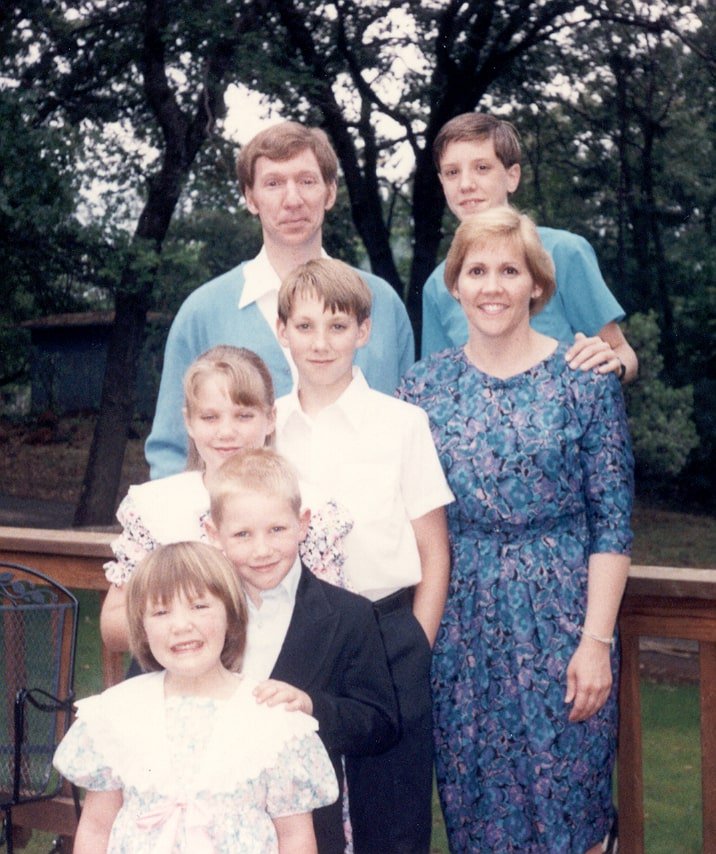
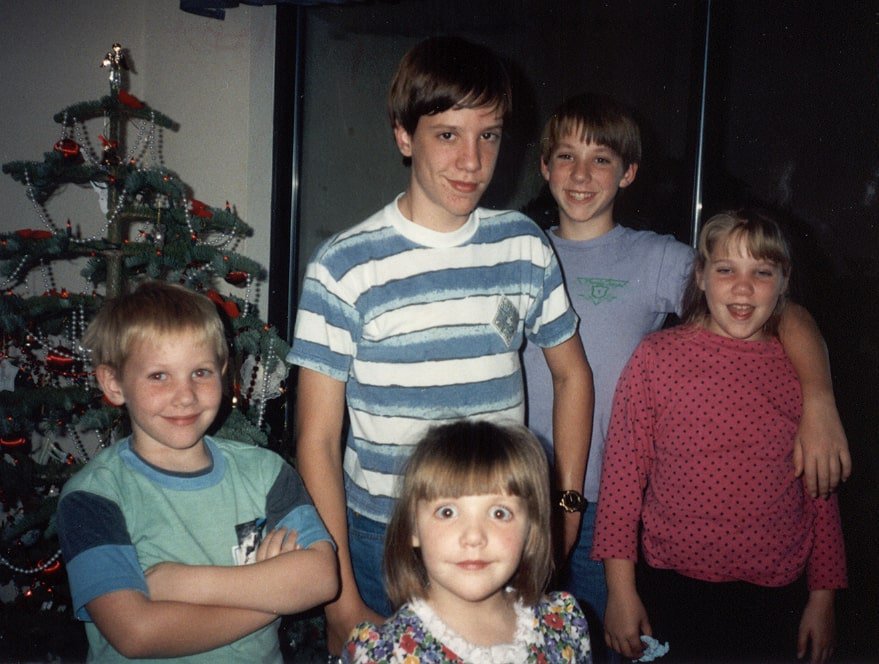
This was us at home in '91.
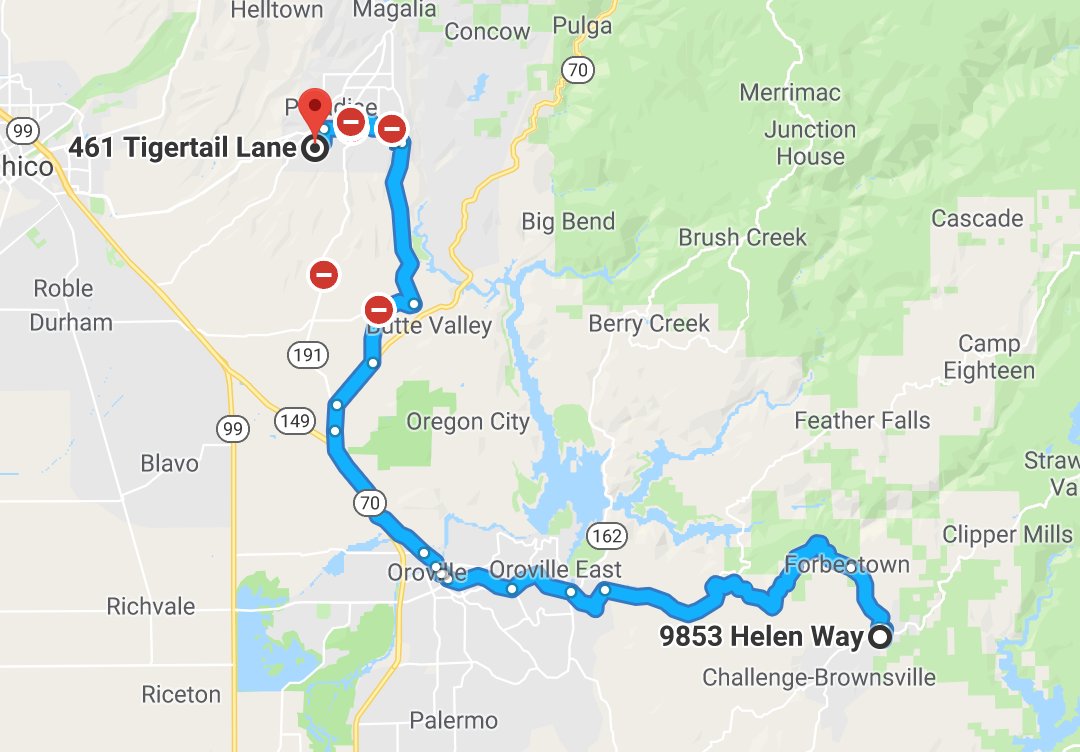
While news has referred to Paradise as isolated, we actually were moving from an even smaller town. I'd spent elementary school in Brownsville in Yuba County. When my dad got a new medical practice in Paradise, we were blown away by the McDonald's and "all those power lines".
I only spent one year in the Paradise school district, before my mom got a job teaching at Chico Jr. High. Through high school, I spent every early morning at church in seminary, and then driving down the Skyway to Pleasant Valley High School.
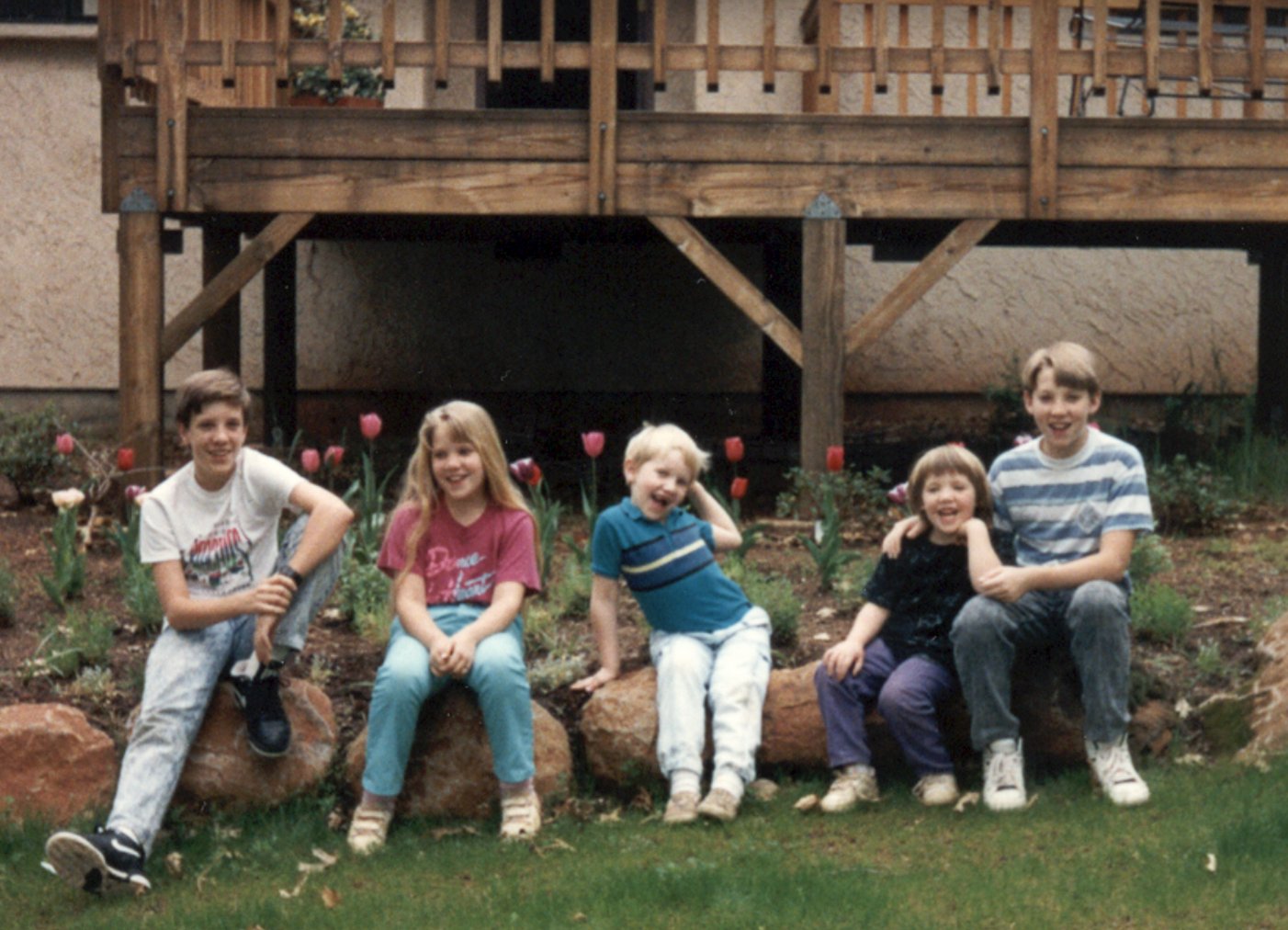
(Here's us in front of our house)
Paradise was always a retirement community. My dad's work was primarily elder care - geriatrics. Sometimes they died. More than once, I accompanied my dad to the coroner's office while on rounds. As he said, either their heart stopped, or they stopped breathing. Circle of life.
But that didn't mean death by other means was impossible. Fire was by far the top concern for the community. Paradise is located on a ridge in the foothills, placed squarely between two canyons. When fire would light, it would often head for the city.
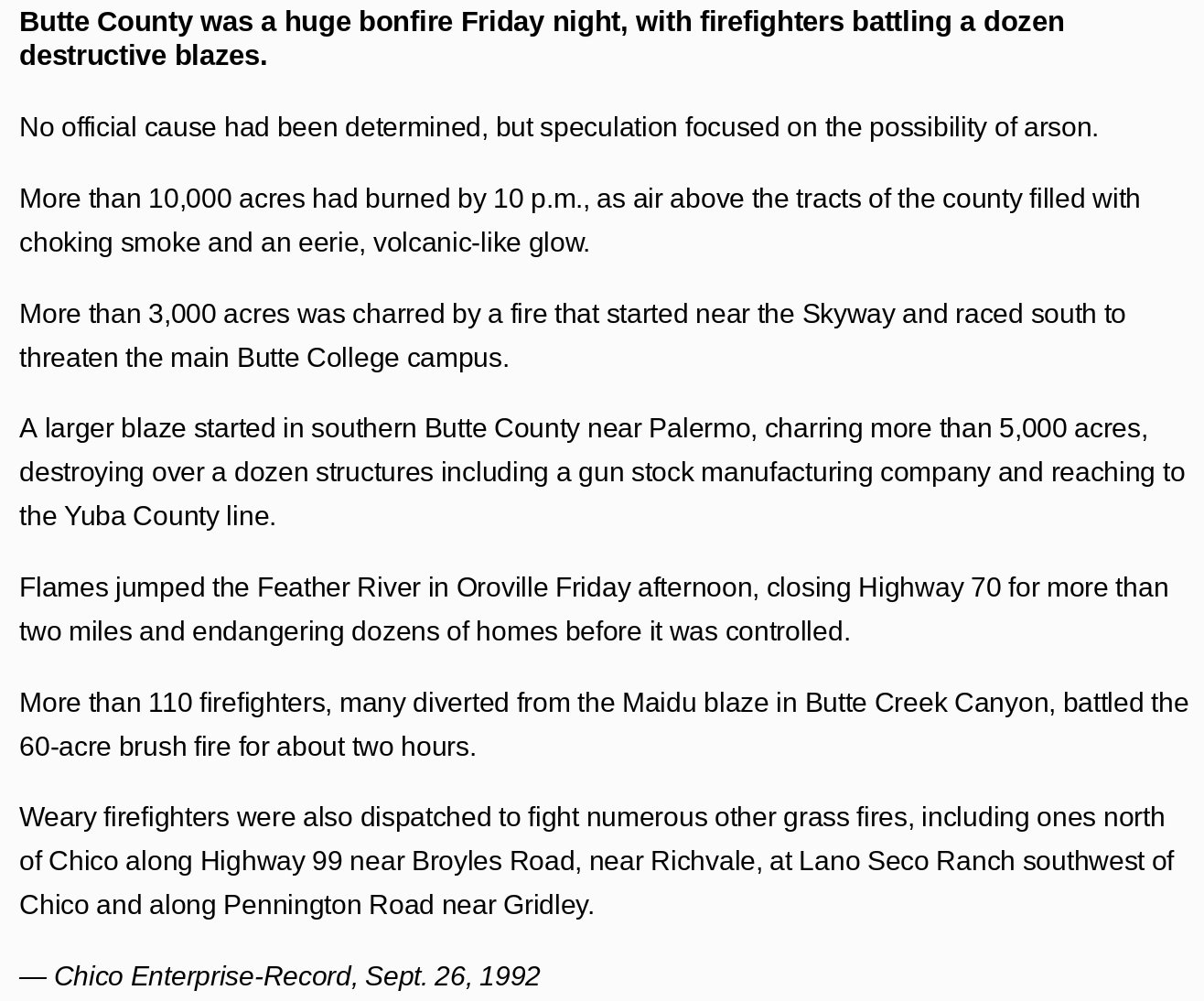
In 1992, my sophomore year of high school, we evacuated twice. See the @ChicoER's coverage of those fires. Notice one of those started -- you guessed it -- at the Skyway. The problem with this, of course, is that was the main road out of town.
In 1992, even as we had yet to unpack from evacuating the first time, ash started to fall on our driveway and house. Thick, black smoke loomed above us, and the fire was closer than ever. Some firebug, in copycat mode, had lit a blaze near city limits. We left again.
Luckily, as with every other time, the fire crews did an amazing job stopping the flames from getting deep into town. We marveled at the burn scars that approached neighbors' property, but didn't take any homes or casualties. Some have argued Paradise is a woodsy town that had no business building where it did. But it's not all the thick forest you may have in your mind.
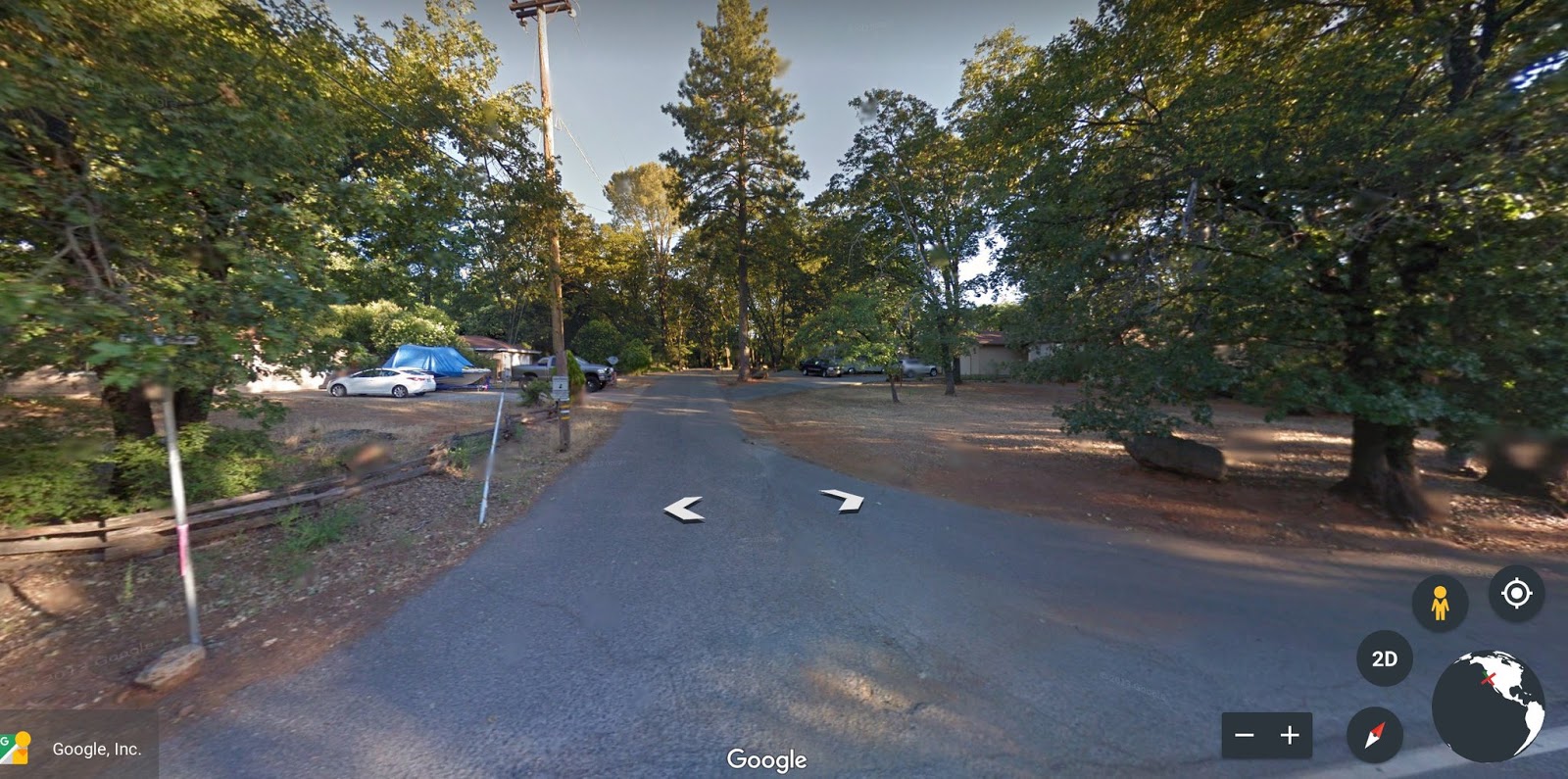
This is the entrance to Tiger Tail Lane from Foster Road (via Google Street View).
Long after I left to college and embedded in Silicon Valley, there have been other fires. As with those in the early 1990s, most were stopped. And as @Weather_West and others have reported, there were many plans in place to protect residents if worst-case happened.
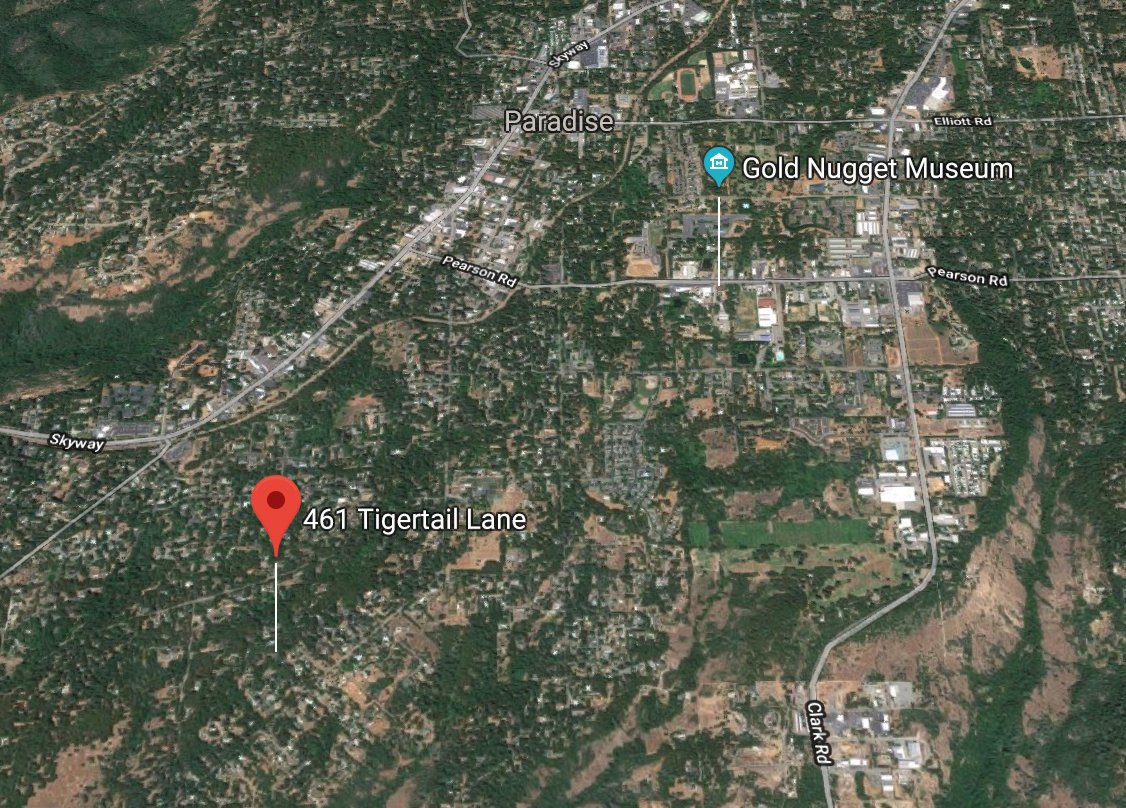
So what made the Camp Fire different? How did the above map turn into this scar on the North state? In addition to the exceptionally low humidity and the high winds (which can't be discounted), I'd say the origin of the fire played a huge part.
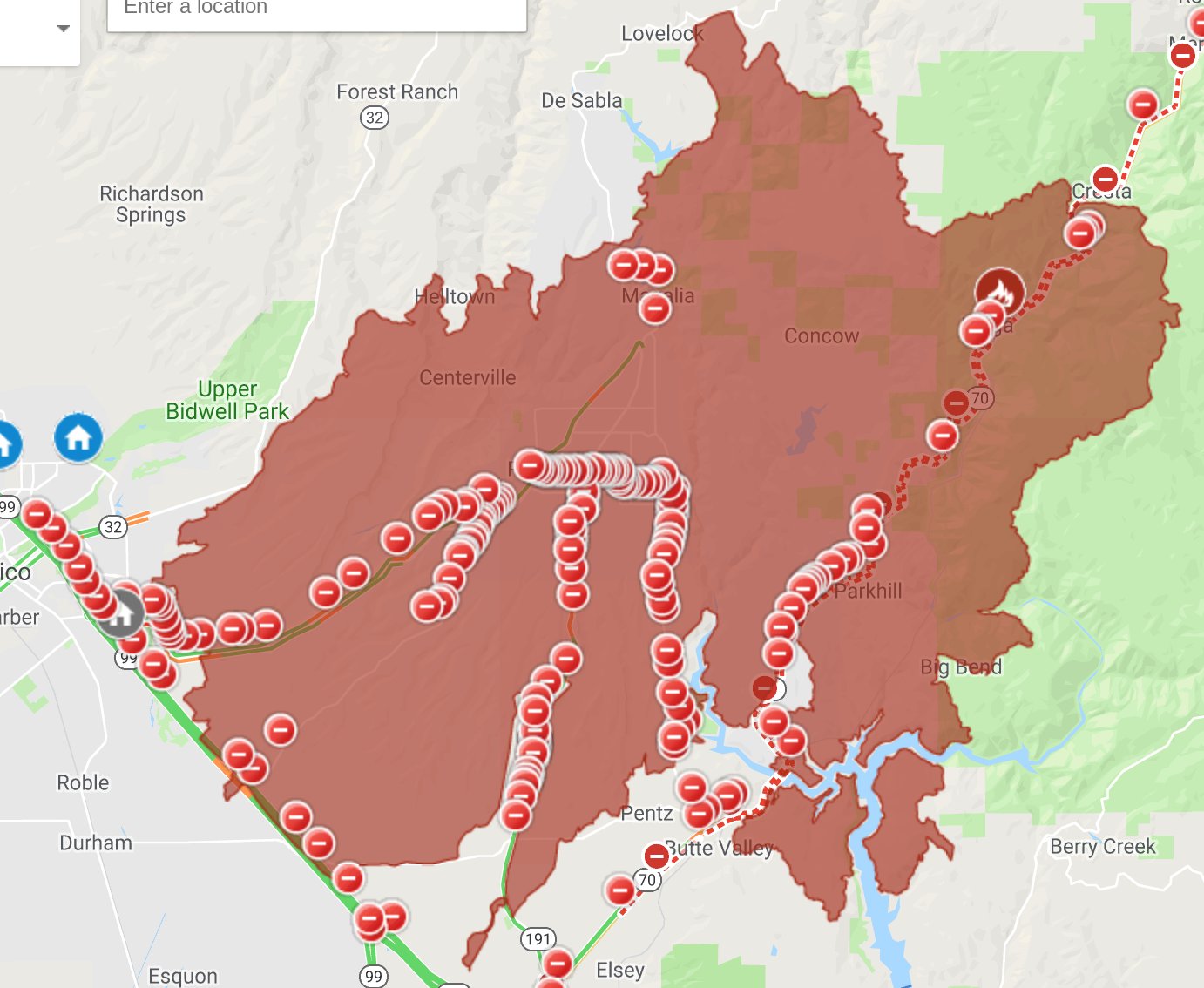
Previous fires, which started by Skyway or the canyons, and slowly meandered their way to the city, gave residents and firefighters warning. People had time to pack and leave, and routes were not frantic. The Camp Fire was a sneak attack with brutal force.
The Camp Fire didn't start on the lower Paradise side. It started in Pulga, an even tinier community. It started in the more woodsy side, where topology made it nearly impossible to stop, in starved fuel-laden forests, powered by ferocious winds and drought.
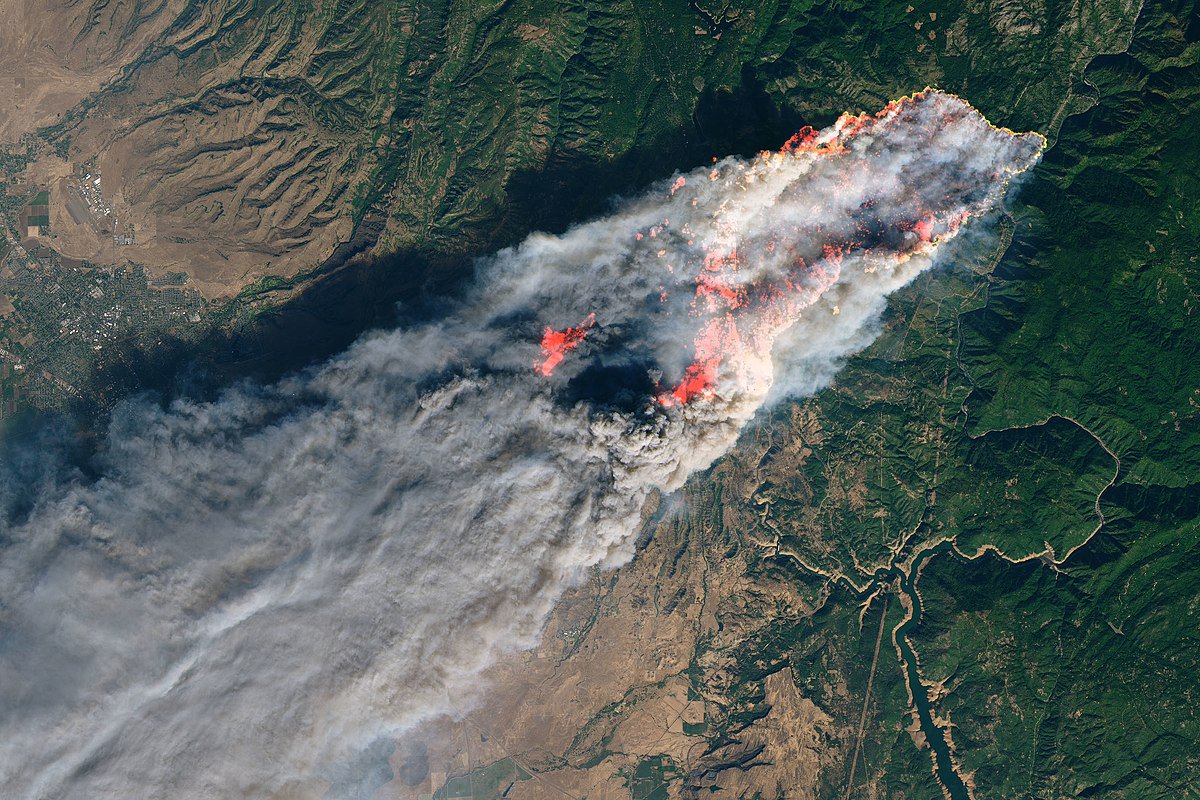
The winds pushed the fire into the main part of town, to all the people and all the businesses, and it hasn't stopped. Adventist Health Hospital, where my dad worked, was among the first to go.
When @Weather_West shared a tweet from @Gloria2marie, showing fire South and West of Paradise, I immediately realized the town was gone. In a Slack message to a friend, I wrote:
Classy, I know. But not wrong.
The casualty totals, surpassing all records in California, have not been a surprise. Knowing the aging, slow, immobile population, many who don't drive, and the speed of this fire, we're lucky thousands did not perish. But the loss is still stunning.
That an entire town can be zapped off a map is practically unprecedented. And for those who want to go back... to what exactly? No infrastructure. No power. No water. No cell service. And possibly human remains waiting for you.
Chico, where I went to high school, has for the most part escaped the direct flames. But now the refugees from Paradise are encamped at the town Walmart, a drier, more outdoor version of the Lousiana Superdome during Katrina. Thousands have nowhere to go.
More than 52,000 people have been evacuated since the Camp Fire erupted in Paradise on Thursday, packing parking lots, shelters and hotels across Northern California, and straining the housing stock.
There are still hundreds missing. So many are unaccounted for that law enforcement is releasing names in batches to avoid overload. Imagine that. The fire was so intense, many people may never be found -- incinerated and returned to the dust.
The Camp Fire is not just another news story or a set of headlines, or an unfortunate reason the Bay Area is smoky. It's a remarkable human and modern disaster.
I've read some ridiculous tin foil hat conspiracies on Twitter that you wouldn't believe about how the Camp Fire started. You could say this type of fire was inevitable, but also preventable. Of course climate change played a role. Of course the town makeup played a role.
Either way, this is a conversation we are going to keep having in California, and throughout the Western US and beyond. Is Lake Tahoe safe? Is Sunnyvale? Last year Napa found out the hard way. My grandparents' home in Redding was threatened in the Carr Fire.
It's reality.
This isn't a "feel sorry for us" thread. It's been a while, and my whole family is safe. But they are active in connecting with those who stayed. The woman who prayed her way to safety in a firey ride you may have seen on @Gizmodo was a high school friend I've heard pray before.
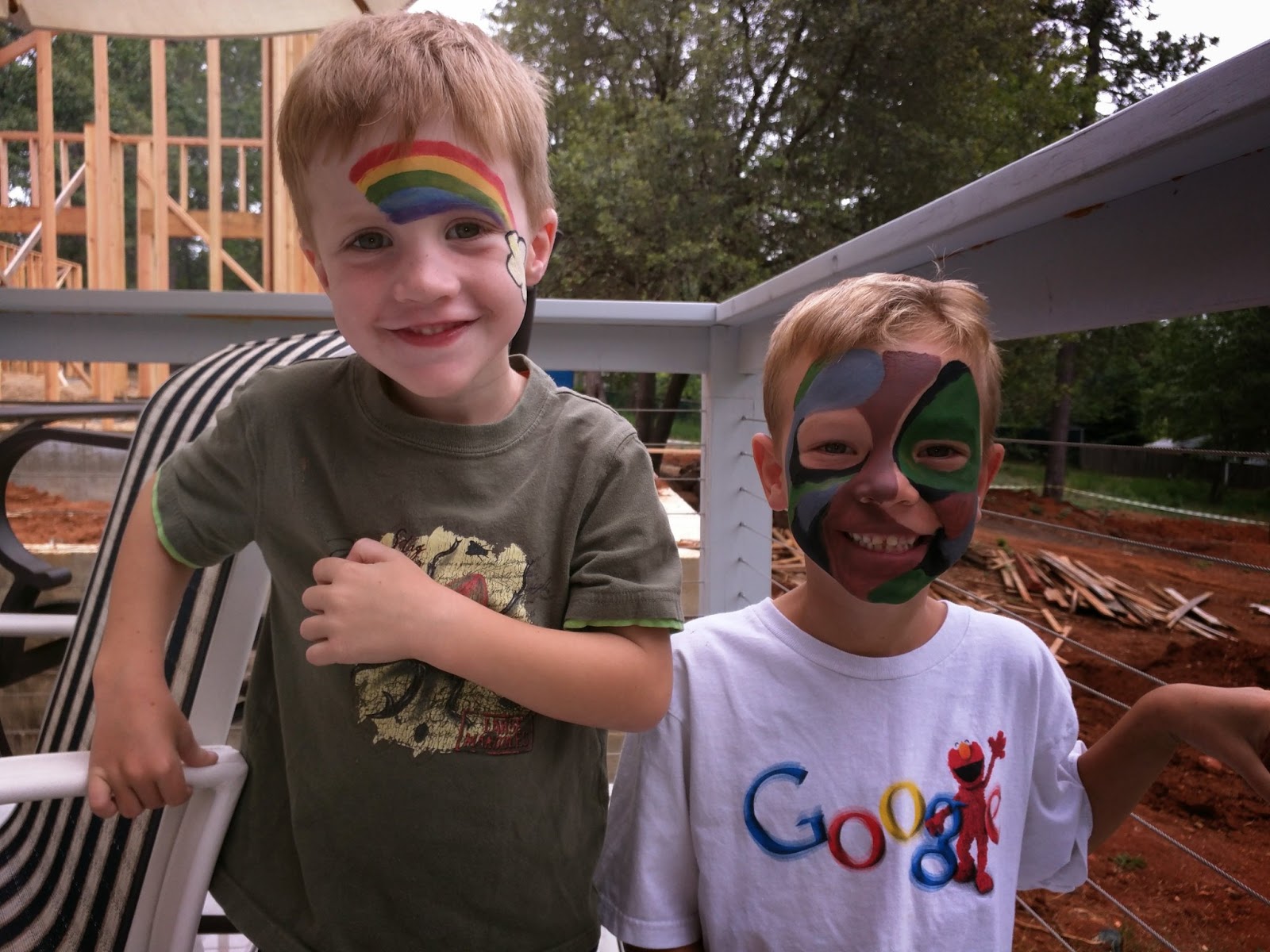
This was the last photo I took in Paradise, in May 2015, when I took my boys to a party for my brother's child - their cousin. The home that looks like it was under construction a few short years ago... it's gone now, to dust and ash.
As you lament the bad air and see the numbers rise ever upward, I hope this helps remove the abstract from what seems like a tiny town far away. Like the Woolsey Fire and the Carr Fire and all the others, your home could be the next hashtag. Have a plan.
(This story is adapted from a thread I initially posted on Twitter)

This was us at home in '91.
While news has referred to Paradise as isolated, we actually were moving from an even smaller town. I'd spent elementary school in Brownsville in Yuba County. When my dad got a new medical practice in Paradise, we were blown away by the McDonald's and "all those power lines".

The route from my elementary school home to Paradise.
I only spent one year in the Paradise school district, before my mom got a job teaching at Chico Jr. High. Through high school, I spent every early morning at church in seminary, and then driving down the Skyway to Pleasant Valley High School.

(Here's us in front of our house)
Paradise was always a retirement community. My dad's work was primarily elder care - geriatrics. Sometimes they died. More than once, I accompanied my dad to the coroner's office while on rounds. As he said, either their heart stopped, or they stopped breathing. Circle of life.
But that didn't mean death by other means was impossible. Fire was by far the top concern for the community. Paradise is located on a ridge in the foothills, placed squarely between two canyons. When fire would light, it would often head for the city.
In 1992, my sophomore year of high school, we evacuated twice. See the @ChicoER's coverage of those fires. Notice one of those started -- you guessed it -- at the Skyway. The problem with this, of course, is that was the main road out of town.

Fires have always been common in Paradise. We evacuated in 1992.
In 1992, even as we had yet to unpack from evacuating the first time, ash started to fall on our driveway and house. Thick, black smoke loomed above us, and the fire was closer than ever. Some firebug, in copycat mode, had lit a blaze near city limits. We left again.
Luckily, as with every other time, the fire crews did an amazing job stopping the flames from getting deep into town. We marveled at the burn scars that approached neighbors' property, but didn't take any homes or casualties. Some have argued Paradise is a woodsy town that had no business building where it did. But it's not all the thick forest you may have in your mind.

This is the entrance to Tiger Tail Lane from Foster Road (via Google Street View).
Long after I left to college and embedded in Silicon Valley, there have been other fires. As with those in the early 1990s, most were stopped. And as @Weather_West and others have reported, there were many plans in place to protect residents if worst-case happened.
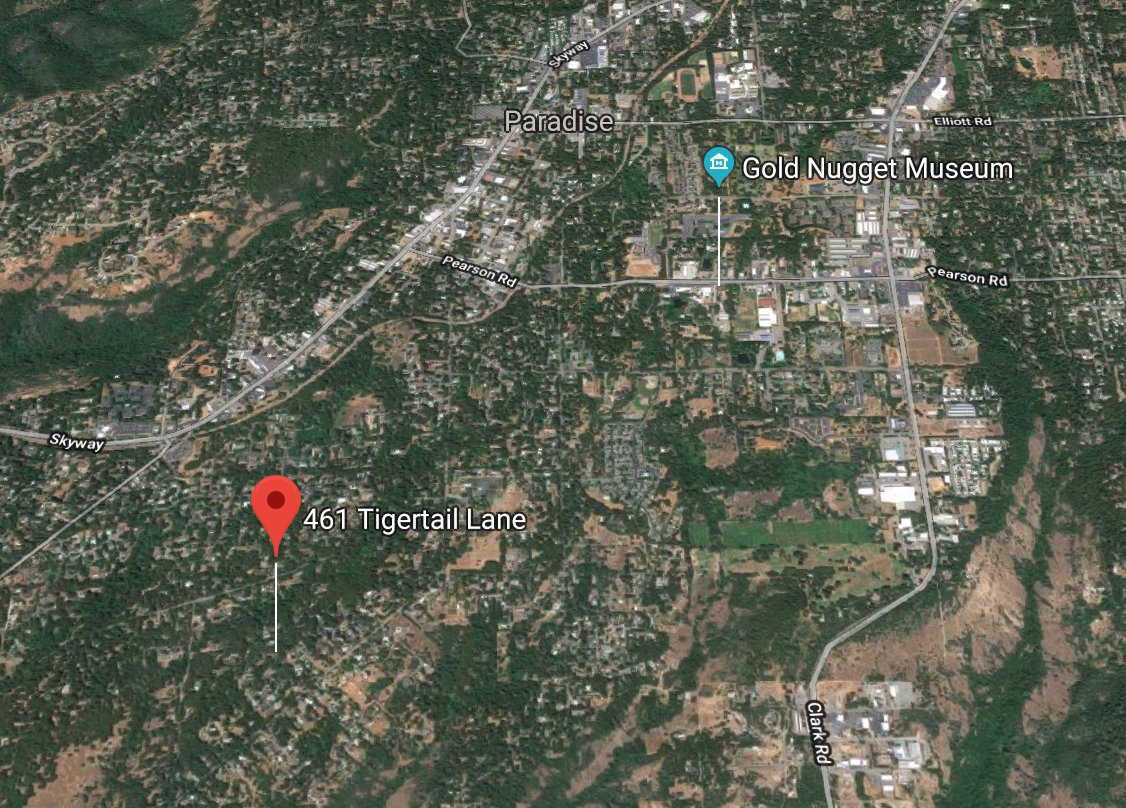
Our home's position in a terrain map, clearly in the fire zone.
So what made the Camp Fire different? How did the above map turn into this scar on the North state? In addition to the exceptionally low humidity and the high winds (which can't be discounted), I'd say the origin of the fire played a huge part.

The fire's position (and all the closed roads), as of this week.
Previous fires, which started by Skyway or the canyons, and slowly meandered their way to the city, gave residents and firefighters warning. People had time to pack and leave, and routes were not frantic. The Camp Fire was a sneak attack with brutal force.
The Camp Fire didn't start on the lower Paradise side. It started in Pulga, an even tinier community. It started in the more woodsy side, where topology made it nearly impossible to stop, in starved fuel-laden forests, powered by ferocious winds and drought.

Instead of starting at the bottom of the above photo, it started at the top and right.
The winds pushed the fire into the main part of town, to all the people and all the businesses, and it hasn't stopped. Adventist Health Hospital, where my dad worked, was among the first to go.
When @Weather_West shared a tweet from @Gloria2marie, showing fire South and West of Paradise, I immediately realized the town was gone. In a Slack message to a friend, I wrote:
"This means, if true, it's going to F--- up the whole town. Bye."
Classy, I know. But not wrong.
The casualty totals, surpassing all records in California, have not been a surprise. Knowing the aging, slow, immobile population, many who don't drive, and the speed of this fire, we're lucky thousands did not perish. But the loss is still stunning.
That an entire town can be zapped off a map is practically unprecedented. And for those who want to go back... to what exactly? No infrastructure. No power. No water. No cell service. And possibly human remains waiting for you.
Chico, where I went to high school, has for the most part escaped the direct flames. But now the refugees from Paradise are encamped at the town Walmart, a drier, more outdoor version of the Lousiana Superdome during Katrina. Thousands have nowhere to go.
More than 52,000 people have been evacuated since the Camp Fire erupted in Paradise on Thursday, packing parking lots, shelters and hotels across Northern California, and straining the housing stock.
There are still hundreds missing. So many are unaccounted for that law enforcement is releasing names in batches to avoid overload. Imagine that. The fire was so intense, many people may never be found -- incinerated and returned to the dust.
The Camp Fire is not just another news story or a set of headlines, or an unfortunate reason the Bay Area is smoky. It's a remarkable human and modern disaster.

This was our Christmas photo our first December in our Paradise home.
It's almost certainly gone now, but we're alive.
I've read some ridiculous tin foil hat conspiracies on Twitter that you wouldn't believe about how the Camp Fire started. You could say this type of fire was inevitable, but also preventable. Of course climate change played a role. Of course the town makeup played a role.
Either way, this is a conversation we are going to keep having in California, and throughout the Western US and beyond. Is Lake Tahoe safe? Is Sunnyvale? Last year Napa found out the hard way. My grandparents' home in Redding was threatened in the Carr Fire.
It's reality.
This isn't a "feel sorry for us" thread. It's been a while, and my whole family is safe. But they are active in connecting with those who stayed. The woman who prayed her way to safety in a firey ride you may have seen on @Gizmodo was a high school friend I've heard pray before.

As you lament the bad air and see the numbers rise ever upward, I hope this helps remove the abstract from what seems like a tiny town far away. Like the Woolsey Fire and the Carr Fire and all the others, your home could be the next hashtag. Have a plan.
October 17, 2018
How 23 Year Old Me Got a Job at a Stealth Company With a Fake Website
How 23 Year Old Me Got a Job at a Stealth Company With a Fake Website
My first two years in Silicon Valley were spent in Burlingame at a dotcom that hoped to revolutionize telecommunicatons online - with Web meetings, conference calls and even faxing from the Web. They had great services, but not enough customers, and eventually ran out of funding in early 2001, jettisoning marketing, sales and business development folks, before selling for scraps to Oracle.
Being in Marketing myself, this meant it was my first trial to try and find a full-time job, in a world where online job databases were taking over. I'd polished the resume and started applying at anything that sounded close to what I thought I did...
Web Marketing Manager... E-Marketing Manager... Marketing Manager... Internet Marketing Manager...
Keep in mind this was a time when companies knew the Internet was a humongous deal, but were still trying to figure out where the money was coming from. The dotcom stocks had gone to the moon and crashed down. E-Business firms were raising tens of millions to figure out how put supply chains on the Web, and it could be hard to separate the real from the fake.
Meanwhile, with the crush of aspiring gold-seekers flooding to the Valley, hoping to win the stock option lottery, traffic was a mess. I used to compare driving 101 South to parallel parking at 70 miles an hour -- just a zoo. So very quickly, the location of where I could start was just about as important as the starting salary. Belmont was better than Palo Alto. Mountain View better than San Jose. Maybe I could even walk.
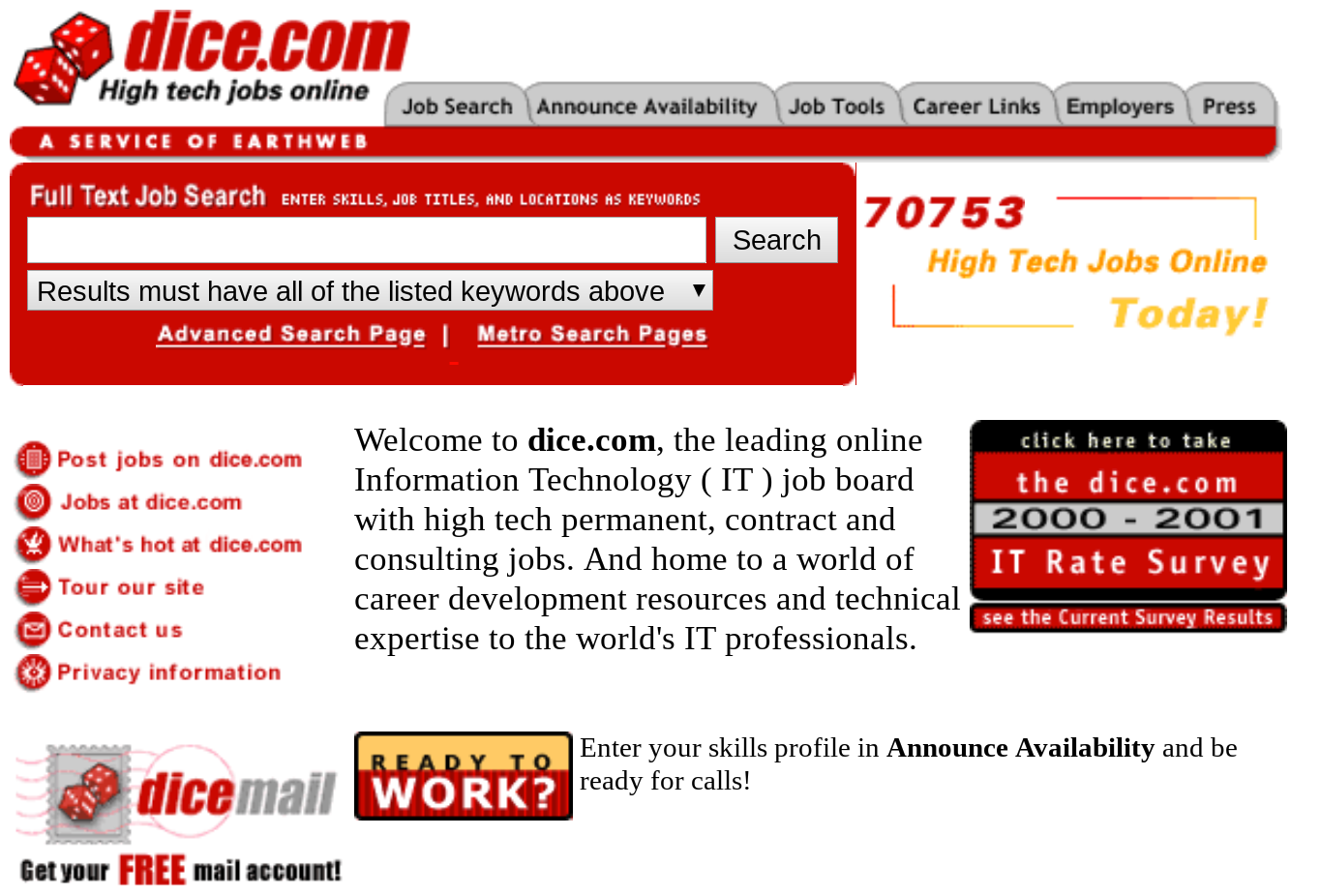
I tweaked my CV as best I could and threw it on Monster and Dice.com and all their clones, hoping to break through the noise. Here's what Dice.com looked like back then.
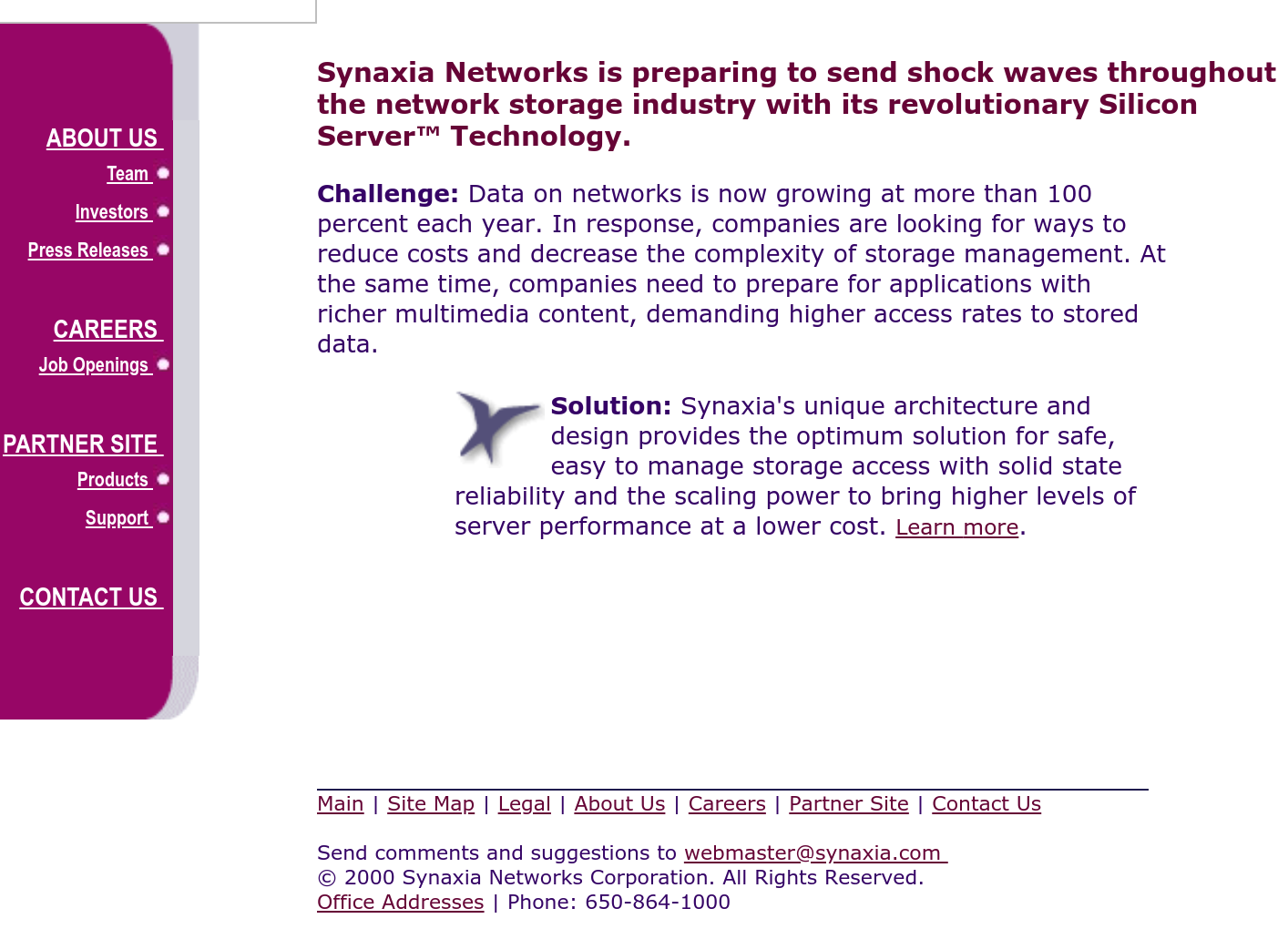
One of my job hunting volleys reached a company who so obviously needed my help. Their website was this hideous reddish purple and their icon looked like a squished crow. But they promised big things with revolutionary shock waves. I applied for the role of eMarketing Manager, to aid with promotion and copy, and redo their Website.
They asked me to come in for an interview and I pored over their site, ready to talk about how they needed to tailor their content for who their visitors would be -- investors, partners, analysts, and yes, customers. I studied the site in and out and felt prepared.
That Monday, sure their headquarters was in some garage somewhere, with like maybe 5-8 guys who couldn't write, I rolled in ready to tell them the ins and outs of marketing and publishing on the web. I pulled into the parking lot on Bernardo in Mountain View. Across their lot was Placeware, the Web meeting company eventually purchased by Microsoft. And one building down -- Handspring, the exciting handheld company run by Jeff Hawkins and Donna Dubinsky in their follow-on from Palm.
Instead of less than a dozen people, Synaxia had a quiet swarm of folks. About 50 were in Mountain View, and they'd raised two rounds of funding, for about $35 million. I still didn't really know what they did.
The first interviewer, a director of product marketing, and I went back and forth as I kept sounding confused as to their promise. He said they made the Web faster with specialized network servers. I thought they competed with Akamai. He said no. Maybe Akamai would be a customer? No. I felt a little stuck, as he talked about host bus adapters, raid arrays, and fibre channel.
So I went to what I knew - Web sites. As I began my spiel, he shook his head and stopped me.
"Louis, the Web site is a fake. The company name is a fake. In two months, we're going to rebrand and launch our product, so none of this matters."

I felt like my legs had been pulled out from under me, that I may as well just leave, but I was young enough (and likely cheap enough) that they didn't give up on me, even as I got through two more people.
My final interview was a friendly, older, and heavier guy, with short cropped white hair, folded arms resting on his belly, and an ability to talk your ear off. He was the vice president of marketing. I had 30 minutes with him, and for 20 minutes or so, he yammered on about the state of Catholic high school athletics, and told me about his kids, or told me stories about his career. He seemed very nice, but I was scared he wouldn't get a chance to learn about me at all - let alone figure if I was worth hiring.
Before I had felt like I even had a chance to get a word in edgewise, he interrupted, and said, "Look, if you got to me, you'll be fine," and just as quickly, he was gone -- off to the next meeting.
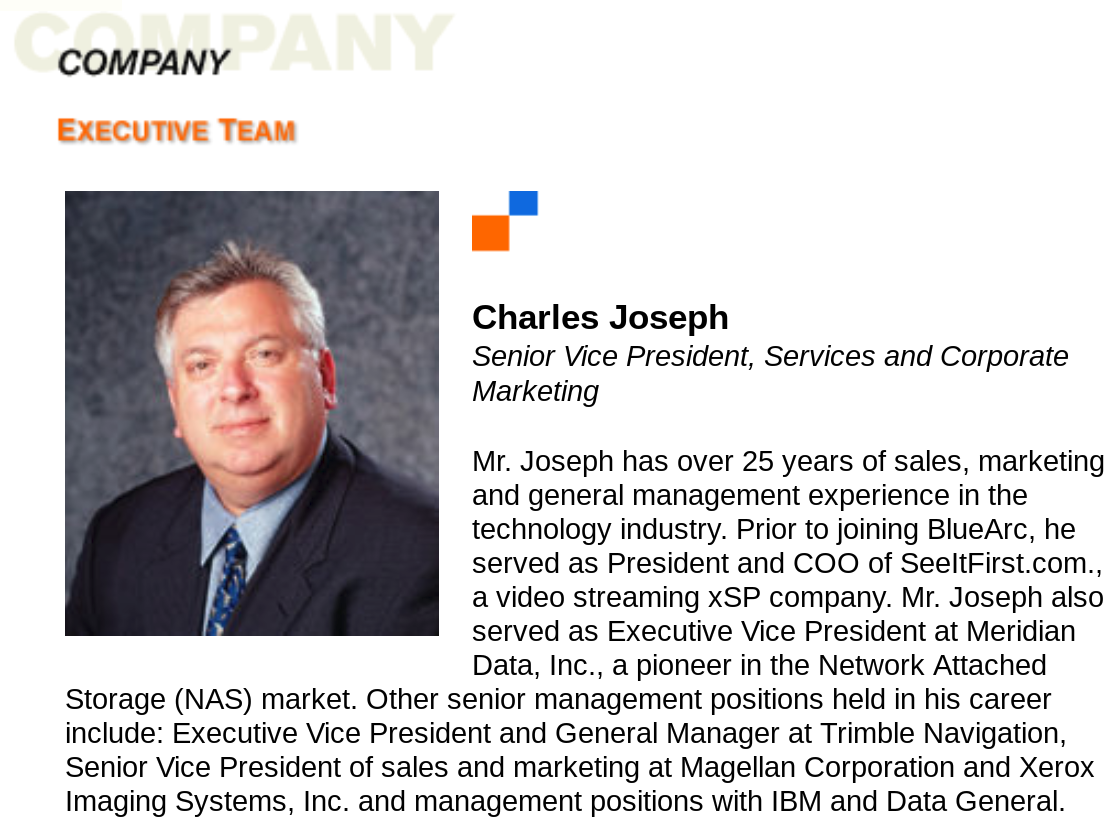
Years later, he would constantly tell me how he had been the reason I was hired, that I had been his discovery, and he took all the credit for my accomplishments. A fantastic boss, but an even better story teller.
A few days later, I got a call that offered me the job. I had no idea, really, what kind of salary to ask for, but, having just finished my double major from Berkeley, and getting two years under my belt, I was looking at a 50% raise over my last job. It seemed like so much money -- commensurate with being able to deliver a brand new website in about 30 days (which my designer and I managed).
I agreed to the job, and the pay bump, and my excitement lasted almost a full workday.
On the first day, HR asked me to sign papers to complete my employment, and I added my signature with enthusiasm. I walked back to the HR manager's desk, and she opened a folder titled "E-marketing manager". The first page in the folder was a job description (mine) with a salary range.
The bottom of that salary range was above where I had signed, and the top of that range went a full $30,000 higher. I immediately felt like I was underpaid, and I'd have to work a decade before I felt like I'd caught up. But I managed to get the job at the stealth company, and their fake website -- lasting 8 1/2 years, until I left in 2009.

Above is one of the last real ones I published, after multiple generations of product and many hundreds of customers. (And eight bosses. I outlasted everyone I interviewed with)
Being in Marketing myself, this meant it was my first trial to try and find a full-time job, in a world where online job databases were taking over. I'd polished the resume and started applying at anything that sounded close to what I thought I did...
Web Marketing Manager... E-Marketing Manager... Marketing Manager... Internet Marketing Manager...
Keep in mind this was a time when companies knew the Internet was a humongous deal, but were still trying to figure out where the money was coming from. The dotcom stocks had gone to the moon and crashed down. E-Business firms were raising tens of millions to figure out how put supply chains on the Web, and it could be hard to separate the real from the fake.
Meanwhile, with the crush of aspiring gold-seekers flooding to the Valley, hoping to win the stock option lottery, traffic was a mess. I used to compare driving 101 South to parallel parking at 70 miles an hour -- just a zoo. So very quickly, the location of where I could start was just about as important as the starting salary. Belmont was better than Palo Alto. Mountain View better than San Jose. Maybe I could even walk.
I tweaked my CV as best I could and threw it on Monster and Dice.com and all their clones, hoping to break through the noise. Here's what Dice.com looked like back then.

One of my job hunting volleys reached a company who so obviously needed my help. Their website was this hideous reddish purple and their icon looked like a squished crow. But they promised big things with revolutionary shock waves. I applied for the role of eMarketing Manager, to aid with promotion and copy, and redo their Website.
They asked me to come in for an interview and I pored over their site, ready to talk about how they needed to tailor their content for who their visitors would be -- investors, partners, analysts, and yes, customers. I studied the site in and out and felt prepared.

That Monday, sure their headquarters was in some garage somewhere, with like maybe 5-8 guys who couldn't write, I rolled in ready to tell them the ins and outs of marketing and publishing on the web. I pulled into the parking lot on Bernardo in Mountain View. Across their lot was Placeware, the Web meeting company eventually purchased by Microsoft. And one building down -- Handspring, the exciting handheld company run by Jeff Hawkins and Donna Dubinsky in their follow-on from Palm.
Instead of less than a dozen people, Synaxia had a quiet swarm of folks. About 50 were in Mountain View, and they'd raised two rounds of funding, for about $35 million. I still didn't really know what they did.
The first interviewer, a director of product marketing, and I went back and forth as I kept sounding confused as to their promise. He said they made the Web faster with specialized network servers. I thought they competed with Akamai. He said no. Maybe Akamai would be a customer? No. I felt a little stuck, as he talked about host bus adapters, raid arrays, and fibre channel.
So I went to what I knew - Web sites. As I began my spiel, he shook his head and stopped me.
"Louis, the Web site is a fake. The company name is a fake. In two months, we're going to rebrand and launch our product, so none of this matters."

I felt like my legs had been pulled out from under me, that I may as well just leave, but I was young enough (and likely cheap enough) that they didn't give up on me, even as I got through two more people.
My final interview was a friendly, older, and heavier guy, with short cropped white hair, folded arms resting on his belly, and an ability to talk your ear off. He was the vice president of marketing. I had 30 minutes with him, and for 20 minutes or so, he yammered on about the state of Catholic high school athletics, and told me about his kids, or told me stories about his career. He seemed very nice, but I was scared he wouldn't get a chance to learn about me at all - let alone figure if I was worth hiring.
Before I had felt like I even had a chance to get a word in edgewise, he interrupted, and said, "Look, if you got to me, you'll be fine," and just as quickly, he was gone -- off to the next meeting.

Years later, he would constantly tell me how he had been the reason I was hired, that I had been his discovery, and he took all the credit for my accomplishments. A fantastic boss, but an even better story teller.
A few days later, I got a call that offered me the job. I had no idea, really, what kind of salary to ask for, but, having just finished my double major from Berkeley, and getting two years under my belt, I was looking at a 50% raise over my last job. It seemed like so much money -- commensurate with being able to deliver a brand new website in about 30 days (which my designer and I managed).
I agreed to the job, and the pay bump, and my excitement lasted almost a full workday.
On the first day, HR asked me to sign papers to complete my employment, and I added my signature with enthusiasm. I walked back to the HR manager's desk, and she opened a folder titled "E-marketing manager". The first page in the folder was a job description (mine) with a salary range.
The bottom of that salary range was above where I had signed, and the top of that range went a full $30,000 higher. I immediately felt like I was underpaid, and I'd have to work a decade before I felt like I'd caught up. But I managed to get the job at the stealth company, and their fake website -- lasting 8 1/2 years, until I left in 2009.

Above is one of the last real ones I published, after multiple generations of product and many hundreds of customers. (And eight bosses. I outlasted everyone I interviewed with)
January 9, 2018
Space Fillers and Superstars: Silicon Valley's Divergent Career Arcs
Space Fillers and Superstars: Silicon Valley's Divergent Career Arcs

Career Paths Are Often Circuitous Routes
My career in Silicon Valley started before I'd even graduated from college. Rather than plug away at Berkeley and try to get top grades, I split my time my senior year between going to classes and commuting across the Bay Bridge to Burlingame, working for a revenue light startup during the initial dot com boom. By the end of 2018, I will have completed twenty full years in the Valley.
In these twenty years, I've been laid off. I've been promoted. I've fought for raises and rejected stock offers. I've co-founded my own consulting business. I've worked at startups with three people, ten people and two hundred. And for the last six plus years, I've been at Google, which can hardly be called a startup.
In these two decades, I've seen companies lay everyone off firsthand, and had another acquired. I've pitched Sand Hill Road for venture capital funding, been part of corp dev talks about a possible acquisition, and even filed for IPO. I've worked with billionaires, millionaires, neighbors, and colleagues straight out of college, with debts to pay.
And while I've been lucky enough to accumulate 15 years of work at just two jobs, that is fairly unusual for the industry. Some estimate the average software engineer, used as a metric for the average employee in our tech-centric world, is only 1 to 3 years. (Source)
Underneath the headlines and noise of product announcements, and seeming get rich quick ideas, the reality is the overwhelming majority of Silicon Valley employees are role fillers, who just get things done. Some are living month to month, and others are more comfortable. But for each example of wunderkids who get lucky on their first try, you have cubicle dwellers whose LinkedIn history won't have you blinking an eye. And the Valley needs these people. Hundreds of thousands of them.
The Intersection of Skill, Luck and Loyalty
Marissa Mayer famously put together a rubric after completing a Symbolic Systems degree at Stanford to determine where she would take the leap from her 14 job offers, and Google was seen as having the greatest upside. Tough to argue against those results, and hindsight is 20/20. Yet a close friend of mine who graduated from the same school with the same major is as anonymous as they come, with a pedestrian career. There's no discounting Marissa's hard work and ambition, but not everyone gets lucky.

In 2009, I wrote about this magical intersection of skill and luck - where good people work incredibly hard at toxic companies, or doomed dinosaurs. There are tomes to be written about the worker bees of the Valley who come in and work hard for a full day's pay to make all the services go, but aren't job hopping for the latest startup du jour, instead hanging on with loyalty to the company even if the company doesn't return the favor.
Roll the Dice or Buy a Lotto Ticket
For every superstar like Marissa, there are thousands more stories like my friend and others who just missed. A decade plus ago, I had a roommate who passed up being one of the first 25 employees at Google, so he could instead finish his PhD. (He is now a professor at NYU)
The more cynical among us could say that aggressively enterprising workers should quickly hop from job to job and ride the rocket to financial happiness, and yet another group will say that if the current workplace isn't looking like a lottery ticket, you should quit and form your own startup. It certainly looks easy enough, with so many ideas landing venture funding.
Venture capitalists will tell you they are looking for that elite leader, the masterful person with unique product vision and market awareness - a founding team with impeccable credentials. But every decision is a bet. The VCs and companies make bets on the staff, and the staff makes bets on the companies each day they show up. Sometimes you win the jackpot, sometimes you push, and other times, you could lose it all and have to start over.
Among a world of aspiring superstars, a much more common, but also important, role played out daily amidst the rows of cubicles and open office spaces in the Silicon Valley is an army of people making it all run, quietly.
Disclosures: I briefly overlapped at Google with Marissa from 2011 to 2012. Also, if you must know, I attended UC Berkeley, a natural rival of Stanford. But that's not really super relevant.
April 21, 2016
Real Valley Stories: The SVP of HR and a Bunch of Lawyers Will See You Now
Real Valley Stories: The SVP of HR and a Bunch of Lawyers Will See You Now
Editor’s Note: Part 11 in an irregular series of stories from my many years in Silicon Valley. Part 10 talked about the time I left my job for a competitor and rescinded the offer. This time, a story involving industrial espionage, the SVP of HR and way too many lawyers.

If I could show the leads from the lawyers’ lists were gone from our system,
we’d be on a path to redemption.
we’d be on a path to redemption.
The day had started innocently enough. I was hosting our company’s public relations firm at the office, as we worked with our product marketing and management teams on interacting with press. At a break, I stepped outside of the conference room and found the longtime senior vice president of HR waiting for me — usually not a good sign.
“Louis, please come into my office,” he said, with a tone that made it obvious this wasn’t really a choice. So I followed.
We entered his office, only to find another man in a suit was waiting. The HR SVP shut the door behind us, and then turned back to me. “Louis, on the date of (whatever it was), did you upload a list of contacts to Salesforce.com from (an account manager)?”
“I Don’t Recall”
I paused. In my marketing role over the last few years, I had used Salesforce.com practically every day. It was our customer contact tool that hit all aspects of our business, from prospecting, to forecasting and demand generation. So it sounded like something I’d do. But I couldn’t tell him yes or no without looking.I heard the words escape my mouth as bluntly as Oliver North in the Iran Contra hearings: “I don’t recall.”
But I promised to check — not knowing exactly what they were expecting to find. Somewhat shaken, but mostly mystified, I opened up Salesforce.com, logged in, did a query, and found I had uploaded a list of contacts into the system on that date. But it didn’t have any significance for me than any other list or date. It was just one of the regular requests I’d gotten from our director of Sales Operations, who often asked me to do the imports or set up reports in the system that she was responsible for, but didn’t completely understand.
So I went back to the SVP of HR, a little more nervous now, and said that yes, I had uploaded the list on that day. So what was going on?
Unwittingly Aiding Corporate Espionage
It turned out that, unbeknownst to me, an account manager acquired a customer list from his previous employer, complete with contacts and titles, and shared it with his inside sales representative — whose job it was to email and call these prospects to sell them our products. The ISR then sent the list to the Director of Sales Ops, who forwarded the request on to me. So while I had been fulfilling a standard request, I was, in effect, aiding what amounted to corporate theft.The SVP of HR was clearly not too excited with me about my role in the upload. But he was more annoyed by the director’s not investigating the source of the list, and her not being in tune enough with Salesforce.com to do the upload herself — not to mention his being beyond furious with the account manager and ISR who had put us in this mess. Unsurprisingly, the suited man in the HR SVP’s office was on the company’s legal team, and our competitor wanted us raked over the coals for the impropriety.
Immediately, on the spot, the account manager responsible for obtaining the list was fired. The ISR, whom I considered a friend, was also fired, knowing what the contacts contained and calling against the list. He packed his personal items into a box, took a very lonely stroll trough the parking lot — and I never saw him again.
Running Queries to Solve the Whole Mess
Now I was back in the HR office. Having somewhat absolved myself, our efforts turned to limiting the damage. The press training boondoggle I’d been working on with the PR team was practically a memory at this point. I told them they could leave whenever they were done as I was busy, but didn’t tell them just why I was now occupied.The HR SVP, and our attorney, wanted to know if I could find all the records that had been uploaded from that list, if I could find out what action had taken place — and if possible, could I remove those records from our company database. Of course, the answer was yes, so long as I knew what questions to ask Salesforce.com.
I started to run the queries, with both him and our attorney looking on. I ran a query showing what Leads had been added to Salesforce.com by my account on that day — and came up with a few hundred. A few clicks on each lead would show if they had been called, or emailed, if any meetings had taken place, and if we had any resulting sales pipeline in our forecast from the illicit list.
I produced reports that showed how many records were in the system, with both he and the attorney taking note of what I found. I was told to take no action on those records, and to be ready to come back into the office at the crack of dawn the next morning to begin the purge.
With Great Data Comes Great Responsibility
After a night to repeatedly think over the previous day’s events, I got up early, dressed much better than normal, grabbed my work laptop and headed back into the office to join the SVP, that same attorney, and surprisingly, about a half dozen more lawyers, who represented the competition, and had been sent to confirm we were in compliance. We entered the boardroom, centered with a long table seemingly carved from a massive cedar tree, and I had the projector all to myself.Whether I could perform the next tasks correctly were central to showing if we were acting in good faith.
My task was clear — explain to everyone in the room what had been uploaded, show how it could be extracted from our main database, and then destroyed forever in a way that was unrecoverable.
After an opening introduction from the HR SVP, I fired up Salesforce.com, ran the same queries as the day before, highlighted the records, and started the purge. As I’d delete 100 records at a time, the attorneys for all sides would mark it. I’d pause for agreement to continue and move to the next set of 100. Soon, the records were out of the main DB, and into the Trash.
Then, with everyone around the table nodding in agreement, I emptied the system’s Trash, so the records were truly gone. Then, the attorneys flipped through hard copy printouts of the offending names and cherrypicked customer data to see if could be found. “Jane Smith of Acme,” they might say. I’d search. No records found. “Evan Jackson of Key Labs?” No records found.
The Salesforce.com database was clean. I was pretty much off the hook — having shown I had the capability to both get us into the mess and get us out of it. But it didn’t mean our company was found without fault. Those prospect companies on the lists were added to a “Do Not Contact” registry that fell across our entire sales organization for at least a year forward, and had us saying no to many different potential sales opportunities as a result.
In the next few years, the SVP of HR left our company and later became the Executive Vice President at a pre-IPO firm that eventually went public and made him undoubted millions. The director of sales operations didn’t last long, finding her role replaced by her predecessor, who was returning to the company — later telling me how stunned he was that personal keepsakes he’d left in his desk drawers remained untouched while he was away. I stayed another five years or so, exceptionally more skeptical now about importing any leads to Salesforce.com from any source that Marketing didn’t explicitly gain ourselves. And that ISR, according to LinkedIn, seems to have recovered and since enjoyed a solid career in sales management.
The experience was not one I had expected to have when taking such an active role with our customer relationship management system, but with great data comes great responsibility. When it came to proving ourselves in a room full of lawyers, we had survived.
January 14, 2016
Listen Different And Learn
Listen Different And Learn
For most people, new ideas and perspectives make us uncomfortable. It’s easier and less taxing to surround ourselves with people who agree with our worldview, and reinforce our way of thinking, to make us believe we are correct. We self-select our communities, both in the physical world, and the online space, and these friends or peers become an extension of our own identity.
A byproduct of this selection process is that our communities end up looking a lot like us and behaving like us. Techies follow techies. White guys talk to white guys. Democrats engage with Democrats. While the Internet has a virtually infinite pool of people and ideas to choose from, we easily ignore, unfollow, mute or block those voices and appearances that we don’t identify with or make us question our position.
Ten years ago, I saw this polarization coming, saying the web was dividing in what I called a “bifurcation”:
But I know that’s not good enough. To close ones eyes to the rest of the world means also closing my ears, and my mind. Last May, I was especially struck, and angered, honestly, by how the Silicon Valley community seemed especially blind and silent on the topics of racial bias in our country’s police forces, which sparked unrest in places like Ferguson and Baltimore. While protesters loudly called for improvements in their world that begged for equality, millionaire VCs speculated about unicorn valuations and other techies complained about high rents in San Francisco — which don’t seem all that important in comparison.
Amid this noise and seeming tone-deafness from the public profiles of many active Valley participants, we have an ongoing cry for help and recognition and value from women in tech, who correctly see an uneven playing field that throws roadblocks at their career progress, polluted by landmines of sexism, bias and the good old boy networks — as well as a call for an expanded level attention to increase diversity in all our ranks, with diversity meaning not just women, but people of color (POC).
So over the last year-plus, I’ve actively tried to do a much better job of listening and engaging with people who aren’t like me. And this simple act of listening opens my eyes every day to things I may have missed — while making those topics that I might have previously ignored become critically important to me as an individual.
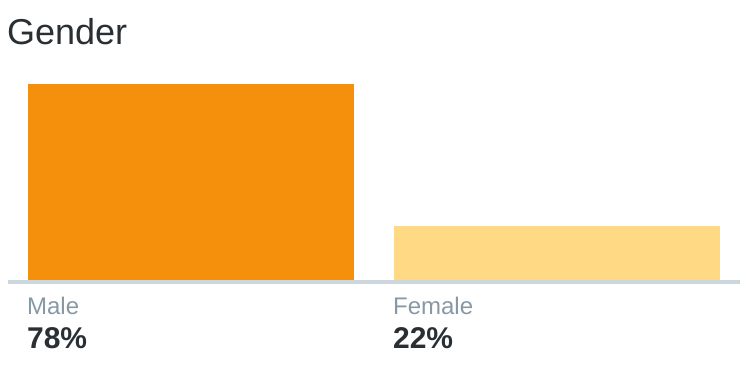 Twitter Analytics shows my audience is overwhelmingly male. Not a surprise.
As I still love tech, and still identify a geek, my bias and interests remains there, but I’ve aggressively opened my eyes and ears to more women voices and more black voices — especially on Twitter, where the following model is very lightweight, and the stream’s recommendation system smartly brings me new people who I may never have previously discovered.
On Twitter, as of today, I follow just under 600 accounts, including brands. But by no means is my stream a perfect picture of diversity and equality. So I created a list that explicitly expunged all the men and all the brands from my stream — carefully only showing tweets from the 170 or so women I choose to follow, as well as those retweets they found interesting (No Men. No Brands.). And by dipping my toe in this curated stream, the view is remarkably different.
While this may not be rocket science, women don’t always want to talk about what the loudmouthed ego-driven men want to talk about. They bring in topics and conversations that often get otherwise lost in the testosterone flood, and introduce me to even more interesting ideas and initiatives. So when the men annoy me too much, I turn them off by following that list instead.
But as I said above, it’s not enough to count my streams as diverse just because I made a list that follows a bunch of women — because diversity means diversity of thought and backgrounds.
As the conflicts in Ferguson and Baltimore extended to cover alarming incidents in Cleveland, Texas, and so many other places across the country, those leading the social justice movement, like Deray McKesson, Shaun King, and Johnetta Elzie spoke loudly to me, as did others speaking up about inequality everywhere, like Bianca St. Louis, Jacky Alcine, Yukio Strachan and Trilly Stardust. I started adding them, and each new person brought me a new voice. And, unlike the old days, where the lack of a return follow may have felt like personal rejection, I’ve left the ego at the door, and not expected the same. I have to earn my way into the conversation, and can’t just expect a seat at the table.
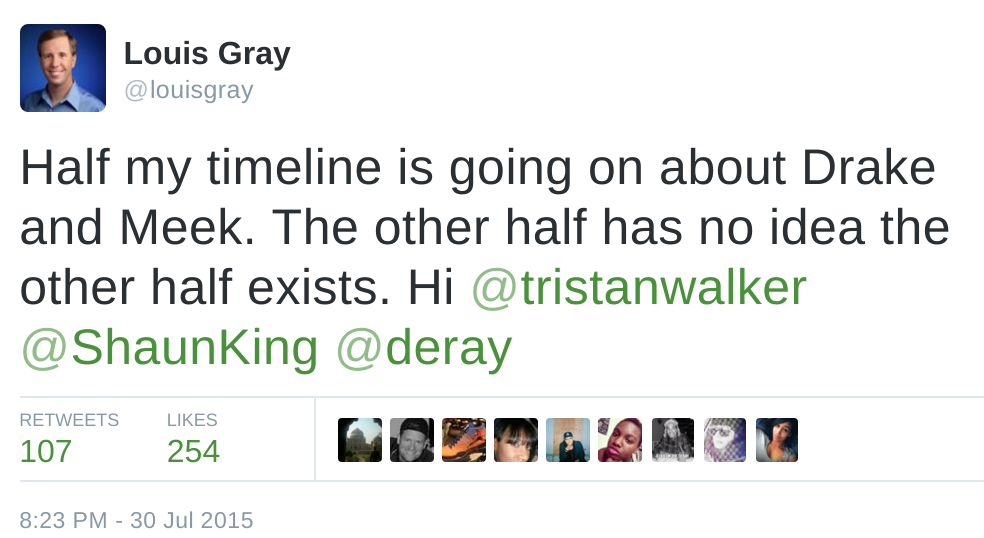 In July, I saw many in my stream go in euphoria over Drake and Meek Mill.
But most of you missed it.
Now, it’s not uncommon for my Twitter stream to be overwhelmed by updates from women, and people of color. And it’s excellent. The increased diversity of voices and topics means it’s not a monotonous echo chamber, but one that’s vibrant and has me seeing things I would never likely otherwise see.
All of us who participate online, even if we’re not in tech, have a responsibility to keep our eyes, ears and minds open to people who don’t share the same backgrounds, and may not look like or sound like us. But so many times, that’s the trap we fall into. We may not like looking into a mirror, but we are surrounded by our clones.
My colleague and great friend, Rick Klau, also spoke on this issue last summer in his post “My unconsciously biased address book”, where he stated the downside of keeping our world homogeneous:
Without listening, we can’t be learning. If you think you’ve built your networks with blinders, take them down. Cast them aside and rebuild. It’s beautiful over here.
A byproduct of this selection process is that our communities end up looking a lot like us and behaving like us. Techies follow techies. White guys talk to white guys. Democrats engage with Democrats. While the Internet has a virtually infinite pool of people and ideas to choose from, we easily ignore, unfollow, mute or block those voices and appearances that we don’t identify with or make us question our position.
A Divided Web
Ten years ago, I saw this polarization coming, saying the web was dividing in what I called a “bifurcation”:
“It is human nature to seek out a community of peers and equals, of those who yearn for the same things or have parallel experience… (and thus) polarized and wholly separate communities will grow and thrive.” — Feb. 23, 2006As a white male in Silicon Valley for the better part of two decades, my world view is a very specific one. I know that my experiences don’t always match people who don’t look like me, or whose LinkedIn profile looks vastly different. And over the last decade of participating in many different social channels, (Google+, Twitter, Facebook, etc.) my established audience I’ve curated has ended up looking a lot like me. It’s very white. It’s very male. It’s full of people from Silicon Valley, who love tech, and, in most cases, vote Democrat.
But I know that’s not good enough. To close ones eyes to the rest of the world means also closing my ears, and my mind. Last May, I was especially struck, and angered, honestly, by how the Silicon Valley community seemed especially blind and silent on the topics of racial bias in our country’s police forces, which sparked unrest in places like Ferguson and Baltimore. While protesters loudly called for improvements in their world that begged for equality, millionaire VCs speculated about unicorn valuations and other techies complained about high rents in San Francisco — which don’t seem all that important in comparison.
Amid this noise and seeming tone-deafness from the public profiles of many active Valley participants, we have an ongoing cry for help and recognition and value from women in tech, who correctly see an uneven playing field that throws roadblocks at their career progress, polluted by landmines of sexism, bias and the good old boy networks — as well as a call for an expanded level attention to increase diversity in all our ranks, with diversity meaning not just women, but people of color (POC).
Exploring New Streams for New Voices
So over the last year-plus, I’ve actively tried to do a much better job of listening and engaging with people who aren’t like me. And this simple act of listening opens my eyes every day to things I may have missed — while making those topics that I might have previously ignored become critically important to me as an individual.

As I still love tech, and still identify a geek, my bias and interests remains there, but I’ve aggressively opened my eyes and ears to more women voices and more black voices — especially on Twitter, where the following model is very lightweight, and the stream’s recommendation system smartly brings me new people who I may never have previously discovered.
On Twitter, as of today, I follow just under 600 accounts, including brands. But by no means is my stream a perfect picture of diversity and equality. So I created a list that explicitly expunged all the men and all the brands from my stream — carefully only showing tweets from the 170 or so women I choose to follow, as well as those retweets they found interesting (No Men. No Brands.). And by dipping my toe in this curated stream, the view is remarkably different.
While this may not be rocket science, women don’t always want to talk about what the loudmouthed ego-driven men want to talk about. They bring in topics and conversations that often get otherwise lost in the testosterone flood, and introduce me to even more interesting ideas and initiatives. So when the men annoy me too much, I turn them off by following that list instead.
But as I said above, it’s not enough to count my streams as diverse just because I made a list that follows a bunch of women — because diversity means diversity of thought and backgrounds.
Diversity Doesn’t Just Mean Women
As the conflicts in Ferguson and Baltimore extended to cover alarming incidents in Cleveland, Texas, and so many other places across the country, those leading the social justice movement, like Deray McKesson, Shaun King, and Johnetta Elzie spoke loudly to me, as did others speaking up about inequality everywhere, like Bianca St. Louis, Jacky Alcine, Yukio Strachan and Trilly Stardust. I started adding them, and each new person brought me a new voice. And, unlike the old days, where the lack of a return follow may have felt like personal rejection, I’ve left the ego at the door, and not expected the same. I have to earn my way into the conversation, and can’t just expect a seat at the table.

But most of you missed it.
Now, it’s not uncommon for my Twitter stream to be overwhelmed by updates from women, and people of color. And it’s excellent. The increased diversity of voices and topics means it’s not a monotonous echo chamber, but one that’s vibrant and has me seeing things I would never likely otherwise see.
All of us who participate online, even if we’re not in tech, have a responsibility to keep our eyes, ears and minds open to people who don’t share the same backgrounds, and may not look like or sound like us. But so many times, that’s the trap we fall into. We may not like looking into a mirror, but we are surrounded by our clones.
We Have a Responsibility and Challenge
My colleague and great friend, Rick Klau, also spoke on this issue last summer in his post “My unconsciously biased address book”, where he stated the downside of keeping our world homogeneous:
If the majority of leaders at most companies are men and if the majority of their networks are men (as mine are), then this is a self-perpetuating problem.We have an opportunity to choose our networks. When we unconsciously choose for our network to shut out a segment of people, we are doing a disservice to them and to us — and we extend the issues, which are very real, one generation further, rather than confronting them head-on ourselves.
Without listening, we can’t be learning. If you think you’ve built your networks with blinders, take them down. Cast them aside and rebuild. It’s beautiful over here.
January 12, 2015
Adult Problems Stink. I Blame Drew's Cancer. #BlameDrewsCancer
Adult Problems Stink. I Blame Drew's Cancer. #BlameDrewsCancer

I quickly glossed over it during my first post of the year, when I said "Adult problems can be a real pain," but I'd be skirting around some big issues if I didn't go deeper on some very real drama that in years past would see me aggressively pounding the drum to draw attention to their pain, hoping to rally others to their cause. But as I get older, and, as a result, my friends do too, struggles with health, family, work or finance are hardly isolated - making it somewhat selfish to choose one cause against another. And that sucks.
Nearly five years ago, +Drew Olanoff, one of the best friends my family has ever had, was diagnosed with Hodgkin's Lymphoma. He, along with +Mike Demers and others, launched the #BlameDrewsCancer phenomenon, blaming all the world's ills on his cancer. A year after, we were delighted to learn Drew had been declared cancer free. We'd always expected a full recovery, and it was a relief to hear the doctors say so.
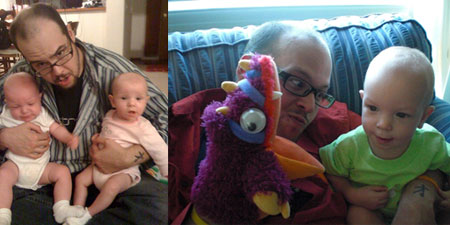
My best buddy Drew with my kids in late 2008 and 2009.
But, as most of you who follow my social streams know, Drew's cancer is back. And while I'm hopefully optimistic again (as is he), I'd be lying if I didn't say we're both worried. Cancer is no joke. This time around, Drew is older, and a bit more fatigued. He needs to use his energy to fight the cancer (again) and doesn't need the weight on his back of every cancer story that doesn't have a happy ending.
Before Christmas, I took my two boys up to San Francisco to see Drew in the hospital, where he was getting ready for a round of chemotherapy. The trip was done quietly, as Drew, at the time, hadn't told the world his cancer was back. But my kids gave Drew their handmade cards, exchanged hugs, and we did what we could to let Drew know how important he is to our family, and that we're on the same team.

Matthew and Braden in SF after seeing Drew in December.
But Drew's not the only one with a challenge and raising the rally flag for him does something of a disservice to other friends who are fighting their own demons, cancer included. +Adam Singer and I visited +Justin Levy at Citrix before the end of the year, seeing how he's progressing after being diagnosed with a brain tumor and two broken shoulders, fractured in a dramatic seizure. Search marketing and analytics blogger +AJ Kohn is also undergoing chemotherapy treatment, and +Sid Burgess has had his own round with cancer.
Summary: Cancer sucks and it isn't just picking on one guy and I hate it.
And cancer's not the only demon working to make friends' lives unhappy. My colleague +Julia Ferraioli has been sacked with an array of issues over the last year plus that have turned her life upside down. My colleague Ken Norton lost his son to childhood heart disease, and in June, when I read Eric Meyer's story about losing his daughter, I was nearly in tears, dumbly staring at my Nexus 7 and going through her Flickr archive to better know the life that was cut short too soon.
Comparatively, my life is pretty darn good. Family is healthy. So far, the bills are getting paid (even though it's not easy), and most of our struggles are simply getting the kids to be obedient, or dealing with car and tech issues. But I'm thinking about it. Don't get me wrong. I am worried about Drew this time, and he is scared too. He should be.
But every time I see a friend, be it Drew or Sid or Julia or Justin, ask the world for help, I see the world answer strongly with a Yes. And that's what's so impressive about our hyperconnected planet now. I feel I really know these friends who I don't see every day. I can feel their pains and champion their successes, root for their wins and console them on losses. When Drew put the weight of the world on his back in 2009, he didn't take enough time to take care of himself. As his friend (and a friend to many of you), I can say if you are struggling, you should know you're not the only one. Ask others to help distribute the pain. We can't make it go away, but you can know we care and we will help you fight.
If you want to help Drew, consider signing up as a bone marrow donor with BeTheMatch or Blame Drew's Cancer for your own issues. And if your heart was broken by the loss of Riley Norton, as mine was, you can donate to Camp Taylor, as we did with our FitBit100k challenge. Good luck to all of us in 2015.
January 1, 2015
10 New Year's Resolutions (for you) for the Year 2015
10 New Year's Resolutions (for you) for the Year 2015
A new year is a somewhat arbitrary point in time to mark change. But tradition has it that we do two things when the calendar turns from December to January. We look back on the previous year, either with pride over accomplishments, or dismissal of bad experiences, and we optimistically expect the best for the coming twelve months.In years past I've put forth fun predictions for the world in tech. And trust me, I have some predictions, but I'll hold those close to the vest. Working at Google makes predicting the future like cheating. And I won't bore you with a list of my own resolutions for 2015. Instead, I'll suggest (with bias) ten resolutions each of you (and often us too) should take this year to make our online and offline lives even better.
1. Protect yourself and your data from the bad guys.
Seemingly every week, we are seeing news about security breaches at major retail stores, or finding online databases have been impacted. And outside the headlines, bad actors are out there trying to harvest your online information. I recommend protecting yourself by using two-factor authentication wherever possible, trying to avoid the reuse of passwords, and setting up automatic alerts that tell you if your credit cards are being used anywhere, or over a certain dollar amount.

In 2014, I managed nearly 6 million steps on Fitbit.
2. Use intelligent data to make yourself a better person.
Seemingly everyone's New Year's resolution is to go to the gym more or lose weight. But those resolutions tend to fade out after a strong month or so. Instead, find a fitness tracker or application that makes sense to track what you already do, and find a way to increase those numbers. My adoption of Fitbit two and a half years ago helped me lose more than 20 pounds, encouraged me to buy a treadmill, and find the way to walk just about everywhere.
3. Use intelligent data to make your home a smarter one.
Once you know to count your data with services like Fitbit, running your home without data is kind of dumb. By adopting Nest and Sunrun to handle our energy costs, and Rachio to manage our smart sprinkler system, we've not only set ourselves up to save money each month, but we can better predict our use, and make changes when necessary.

Our Solar powered home saves money and saves the air too.
4. If you have money, put it in places with long term benefits.
In 2010, we bought our home, putting out more money than I've ever done. But with rising Silicon Valley real estate prices, that looks like a good investment. In 2011, we refinanced. In 2012, we paid off our cars and, with the exception of our home, were debt free. In 2013, we bought a treadmill, to keep us active, even if not leaving the house. And in 2014, we made two big expenditures: The first being our Sunrun solar system, which will save us more than $65,000 in the lifetime of the 20 year contract, and the second, paying off a home equity line of credit, which was taking $300 a month, every month. We paid it off 28 years early. This year, we're hoping to get rid of our external storage unit, and continuing to take costs off the top.

5. Reduce clutter, be it of physical things or your time.
One of our 'first world problems' is the accumulation of stuff that takes up space. But many of things that occupy space where we live are for temporary enjoyment. I made a choice to ditch physical items for digital ones years ago, and I don't have books or DVDs following me around. Similarly, it makes sense to cut out activities, networks, people or habits that are a time suck for you and may have stopped adding value long ago. Whether it's closing accounts, unfriending, unsubscribing, or just walking away... if you truly miss it, you can always add those things back.
6. See things from another person's perspective.
It's easy, especially online, to divide into two directly opposing camps. What you like is amazing, and what the other person likes stinks. But it's often very interesting to see why someone has made a choice, be it where they choose to spend their time, what hobbies they enjoy, what apps they use or what mobile or computer operating system they've selected. It can't hurt to ask and understand before overwhelming them with your bias.
7. Recognize a lack of diversity hurts everyone, and work to solve it.
There is bias everywhere, obvious or unconscious. The results of generations of bias have led to dramatically skewed workplaces, city makeups, perceptions and manufactured realities. 2014 saw many tech companies open up about their own diverse makeups. Recognizing the issue is just the first step, and being comfortable with the status quo isn't acceptable.
8. Don't read the comments. And if you do, don't respond.
There's a bell curve when it comes to quality commentary, and the fringes of that curve are in charge of most active conversations, be it on mainstream media sites, popular discussion boards, or video networks. Practically every time, you lose brain cells by reading them, and engaging just makes you part of the mess.
9. Do something good for people who need the help more than you do.
Not everyone feels like they can give money to charity, but practically everyone has time. 2014 saw many of my friends get cancer. Another friend lost his 11 year old son to heart disease. Close friends suffered job losses, divorces and messy breakups. The world got Ebola. Adult problems can be a real pain. Find a cause or lend an ear to a friend that needs the help and always be there. The time you give is better than money.
10. Evaluate what you've always been taught and consider whether its true.
Much like bias can be taught from one generation to the next, so can half-truths and pure make believe, from pseudoscience to religion, political leanings and the latest version of history, depending on the author. Put two people in a room and ask them a direct question on a challenging topic, and you'll get wildly different answers. Find out why you'd state yours, and see if a little research could make you update your story.
Starting here, even if you can't get to them all, will have a big impact on you - online and offline, with health, with finance, and well being. You could give yourself a crazy goal that sets you up for disappointment, or you could just start with these. I'm working on each one and have a lot more to do. Good luck to you in 2015.
November 25, 2014
You Can't Achieve Equality by Expecting Everyone to be the Same
You Can't Achieve Equality by Expecting Everyone to be the Same
There's not much a fairly privileged white guy who hails from the suburbs can say about diversity or racism without being questioned. Compared to many other people who don't hail from WASP backgrounds, most of my challenges are pretty easy. I don't come into life fighting against a biased expectation of who I am or what I'm capable of. I don't immediately find that people assume I'm not smart enough, or honest enough, or trusted enough to participate in their workplace and their communities. Things are remarkably comfortable.Speaking up or talking about hard issues like racial bias or diversity, or calling for attentiton to inherent problems, makes it possible I'll misspeak and say something quotable where I don't want it. It's instead much easier to sit quiet and let other people fight their battles - to watch big conflicts and flareups remotely, trivializing someone else's experience, as something that's not happening here. But even in the 'burbs, and in our corporate offices, there are issues. We may not see unarmed men shot 12 times and killed in our hallways, but there are opportunities to bring down or build up our peers daily, and most of us aren't doing much to aid their quiet struggles.
Earlier this month, one of my best friends, +Erica Joy, who works with me here at +Google, talked about how bias has worked against her, as a black woman, in a predominantly white and east Asian world. Her piece "The Other Side of Diversity" removes the abstract anonymity of company statistics and tells you the direct reality of what it's like as someone who walks into a position where people may have already made their mind up about you, where your mere presence may make them uncomfortable, and where artificial limits are put on your potential.

Lunch With +Erica Joy in 2013 #throughglass
(And she'll hate that I shared this photo...)
I've known Erica for about seven years, and have been colleagues with her for the last three plus. She's the kind of person who I've always felt free to open up to and tell her just about anything. She's clever, insightful and hilarious - if you take the opportunity to know her. She's also especially thoughtful. She can be a sharp critic when our products don't work well, and she can push back on me if I say something daft that needs revision or clarification. And yet I know not everyone is open to finding out her personality, and as she spells out in her piece, as well as the follow-on "No Solution", her professional career (and personal no doubt) has been impacted, multiple times, by the shortsightedness of others.

Sometimes when Erica and I get together, we joke about seeing if we can hit a quota of spotting more people like her (namely black women) on campus - like the proverbial unicorn. If we can find two more (not including her) over a standard lunch visit, we've done pretty well. Sometimes, depending where we walk or where we're eating, we see more. Other times, none, as streams of geeky white guys (like me), and assorted people from all other directions walk by.
But it shouldn't be a numbers game. One shouldn't have to try and play "Where's Waldo?" to find peers who share their same background. One shouldn't have to try and mask their identity to be included, or assimilate as to not draw attention. As I read Erica's first post pre-publishing, as a friendly editor, what struck me the most from her experience was one of her last bullet points:
"I feel like I’ve lost my entire cultural identity in effort to be part of the culture I’ve spent the majority of the last decade in." -- "The Other Side of Diversity"If you have to change who you are to fit into the culture, maybe it's the culture that needs changing. I've been lucky enough, even as a dumb white guy from the burbs, to have had some experiences in fairly open communities. I'm glad I attended UC Berkeley, which was even more diverse when I attended school there in the late 1990s than it is now, and for all its continued challenges, I believe Google has its heart in the right place to empower people from all different backgrounds, and is working on it from multiple directions. While my neighborhood isn't the picture of diversity, I've always followed and engaged with stimulating people online, no matter their racial makeup.
As a numbers exercise, I did a quick count a week-plus ago of those whom I'm connected to online. Of the 246 people I'm mutual friends with on Facebook, for example, only eight are black. That's 3.5%. If I edit the count to remove immediate family members, or colleagues, to only include friends I've hand selected as acquaintances, that goes up to 4.5%, ahead of the Santa Clara County percentage of 2.9%, but behind the California percentage of 6.6% and the national census of 13.5% or so who self identify as black. And really, what constitutes a good number anyway? I can't look at my social networks, pick a few dozen black avatars, add them to my circles and call it a day. There's no seal of approval that clarifies whether I'm part of the problem or part of the solution.
The Ferguson incident and its ongoing echoes has the topic of race back in the headlines again. And eventually our short attention spans will migrate on to some other hot issue of the day, while the family and community suffers permanent scarring. But for many of our friends and peers, this is not a one day, one week, one summer type of challenge - but a lifetime.
We can abstract the Valley's diversity issues into sets of percents, charts and graphs, and cite our efforts with dollars spent or scholarships awarded, but whatever we do, we have to keep pushing and it starts with a recognition that something is broken, and we need to be aware of it. We need to encourage people who run into these trials daily to speak up, and to please be themselves. We are better because of our differences.
August 19, 2014
Joining the Google Analytics Team to Help Make Data Count
Joining the Google Analytics Team to Help Make Data Count

As I approach three years at Google since joining in August 2011, I'm moving to a new role, leading the Advocacy team for Google Analytics, giving me full-time focus on one of the most fundamental and impactful products that powers the Web. From casual part-time bloggers (like me) who rely on Analytics to learn what stories gain traffic, to e-commerce analysts who want to optimize the customer flow on their website and digital marketers aiming to learn what campaigns are delivering measurable impact, Analytics is the common thread that translates data to results.

Google Analytics Tracks My Visitor Data
One of the big draws of a company like Google is exposure to smart colleagues taking on new challenges with a wide variety of applications, from wearables to mobile, social, and infrastructure. Moving between teams is encouraged, as we pick up new skills and expand our exposure to new ideas and people. At this stop, I'm joining +Justin Cutroni, +Daniel Waisberg and +Adam Singer on the Advocacy team, to name a few. Teaming up with them, and Adam specifically, who I referred into the company in early 2012, should be a high quality experience with plenty of challenges as we push each other and our own expectations forward.

Speaking of Counting... This is Post #3000 on louisgray.com.
To stay on top of what we'll be doing in the world of Analytics, subscribe to our blog and follow us on Google+ and Twitter. Now... back to work.
August 14, 2014
Achievement Unlocked: Throwing Out 1st Pitch at an A's Game
Achievement Unlocked: Throwing Out 1st Pitch at an A's Game

Some of you may have seen my Google+ post on how I got this "Bucket List" opportunity. But if you didn't, I got a surprise phone call at work in late July from +Sunrun CEO Lynn Jurich, who thanked me for my being a good Sunrun customer, and then extended the option to throw out the first pitch at the game on August 1st, where the company was sponsoring that night's fireworks display. After some schedule flexing, I agreed.
In preparing for throwing out the first pitch, one must understand you essentially have one minute of fame, tops, and you only get one pitch, so it had better be a good one. There's no "best two out of three" or do overs. You walk to the mound, throw, and then leave. Not being a regular pitcher from just about 60 feet, I guesstimated the distance in our backyard, and in the week prior, practiced throwing the full length of our backyard, enlisting my kids to act as retrievers, picking up the ball after my pitches, and throwing it back. When the day came to actually do the same in front of what was eventually a sellout crowd of more than 30,000 in Oakland, I was confident I wouldn't make a dramatic mistake.
 The game was at 6:35 p.m. that Friday, and I was asked by the A's to be in my seat by 6. At that time, an A's representative would pick me up and escort me to the field. I was given a lanyard that granted me access to the field, and I was awaiting my role by 6:10, standing just off the A's on deck circle. I was given a brand new +MLB ball, and was told that A's relief pitcher Fernando Abad would be playing the role of receiver. As I assumed, and was told, any player in the starting lineup is not going to step in for the ceremony, so it always falls to whomever has nothing to do.
I remarked my biggest concern, beyond making a fool of myself, was possibly injuring the player with an errant toss. My guide said the players were instructed to make the guest pitchers "look good" but not to get hurt. Simple enough. I was also told to throw as if I were playing catch in the backyard, and not to fire it in, as many people end up spiking the grass, not prepared for the ball's descent.
It turns out there were to be two ceremonial first pitches that evening, and I was to go second. As our time came, the first pitcher approached the mound and made his throw, while I stood just off the third base foul line. Then it was my time to stroll up. As I did, despite not being nervous up to that point, I started to be very aware I had a chance to make a mistake. The ball started to feel lighter in my hand, and I didn't want to overgrip or undergrip it, which would send it sailing way beyond my target.

My first pitch, to Abad, courtesy of the A's and G+ Auto Awesome.
Over the loudspeakers, A's public address announcer Dick Callahan introduced me, as representing Sunrun, his familiar voice drawing out the vowels in my name: "Loooouiiissss Graaayyy..." Then he guided along, "Go ahead, Louis." (Catch the video from +Drew Olanoff on Instagram)
I got the nod from the A's guide on the third base line, and fired a strong throw with good velocity. Instead of it being in slow motion, as you might expect, I simply saw the ball hit his mitt, like I'd seen so many thousands of strikes do before. He barely moved. The throw in reality was much better than I'd even had in my head. Over the speakers, Callahan commented, "Nice pitch." Then I got off the mound, and strode quickly toward the third base line, knowing my moment was up.

Abad, as is customary, came by to sign the ball. There were photos, which I'm told I'll get in a couple weeks. We stayed on the field for the national anthem, and at the song's conclusion, walked past the A's dugout as the players readied for the game, re-entered the stands, and the ceremony was over.

Selfie with +Terrie Gray and two photobombing guests.
When I got back to my seat, I was just me again. Just a fan, sitting with my wife and parents, watching the A's play a game. And despite my nice pitch, they lost 1-0 to the surging +Kansas City Royals. It was a fantastic event, even though they lost, but like any good fan, I'd have traded it for a win. Thanks a ton to Lynn, +Christa Keizer and the Sunrun team for inviting me for an unforgettable experience.
July 28, 2014
Life By Numbers and Notifications
Life By Numbers and Notifications

From morning until night, I'm led by numbers and notifications. These numbers prompt me what to do next, what actions to take, and often, can be used to inform whether my decision was the right one. And throughout the day, all my devices, working in concert, alert me to what they believe is the information I need to know right now. As we've seen a graduation of our primary content consumption from longform text to microtext, we're moving again to the notification being the central medium by which our get our updates.
 Like most of you, my day starts with an alarm clock - mine being on my Nexus 7. When the time hits a certain number, the familiar tone blares. I pick up the device and am confronted with two things: Notifications, which catch me up on the emails I received, responses on Twitter, and any texts or instant messages that came overnight. The next scan goes to the numbers. How are the stocks I watch doing? Up, down or unchanged? How many emails do I need to respond to, and do the social networks (Google+, Twitter and Facebook) need responses?
With the essential bits out of the way, I move on to the next numbers - which usually means opening up my laptop and using Feedly. Feedly, like Google Reader before it, catches all my RSS feeds and lets me know how many items are new, I hit J and K to get caught up, share the very best to Pocket (which then flows to LG Stream on Twitter), and bring that number down to zero.
Only with my email box empty, social networks made whole, and Feedly brought down to even can I move on to the next steps. No pun intended, that means getting ready for the day and making sure I have my Fitbit on - and have weighed in on the Fitbit Aria scale to track progress. If I'm completely wired, I might be sporting an Android Wear watch (I have the Samsung Gear Live), my Nexus 5, and the Fitbit. All three devices are counting my steps, and the Nexus 5 (thanks to the Moves App) actually tracks exactly where I've been and how long I stayed there - my every movement being tabulated.


Moves Tracks My Every Step in Parallel with Fitbit

While I'm at the office, my Nest thermostat works in the numbers to keep the home temperature feeling just right. My Sunrun solar panels are taking in heat from the sun and converting it into Kilowatt hours of energy. If the numbers produced are higher than the numbers consumed, and they almost always are, then we saved money that day. The Rachio sprinkler system checks to see if expected rainfall is above a specific numeric value, and if it is, they simply won't run.
If I've updated my content channels, at home or at work, the numbers tell me what's happening - through Google Analytics, Twitter and Google+ Insights. Who's watching and engaging and sharing the content? I can be alerted if one of my posts has reached the top of Hacker News, or is shared by Marc Andreesen on Twitter. The numbers always tell the story.

The Hacker News bump begins.
While most of those numbers are a holdover from the PC and even mobile-centric world, the new age of devices is driven almost entirely by notifications. Google Glass, in addition to being a first-person perspective camera, is a notification machine, getting you the updates you need directly, and giving you the option to engage. Android Wear goes beyond the clock and brings the notification (and engagement) to the wrist.

Android Wear is here. You can get yours on Google Play.
Application developers are getting smarter about how they can make their app less passive and more active. If it can justify notifying you to an update - be it ESPN's SportsCenter alerting me to trades or Google Now telling me it's time to drive home, then the app stays on my radar. Abuse the privilege, and the app (often games) will get uninstalled.
The day's efforts becomes a balance of managing the numbers and the notifications. Answer the emails. Read the updates in Feedly. Respond to Twitter and Google+. Answer the instant messages.
There are three checkpoints to tell you how you're doing. The first comes at 1 p.m. Pacific (4 p.m. Eastern) when you find out how your stocks did on the market. Did you make money or lose it? Mint.com and the Check app can give you updates on your daily progress. The second comes at the end of the workday when you get home. Did you whittle down your work to inbox zero or have more to do when you left than when you started? And the third comes at the end of the calendar day. Did you walk enough to get your step goal? Did you drive well enough to keep your score at 100? Did your favorite team win? What was the score?
Then you get ready for the next day by setting the alarm and seeing, in clear numbers, how many more hours you have left before starting the numbers and notification race again. There's an app for that. Now if you'll excuse me, I have some notifications and updates to clear.
Disclosures (per usual): I work at Google, which owns Nest, and is behind Android Wear, Google Glass and the Nexus 5 and 7. Our friends at Facebook now own Moves, and we occasionally partner or compete with Twitter and others on various bits.