Silicon Valley Technology Commentary & Archives · Est. 2006 3,045 Posts · 2006–2026
Showing posts with label Hulu (3 posts). Show all posts

September 10, 2014

September 10, 2014 · 4 MIN READ · BY LOUIS GRAY

If Content is Portable, Where You Consume It Doesn't Matter

If Content is Portable, Where You Consume It Doesn't Matter

My good friend and colleague +Adam Singer lit a thought bubble with his latest rant against the dumb pipe of television, saying the formulaic, reality show centric content there is no longer palatable to generations growing up with many more choices - dominated by the on demand, everything's available alternative of the Internet. The summary, he says... is that who actually watches TV is "the old", backed by data from the Washington Post echoing the same.

The argument that the Internet is supplanting TV is one that can't be denied outright, but I believe it's the wrong discussion. What's happening is that the consumers wield incredible power in terms of deciding what they want to watch, when they want to watch it, and where they want to consume it - thanks to dramatic developments in on demand libraries like Netflix, YouTube and others, content destinations, including the smartphone, tablet, and PC, in addition to the TV, and, yes, the humble DVR, which extended the first volley from the VCR (remember those?) and timeshifted our entertainment to take place whenever we wanted it, not when it first aired.
I agree 100% with Adam that a good chunk of the content that fills TV's many channels is low quality stuff that has no redeeming educational value. Then again, the same could be said for much of the Internet and the many social networks we all participate in. Humans love turning their minds off and being entertained. I prefer to not watch reality shows and soap operas, but I do watch TV for live events, and have a list of serial dramas that I watch with my wife - in addition to late night fare like The Daily Show and Conan O'Brien.

One taking a pro-Internet vs TV stance could say, wait. You can watch The Daily Show or Conan online after they air, just like you watch them on your DVR. Sure. You could also, assuming Major League Baseball lets you, watch streaming games live on your tablet through their app. And you can now watch many of those comedies or dramas the same day or later through various network-led outlets online, or on Hulu, YouTube, Netflix, iTunes or some other place.

And at that point, I think the conversation changes. If you're watching The Daily Show online instead of on TV, you've just changed the destination screen, but are still watching the same content. If you're watching a movie on your tablet instead of on your TV, again, you're watching the same content - and the content producers are still bringing you value, whether you're watching on a 5 inch screen or a 50 inch screen.

As an individual, what I've observed in the last decade or so is that as traditional network television has taken fewer risks with their content, and tapped into a soft pudding of reality shows and 24 hour gab events, the premium cable networks are the ones that have delivered an overwhelming amount of perceived high quality content. From Breaking Bad to Dexter, Homeland, The Killing, Ray Donovan, and others, I'm spending a lot more time watching content on AMC, HBO and Showtime than I do on the stalwarts of ABC, CBS and NBC. And I'm paying them money for the privilege.

The success of shows like Breaking Bad on AMC has seemed to lead quickly to top-notch shows like House of Cards and Orange is the New Black skipping the TV route altogether and debuting on Netflix. Netflix marries the quality of premium channels with Internet delivery and on demand, which the new generation likes - leading to binge watching instead of scheduled consumption.

But my enjoying those shows instead of reality tripe on network TV doesn't mean the Internet has won. After all, if House of Cards were to be the exact same, only on CBS, I'd still watch it. When I'm making a decision on what to watch, I'm not selecting the show due to any loyalty to a network, a medium or a device. I'm watching it because I want to be informed or entertained. If the only way I can get live sporting events is on my television, that's where I will go. If the only way I can get House of Cards is on Netflix, that's where I will go.

I never bet against the Internet. I have long been a huge advocate of migrating from analog to digital, and bringing content on demand - all of it - to be available any time anywhere. But it's not a contest to consume on one screen instead of another - even if it makes me seem like an old fuddy duddy.

Disclosures: I work at Google, which loves the Internet, and owns YouTube.
October 3, 2011

October 3, 2011 · 5 MIN READ · BY LOUIS GRAY

Web Video's Challenge of Inventory, Portability

Web Video's Challenge of Inventory, Portability


Last month, Netflix CEO Reed Hastings set off a tech media firestorm with the announcement of a split between the company's streaming business, which would bear the original Netflix name, and its DVD by mail business, now known as Qwikster. Much of the discussion centered around two parts - the first being Netflix's price increases announced this summer, and the second, focus on the name of the new business, which sounded way too much like Amway's sub-brand, Quixtar. But both flareups circumvented the real trajectory of Netflix making a choice to decrease its attention on the physical media world, one I publicly said I walked away from this Spring. With a smart combination of online video properties, including Netflix, YouTube, iTunes and Hulu, you can have your entertainment needs satiated practically any time. However, there remain gaps of content and availability from site to site, thanks to exclusivity deals with entertainment owners, copyright and who knows what else.

Apple's initial foray into renting movies (and later television shows) online, combined with the release of Apple TV units, made it easy for me and my family to select movies on demand, and watch them almost instantly. After some buffering, the selected title would be in our living room and could play that evening. Back in 2007, when Netflix was not streaming, the opportunity was available, in my opinion, for Apple to seize the market, through introducing a subscription service. (See: How Apple Could Crush Netflix Now) But it didn't happen. Apple didn't go the subscription route, Netflix evolved, and no doubt Hollywood studios were afraid of Steve Jobs having as much power over their titles' success as he did in the music business. In time, Netflix figured out streaming, kept the subscription model intact, and presented another choice for online video. Even better, Netflix did something that Apple chose not to do - embracing the Web by allowing for in-browser movie plays, and releasing mobile apps for practically every phone and tablet. (See: Netflix Edges Closer to Making the Perfect Web Video Site)

While Apple did a great job of bringing films and TV into my living room or laptop, Netflix did a better job of making them portable. In addition to box office wins, I've seen full seasons of shows like Dexter and Mad Men through Netflix, available on any laptop and through most connected TV devices, such as Google TV, TiVo and the Nintendo Wii. Netflix gets the Web, and is so simple to use that my 3 year old twins spend a lot of time running the Netflix app on our iPads. I'm often amused to see the recommendations that come my way from Netflix after Matthew or Sarah have spent an hour with Nickelodeon and Sprout shows for toddlers.

Similarly, YouTube's tie-in with the Android Market has also embraced the cloud for streaming video. As I wrote in June, you can rent films on the Android Market, and watch them on YouTube from any computer. That too is very convenient, and there's no entrance fee requiring subscription. Meanwhile, Hulu has access to some shows (like my personal favorite, Peep Show) that you can't get anywhere else - and there's the catch. Much like in the old days of instant messaging, where services were splintered without standards for interoperability, consumers are left to have multiple accounts from multiple places and remember which shows and titles are where. An evening's entertainment can come down to which device you have in which room, which services are supported and which titles are available for which place. It's easier to deal with for the cloud-backed properties, like Netflix and YouTube, but less great for the others. Nobody's yet got it 100% nailed.

Additionally, what all of these services miss is the opportunity to satisfy the home viewer who wants to see movies currently playing in theaters. I've been begging for this for more than three years now. (See: Think Apple Would Dare To Take On the Movie Theaters?) As a parent of three kids three and under, planning for a babysitter to cover the hours when my wife and I would attend a movie is a challenge, one that will no doubt cost much more than the face value of the tickets. So most of the time, the theater experience is unavailable. Meanwhile, most families' home theater systems are getting even better. I would have to bet the availability of in-theater titles to play at home would have real value and I know I would pay a premium for it. I would have seen Moneyball this weekend, if it was available, but being homebound means either we have to wait, or we have to seek out illegal downloading alternatives - which aren't ever a good option.

Spotify delivered the reality of a near-infinite music library on demand. Practically any title in the world (or so it seems) in high quality with no downloads or delays. The movie equivalent is still missing. No doubt this is a harder quest, but it's one worth conquering. Any time you see knowledgeable people debating Netflix's streaming movie inventory online, you hear concerns about its library. The company is closing deals to make that better, but they're quite expensive. Apple hasn't budged on a subscription model. YouTube remains best known for amateur videos, while that's expected to improve. And who knows what's happening with Hulu? Not me.

As broadband becomes more ubiquitous, and traditional entertainment leaders get innovative on their own about reaching customers, partnering with all services, I expect the portable cloud model to win, as it always does. Things are much better now than they were two or three years ago, but there's much more room to go. I hope in two or three more years in the future, we'll be laughing about how hard it was to get the titles we wanted anywhere.

Disclosures: I work at Google, of course, and you can decide if that impacts how I discuss Google TV, Android, YouTube or any of Google's perceived partners or competitors. :)

September 19, 2009

September 19, 2009 · 3 MIN READ · BY LOUIS GRAY

The World Wide Web Isn't World Wide Neutral

The World Wide Web Isn't World Wide Neutral

Leaving aside socioeconomic issues that prevent many parts of the world from having access to computers, mobile phones, or broadband, the panacea of an always-connected populace to access with all content, regardless of location, computer or Web browser, is still very far away. Thanks to overzealous individual governments or convoluted legalities that often involve copyright, the Web you see is likely far different from that enjoyed by the country bordering yours. Even in my short visit to the UK this week, I was annoyed to find that some of my data was blocked thanks to my newfound geography.

The phrase "geotardation" is one I often see from my cranky Canadian friend Steven Hodson, or his colleague, Duncan Riley, as the pair fight through blockades from the north or from Australia. But I haven't had to experience it, thanks to being in the domestic United Stats for the vast majority of my life - and started think about it more this week as I hit site after site that behaved differently if I was surfing via an IP address that resolved to ".co.uk" instead of a simple US IP address.


But YouTube Would Still Work, Right?

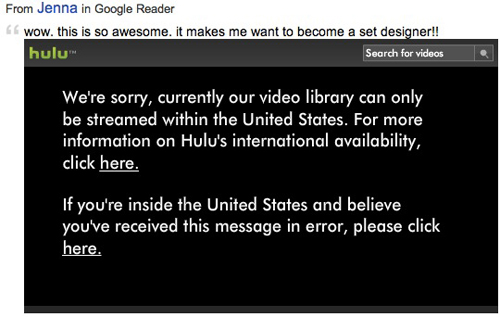
Blasting through items in my Google Reader queue on Wednesday, I ran into a shared item that contained an embedded Hulu video. As you know, Hulu is, so far, limited to viewing in the United States. If I were physically located at home, seeing the clip would have been no problem, but in London, it was as good as dead.


Does this mean I add U's, and change Z's to S's?

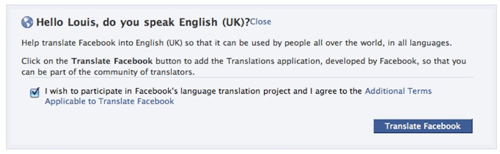
Then, I turned to Facebook. After finding Facebook kindly asked me to help translate their site into "English (UK)", I checked my available Scrabble games, only to find that Scrabble was for North America only and that using it from the UK was "invalid". All my games had to wait until I got back last night.


Really, Scrabble? No UK players?

During the Thursday presentation, while discussing Twitter and other social networks, I mentioned Foursquare, the hip location-based game that is gaining momentum. But I was quickly reminded that Foursquare was not available in the UK.

In the reverse, we have the issue of Spotify, and the intriguing music service's new iPhone application, which has been approved by Apple, but isn't available in the United States. Hopefully, I plugged in my iPhone, fired up the UK version of the iTunes store, and tried to download it while I was there. Total fail. Apple told me my account was only active for the US version of the store, so my quest had been stopped cold.

Also while in the UK, I logged into my Gmail and saw yes, "Google Mail" where GMail was expected to be. It still worked the same, but again... different.

Meanwhile, we know about Google and other portal's challenges with more-controlling countries (read: China), where data comes and goes based on the governments' requests, or individual's identities, once thought anonymous, are unveiled. The concept of a decentralized, open, anonymous, equal Web where anybody can get to any site and share the same experience is far from a reality today. While my trivial annoyances of not being able to play Scrabble or view a Hulu clip haven't scarred me for life, I wonder just how different it is to try and use the Web on places much more far-flung than our former colonial overlords. Should their be a UN for the Web that works to get all things equal, or should every service kowtow to the rules of those far and near?