Silicon Valley Technology Commentary & Archives · Est. 2006 3,045 Posts · 2006–2026
Showing posts with label fitness (3 posts). Show all posts

December 9, 2014

December 9, 2014 · 5 MIN READ · BY LOUIS GRAY

Ingress: The Incredible & Addictive Covert Game Being Played All Around You

Ingress: The Incredible & Addictive Covert Game Being Played All Around You

A little over two years ago, a small team within Google called Niantic Labs introduced Ingress, a game that adds a virtual reality layer on top of the entire world, which you can claim, defend or destroy for your cause - depending on which side you've chosen. And while I tested early versions of the game while it was developing at Google, and dabbled with it just after launch, I put it aside before jumping back in with both feet two months ago, when a pair of colleagues on my new team couldn't stop talking about it. And now I won't stop talking about it either.

Simply put, in my view, it's the most well-designed, intelligently deployed concept I've ever seen for an immersive experience on mobile, which encourages you to get off your butt, explore the world around you, and find new people to help you achieve goals together. Every facet of the application, even while it seems mysterious, is designed to help you get out of house, to explore new crannies of your neighborhood (and beyond) and discover people on your faction who need your help to achieve what would be impossible alone. I've never seen anything like it.

Some shots of Ingress badges and live portals.

As you know, I've been an avid wearables and personal fitness tracking nut for the better part of more than two years. Fitbit has been counting my steps and Moves has been showing where I go. But while Fitbit only counts my activity, it doesn't provide direction or give me a specific mission. Ingress does - making my steps matter, as they are pulled toward each new destination, and seemingly every turn provides yet another opportunity to take down an opponent, power up or build on my own space, or hack away and get new equipment to make me stronger. This combination has accelerated my near-constant walking and movement into personal record highs, consistent leaderboard domination, and I've fallen way behind in any regular TV watching.

There are many other sites dedicated to the gameplay of Ingress, so I won't go too deep, but at its heart, Ingress is a battle for the hearts and minds of humanity. In the storyline, the Earth has been seeded with exotic matter (XM), and you either believe this XM will enlighten us all, or you will resist it. So from the very begining, you choose a side: The Resistance (blue) or The Enlightened (green).

The Two Factions of Ingress: Enlightened and Resistance

Once you pick a side, you then have three primary functions, much like other multi-player games. You can build sites for your faction, you can destroy the opposition, or you can continually farm for new equipment to make you stronger. This is done by visiting sites, known as portals, which consist largely of landmarks across the world, from water fountains to murals, sculptures, churches and standing structures. If it is something that can shape your mind and appears exotic, there's a good chance it's a portal.

Ingress is played globally as teams battle for position.

As one friend of mine tastefully said, you can't play Ingress "from the comfort of your own toilet." You have to move. And in especially dense places with plenty of landmarks, the next portal can be just another block or less away. So if you find yourself out to build, farm, destroy or explore, the only limit to how much you participate is your own time, and how long your phone can hold a charge. That's led to something of a cottage industry for Ingress players lugging around external phone battery charges so playing doesn't stop short at the worst time.

Now that Ingress has you out of your house, and walking with specific destinations, with the next stop just a little bit further away, you're being stretched. Stretched to find new places in your community you hadn't previously seen, new spots in other cities you've never visited, and it sets you up to be territorial, knowing that particular portals are valuable to you or your side.

The Denver, Colorado Ingress Scene: A Mess of Blue and Green

But if you really want to have an impact, you can't just go it alone. Even the most experienced Ingress player can't build a portal up much more than halfway to full strength, thanks to features in the game that limit your ability to power up portals. It takes two players to take a portal to 75%, three can take it to just over 80%, and in order for a portal to reach 100% strength, it take contributions from eight individual players. So you can deploy and hope, or you need to find people on your side who are often more than eager to help and build, destroy or hack together - spurred on by built-in communications in the app, or augmented through dedicated communities on Google+, Hangouts and other chat tools. There, people will arrange times to meet, secret build or teardown events, or provide updates about activity in their neighborhood.

One Los Altos portal in our neighborhood.

I recently heard somebody say you either go deep into Ingress or you don't go at all. And it's probably true. I originally didn't get the attraction, as a low level player. But now I've seen things I build at midnight before heading home get taken down at 1:30 in the morning, or by six a.m. the next day. I've started to recognize and greet players on both teams, and you learn the patterns of the game, as one faction gains control over a geography, or specific people just refuse to ever give up, and seemingly play around the clock. And once you go deep, it really becomes a numbers game, as every activity is counted. Every hack. Every deployment. Every link from portal to portal. Every field. Every destroyed opponent portal. The more numbers you get, the more abilities you have and the stronger you are against the competition, and the more they need to be prepared for you.

Joining the Enlightened on Ingress has brought destinations, goals and missions to the activity I was already doing with Fitbit. It's dramatically reduced (even further) my idle sitting time, it's made me see and enjoy experiences I hadn't yet gotten to around town and in neighboring cities, and I'm getting new relationships with people from a variety of backgrounds, who all hold at least one thing in common - that we're playing Ingress, and working to expand the minds of humanity. It's more than a game. It's the true reality. I hope you do check the game out, and see what it does to your daily routine. And while I don't mind more competition, it'd be awesome if you saw the world in a new light by joining the Enlightened.

Grab Ingress on Google Play for Android and on iTunes.

Disclosure: I work at Google, and the Niantic team works within Google.

March 9, 2012

March 9, 2012 · 4 MIN READ · BY LOUIS GRAY

Fitbit: Virtual Badges Influence Real Behavior

Fitbit: Virtual Badges Influence Real Behavior

I am not going on a diet - and I have no interest in going to the gym, even if Google makes it incredibly easy to eat healthy on campus, and gym membership is free with equipment abundant. It's just not me. But despite this clear disinterest in my making any kind of physical life change, I have been wearing a Fitbit the last week, obsessively counting my steps, climbing the stairs and tracking how many miles I make on foot. I've even been wearing the lightweight tracker at night to see how long and how well I sleep - working to optimize that as well.
So why would I resort to such silliness? It's the stinkin' badges - helped along by casual competition with friends, and now, despite my best attempts to not make any actual alterations to how I behave, I am sure I am doing things that are actually better for me, in the same way that Foursquare recommendations have pushed me to new venues and trying new things, based on badges and recommendations from friends.

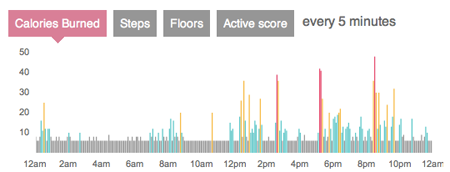
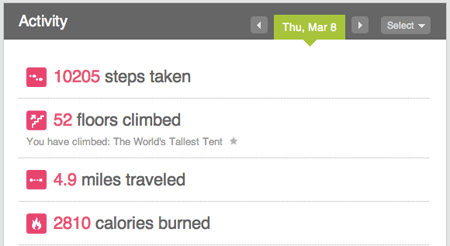
Yesterday's Fitbit activity shows average walking, and lots of climbing.

The Fitbit itself is not entirely new - having debuted in late 2008, and so far, I've been uninterested. I recognize that my mostly sedentary activity of holding down a desk, and chasing after my kids being my main form of exercise would not be particularly interesting. Even now, while I managed 10,000+ steps and 50 flights of stairs yesterday, I still managed to scarf down a great bacon and cheddar sandwich for lunch, so weight loss is not the target.

After scads of occasional tweets and other status updates from acquaintances updating me on the minutiae of their daily fitness activity, it took a simple email of a friend's weekly dashboard last week to recognize this was a device I needed. In minutes, I'd not only purchased the $99 Fitbit Ultra tracker, but also pre-ordered the Wifi-capable Aria scale for another $129. It was the stats, and the idea of competition, that made me knew I had to get it.

A day's activity, showing spikes of walking across campus and at home.

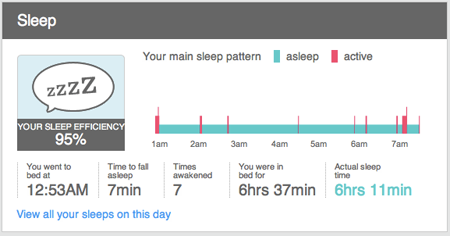
Like a true geek, I'm understandably curious about the Fitbit's accuracy. Does it count 5 steps as a flight of stairs? What about 10? What about small steps, big steps? Do I get credit for manually shaking the tracker or running in place? But despite my moments of tinkering, I've found the tracker's daily reports to be especially accurate. I can spot when I walked to and from my car, to and from lunch, and even when I went from building to building for meetings. I can see when I chased my kids around the backyard, and by looking at the sleep tracker, get a good idea for when they started yowling in the morning, begging to get up.

A night's sleep - 95% efficient, I am told, despite Diet Coke addiction.

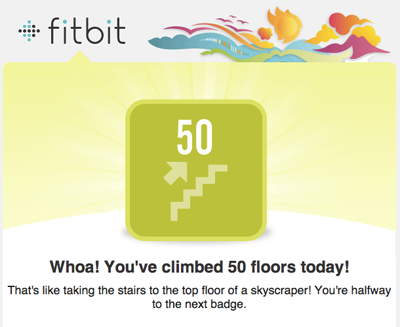
Gaining one's first badges, such as 5,000 or 10,000 steps, or 10 flights of stairs traversed, is pretty straight forward. But I wanted more. When I got home and put the kids to bed, I was at a mere 14 flights of stairs, so I literally, alone in a quiet house, went up and down my 15 stairs at home 11 times, to get to 25 flights. It must have been quite the sight. That got me a 25 flights badge, and later, when I interrupted each chore with 5 more flights, I finally made it to 50 flights of stairs, which earned me a new badge, not to mention a little bit of sweat and some tightness in my calves, which said the exercise might actually have been working. Tricked again!

A badge for 50 flights is one thing. What about 100 flights?

Had it not been for the allure of the 50 floors badge, there's no question I wouldn't have been hiking up and down in my house in some solitary unfulfilling challenge. Had it not been for the intrigue of comparing my daily steps accumulated against my friends, and seeing if I could walk more steps than the previous day, or sleep more efficiently one night versus the previous night, I wouldn't be thinking about it at all. Once the scale arrives and threatens to send my weight to my own internal profile, I wonder if it too is going to impact how I eat, measure and commit to something that resembles good behavior.

As for the Fitbit itself, I can't complain at all. It's very light, inconspicuous, and the software is practically invisible. Just connect to the computer, hit sync, and it's good to go. I'm now addicted to these stats, like any blogger chasing page views, or your favorite fantasy football fan whose future hangs on every rushing yard. The badges are driving the behavior. So if you have a Fitbit and want to challenge my stats, invite me by email. Let's do this.

December 3, 2008

December 3, 2008 · 2 MIN READ · BY LOUIS GRAY

Push Yourself to a Healthy Lifestyle With Web Communities, Tools

Push Yourself to a Healthy Lifestyle With Web Communities, Tools

By Daniel J. Pritchett of Sharing at Work (Twitter/FriendFeed)


photo by nchenga
Has your career eased you into a sedentary lifestyle?  Are you keeping your mind sharp by tracking tech trends but losing your hold on physical fitness?  One of the big downfalls to wired life is the ease with which we can lose touch with our surroundings but the emergence of the social web is helping to change that.  Keep reading for some communities and tools that will help keep you informed and motivated in the never-ending journey to a healthy life.

Learn new exercises and proper form
Try YouTube and Wikipedia for demonstrations of proper form.  One of my favorite virtual personal trainers is YouTube's Scooby1961.  Scooby is a very modest and endearing fellow.

Real-world personal trainer Ross Enamait has a site full of workout information and a vibrant personal fitness community on his forums.  Ross's stuff tends to be geared towards the "combat athlete", so if you're not into boxing et al you might not appreciate the tone of the forums as much as you will enjoy Ross himself.

Share motivation through social networks

Track your progress with gadgets and web tools

My daily walk plotted on GMap Pedometer
    Nutrition help
    You'll want to keep your diet on track, too.  Check up on the nutrition content of your favorite foods using any of a number of online resources like NutritionData.

    Your turn!
    What keeps you motivated?  What are your favorite online health resources?  I'm sure LouisGray.com readers can chip in with your own personal fitness anecdotes, favorite health tips, and best-loved social networks for exercise help.  I'd say the one thing that really got me thinking about fitness in manageable terms was BripBlap's article titled 101 thoughts on losing 100 pounds.

    Read more by Daniel J. Pritchett at Sharing at Work.