Silicon Valley Technology Commentary & Archives · Est. 2006 3,047 Posts · 2006–2026
Showing posts with label Engineering (1 post). Show all posts

November 11, 2026

November 11, 2026 · 3 MIN READ · BY LOUIS GRAY

When Code Is Cheap, Product Vision Gets More Valuable

When Code Is Cheap, Product Vision Gets More Valuable

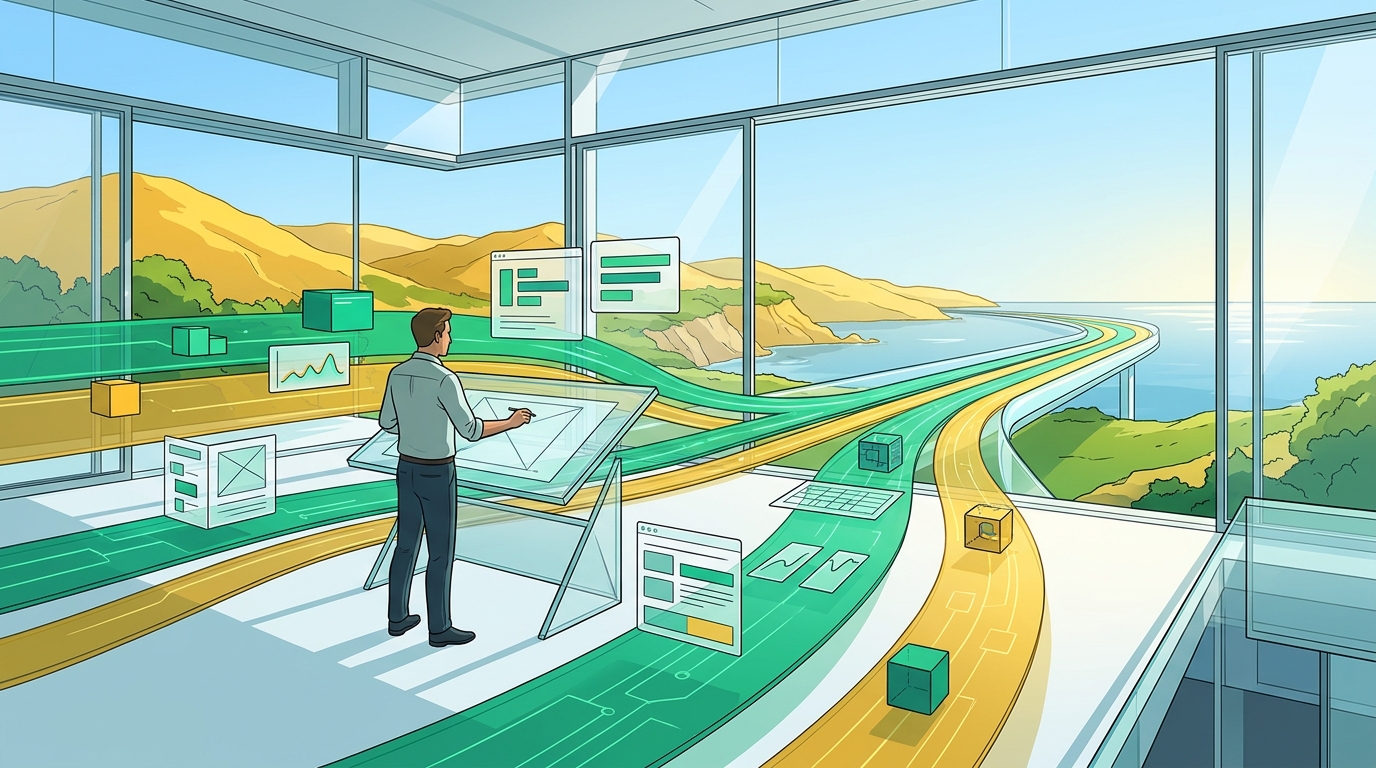
Conducting the product lanes in a sunlit studio [Image via Gemini]
Product vision is as valuable as coding excellence [Image via Gemini]

When Code Is Cheap, Product Vision Wins the Hiring Market

As long as I've been in Silicon Valley, engineers have been king. The most sought after, and highest paying, roles have gone to the code orchestrators with the highest talent, who have been able to turn ideas into reality. Expertise could be claimed due to the number of coding languages they knew, and effort could be arbitrarily counted by the number of lines of code, with only its complexity up for debate. The most flexible and most capable engineers have deftly adjusted their expertise to meet the industry's latest demand, from dedicated apps for the top operating systems at the time, to mobile applications, social network tools, ride sharing apps, autonomous driving, crypto, or whatever business fad or innovation has driven the newest industry.

But now we're in an odd spot. Many of the software engineers I know and have worked with for years are telling me they scarcely code at all, with AI-assisted coding (vibe coding if you must call it that) making it possible for them to tell agents what to do and how to build at unprecedented scale. Meanwhile, recent college graduates sporting computer science degrees are finding entry level opportunities have practically disappeared.

Every technology shift has downstream impact, and the seismic shift toward AI-driven tooling means the roles in demand in this new world have evolved. Lenny Rachitsky's breakdown of the tech job market puts hard numbers behind a shift many of us have seen with our own eyes or felt when looking at our in boxes and LinkedIn messages. Demand for traditional software engineers is plateauing, open mobile and front-end roles have been nearly cut in half, and now product managers are suddenly the ones seeing the biggest hiring surge. 

When I wrote about vibe coding acting as automatic transmission for apps last month, the takeaway wasn't that humans were obsolete, but that the mechanical act of shifting gears was no longer the bottleneck. If a coding agent can build out an app or deliver a mobile view in an afternoon, paying a premium for narrow implementation stops making sense. As Gergely Orosz pointed out in response to Lenny (see Techmeme), specialists who only know one slice of the stack are getting squeezed out in favor of generalists who can steer AI across the whole system.

There is no such thing as a sure thing in a turbulent time. Back in 2018, I looked at Silicon Valley's divergent career arcs and how quickly comfortable middle-tier roles can evaporate when the industry's priorities tilt. We are watching that exact thing play out today in real time.

Telling a machine what to build requires knowing what is actually worth building. If code generation gets cheap, product judgment becomes the scarce resource, which is why product managers and customer-facing builders are having a moment, living in the messy human problem space where no model can hallucinate real user empathy. As I argued in my October piece on human evolution in an AI revolution, the winners won't be the folks guarding the roles and tools of yesterday, but those who are flexible enough to see how the world is changing and be part of that movement themselves.


November 10, 2026

November 10, 2026 · 2 MIN READ · BY LOUIS GRAY

Can AI Deliver Bug Free Code?

Can AI Deliver Bug Free Code?


The bug verification desk is now unmanned. [Image via Gemini]

Can AI Deliver Bug Free Code?All software has bugs. It has always been that way, and much of the recent discussion around AI's impact on software engineering has been about unveiling security holes that plague popular software and may have sat for years -- hardly the setup for promising complete code verification.

I saw the headlines around DeepMind's AlphaProof Code announcement this morning, saying they confirmed Signal's security protocol to be solid, and initially glanced past it, as someone who typically doesn't use Signal. But the post has ignited a foundational discussion about how software will be built and verified going forward in the usual places, including Hacker News, which has zeroed in on a major turning point: moving from classic test-driven development to automated, machine-driven formal proof generation.

The reaction across the developer community spans healthy skepticism to long-term optimism, mirroring a lot of what we've seen in response to AI advancements, ranging from disdain and disbelief to  nodding acceptance. But zero bugs? If AlphaProof Code looked at my code and found no errors, I'd assume the verification itself was flawed. That'd be as impossible as sending one of my draft blog posts to an editor and being told it was perfect.

More broadly, AI systems can now be used to verify human-written libraries, and neural models can now write top quality code, taking the spot we've reserved for decades for well trained and well paid humans.

This shift connects directly to what I explored in Vibe Coding: Automatic Transmission for Apps, where higher abstractions free engineers from manual routine mechanics to focus on high-level architecture. It also reinforces the broader reality I wrote about in An AI Tech Revolution? The Solution: Human Evolution. Technology shifts require human adaptation rather than passive observation. As automated verifiers mature, running unverified raw code on production networks may soon be as outdated as leaving my index directories open with r-w-x (read, write, execute for you non-nerds) to the whole web.

Bug free or not on the first try, we are seeing AI do more. AI is writing, reading, coding and now debugging. I'm betting that even if this pass manages to come back with zero known issues, the definition of what is a bug and what is not will change. 

Disclosures, per always: I work at Google and use Gemini and Antigravity tools a lot. DeepMind is a huge part of Google's AI effort and behind AlphaProof. Nobody at Google reviews my posts, ever.

October 10, 2026

October 10, 2026 · 3 MIN READ · BY LOUIS GRAY

Vibe Coding: Automatic Transmission for Apps

Vibe Coding: Automatic Transmission for Apps


The Human–AI Co-Creation Studio [Image via Gemini]

As a teen training to get my driver's license, my dad wanted me to learn "the right way". To him, that mean getting my first experiences behind the wheel with a stick shift, learning how to coax his sturdy and unimpressive 1990s era Mazda 323, with manual transmission, from low gear to highway cruising speeds, all while avoiding stalls and switching gears smoothly. Through this training, many trial and errors were had as I gained experience.

Eventually, I took and passed the drivers' test, but in an automatic vehicle - my mom's wood paneled Oldsmobile station wagon. Despite its heavy build and thoroughly unattractive appearance, the car's automatic transmission reduced complexity for me, letting me focus on driving the car, not just fighting to get it to work. Now, depending on which survey you choose, less than 1/5th of drivers know how to use a manual transmission, and those cars account for only 2% of all sales in the United States. While there will always be strong opinions about the efficiency or quality of manual vs automatic, from a technology perspective, it's a relic of a previous era.

The rapid ascent of AI-assisted coding, much like that transition from manual transmission to automatic, has reduced complexity and expanded the total market for participants -- not only changing how software engineers work, but making it possible for those without coding experience to speak their ideas into existence, and iterate to make them real. If you can think it, you can build it.

While some debate if AI is conscious or sentient (it's not), it certainly isn't yet fully autonomous. Working with any of the leading AI-powered code environments is a continual give and take between the LLM and the human, a hybrid approach Sean Goedecke calls our "centaur age", reflecting the reality of a time when the machines are so fast and so capable, humans can't directly compete alone but work in tandem with their silicon partners.

Goedecke says: 

"It is no longer possible to credibly argue that an unassisted software engineer can beat a centaur team. The value provided by coding agents is just too great: not just the speed of producing code, but the speed of review and testing."
-- Software's centaur age may last decades

What I have experienced, both at the office, and in my own side projects, is that AI isn't just changing the end product of what we build, or speeding our ability to eliminate tasks -- but more importantly, enabling us to do things we simply were unable to before, expanding our scope and redefining what we could achieve. In the last three years, we've graduated from simple question and answer chatbots to progressively capable workspaces that are waiting to take our instructions, and agents eager to do our bidding.

As I shared one recent experiment, a friend messaged me, "someone has been having fun vibe coding" and I almost recoiled from the description. Even if I never touched an official single line of code, I was able to turn to a software tool, design an idea, work with available technology, and deliver a project users could experience themselves. This was not just for vibes, but a celebration of capability.

The complexity that has defined the world of software development for decades was never the end goal, but a necessity to get there. Now, that journey of pain has been greatly reduced. No more stalling out, no more grinding of the gears. There will always be elite software development. People who have specialized in the field are going to approach invention in ways we amateurs wouldn't think to, due to their education and experience. But vibe coding is a lot more than frivolous toying based on mood -- it's automatic transmission for development, which will put a lot more drivers on the road.

Disclosures per always: I work at Google and vibe code with Gemini and Antigravity tools a lot. I wrote this post by hand.