Silicon Valley Technology Commentary & Archives · Est. 2006 3,045 Posts · 2006–2026

March 24, 2011

March 24, 2011 · 4 MIN READ · BY LOUIS GRAY

Fast Society Says "No Magic" In Group Messaging Alone

Fast Society Says "No Magic" In Group Messaging Alone

To hear some people tell it, the hot new thing in 2011 is the battle for the hearts and minds of group texters everywhere. With the successful sale of Beluga to Facebook, news of Yobongo scoring more than a million in angel funding, and larger rounds by others including GroupMe and TextPlus, you can forgive people for skipping over the lean Fast Society, who has so far stayed away from VCs, gathering just over $200k in funding, and only counts four employees. But despite their being small, they talk a big game. I took a call with company cofounder Matthew Rosenberg earlier this week, and he, without so much as a filter, told me why he feels the industry is fragmented, how every other challenger is going at the problem wrong, and how greedy carriers (such as Sprint) are harming the entire industry.

Fast Society, from much of the coverage I've seen in other tech blogs, has often been characterized as being aimed at socialites, as much about the flashy lights and party-goers as the code - celebrating a good night out more than good syntax. Rosenberg certainly didn't disagree, not shying away from the label, explaining that the service at its foundation was aimed to "help people, when they are going out with their friends, to experience great things around fun events." For him, much of a shared event is not just the actual activity, but the buildup to the event, and the shared emotions associated with the location and experience.

"Everybody else is going for the dirty engineer feel," he said. "We are going for what everybody else wants. Fun and parties and nightlife. That's what normal people do. People don't sit around their computer blogging all night. We have tried to be focused on people who aren't necessarily early adopters who don't care about engineering."

Shrugging off the comment about nocturnal blogging being abnormal, which I obviously disagree with, I asked him how he thought so many different players could participate - and whether users were tired of seeing their social structures split, much like the early days of IM, where AOL users couldn't speak to those on ICQ, MSN or Yahoo!. Unsurprisingly, he had a response all queued up.

"At the end of the day, there's going to be a reckoning," he said. "The fact these things can't communicate hurts the industry. It's so fragmented. Nobody is going to own the communication layer. It's too crowded."

With the crowding comes a seemingly unending stream of news from one company or another. On the heels of SXSW, where many services, including Fast Society, stepped up their game in a war for visibility, Rosenberg said that particular aspect of the service was not groundbreaking. In fact, he practically dismissed it, calling it a "utility", adding there's "no magic behind it". Fast Society instead wants to offer not just group texting, but location sharing, instant conference calls, pictures and video - and unlike practically every other vendor, Fast Society does not use third party vendor Twilio as its back-end, saving the company significant charges on SMS, he explained.

In the group messaging space, TextPlus is both the pioneer and the alpha dog in the hunt, with practically every other service having sprung up in the last twelve months, some to more success than others. Fast Society was launched in September of 2009, focused on building the platform that would enable them to scale without drowning in a sea of red ink, Rosenberg said. "We're the only ones that I know of who don't pay per message," he explained. "We have a flat fee. What our competitors pay in half a day, we pay for a year's worth of messaging costs. It's a big competitive advantage for us".

In a build first make revenue second world, Fast Society seems odd in that they've actually executed real business, striking deals with MTV, and other small sponsorships - which Rosenberg attributed to delivering a compelling experience and providing value for a clearly-targeted audience of teens and 20-somethings out to have a good time. He railed against the industry's tradition of giving value away for free, and being drawn to in-stream advertising like a moth to flame. "It is not pleasant, and not something people want," he said.

The company's image of fast fashion party boys drinking and dancing the night away, augmented by the bright purple and sharp angles of the company's logo and product, may make it seem aloof or too focused on hipsters to be a real business. But Rosenberg almost claimed the opposite, saying "we have the most soul in this space," and railing against the relative dinosaur carriers, like Sprint, who is trying to charge for anybody sending SMS messages to their system, upward of a half cent more per message. "It's disturbing and harms the whole industry," he said. "It's just a nasty thing to do."

If there is a reckoning in the industry, with one or two names ending up winners, others pivoting and fading, Fast Society is going to make pushing to the finish line interesting. Maybe they're the black hat in the fight, or the white knight trying to save end users from a sea of boring apps. Rosenberg may have thought he caught me on a tired afternoon stuck in an airport terminal on the way to an event (which I was), but he still managed to make a good case for why Fast Society is in the game, and why their lean approach targeting real revenue could keep them ahead of others. You can find Fast Society on iOS or Android, and at FastSociety.com. The sign on the door says they're "Built to Party," so go have fun.


March 21, 2011

March 21, 2011 · 2 MIN READ · BY LOUIS GRAY

Cliqly in Alpha: Visual Interface, Filters for Top Tech News

Cliqly in Alpha: Visual Interface, Filters for Top Tech News

Curated news sites are so prevalent, it seems practically everybody has one. With simple tools like paper.li and others, you can even have them automatically generated from the social connections you have on Twitter and other networks. But there's still room for ingenious alternatives that play with highly visual layouts, filters, search and personalization. It looks like we're close to having a new one on our hands with the imminent launch of Cliq.ly, currently ruminating at the longer domain of http://gocliqly.com/, which rolls out top tech news in a tiled format, searchable by keyword.

While that in itself is interesting for fast browsing and article discovery, the service teases with a not yet active menubar for "Popular Scenes", "Views" and "Account", which theoretically lets you select your own keywords, sources or other tweaks that would let this potentially become your start page, providing an alternative to the more traditional RSS reader.

Cliqly Filtered With Google as a Keyword

If you visit the incubating http://gocliqly.com/ now, you'll see graphics from top news sources showing updates on Web services, browsers, and gadgets. A small textbox lets you filter by keyword, be it from the article's title, content or tags. I tried searches for many top tech terms, from "apple" to "google", "Android", "t-mobile" and blogs like Engadget and TechCrunch, all of which returned multiple results, clickable to the main original link.

Cliqly on "Tech"

One assumes that as Cliq.ly gets built, one get the opportunity to tweak views to be more graphical or less so, depending on one's preferences. Given the option for "Popular Scenes", it's possible you could create a personal scene with customized feeds and views and save it for others to view. But it's early days. In fact, DomainTools suggests Craig Condon, one of two behind the project, just snagged the URL yesterday. He mentions a designer, Tim, as a partner on the site, but he is providing the majority of the code.

Cliqly Showing Engadget Stories

What we're seeing from Cliqly on day one is a sneak peek tease of what's to come, no doubt, so bookmark this one, and watch the work develop.
March 21, 2011 · 3 MIN READ · BY LOUIS GRAY

Joint App Brings Instant Messaging, Group Chat to Twitter

Joint App Brings Instant Messaging, Group Chat to Twitter

Twitter's direct messaging system is an easy way for two people to engage in back and forth discussion through the site, but the serve and volley type of chat is a far cry from real-time, and doesn't allow for broader group chat. Today, Joint, brought to you from the team behind LazyFeed and LazyScope, is launching to bring the flow of instant messaging and semi-persistent chat topics to your existing Twitter social graph. You can get your exclusive invite by posting a comment or by following @imjoint on Twitter.

With group chat applications on mobile being all the rage, the desktop experience has been somewhat forgotten, but a dedicated app presents the best keyboard and CPU cycles to avoid any latency between updates, argues founder Ethan Gahng. And once you've tried Joint with a friend or two, you can see how fast you can go from the ping pong manner of DMs in Twitter to real, instant, conversation.

I Can Invite You to Joint Via a Personal URL

You first get connected with Joint through getting invited by a friend through a dedicated, personal, URL. (Such as this one) You are then asked to download a small Adobe AIR client that runs on multiple platforms, and near instantly discovers your Twitter social graph, letting you have real-time chats with people to whom you are bidirectionally connected. This way, all of those with whom you can send and receive DMs can also chat with you in Joint.

Joint In Action With Friends On Left, Chat Rooms Center, Discussion Right
(Click for Full Size Image)

If your friends are using Joint, public chat rooms they have created are displayed in the left sidebar, so you can pop into any chat room and start talking with those who are there. It's a lot like Convore, but on the desktop, and designed as much for 1-1 communication as for static topic chats. In fact, the chat rooms in Joint are set up so that new users who join a room don't see previous entries. Magically, if every user leaves a chat room, it too disappears, so don't be surprised if you set up a popular room more than once.

Adding A New Comment to An Existing Chat Room In Joint
(Click for Full Size Image)

What makes Joint even more like the well-known world of instant messaging (IM) is the idea of status indicators. A green status bubble means you are signed in, while a clock shows you are idle. Once in, you can create a room with any topic, or invite any of your friends to join you. You have the option to create the room with three types - Public, Protected, or Stealth. Clearly, public rooms are open to all, protected means the creator requires a password, and stealth rooms are not displayed at all - even to friends. To get into a protected room, you must be invited, or enter the known password. Stealth rooms even feature a cool stealth bomber icon.

Before you shrug off Joint as "yet another chatroom" service, think of using this first to replace those back and forth DM sessions you've no doubt had with friends, and then think about starting real group chat with your Twitter social graph. Want to get in? Leave me a comment, and follow @imjoint on Twitter. This one's a keeper.

March 19, 2011

March 19, 2011 · 3 MIN READ · BY LOUIS GRAY

How Twitter's @Reply Rules Expanded Conversations, Use

How Twitter's @Reply Rules Expanded Conversations, Use

Twitter's relationship with developers and users has been bumpy, to say the least. The users are fiercely loyal about the service, but like Facebook's fans, every little update is first dissected, then railed upon and is typically finally accepted by the community. For all the tumult over client changes, ad inserts, new retweet styles versus old and Web layouts, users have stuck with Twitter without leaving in mass numbers for an alternative. Among the most controversial choices was the company's move to hide tweets aimed at users that you were not mutually following - meaning @reply tweets sent to a third party you weren't already following were simply hidden outright.

While the initial outcry was strong, and continues to get mentioned as decreasing Twitter's potential for serendipity and discoverability for new voices, I have found the value of the tweak has enabled real conversations in the service that would be a challenge otherwise, and by making replies a major part of how I use Twitter, there has been no backlash in my own increased use, if one assumes follower counts are a valuable measure.

TweetStats Shows I Am Tweeting at a Record Pace

My initial usage of Twitter was extremely cautious, as I knew every single 140 character missive was distributed equally to every potential follower, not to mention redistributed to networks aggregating my content. If I wanted to reply to another user and comment on a subject, I was effectively CCing the entire world, who would have to attempt to piece together what I was replying to, and many more would often jump in mid conversation. It was a mess. While, yes, my connections could see new user names they hadn't previously encountered, plucking quality from the real-time stream in this mix of discussions was a challenge - and I didn't want to add to the noise.

Ev in 2009 Under Fire From the Vocal User Base

In May of 2009, Twitter made what they called a "Small Settings Update. Anticipating a response, the post said "Despite this update, you'll still see mentions or references linking to people you don't follow", assuming the users were mentioned mid-tweet. A follow-on post revealed one of the major issues was technical, that Twitter had to make changes due to continuing scale problems. Eventually the company had to do a mea culpa, not just around the issue itself but in terms of how it was communicated. Users were very frustrated, and the "#fixreplies" hashtag dominating most streams. But in the ensuing two years, as the dust has settled, users, myself included, have learned how to leverage the new environment.

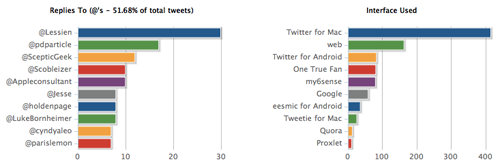
Replies In 2011 Make More than 50% of My Tweets

For every user out there who adds a stray character (usually a . or a *) before replies to extend the visibility of the update to the community, there are many more who use the system as it was intended. Now, conversations between users who are not mutually followed don't clutter up the streams, and there's a lot more freedom to reply without creating so much noise you have to be ignored or unfollowed. Meanwhile, if a third user has already elected to follow both of you, they can watch both sides of the conversation, and likely have an interest in the discussion.

TweetStats Shows Who I Reply To Most Often

In the last few months, I gave up on being overly concerned about flooding my stream with @replies. A cursory glance at TweetStats showed @replies had ballooned from single digit percentages of my updates to more than half in 2011, and leading to record quantity of updates, even at times approaching 40 tweets a day - which for me is fairly voluminous. And yet there's been no outcry or massive unfollowing. The numbers aren't accelerating, but we all know the numbers are immaterial and the time for exponential growth is past. But while in the past conversations were practically impossible in Twitter, moving to other platforms, the @reply change made the service a lot more capable to handle deeper exchanges.

While the initial reasons for the @replies change may have been steeped in scalability problems and strained architectures, users have adapted, and helped to morph the network into less of a simple status update repository and link bombing channel to one of real back and forth discussion. It's let me talk privately in public.