Silicon Valley Technology Commentary & Archives · Est. 2006 3,035 Posts · 2006–2026

August 4, 2006

August 4, 2006 · 2 MIN READ · BY LOUIS GRAY

RapidWeaver Continues to Expand Feature Set

RapidWeaver Continues to Expand Feature Set

In the world of Web publishing, there are a number of ways to go - each of which offers a variety of benefits, depending on your technical expertise, your patience, and your budget. Some packages work for commercial environments, and others are much more appropriate for individuals and blogging.

As noted previously, I selected RapidWeaver from RealMacSoftware at the beginning of this year, to act as the foundation for the Web site, because it enabled me to update the blog from my computer, on my own domain name, without requiring server-side SQL. The system isn't perfect, but the authors continue to make updates, and each rendition of the software gets closer to perfection.

Since the mid-1990s, I have utilized BareBones' BBEdit for all HTML work, both at the office and for the home page. In fact, I still use it at work, and have been able to use it as we scaled from a few dozen to a few hundred Web pages. It's a fantastic product, and the site-wide search and replace functionality is one of the main reasons I've continued to use it year after year.

I'm also familiar with many Web-hosted tools, like TypePad and Blogger. While simple, they are often too cutesy, or demand you host your blog on their site. RapidWeaver offers the best of both worlds, delivering customizability, and the flexibility of my own URL and the option to host data via FTP on my own server.

This week, RapidWeaver rolled out 3.5 beta 3 of the application (Version Notes), making it the 4th version I've used. We adopted version 3.5 the night it came out, and installed the following two betas each month they came out. With version two came permalinks and subpages, and the latest betas have improved stability and tweaked existing features.

My feature wish list for RapidWeaver is there, but diminishing. To truly eliminate any interest I have in iWeb or TypePad or WordPress, we need to see better integrated comment systems, the option to publish remotely, away from the desktop storing the application, and code editing, to name a few, but it's still pretty darn good. We'll keep watching any and all updates and hope the site continues to grow.

Listening to ''Ready Steady Go'', by Paul Oakenfold (Play Count: 16)

August 4, 2006 · 2 MIN READ · BY LOUIS GRAY

Digg The Man a Pit To Hide His $60 Million

Digg The Man a Pit To Hide His $60 Million

By a significant margin, the story demanding the largest amount of buzz on the Web in the last 24 hours has been BusinessWeek's cover story on the latest generation of Web 2.0 leaders who have developed some of the Web's biggest brands in a short amount of time. This week's cover boy is Digg founder Kevin Rose, smiling giddily, with two thumbs up, and a headline saying he made $60 million in only 18 months. If only that were true. It's a great headline, one that has drawn a lot of attention, but it just isn't true.

BusinessWeek makes a number of critical errors in its jump to a monetary stat. It first assumes that Digg is worth a valuation north of several hundred million dollars. It then assumes that this valuation is liquid, and that Kevin can access his share of the large pie, netting him what they approximate as $60 million. Truth is that Digg is only netting the single-digit millions yearly in revenue, let alone profits, and it remains a very small company, run by a determined young entrepreneur, verging on the edge of becoming an Internet media powerhouse.

Those who remember the first wave of Web worship no doubt remain skeptical over BusinessWeek's adoration of Kevin and others who have made tremendous Web products and not yet made the connection from leading brand to leading profits. And now BusinessWeek has made Kevin, a good guy from all we can tell, the posterboy for the latest wave, for better or for worse.

Digg, scarcely known a year ago, in the shadows of Web giants like Slashdot and CNet, has developed organically to be a real kingmaker for all media. The brightest of old-school newspapers like the Washington Post, Wall Street Journal and the LA Times have incorporated new tech tools like Digg and Technorati into their Web coverage to assist with linking and the word of mouth that can springboard a story to the next level. But Kevin's not worth $60 million yet. He has a lot of work to do yet to achieve what is a tremendous potential.

All that aside, nearly all the leading publications have taken the Digg story and run with it. Here are a few of the best responses: (Jason Calicanis, GigaOM, Good Morning Silicon Valley, MicroPersuasion, ValleyWag)

Listening to ''A Rush of Blood to the Head'', by Coldplay (Play Count: 7)
August 4, 2006 · 1 MIN READ · BY LOUIS GRAY

On  Harvard's Hallowed Ground

On  Harvard's Hallowed Ground

With one last day here in Boston, my wife and I traveled on the Metro to the Harvard campus, and though we didn't pick up an admissions form, we did get to see landmarks of the Revolutionary War, monuments to those students who lost their lives in the Civil War, and in a more modern twist, we stepped inside the campus' bookstore and a number of the nearby shops and eateries.

As I had expected, regardless of an institution's interpreted valor, nearly all college campuses follow the same format - large lecture halls, narrow stairways, cement, brick and columns. Having attended UC Berkeley myself, and returned several dozen times post-graduation (mostly to attend Cal football games), it was fairly simple to note the similarities between Harvard's setup, the surrounding Cambridge community, the meandering tourists and the streets' cast of characters.

Really, the only superficial differences between Harvard and UC Berkeley was Harvard's lack of a central bell tower, and the age of its buildings. While UC Berkeley was the first UC institution to start up in 1868, Harvard had been well under way in the previous century. Notes throughout the campus and its diameter remind you of this. Monuments celebrating George Washington and Abraham Lincoln also dot the area.

The homage to history got me thinking - in two centuries forward, what of today will be marked and kept holy, preserved for future onlookers? Will it be our capitol buildings? Our ballparks? Sites of riots and disaster? What will be erected to remind others of what we will someday leave behind? It's an answer none of us will ever know.

Listening to ''Motion'', by Paul Oakenfold (Play Count: 5)

August 3, 2006

August 3, 2006 · 1 MIN READ · BY LOUIS GRAY

An Evening at Fenway Park

An Evening at Fenway Park

There's something about the exuberance of 36,000 Red Sox fans that has you rooting for the team, even if you know that you secretly should be rooting against them. That's the situation I found myself in this evening, as my wife and I shared a visit to the historic venue for the first time together. I had previously made  a stop at Fenway Park in May of 2005 on a business trip, but this was her first time.
The Red Sox led early, taking a 3-1 margin into the 3rd, when Cleveland struck back with a solo shot. In the fourth, Travis Hafner clubbed a homer around Pesky Pole, and tied it up. That was not to be the end of the scoring, however, as little-heralded Shin Soo Choo stepped up to the plate with the bases loaded in the 5th, and hit a grand slam, clearing the bases, and drawing a hush over the sellout crowd. With a 7-3 lead now, the Indians held on to win, even with David "Big Papi" Ortiz and Manny Ramirez coming up in the bottom half of the ninth. Though both sent soaring shots into the outfield, that's as far as the balls went, staying in the yard and extinguishing the team's hopes.

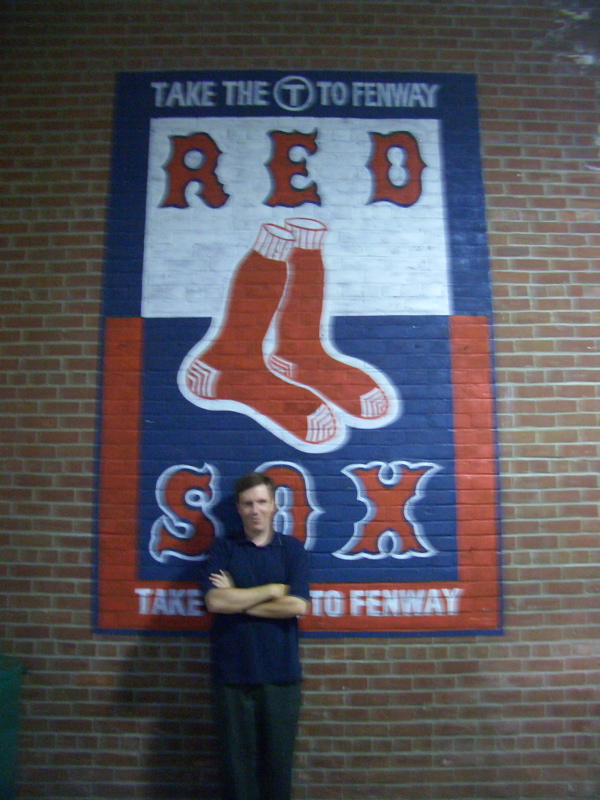
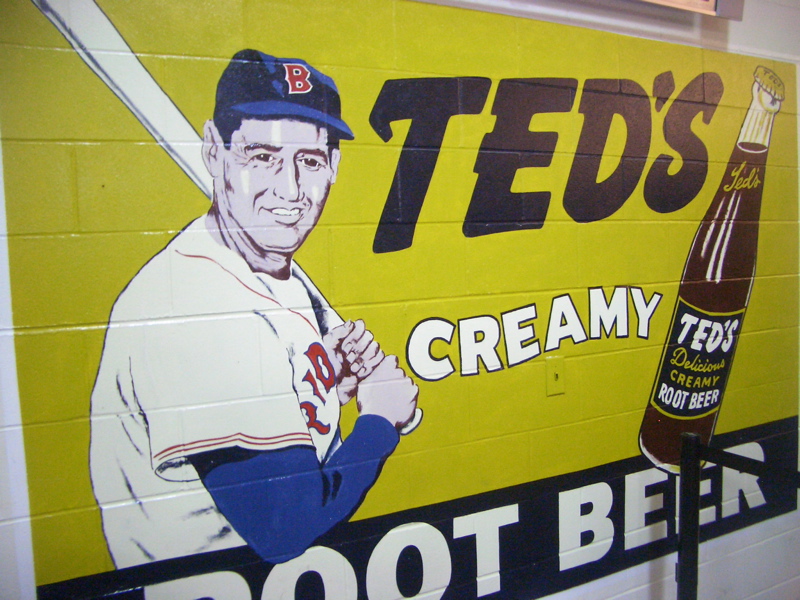
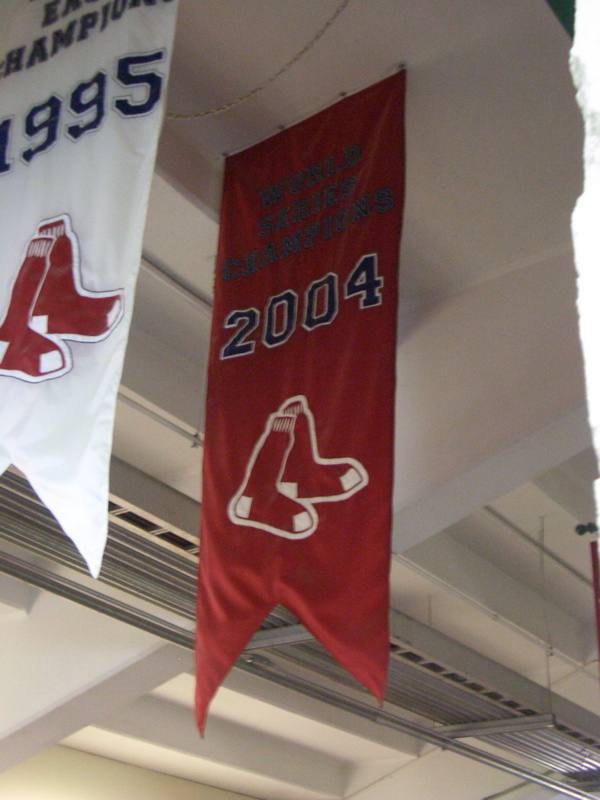
Being a baseball nut, it's hard to play the role of tourist, but we took a few pictures of the park, adding to the dozen or so I took last May. Below are some from this evening's experience.


Click images for larger versions


Listening to ''Mainline'', by Narcotic (Play Count: 4)