Silicon Valley Technology Commentary & Archives · Est. 2006 3,034 Posts · 2006–2026

February 18, 2007

February 18, 2007 · 2 MIN READ · BY LOUIS GRAY

Is Timing an Important Element for Blog Posts?

Is Timing an Important Element for Blog Posts?

This week, an interesting thread emerged when a stats-crunching 15-year-old in India analyzed well known Microsoft blogger Raymond Chen's posts, finding an astounding 77% of his posts came in the 7 a.m. hour, which led to his joking, "Is Raymond a bot?" But is Raymond on to something, that the 7 a.m. hour is the most appropriate time to be posting for optimal readership?

Thought Clusters' Krishna Kumar similarly wonders: "The 7 am intrigues me. Is that the best time for making a blog post visible? I do my posting during the weekends and nights - which is not exactly a good time for US-based audience."

As I see it, there are two ways of approaching this. One is how your own reading patterns flow, and one being the time you have available.

For me, the vast majority of blogging takes place between 6 p.m. and 10 p.m. on weekdays, after getting home from the office, with about two posts a day thrown in on the weekends. By moving from RapidWeaver to Blogger this month, I have more flexibility to post from the office, but through the first few weeks, I haven't been doing that at all - likely the result of work tasks and my own sense of guilt getting in the way.

However, as Google Reader tracks what time I read feeds from other blogs, a pattern does emerge. The 7 a.m. hour is when I do the most reading. It's right after I wake up each morning. You can see in the chart below, covering the last 30 days of activity, that the number of feeds read between 1 and 5 a.m. is almost negligible, which accounts both for my requiring sleep, unlike a bot, and the fact that most bloggers aren't posting at this time, giving me less to read. By reading feeds at 6 and 7 a.m. before I get ready for the day, I'm set with the day's news. You can even see dips throughout the day, one at 8 a.m. when I'm either driving to work or just getting in, and a second, at 5 p.m., when I'm sitting in traffic on the way home.
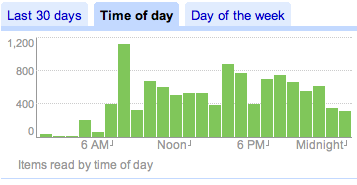

30-day Summary of Feeds Read, by Hour


This tells me that 7 a.m. is a great time to read feeds, or if you post at 7, I'll read it almost immediately. If, like me, you choose to post in the late evenings, you're probably not getting the most traffic available. Many people do the majority of their Web surfing at the office, not at home, so my practice of being quiet during the workday is contrary to what visitors are looking for.

The real question is, can I act on this knowledge? Krishna suggests writing posts at other times of day and posting at 7 a.m., just like reporters write, and their stories emerge with the morning's paper. That could be one option, albeit one that conflicts with the immediacy, real-time feel of the blogosphere.


February 17, 2007

February 17, 2007 · 1 MIN READ · BY LOUIS GRAY

Tidbits from the Link Blog: February 17, 2007

Tidbits from the Link Blog: February 17, 2007


With one fell swoop, Google made a ton of bloggers feel a lot better about themselves, as overnight, their site subscribers increased anywhere from 20 to 50 percent, as the search engine began reporting on RSS feed readers, via Google Reader and their personalized home pages. And for some reason, my overall count didn't budge. I'll live. But it got a lot of people talking about statistics, from Don Dodge to Mashable and a host of folks on TechMeme.

Technology:

Don Dodge: Blog Metrics: Subscribers, Readers, Page Views...
Mashable: Alexa’s Inaccurate Traffic Stats Become More Detailed
Mini-Microsoft: Stop Him Before He Speaks Again!

Politics:

Robert Scoble: What You Won’t See about Iraq on American TV
Americablog: USNews: Bush could sink the GOP in 2008
MyDD: Does This Mean Gore Is Definitely Out?

To see what I'm finding interesting, bookmark or subscribe to my link blog.
February 17, 2007 · 2 MIN READ · BY LOUIS GRAY

Google Reader Ready to Leave Google Labs

Google Reader Ready to Leave Google Labs

Google, well known for leading the charge in Web-based technology innovation, has been lauded for making early version projects available to the masses through its self-proclaimed "technology playground", Google Labs, at labs.google.com. With the idea being that some of their favorite ideas "aren't quite ready for prime time", giving you the chance to "play with prototypes", these Lab projects incubate, sometimes for years, before being released on a wider scale.

I believe that in time Google Reader has been cooking, it has reached the point where it should leave the labs altogether. To not release Google Reader from the labs would only demonstrate to me and other users that Google doesn't take this product as seriously as other applications, and that they are less willing to support it and fix bugs rapidly - which would be assumed once the product went "Live".

Google Reader is, by unofficial statistics, among the fastest growing RSS feed readers out there, and is much beloved by some of the blogosphere's most vocal technology pundits, including Robert Scoble of PodTech. I made the switch from NewsGator's NetNewsWire to Google Reader late last year and haven't turned back, making Google Reader a must visit throughout the day, every day, as it dutifully collects all the latest posts and articles from my feed subscriptions, while dramatically reducing my need to visit Web sites directly.

In most companies, for a product to leave beta status and go to general availability (GA), it should have gone through significant quality assurance (QA) testing, and displayed consistent reliability and uptime without show-stopper bugs. Over the last four-plus months since its unveiling, Google Reader has been stable, and added new features on a regular basis, from sharing links via a customized links blog, to displaying individual trends on reading and sharing RSS feeds, all while keeping a simple GMail-like interface that Google has kept as a standard for its Web-based applications.

It is my expectation that Web-based applications, like search engines, and all Web pages, will retain the ability to be updated rapidly over time. Releasing Google Reader out of the Labs, while continuing to add features and fix any bugs that arise, makes sense. In its short time in the Labs, Google Reader has evolved to a must-use application, one I likely use more than the Google search engine itself. And that's saying something.

More:
Google Reader: Official Blog
RSS a Demanding Mistress
RSS Eliminates Need for Frequently Repeated Searches

February 16, 2007

February 16, 2007 · 1 MIN READ · BY LOUIS GRAY

It's Time to Make Power Wireless and Battery-Free

It's Time to Make Power Wireless and Battery-Free

When Steve Jobs passed an Internet-connected iBook through a Hula Hoop during MacWorld just under a decade ago, it whisked in the era of wireless Web for most of mortal consumers. Today, WiFi is both accepted and expected nearly everywhere, at home, at work, and in some larger cities, outside. But in order to truly cut the cord, we need to find a solution that doesn't require being tapped into an electrical cord, hanging as a leash (or ball and chain) to the nearest socket.

Today, a rumor surfaced that Apple was pursuing a patent that would pass both data and power without physical contact. For those of us tired of lugging around laptop power cables, or stowing a spare battery, any type of positive change can only come too soon. While processor power and network speeds have continually increased over the last few decades, the typical battery life for a laptop hasn't budged much. A few years back, in 1999, Apple advertised watching a single DVD more than once (though they were shown to be wrong), but now, I'd be surprised if I could finish a good two to three hour film, especially if I were running any other applications.

When I posed the topic of "wireless power" to a colleague a few years back, he practically scoffed at me, saying that wireless power had been invented, in the form of microwaves, and that we would all be nuked ourselves if we demanded the power be transmitted wirelessly through the air, in the same fashion as 802.11 wireless Internet.

Maybe so. But it seems only logical to me that the first company to debut a simple solution for wireless power adapters for a mass audience is set to make significant money. I can't wait to detach myself and cut the cord when that time comes.