
Silicon Valley Technology Commentary & Archives · Est. 2006 3,034 Posts · 2006–2026

May 27, 2007

May 27, 2007 · 3 MIN READ · BY LOUIS GRAY

My Web Widgets: The Why and Where

My Web Widgets: The Why and Where

I vacillate between wanting a spartan blog that loads quickly and looks sharp, and one that features all sorts of widgets that increase interactivity, community and information. A Web site owner can easily overdo the use of widgets, and relying on many third party sites for functionality can serve to slow the user experience, as browsers are forced to make calls and retrieve data from multiple points. But despite this, I've implemented a few widgets worth highlighting.

1. Recent Comments (from Storago)

Google's Blogger platform doesn't offer an easy way to highlight recent comments, so after searching the Web for options, I added a tool from Storago.com that highlights the five most recent comments on the right sidebar of the page. The widget says when the comment was made, by whom, and on which post. This way, if somebody finds a post from the archives worth commenting on, I don't miss their note, even if its off the front page.

While I don't get dozens of comments a day, I do get some regulars, including Tony Chung of Geekwhat, Gal Josefsberg from 60in3 and Erin Gurney of Ballhype. Others of note include Webomatica and Galeal Zino from NextBlitz.

2. Recent Shared Items from Google Reader

There are a lot of great bloggers out there, far too many for me to post about each day. I've subscribed to more than 100 RSS feeds, and read more than 500 items each weekday. Those which I find most interesting, I'll share via my link blog from Google Reader. Google has made it very easy to share this in Blogger, which you can see on the right sidebar.

Google Reader Trends says that in the last month, my most frequently shared bloggers were TechCrunch, Robert Scoble, Mashable!, Engadget and Read/WriteWeb - all outstanding blogs.

3. ZoomClouds

ZoomClouds takes tagging to a new level. Rather than asking me to proactively tag each of my posts with a specific topic or set of topics, ZoomClouds watches what I write about and reports the keywords, in descending order of use. The larger the font, the more frequently I blog on that topic.

It should be no surprise that my top 5 topics, according to Zoomclouds are: Apple, Google, Microsoft, TiVo and iTunes.

4. Technorati

Despite some criticism of the site's uptime, and continued competition with Google, Technorati is well integrated with the blogosphere, offering tools that summarize a site's Web influence, tagged as "Authority", with the option to read a blogger's profile, add to favorites, and search previous posts. Over the last few months, I've seen my blog's authority jump all the way from the mid-50s in late March to almost 100 today. While some of those counts may be spam blogs, I know Technorati is doing a great deal to avoid overcount.

Technorati tools: Blog Summary, My Profile and Blog Reactions

5. MyBlogLog

MyBlogLog, now a Yahoo! property, showcases icons that display recent visitors, and gives a better sense of a site's community. Even those of us without thousands of visitors a day can get an understanding of who visits the site, what other topics they like, and when signed in, let other bloggers know I've been visiting their site. Depending on site settings, MyBlogLog will add me to a community based on how many times I've visited their site. The service also tracks site visitor traffic and popular outgoing links, though I can honestly get that data in a multiple of other places...

MyBlogLog: Join the Community View the Community and View My Profile

Other widget-like details in the sidebar are gussied up links to LinkedIn for professional networking, and signups for my RSS Feed from Feedburner and blog by e-mail from Feedblitz.

While not fully comprehensive, there's a lot here. What other widgets do you use on your blog and think I should look into?

May 26, 2007

May 26, 2007 · 1 MIN READ · BY LOUIS GRAY

U.S. Web Traffic Down For Memorial Day?

U.S. Web Traffic Down For Memorial Day?

This being a 3-day weekend and the traditional kick-off to summer vacation season, it looks like even the geeks have left the keyboards behind and headed for more enjoyable places - ostensibly without net access. Robert Scoble's on his way to South Lake Tahoe, and even TechMeme makes it look like it will be a slow weekend.
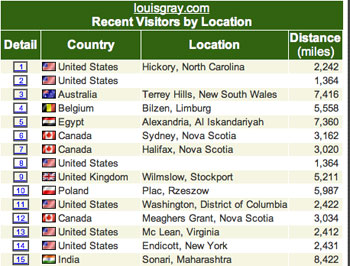
Of interest, I looked at my own traffic, and I see that nobody from within 1,000 miles has come to the blog in the last little while. Instead of the usual domestic traffic, with much of that from the Bay Area, I've been frequented by visitors from India, Egypt, Belgium, New South Wales, Poland, the UK and a flurry from Nova Scotia. I guess they didn't get the memo the rest of us are on holiday.


Also of interest, it looks like the Register.com laptop theft I mentioned yesterday is leaking to mainstream press. The Inquirer (UK) starts the coverage. Paul Ferguson notes the security breach as well.
May 26, 2007 · 4 MIN READ · BY LOUIS GRAY

Intellequity: A VC-like Concept to Tackle Higher Education Debt

Intellequity: A VC-like Concept to Tackle Higher Education Debt

With June right around the corner, college campuses around the country are seeing commencement exercises and graduation ceremonies filled with pomp and circumstance, as they hand thousands of students pieces of paper that exit most of them from the campus and into the world of earning a living. Some may already have started new jobs. Others may just be starting that search now. But for many, the years of schooling have already put them deep in the hole financially. While the mood on the day of graduation is a gleeful one, the issue of debt is very real, one that could be haunting some for a very long time.

Uber-blogger Chris Pirillo highlighted this issue in a two-parter today on Student Loan Solutions and Student Loan Debt, concluding that he doesn't know if student loans are "more of a hindrance than a help." The major issue, he writes, is that forward-looking young adults are expected to get an education, whether we can afford it or not, meaning some are weighed down "with tens of thousands of dollars in student loan debt before we’ve even had a chance to see whether or not our higher education was actually worth the price of admission."

While I was in college, I occupied an odd middle ground where my parents' collective income was too high to qualify me for financial aid, but their month to month struggles meant that the tuition checks going home weren't always covered on time. Some months, the way I'd find I was negligent was that my meal card for on-campus dining would simply stop working, sending me to nearby eateries in Berkeley, bleeding away my already low cash on hand. But the good news was that I managed to pull through, getting a degree in four years without establishing debt. Other friends of mine, also entering their early 30s, did qualify for financial aid, but also racked up debt, some into the six-figure range, and to date, haven't made much headway. In fact, one of my best friends, whom I've known for half my life, may have to file for personal bankruptcy just to clear the deck and start over.

In the heady dot-com mania of the late 1990s, when everybody had a business plan sure to make millions, I had come up with what I saw would be a sure solution - a program I had dubbed "Intellequity". The concept was that instead of basing loan agreements on current cash on hand or current income levels, I would set up a company that doled out loans to promising students or recent graduates. The better the prospects seemed for a student, the better the loan terms would be. Effectively, based on a detailed matrix of experience, grade point average, major, brand name of the attended school, and a small battery of aptitude tests, and interview, we would offer loans that would not come due until the applicant began their first salaried job.

The student would not incur a specific dollar value of debt at all. Instead, the way the "Intellequity" project would be funded was through asking for a small percentage of future income over a set period. For example, if $10,000 were the loan amount, and the candidate were to have established a 2% payback rate over an 8 year period, they would pay Intellequity 2 percent off the top for 8 years. Assuming the applicant made $500,000 in salary over the 8 year period, the pay back would be the same $10,000. But if they made more, the company would gain a profit. If they made less, it would be our loss. If the payback rate were higher, say at 3% or 4%, the return would be that much greater as well.

Those applicants who didn't see their career paths pan out they way they had planned would not be equally burdened as those who had skyrocketed, those who we had taken a chance on. The risk would have been transferred away from the student who started accruing interest right away, but instead, to those of us funding the individual. In effect, it would be acting like a VC firm, not for a business, but for an individual. Some investments, as with VCs, would be duds. Others could make millions. And Intellequity would become a partner with the student, finding them better paying jobs and opportunities, hoping to push the individual toward a route that would make them more money in the end.

Would bringing a VC-like environment to the student loan process work for everybody? Of course not. But it sure would make things interesting, and it would eliminate the problem that some students find themselves in from the day they walk the stage and throw their mortarboards in the air - one of being alone and in debt from the very beginning.

May 25, 2007

May 25, 2007 · 1 MIN READ · BY LOUIS GRAY

Google User Experience Study Promises No Electrodes

Google User Experience Study Promises No Electrodes

They say that Google strives to "Do no evil", but as the company comes under increasing scrutiny for having a monopolist's share in the global search market, and others are growing more distrusting over the company's motives, in light of the Feedburner acquisition that expanded Google's ability to track user behavior, it's no surprise they have to remind people now and again they're not Big Brother.

Users of Google's Blogger service, the service powering this Web site, are invited to undergo a user experience study testing new features. Applicants may even get paid, upwards of $100, the company promises.

But clicking through to learn more about the opportunity led me to a Frequently Asked Questions (FAQ) page detailing what would be expected. While it's no surprise that you could "try out a prototype" and give feedback, the third question could be seen as a surprise, reading: "Does it involve having electrodes attached to my body?"

The answer? "No. Sorry."

Apparently, not only does this question come up a lot, but applicants appear to have been disappointed by the lack of electrodes. An odd group, to be sure.

Also of interest, the FAQ dictates that you would have to sign a non-disclosure agreement (NDA). While that's no surprise in the trade secret protecting Valley, for Google to expect bloggers who use their Blogger service to be the shy, quiet types is unlikely. It would be like telling a 15 year-old girl a juicy secret, sending her to a slumber party and expecting your confidence to be iron-clad. Not a safe bet, unless you were eavesdropping, and she were wired to electrodes...