
Silicon Valley Technology Commentary & Archives · Est. 2006 3,034 Posts · 2006–2026

May 31, 2007

May 31, 2007 · 2 MIN READ · BY LOUIS GRAY

Google Gears Another Utility That Won't Work With Safari

Google Gears Another Utility That Won't Work With Safari

Ratcheting up the company's applications battle with Microsoft today, Google debuted a new platform called Google Gears, a new developer API that lets Web developers also develop for offline use. Some are calling the introduction a game changer, and the service's cross-functionality on multiple platforms is lauded. But in what's too familiar a story, if you're a Mac user like me who prefers Safari as your Web browser, you're locked out.

The Google Gears page says in its system requirements it supports both Firefox 1.5+ and Internet Explorer 6.0+ browsers, with no mention of Safari. This despite recent close interaction with Google and Apple to deliver YouTube for the AppleTV, Google Maps for the iPhone, etc.

For some reason, being one of those on Safari today is akin to being a Mac user in the 1990s. Developers are coding for the major browsers, and we're lucky to be thrown a bone. Below are a few more bigtime apps that refuse to work under Safari:

1. The Alexa Toolbar

Alexa always, always dramatically undercounts Macs because Mac users site visits aren't counted. Despite years of knowing this was an issue, Alexa has made no move to offer anything but a toolbar for Windows users with Internet Explorer.

2. StumbleUpon

Although StumbleUpon has achieved success, recently making news for being purchased by eBay, the service is mostly mystery to me. The StumbleUpon toolbar is available only for Internet Explorer and Firefox. Safari users are not invited.

3. Google Pack

The Google Pack is available only for Windows users, period. Forget about any Mac version.

4. Google Toolbar

Making Safari 0 for 3 in the toolbar battle, Google Toolbar is only available on Firefox for the Mac or Internet Explorer. Safari users need not apply.

5. Yahoo! Toolbar

Aha! 0 for 4. The Yahoo! Toolbar is only available for Windows Internet Explorer or Firefox. Got Safari? Got no toolbar.

So whose fault is it here? Is it Apple's fault for creating a Web browser that wasn't extendible or developer friendly? Is it instead that the developers are ignoring the Mac OS X Safari market? Or further, are Web standards not being followed? I'd assume Google has the manpower to provide Mac OS X Safari capable Web applications, but they are putting resources somewhere else. For me, Safari is the very best browser. That these popular sites and programs are unavailable is extremely frustrating.

May 31, 2007 · 1 MIN READ · BY LOUIS GRAY

For $33.75, I Could Ditch DRM from 130 iTunes Songs

For $33.75, I Could Ditch DRM from 130 iTunes Songs

Apple's iTunes Plus project launched today, giving me the option to strip digital rights management (DRM) from a select subset of my musical library for 30 cents per affected song. As the promotion only covers a fraction of the total available iTunes Store, I was curious to see how many I would be offered, and at the end of the first day for this promotion, I could upgrade 130 songs for $33.75, Apple says.

What would I get?

With iTunes Plus, I would remove the iTunes and iPod-only barrier from these songs, letting me pass songs to friends, copy to multiple computers, or in theory, play on other, inferior music devices. Additionally, the songs would be offered in higher quality bit rates.

On the first day of announcement, bands in my purchase history that are available include Coldplay, Beastie Boys, Royksopp, The Chemical Brothers, M83, Fatboy Slim and Cosmic Gate.

While others are excited about the move and hate all things DRM-related, I haven't seen Apple's limitations as much of a hindrance to the way I enjoy music. The iTunes and iPod combination work for me, and I won't be paying a premium to convert my library to iTunes Plus any time soon, whether it was $3.75, $33.75 or $337.50.
May 31, 2007 · 1 MIN READ · BY LOUIS GRAY

Google Reader Team Adds Trends to Main Page!

Google Reader Team Adds Trends to Main Page!

It's the little things. A little over two months after I put together ten suggestions to help Google Reader improve, we're starting to see some of the proposals implemented. Very quietly, I noticed this evening that Google Reader has added the trends button to the main column, meaning I can keep tabs on my statistics without having to go to my bookmarks to retrieve the data.
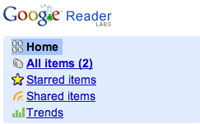
Being a stats guy, I always appreciate any way that helps me get to and make sense of the numbers quickly and easily. While some are making more noise around Google Reader's other announcement - that you can now read feeds offline, this little trends logo is much more important for me. After all, I have no intentions of being offline if I can help it.

May 30, 2007

May 30, 2007 · 3 MIN READ · BY LOUIS GRAY

Berkeley's Neil Henry Takes On New Journalism Reality

Berkeley's Neil Henry Takes On New Journalism Reality

Though only a near-decade removed from my time of studying for a Mass Communications major at UC Berkeley from 1995-99, there are precious few professors who I can recall having made significant impact. In the mass communications department, a pair I distinctly remember was the dynamic duo of Neil Henry and Thomas Leonard, who teamed up to teach a number of the core classes to the major, and helped shed light both on how today's media has been shaped through history, and where they expect it to go.

Today, Henry's name gained significantly more recognition around the Web, as he penned a editorial for the San Francisco Chronicle focused on what he termed "The decline of news", set in motion by a massive reduction in advertising spending with newspapers, which in turn eliminates funding for reporters and investigative media. Instead, money has moved online, to sites powered by robots, he says, and that this move, amid reduced professionals in the newsroom, in favor of amateurs, will be significantly damaging, resulting in "a world where the craft of reporting the news fairly and independently is very much endangered; and with it a society increasingly fractured, less informed by fact..."

Old media is in a state of crisis today. Readers are leaving in droves. Newspapers and magazines are folding. The money isn't there, and media is not always financially rewarded for a job well done. Henry raises the alarm bell that with fewer trained journalists, or "trained watchdogs", as he puts it, those creating scandal could get away with it. While he admits that the millions of blogs online offer a new source of news, he doesn't believe the quality to be on par with those who have studied the craft and gone through journalism school.

Most controversially, Henry says that companies like Google, who have risen the top as new media leaders, should accept responsibility for media's future, and they should support journalism schools, even as their algorithms serve to replace more traditional methods of collecting the news. But here, while I respect Henry a great deal, and enjoyed his classes, I have to disagree. Google as a business has no new edict to save an industry under assault. The industry itself as a whole needs to change to survive.

It is worth noting that Henry took a very old world approach to his perceived crisis. He wrote a letter to the editor of a newspaper, albeit one with a strong technology foundation. Yet, even though he went the old world route, I found it not through a printed copy of the Chronicle, but through new media - the blogosphere. While bloggers do read the online version of the Chronicle, it is the new media which is spreading his message.

Other bloggers who are quite one sided in their own views of the argument, like Mathew Ingram, Scott Karp and John Battelle, champion continued evolution in media, as I do.

Some of my biggest frustrations with the Mass Communications course content at UC Berkeley was the slowness to pick up on the Web's sure impact on media. Though it was in a class taught by Henry and Leonard where I first learned about The Drudge Report and the Monica Lewinsky scandal, the attention to the Web was little and far between. When in another course, the professor's idea of a new media lecture was to show a video on the founding of Yahoo!, after I had offered to help prepare a more in-depth presentation, I simply stopped attending her lectures for the remainder of the semester out of pure frustration.

A decade ago, the onus for change in journalism was there, and those calling for adaptation by the new leaders to help out those left behind simply missed it right before their eyes. It is not Google's obligation to bail out the Chronicle or to train the journalism students at UC Berkeley. It is Google's obligation to make money for its shareholders, and continue to improve its products, period. They are not a charity organization. If a generation of journalists finds the road ahead hard, then personal decisions will have to be made, and companies will have to make adjustments. That's business.