Silicon Valley Technology Commentary & Archives · Est. 2006 3,034 Posts · 2006–2026

September 6, 2007

September 6, 2007 · 1 MIN READ · BY LOUIS GRAY

Google Update Breaks Embedded Shared Links

Google Update Breaks Embedded Shared Links

Often in engineering, a new feature comes with a tradeoff - new bugs. It appears that with the introduction of the new Google Reader, all bloggers who embedded their "Shared Google Reader Links", as I did, have seen their links disappear.

The ability to easily display my shared items from Google Reader in my Blogger template is one of the best features of Google's RSS feed service. Rather than updating my blog manually with each new shared link, the code was automatically refreshed through JavaScript. But as I noted on the Google Reader support forum, "something is broken", and there's nothing I can do to restore the feature.

As another avid Google Reader user writes, "Please fix this ASAP cause i have big community of bloggers internaly connected with this and it would not be nice to tell them all to change the code."

Just when I thought Google Reader was ready to turn the corner, and graduate from Google Labs, I found out this happened. We'll see how long it takes the company to respond. Previously, they haven't been fast at all in responding to user complaints and outages.

September 5, 2007

September 5, 2007 · 2 MIN READ · BY LOUIS GRAY

Google Discovers Search! (In Reader)

Google Discovers Search! (In Reader)

This evening, as I settled in to catch up on the hundreds of RSS feed items I'd missed in my post-Apple keynote and otherwise distracted haze, I saw a new box atop my Google Reader window pane. Simply and quietly, the Google Reader team integrated search functionality, quite likely the most obvious and most requested item in a list of potential enhancements for what's already the world's best online feed reader.

More than six months after I pleaded with the Google Reader team to add search, saying, "If your job is to search and archive all the world's information, then how does temporarily displaying news items that go away permanently, without offering an ability to search them, fit into that mission?", Google's coders have responded in a big way, not just adding the core ability to search all feeds, but also to search within specific feeds, or folders.

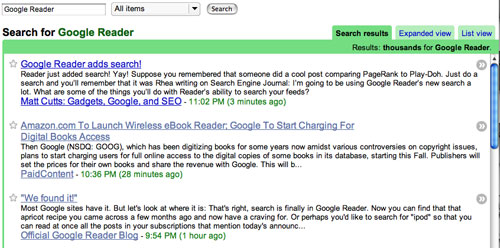
As Matt Cutts and the official Google Reader blog note, the service has added search across your entire feed items history, and it operates in an extremely familiar way - just like GMail. Results are given with the total count, and organized from newest to oldest, in reverse chronological order. (See the below screenshot)


An example search for "Google Reader" within Google Reader


Given how Google Reader has eclipsed BlogLines, NetNewswire and other feed readers in quality, is rising in popularity, and clearly has the development resources to dedicate to the project, the only question I really have is this: "Why is the service still in the Labs?" It makes zero sense to me how Google can make a service so good that its become my default start page across all Web browsers, yet not see it fully baked enough to take out of its development stage. It's high time the company pulled it out of the petri dish and pushed it toward full-fledged evolution. After all, I've been calling for it since mid February. Where is Google's confidence?
September 5, 2007 · 3 MIN READ · BY LOUIS GRAY

We Discerning Apple Fans Always Want More

We Discerning Apple Fans Always Want More

Unless you've been living under a rock, you already know that Apple raised the ante once again with a slew of updates to their iPod lineup, introducing a new iPhone-like iPod touch, with a widescreen look, touch screen application launching, built in wireless downloads and the dreaded iPhone keyboard. The company also added new colors to the iPod shuffle, further shrunk the iPod nano, and expanded the iPod (now the iPod Classic) to a massive 160 Gigabytes. Oh yeah, they also reduced the price of the iPhone by 200 bucks - meaning the barrier to entry, not counting AT&T, is a mere $399.

Sweet.

Apple owns this space, and rightfully so. While slower moving dinosaurs, including Microsoft and Sony, try as they might to approximate the company's previous iPod model, Apple is more than happy to innovate faster than everyone else and change the game right from under their feet. And consumers are loving it - with more than 100 million iPods sold (including several to my household). But the funny thing is that the more we Apple fans overthink the whole thing, it's not too hard to always want more, and find ourselves demanding the impossible - a new device that doesn't exist, and isn't coming.

Here's the thing. The iPod touch is exactly what everybody was begging for: An iPhone without the phone, plus a wireless iTunes Store - including the ability to hook up to WiFi and watch YouTube, view TV shows, photos, and even surf the Web. But saddled right next to the iPod classic, we start thinking... only 16 gigabytes? But the iPod classic has 160! That's ten times more! Bah humbug!

And don't even get me started on the whining around the iPhone price drop. Fans are screaming bloody murder, from Engadget, Paul Thurrott, Business 2.0, Zoli Erdos and Chris Pirillo to TUAW, who went so far as to say "Apple screwed you". (At least ParisLemon gets it.)

Silly consumers.

All Apple has done is create the widest, most versatile lineup of digital audio devices out there, period. Want the minimum? Shuffle is for you. Want a phone? The iPhone is for you. Want to store your entire music library? You need the Classic. But we seem to always want to have this delicious sounding mashup - say... a 160 Gigabyte widescreen iPod with a touchscreen, wireless downloads, infinite battery life, and phone capabilities, not from AT&T, for $99. It's not going to happen.

It reminds me of the famous Homer Simpson line, when Lisa informs him that bacon, pork chops and ham all come from the same source. "Yeah, right Lisa. A wonderful, magical animal."

If Apple announces the world's largest, clearest laptops, we want them lighter. If Apple announces five colors of iPod shuffles, we want a black one. If Apple announces the iPhone is on AT&T, we want it on T-Mobile. Though Apple surprised us with a partnership with Starbucks, many were expecting the long-awaited addition of The Beatles. It's enough to make a product marketing, product management and engineering team completely crazy.

So while I drool over the new introductions, take time to watch the Steve Jobs presentation tonight, and try to think about good reasons to upgrade my iPod or switch over to the iPhone, we should all remember that despite the company's God-like appearance, they still have to operate within the laws of physics and fiscal responsibility. Oh! And if I end up purchasing anything nifty, I'll be sure to let you know.

September 4, 2007

September 4, 2007 · 3 MIN READ · BY LOUIS GRAY

Why My Technorati Ranking Is Slip-Sliding Away

Why My Technorati Ranking Is Slip-Sliding Away

It'd be great if Technorati took a daily snapshot of a blog's influence, and tracked that Authority over time. Rather than a single number to define influence, bloggers could have a six-month or greater graph of their influence as it waxed and waned, or see just how many new links each story gained, with considerable spikiness. Given Technorati's struggles to remain a leader in the face of the Google Blogsearch onslaught, further tweaks to the statistics and tracking models they do best could help gain stickiness and relevancy.

It's no secret that the Technorati Authority ranking system works by tabulating the number of links by unique blogs in the prior six months to your site. Elite blogs can rank in the thousands, while "B-List" bloggers tend to occupy a lower tier, commonly in the 100 to 500 space. But given the tendency of certain stories to get a cluster of links, and those clusters being irregular in timing, it's no surprise that sometimes, one's Technorati Authority can take a steep dive in a matter of days - as a watershed moment or popular post passes the six month point.

Just this Saturday, in my "State of the Blog", I noted my Technorati Authority was 117 - signifying that 117 unique blogs had linked my way in the prior 180 days. By the time I got home from the Cal game late that night, the number had dropped to 108, then 104, and it now sits at 103. While I have attributed previous drops in this ranking to the company's work to eliminate spam blogs that artificially inflated the number, this time it's clear the drop has a lot to do with me, and I can see future drops ahead.

Six months ago, the blog had a serious traffic event when my comments on Google Reader reached Steve Rubel's Micropersuasion, Robert Scoble's Scobleizer, and TechMeme. By the end of the rush, Technorati noted 30 unique "Blog Reactions" to the article. But the article's publication date was March 3rd, a full six months and one day ago now. So, unless each of those blogs linked again to me later, their contribution to the Technorati Authority ranking will be removed, and my count will go down.

This isn't to say that my Technorati Authority hasn't increased in the last six months - for it has, quite a bit. When I first passed 100, I was fairly pleased, but given the spikiness of external hyperlinking, there's no doubt that the count will vacillate upwards and downwards, and at this time, we're headed on the side of gravity.

As the six month window first erases early March links and moves onward to mid-March, and eventually April, I can expect additional bites out my ranking, as I lose the ten external links to my comments on Google's Earth Day logo, made on April 22nd, and the ten others I gained from the aforementioned Technorati Spam Blogs story from late March.

Not only will I be losing those spikes in linkage from the "six months ago" window, but even in that short time, the world of blogging has changed considerably. Even since this spring, the rise of microblogging with Twitter, moves to Facebook, and reliance on bookmark harvesters like del.icio.us or Google Reader shared links will drive down the amount of external linkings from the general blogosphere.

I also believe that we're seeing an incredible amount of clique-like behavior among similarly themed blogs (something I'm guilty of as well). Those who find similar blogs to theirs get comfortable and link to one another, or rely solely on RSS feeds for all news, not stepping out to see what others are saying. Yet, if I continue to simply link to known quantities like ParisLemon, Webomatica, WinExtra and Kent Newsome, I won't be helping their Technorati Authority or their mindshare any more than my own. Instead, I'll just be extending the cycle.