Silicon Valley Technology Commentary & Archives · Est. 2006 3,034 Posts · 2006–2026

December 12, 2007

December 12, 2007 · 5 MIN READ · BY LOUIS GRAY

The Web Advertising Bubble Has Got to Pop

The Web Advertising Bubble Has Got to Pop

A few weeks ago, while having breakfast with well-known Silicon Valley author, Emanuel Rosen, in Palo Alto (more on that later), I said that I was very concerned that all the companies chasing after advertising dollars, from blogs carrying AdSense to startups, all the way to the mighty Google, will be dramatically impacted by what I see as an obvious crunch in the online ad market. The more I think about it, the more obvious it becomes to me that the ad-driven economy, both offline and on, could soon be in dire straights, and companies hoping to cash in need to think of new revenue targets - quick.

I can't remember the last time I clicked on an online ad. Whenever possible, I am running ad blocking software on my browsers. I've learned to ignore AdSense blurbs that sneak through, and any time I'm forced to see an interstitial ad before reading a story, I'm clicking "Skip this Ad", or right-clicking it and adding to my ad blocker's memory.

Meanwhile, I find it painful to watch television without my TiVo. If watching something live, we mute the commercials, and either get something elsewhere in the house, go back to the Web, or pick up a magazine. I just do not want to be sold to.

To me, the most effective way to reach me as a consumer is through buzz, to hear genuine excitement from others who are trying a product early. If they like it, I'll see it in their blogs, in their Del.icio.us links, Google Reader shared items and FriendFeed. I'll see it on Digg or TechMeme. I'll see people using it and showing it off at the office. But I'm not more likely to purchase a product because they purchased some run of site banner ad space.

As I'm doing my very best to avoid advertising, I have to believe a significant number of others like me are doing the same thing. If you (safely) assume that the more educated, more technologically-savvy among us will be the first to block Web ads, then one of the most prized demographics for marketers will be unavailable. Then, as others latch on, the click through rates on ads will dry up. Total revenue from pay per click ads, from Google and elsewhere, will go soft and then crater. Advertisers will decrease their rates per click, and decrease their total ad budgets, moving money somewhere else, to more viral, buzz-driven, targeted campaigns. And while the Web has done a fantastic job about turning a per impression model to a per action model, proactively shunning the medium altogether makes you a deaf audience.

I'm waiting for a major browser manufacturer, like Firefox, or a smaller one, like Flock, to come bundled with ad blocking software, making it even easier for the non-tech savvy customers to start blocking banners from day one, not just stuffing the pop-up variety. It might not ever happen. It might be that there's too much pressure from advertisers and marketers to keep things status quo. I certainly don't expect Microsoft to be the first to adopt it with IE, for example. But can you imagine what would happen if they did, and the unwashed masses found their default browsers blocked ads out of the box? Euphoria.

Think I'm nuts? Look at what's happening out there. While many Web 2.0 companies are making ads their sole revenue target, eschewing subscriptions or chargeable paywalls, see all the news about how the ad-driven economy is showing cracks.

Center Networks: I Want My Slice of the Pie: A Look at Startups and Ad Spending

"We have thousands of sites competing for a piece of the advertising pie today… the problem is, innovation is outpacing ad spending at this point".

Read/Write Web: There's No Money In The Long Tail of the Blogosphere

"Whatever monetization means the blogger in the long tail settled on, be it Google AdSense or Amazon affiliate codes, it can only work on large volumes of traffic. AdSense works for Google because the odds are in its favor - it is aggregating small amounts of traffic across the entire web. The math works for them because it is based on the massive scale of the web. It similarly works reasonably well for the sites with large amounts of traffic, but it fails for smaller publishers who have low visitor counts."

Mashable: 15 Reasons Facebook Isn’t Worth $15 Billion

"Research firm eMarketer projects that by 2011, ad spending in the United States on social networks will reach only $2.5 billion. While I personally believe that most projections from research firms are BS, it’s worth noting that most of the time, these projections actually exceed the numbers that are realized."

Silicon Valley Watcher: Reasons Why Media and Bloggers Should Not Run Google AdSense

"Running Google AdSense will return pennies per click, you cannot make a living off of AdSense. But by running AdSense you are undermining your own efforts to charge a meaningful amount for online advertising. By running Google AdSense you have to accept the pricing of the advertising as determined by Google's AdWords advertising network."

eMarketer: Online Ad Spend to Hit $42 Billion by 2011

"While the current total media ad spending forecasts reflect economic anxiety, a downturn will affect online ad spending... (and) because of the credit crunch and related economic fallout, Internet ad spending will not increase as much in 2007 and 2008 as analysts previously expected"

As a consumer, I recognize Web properties and media need revenue. I'm willing to pay for access in many cases. I don't always assume things are free. But if you're running ads, it's very likely I'm not seeing them, and neither are a lot of people I know. The question is, will there be enough of us and enough innovative tools built to avoid ads that the big giants like Google, who to date has lived almost exclusively through ads, without monetizing its other products, start to have serious revenue trouble? And if they do, how far does that domino effect go? If I were running an ad-driven startup or media company, that question would be keeping me up at night.
December 11, 2007

December 11, 2007 · 3 MIN READ · BY LOUIS GRAY

My Laptop And Me: A Committed Relationship

My Laptop And Me: A Committed Relationship


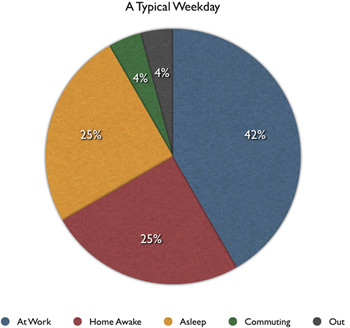
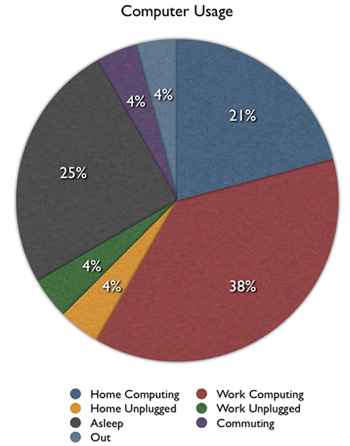
A typical Silicon Valley day (mine)

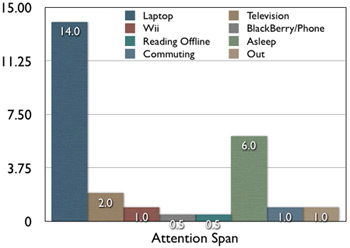
For many, including myself, my laptop goes with me to the office and comes back home. While the equipment stays the same, only my usage patterns change. In fact, I likely spend a similar percentage of time online while at home as I do at the office. Using a quick "back of the hand" measurement, I figure in a 24-hour period, assuming 6 hours of sleep, and 1 hour commute time, of the 17 remaining hours in a day (approx. 10 at the office), it's likely I'm on the laptop a good 14 to 15 hours. That's huge.

As we get more wired, and Web-enabled computers are pervasive, the amount of time we spend away from computers is decreasing, as is the total amount each of us spends outside, period, as the Web eliminates the need for many to go out and socialize, preferring social networks, to go shopping, to see movies, or do many of those things that used to require gassing up and heading out.


How many of my total hours awake are spent online? More than 80%?

When I do close the laptop lid to head out, I'll be supplementing my fix by making sure I have my Web-enabled BlackBerry on my hip, just in case I need to check a sports score while at the gas station or barber shop, or I'll click through to Google Reader Mobile to see if TechMeme is blowing up over the latest topic du jour.

Often, at home, my wife and I will be in separate rooms, on our separate laptops. Other times, we'll be watching TV together in the same room, and both our laptops will be open. I'll be reading RSS feeds, and checking Ballhype or Friendfeed. She'll be catching up on blogs, the news and discussion boards. Does this show a lack of communication or marital strife? I doubt it. It's just the way it's become. We both know catching up on work e-mail from home means a fast start to the next day. We both see the Web as a source of news and a place to unwind and communicate. And just because we're taking in one form of media doesn't mean we can't take in another part-time.


A conservative estimate on my part of hours spent during a day (exceeds 24)

As our Web intake has increased, consumption of written media has been decimated. I don't read as many books as I used to. I still buy them, but they pile up. I haven't gotten a newspaper in years, and I think I'm going to let my subscriptions to Newsweek, Sports Illustrated and ESPN Magazine lapse when they come due. Sitting to read them often feels like a chore, and it's not uncommon to be seen reading a magazine at the foot of my laptop on Saturday, with the TV muted in the background.

But while we're working to extend our social networks through LinkedIn and Facebook, or making comments throughout the blogosphere, the total hours spent with real-life humans is probably going down too. What does it say that I spend more time with my laptop than my wife? I guess it makes it just that much more important that I get the right computer, huh? Why is it that I can read 200+ feeds a day, but not call my mom? Why is it that I make sure all my e-mail items are read almost immediately, but I'd rather wait until my bills come in for a second notice before I shake the dust off my checkbook? Why is it that I probably would spend more time making sure the RAM and hard drive size on my laptop is just perfect, but I can't take the time to fix the broken bedroom dresser hinges?

It could be that I recognize my laptop is a perpetual giver. Empowered by the Web, it gives and gives and gives without question and is one of the last things I see before I go to bed and the first when I wake up. Maybe that's why, as I've embraced this digital lifestyle, that I recognize I quietly, secretly, signed on with my laptop to become my life partner. Just don't tell my wife.

December 10, 2007

December 10, 2007 · 2 MIN READ · BY LOUIS GRAY

AideRSS Judges Feed Posts as Good, Great, Best

AideRSS Judges Feed Posts as Good, Great, Best

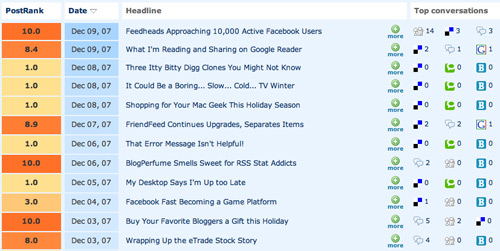
While many in the blogosphere discovered AideRSS upon its debut back in July (see: Read/Write Web, Mashable or Mathew Ingram), I've only recently come across the interesting tool, which analyzes specific feeds, and based on their social activity, whether through the number of comments, Diggs, bookmarks on Del.icio.us or Technorati links, determines their "quality", in a ranking of Good, Great and Best.

The idea behind AideRSS is that you can subscribe only to the "Best" or "Great" posts in a particular feed, rather than getting all of the feeds, in effect, slimming down your reading material - a lot like iTunes' option to buy single tracks from an artist's album without also having to purchase the filler.

According to my pointing AideRSS at my own feed, it tells me that of the 197 posts it found after July 8th of this year, 23% rate as "Best", 47% as "Great" and 63% rank "Good" or better. I'd expect they try to follow a quintile rule, showing a common 20/40/60 tiering. But this grade is obviously on a curve. Given that I often have posts without any comments at all, a pair of comments or handful of external links can vault my post into the "Great" category. I'd venture a guess that the bar is a lot higher for more popular A-List blogs.


Over the last few months, I can't argue with AideRSS' analysis to my top stories, including "What is the Future of MyBlogLog?", "Alexa Web Statistics Show Old Media Influence Nosedive", "Internal Linking On Some Tech Blogs Is Out of Control", Eight Reasons the Apple TV is Failing, and How It Can be Saved and yesterday's "Feedheads Approaching 10,000 Active Facebook Users".

Despite this, I am fundamentally opposed to the idea of filtering my RSS feeds. Waiting for the reactions to already occur pretty much guarantees I would get to the stories after all the activity has occurred, and if I jump into the conversation, I won't be first on the scene to participate at all. I'd rather get all the news fast, make the determination on my own, and keep going. For me, AideRSS just becomes another toy to play with my blog and RSS feeds in general, not a catch-all sieve.

December 9, 2007

December 9, 2007 · 1 MIN READ · BY LOUIS GRAY

Our Beagle and Friends Get in the Holiday Spirit

Our Beagle and Friends Get in the Holiday Spirit

In our house, getting ready for Christmas doesn't always mean a tree and lights, but we start in our own, special, way - by putting up small items of Christmas cheer and decking out the animals (live and stuffed) in Christmas outfits. With temperatures in the mild Bay Area dipping down to the 40s, nobody was complaining when we gave them a few extra layers, including our 18-year-old beagle, who finds this lap of luxury sufficient for her needs, staying inside near the heater, on our couch.


Molly sports a red Christmas sweater and Oakland A's blanket.

This year, she shares the living room with a pair of teddy bears in holiday spirit.


The first also is donning a red sweater and chats up a reindeer.


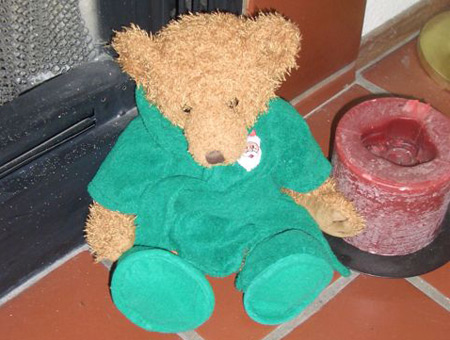
The second, Bradley, likes his green slippers and Santa robe.

We won't be in our condo on Christmas day, so we're not going to be making a big production of things, but it's nice of our stuffed animals and beagle to do their part to set the mood - don't you think?