Silicon Valley Technology Commentary & Archives · Est. 2006 3,034 Posts · 2006–2026

December 19, 2007

December 19, 2007 · 2 MIN READ · BY LOUIS GRAY

We Welcome iPod Touch to the Family

We Welcome iPod Touch to the Family


Home is Where the iPods Gather

Despite my role as an unrepentant Mac geek, I've been a longtime (for me) holdout in the iPod Touch/iPhone arena. After my 60 Gigabyte iPod Photo started trying to die, I switched to the cheaper, lighter, iPod Shuffle for music, and the upgrade to a new MacBook Pro negated the need to cart the old iPod around solely for disk storage. When the iPod Touch and iPhone came out, I knew they were leagues beyond what I had, but as much as I knew I wanted them, I couldn't justify buying them.

So, imagine my delight when a frequent reader of this blog saw my call for help last Saturday, and bought me an iPod Touch.

Today, FedEx dropped off a package from Amazon.com at the office, containing a brand-new 16 gigabyte iPod Touch, free of charge. Now, thanks to their overwhelming generosity, I can watch videos in wide-screen mode, I can browse YouTube, I can download TV shows and take them with me, in my pocket, and browse the Web anywhere I can get WiFi. This new device, already far better than any iPod I've ever had, will be an amazing gadget for cross-country flights, and it makes me feel whole again, as a Mac geek. I no longer have to admit being so far behind when friends show me their iPod Touch, and when iPhones come up, at least I can keep my head up.

Since unwrapping the new iPod Touch, I loaded up more than 1,200 songs, visited a few Web sites, including FriendFeed and Louisgray.com. I logged into our company's Webmail access for Exchange, and it performed flawlessly. I checked out YouTube, enjoyed CoverFlow, and keep rotating the device to see the screen's orientation change. It's just too cool.
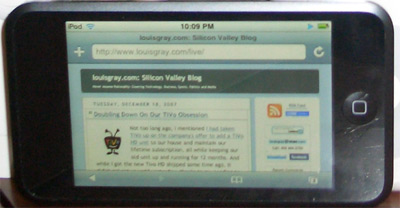

The Real Internet, In Your Pocket

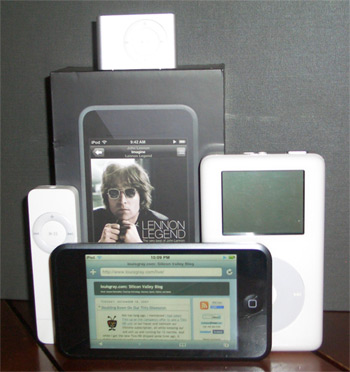
As you can see in the top photo, the iPod Touch joins our first and second generation iPod Shuffles and the aforementioned iPod Photo in the louisgray.com household. Now, I will retire our iPod Photo to its permanent roost atop our iHome alarm clock, my wife will utilize the 2nd generation iPod Shuffle, and in the case I need to travel light, I'll keep my 1st generation Shuffle around. But if anybody tries to tell you there's such a thing as too many iPods, they're wrong. Just make sure the iPod Touch is one of them!

December 18, 2007

December 18, 2007 · 2 MIN READ · BY LOUIS GRAY

Doubling Down On Our TiVo Obsession

Doubling Down On Our TiVo Obsession

Not too long ago, I mentioned I had taken TiVo up on the company's offer to add a TiVo HD unit to our house and maintain our lifetime subscription, all while keeping our old unit up and running for 12 months. And while I got the new Tivo HD shipped some time ago, it didn't get set up until yesterday, thanks to my needing to install new cable cards, and having to wait around for Comcast to offer me the privilege of utilizing their services.

While relying on the cable company to show up in the all too familiar "8 to 12" window isn't fun, their serviceman came by yesterday and did a quick, efficient job.

After I configured the TiVo HD unit in our bedroom, attached to our 42-inch plasma TV, I took our old unit back to the living room, to our long-neglected 27-inch CRT, and got that one set up. Now, instead of my wife and I having to share the one functioning TiVo in the house, we can both be watching our recorded shows, pausing and rewinding live TV, and avoiding commercials. It's yet another excuse for us to be spending time apart while we're both at home!

While this is a tremendous advance, graduating from our current setup to home entertainment nirvana will still take quite a bit of work, however. We still need to:

1) Sell or give away our oak entertainment center (almost completed!)
2) Purchase a flat-screen plasma or LCD for the living room, getting rid of the older TV
3) Put the plasma TV on the wall in the bedroom (not the dresser)
4) Put the new, not yet purchased, TV on the wall in the living room
5) Move the Wii and Apple TV to the living room
6) Consider getting real home theater audio

As you can see, this project could take a while, especially at my typical glacial pace. We love our TiVos, and are excited to have the power of TiVo throughout the house now, but it's always good to have a plan to take things to the next level.

And yes, I haven't lost the irony that now we've gotten our second TiVo, there's absolutely no new TV to watch, thanks to the writer's strike. I guess that's why I'm watching ESPN Classic's rebroadcast of the 2004 league championship series between the Boston Red Sox and New York Yankees. Please don't tell me who wins.

December 16, 2007

December 16, 2007 · 2 MIN READ · BY LOUIS GRAY

Millions and Millions of Search Results... Ignored

Millions and Millions of Search Results... Ignored

When you put a common term into a search engine, you're likely to get hundreds of thousands, if not millions, of search results, whether you use Google, Yahoo!, or any other leading engine.

In fact, to some, the vast number of search results is used to see which search engine crawler has done the most thorough job at indexing the Web - and it's assumed that with the most results has the superior algorithm.

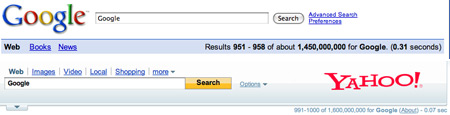
But did you know that regardless of how many results there might actually be for a query, both Google and Yahoo! will only let you see the first 1,000?


Sorry, can't go past page 100. You've reached the end.

This artificial limit is excused as saying the limit has been put in place to reduce software and hardware resources, and that 1,000 results is good enough for most people. So you'll never, ever, get past page 100 on Google or Yahoo!, even if a search for "Google" on either engine shows more than 1 billion results.


But it's retrieving that data somewhere, right? If Google has a mountain of results available for a term, and only delivers the top 1,000, then some database somewhere knows what are the results for positions 1,001 to 9,999 and beyond, to the tens of millions. Yet users have no recourse if they want to peer into that index. There's no option to "Show all results" or "Display the top 10,000 results". Google and Yahoo! have arbitrarily decided that 1,000 is good enough for you, and that's that.

Do you feel lucky? Some have said Google overwhelmingly optimizes for the first results, and as the company writes, "We try to make your search experience so efficient that it's not necessary to scroll past the first ten listings."

But isn't it likely that there are projects out there where it would be helpful to analyze the top 5,000 results? Or 20,000? If you were an SEO firm, there are obvious benefits to this, or if you're doing any kind of artificial intelligence research, Google would be one of the best data pools out there.

So why are they doing this? It looks like even Google, who is assumed to have one of the most redundant, robust systems known to man, is trying to save money and resources. They write, in an explanation, "It would heavily tax our system to provide these results for everyone."

While that's understood, then what data is propping up Yahoo! or Google's claims that they have the most thorough results? Could the last step from Google's algorithm state (multiply results x 2), solely to have the biggest number available? After all, if you could only see the first 1,000, why not report you got eleventy trillion? There's got to be a way to get to the rest of the data.

(Also see: Search Engine Roundtable, Instant Fundas and FirstStop WebSearch for more...)

December 15, 2007

December 15, 2007 · 3 MIN READ · BY LOUIS GRAY

I Have Seen the Future of Social RSS Feed Readers

I Have Seen the Future of Social RSS Feed Readers

Reading one's RSS feeds today is a journey of isolation.
Whether you use Google Reader, NewsGator or BlogLines, the typical interaction with a new feed item is to read it, and then move on, until you hit the next item. Some feed readers, including Google, have let you take things a step further, by sharing your favorites in a shared items link blog.

Recently, Google has made some noise about getting more interactive, through recommending feeds based on your Web history and subscriptions, or show that multiple people with link blogs shared a specific item.

Good. But not good enough. Not nearly enough.

Despite these efforts, I have no idea, for the most part, who my RSS feed suscribers are, and Google Reader doesn't tell me who is reading my shared link blog, what are the most popular shared items, or what my friends are reading. While I'm going through hundreds of feeds a day and almost a thousand items, I am not telling people what I think. I'm not adding comments, and I'm not getting social with others like me reading the same thing. And when I find something on the Web I'd like to share via Google Reader, I can't do it.


Google Reader can't do this...


Google Reader can't do this either...


And you know what? I don't think Google is going to get me there. After all, it took the company's interns to deliver their newest features... and some former Googlers are showing how easy it is to make new, more social, services, like FriendFeed, while Google stays comparatively quiet.

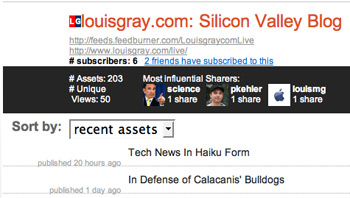
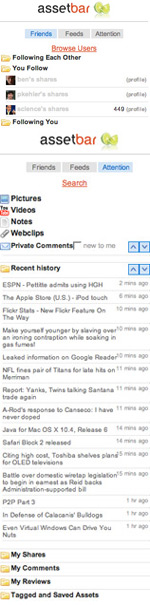
Today, I got a sneak peek preview of a brand-new application, called AssetBar, set to hit the Web in the next month, which not only lets you read your feeds, and share what you find the most interesting, but lets you select friends based on your interests, lets you share individual items with one or more friends directly, tells you how many times a feed or item has been read, and what others think about it.

The tool even lets you go beyond feeds, offering integration with services including Facebook, Twitter, Flickr, YouTube, Pownce and more.

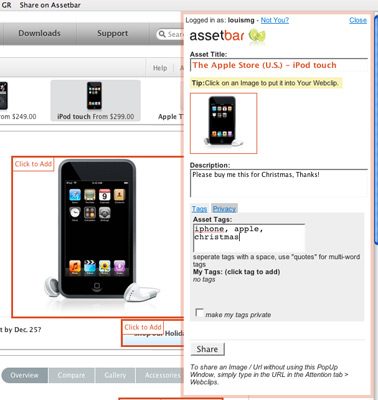
Utilizing an extremely scalable database built for this purpose, AssetBar does what Google Reader cannot do. It eliminates duplicate feed items. It shows me what are the most frequently shared feeds and posts. It allows for customization, where Google Reader does not. And it, like Friendfeed, allows me to share items with my friends or all viewers outside of feeds. If I want to share a screenshot of the Apple Web site, I simply click "Share on AssetBar" in my Firefox toolbar, select an image, write a note, and it's off.

There are calls far and wide from the Web for change. Take a look just from the last week's comments in blogs I read:

Kent Newsome says, "Bloglines is still slow and unreliable. I tried hard (for the third time) to use Google Reader, but I can't. I hate Google Reader. In fact, I could write 1000 pages on how much I dislike the interface."

Robert Scoble writes, in "Workaround for Google Reader’s suckage", "I still wish the Google Reader team would do a better job of getting rid of duplicates."

Webomatica says, "Let me just say that I now have nearly 1,500 articles waiting for me on a daily basis. And even as I try to comb through them, more appear as I mark others read. It’s like a fire hose aimed at my head."

AssetBar, while still teething through the development process, offers the most potential to successfully bridge the gap between high-volume RSS feed reading, and social interaction. Come this January, you'll get the opportunity to give it a trial run and see if it just might deliver on the promise of the true Web 2.0, and make RSS not just a passive, solitary sport, but a social, multi-dimensional activity. I bet, that with focused development, and your collective feedback, it can get there. And it just might see me leaving Google Reader behind.

If you want to get your hands dirty and test out a early pre-release version of AssetBar, send me an e-mail, or post a comment here, with your e-mail address, and I'll hook you up. If you don't want to get in on the bleeding edge, stay tuned here, and visit the AssetBar Web log. We will both keep you posted.