Silicon Valley Technology Commentary & Archives · Est. 2006 3,045 Posts · 2006–2026

August 12, 2011

August 12, 2011 · 2 MIN READ · BY LOUIS GRAY

Spotify's Artist Radio is Music Discovery, Pandora Style

Spotify's Artist Radio is Music Discovery, Pandora Style

While I've been head over heels for Spotify going back two years now thanks to its increasingly deep music library on demand to my laptop and mobile devices, integrated social sharing with friends and high quality sound with practically no buffering, I have seen some pushback from people who, seeing it for the first time, found it great for playing music you found, but not great for finding new music, in the same way that Pandora and Last.fm are known.

But there is a solution. It's called Artist Radio, and the company quietly pushed it out at the end of July without much fanfare. The combination means you can get the musical serendipity you like about Pandora and Last.fm, the social recommendations from friends, and yes, all the music you can eat on your own.

Here's how it works:

1. Search for any artist in Spotify (Examples: Underworld, The Cars, Blink 182)

Searching for Underworld Gives me a Track List

2. Click the artist name in search results.
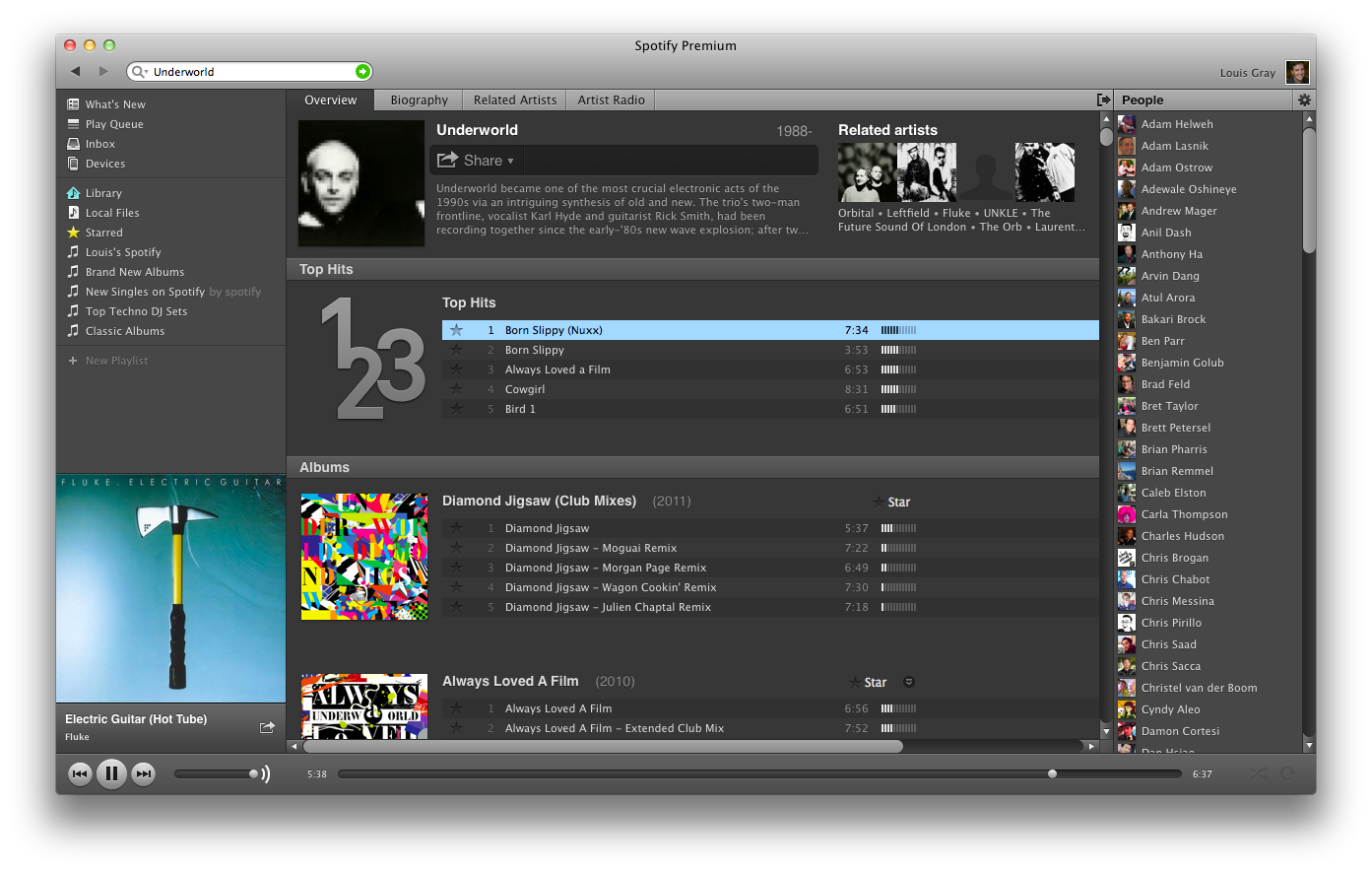
The Underworld Artist page shows hits, albums... and see that at the top?

This brings you to the dedicated artist page, complete with their Top Hits, Albums, and even lower, compilations where their music appeared. Almost all artists have a short bio, as well as a list of "Related Artists", one fast way to find similar music. But there's more.

Underworld Artist Radio Plays More than Just Underworld...

3. At the top is a tab called "Artist Radio". Artist Radio performs the same way as an artist's channel plays out in Last.fm or Pandora. If you select Underworld as your artist, Spotify will play songs not just by Underworld, but by bands including Orbital, Fluke, DJ Shadow and more. Dr. Dre sets up Snoop Dog, Eminem and N.W.A. Tori Amos plays music from Kate Bush, Bjork, Suzanne Vega and others. You get the idea. Without having to go find more music yourself, Artist Radio streams a set of new tracks to you until you hit the stop button.

As longtime Pandora and Last.fm fans will attest, finding new music from artists that are similar to music you already like is a great way to find new bands, new albums, and keep your music library fresh. Spotify hasn't talked a lot about this for its new US audience, but the combination of related artists, artist radio, and social recommendations probably puts the service ahead of all the others in terms of total offerings. So for me, someone who hasn't paid any money to iTunes music for years (aside from upgrading to iTunes Plus for Google Music) and who just disconnected Sirius XM Radio to save a few bucks, I enjoy letting Spotify play DJ. So if you tried Spotify at first and missed this feature, come back and check it out.
August 12, 2011 · 3 MIN READ · BY LOUIS GRAY

Tracking Commute Speeds and Slowness With Foursquare

Tracking Commute Speeds and Slowness With Foursquare

While many people see Foursquare as a strictly social experience, to alert friends to their comings and goings, or to highlight their incredible coolness factor by checking into happening venues, I've long held to the service playing a role of utility. I don't filter my check-ins, and have always been willing to bend the rules a bit, through proximity check-ins, drive by check-ins, and just having a little bit of fun. Having recently been commuting regularly for a new Paladin client, I've found I can use Foursquare to determine the usual commute times, not just for the whole trip, but from points of interest along the way. With every check-in, it also signals to colleagues I'm on my way.

What I've found is that despite any matter of grousing on my part from day to day fluctuations in traffic, from backups on the Dumbarton Bridge connecting the Peninsula to the East Bay, crawling on 880 North, or navigating the 980 to 580 to 80 East maze into Emeryville and Berkeley, where RepairPal is headquartered, the minor annoyances actually have little impact on the average commute time. In my sample size, the time between consistent points is surprisingly stable.

Three Days of Routine Checkins and Timestamps on Foursquare

For the local folks, my usual commute over the last few weeks has me taking 101 North from Sunnyvale, exiting Willow Road toward Dumbarton (Highway 84) and then going north on 880 past the Oakland Coliseum before exiting toward Emeryville. On the way, I've made it a habit of checking in at the same places each time - starting with the new Facebook Headquarters in Menlo Park, followed by the Dumbarton Bridge, then the O.co Coliseum (where the Oakland A's and Raiders play) and then finally RepairPal.

The Daily Trek from SF Bay Corner to the Other

Today, the check-in at Facebook happened at 8:08 in the morning, followed by 8:12 at Dumbarton, 8:33 at the Coliseum and finally 8:49 at RepairPal. A similar trek that started 16 minutes earlier at Facebook saw the same three minute gap to Dumbarton, 22 minutes to the Coliseum, and a total trip of 42 minutes from point to point to RepairPal. Previous days show the total trip as 44 minutes from point one to point four.

So what and who cares? Not too many people, of course, which is why I toss all my silly check-ins to Twitter on a dedicated account (@lgloco) and don't post updates to Facebook. But by using the exact same route and checking in at the same places in the same order, it gives very precise indications of the time between points on any typical weekday, and lets colleagues anticipating when I'll arrive pretty much track my debut to the minute.

I'm also one of the people who keeps Google Latitude running constantly to provide closest connections with a precise knowledge of my whereabouts, but running Foursquare this way helps move the game-driven toy intro something more useful as a metric. If enough people followed the same approach, with consistent check-ins at specific points on a regular basis, you could safely estimate real-world timing between distances in practically any geography.

If you don't mind my nonsensical check-ins, you can follow @lgloco or see me on Foursquare here: https://foursquare.com/lgloco.

Disclosure: RepairPal is a Paladin Advisors Group client, where I am managing director of new media.

August 10, 2011

August 10, 2011 · 2 MIN READ · BY LOUIS GRAY

Subjot Subject-based Sharing To Help You Follow Interests

Subjot Subject-based Sharing To Help You Follow Interests

Social networks can be a messy clot of randomness, even when you're extremely selective on who you choose to connect with. The reason? Because people talk about all sorts of things, from the casual to professional, inanity and newsworthy. People display a wide variety of interests when they show their true selves. Subjot, an interesting twist on the update and follow structure so closely affiliated with Twitter, invites you to follow relevant updates from your friends by pairing the posting and following model with tags, essentially asking you to select just what updates you want to see from your friends instead of others. This way, if you want to see my tech updates but not updates around my family or sports, you simply don't have to - assuming I tag correctly.

In invitation-only beta right now, Subjot asks you to "jot your thought" of up to 250 characters, and choose a single subject for each update, selecting from one you've previously used, creating a new subject, or one the community already uses. If your friends follow your updates in that particular interest, it will end up on their timelines - and if they don't, they won't see it, barring visiting your profile directly.

Subjot Posts on Tech and Life With Embedded Comments

In another variance from the traditional Twitter model, Subjot allows for comments to be appended to each update, presenting a parent and child metaphor, where reactions from followers are nested below the original jot. Jots with activity display the number of comments, in addition to the timestamp and applied tag.

Finding People Jotting About Movies on Subjot

Browsing Additional Topics on Subjot

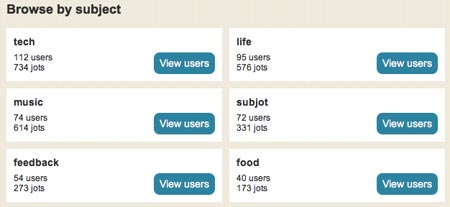
Chris Carella, who co-created Subjot with his wife last year after noticing that his fickle Twitter followers would increase or decrease depending on his changing subject matter, has posted more than 2,000 jots on a range of 64 subjects. With such a range, you can start to see how his most frequently updated topics (currently tech, life and music) start to build in weight with hundreds of updates each. I may care about his insight on Subjot itself, and care less about his NFL updates, much like he probably doesn't want to hear updates on my three kids or how I think the A's are doing in their division.

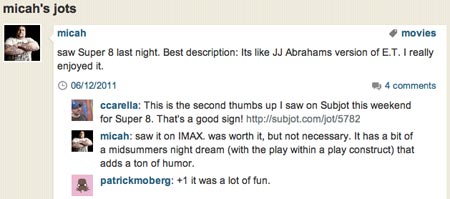
A Post from Micah Baldwin on Subjot from June

With the volume per Subjot user being filtered based on your preferences and their updates, it looks like Subjot could present a quieter, more on-topic alternative to Twitter, one that has information you care about in your stream and less about what you don't. It's essentially Google+ Circles designed by your followers, not designed by you to contain your followers. My earliest Subjot content is hiding in plain sight here: http://subjot.com/louisgray/