 I tend to view the Web and the interactions I have with people online optimistically, trusting first and dismissing only after repeat offenses through odd comments or bad behavior. As Cyndy's article from Sunday mentioned, there are bad people out there who have troll-like behavior, whose aim it is to disrupt your life, add frustration and intimidate, but those can usually be tossed out like rubbish. But I've had the most odd experience with one individual this year, who would contact me almost every single day, by e-mail, by social networks and by phone, and couldn't be shooed away by any normal social standards. This individual, despite being told I had no interest in their venture, and that I was uncomfortable with their continued outreach, followed me from Facebook to FriendFeed to Twitter to GMail to my cell phone and back, and has been a bizarre thorn in my side for about four months. I thought I'd show you some of their handiwork without giving away who they are, and so you can see how my attempts to be civil gave the individual the wrong idea.
The individual's art of being a borderline Web stalker in this case was to at first appear friendly, and interested in me as an individual or as a future colleague. What started out as a respectful exchange then saw odd cracks in their mental togetherness as I would get one liners that dismissed me and then came crawling back in days, and each time I'd try to end the conversation, one more would come in its place.
This person first started making comments on my blog back in March, and added me as someone to follow on FriendFeed and Twitter soon after. Their comments, at the time, seemed upbeat and usually thoughtful. By May, they reached out on Facebook, trying to start a more direct relationship:
On May 13, I got a note:
"What is a good time for me to call you (or you call me)?"No big deal, or so I thought. We talked, and they sent follow-on e-mails by Facebook on May 15, 16, 17 (twice). By the 19th, they were probably 80% of the total messages I got on Facebook, since I rarely use the service. The fact I'd given them any attention made them think I was clearly looking to join their team, leading to the following note:
"When we close the initial round of financing, I am interested in interviewing you, if you wish, for our Director of Websites Experience and Operations/SVP position. It pays well into six figures and includes stock options."I communicated I was flattered, but not interested. On the 20th, I got four more e-mails via Facebook, and on the 21st, I got the same message again. Then, on May 22nd, as one of four more messages that day, a quick note: "I hope all is well."
This was typical, and while not negative, a ploy to get me engaged again.
As I was now in the habit of ignoring most of their Facebook notes, by May 30, I got a message: "Interview is cancelled due to lack of your response." and the next day, a spiteful barb: "I have high standards. I have tried to be helpful to you as well."
So I thought we were done. Guess not. Because the next day, June 1st, I got a note:
"Together we would be stronger."
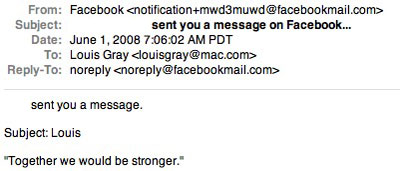
Ooh. Just past the creep-o-meter. And the next day, regarding my not joining his team and staying solo:
"Do you feel that your go it alone tendency is holding you back (I do, but what you think is what matters)."The next day:
"I want to work with you because I believe that you are very talented."And by June 4:
"I hope that all is well. Sometimes I think that you are wrong, and sometimes I think that I am. I can be impatient and a little demanding."Stupid me, trying to be nice, I responded and offered to help with a side project. My mistake. When I didn't follow up after another e-mail in 24 hours, as I was busy with my real-world job, I got another note...
"I changed my mind about including you."
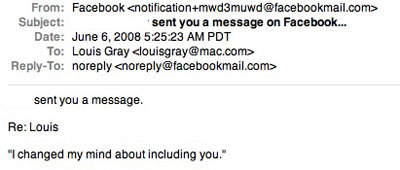
At this point, I was elated. So I removed them as a friend in Facebook, hoping the email flow would stop. Wrong.
On June 10, they noticed.
"If you apparently, it seems, took me off as a Facebook friend. I only work with very successful people!"And on the 17th, a cryptic:
"Louis - I was wrong before."At this point, realizing they weren't going away, I wrote back:
"On what part? Wrong on reaching out, or wrong on turning away. You keep going back and forth, and this constant stream of Facebook items got to be too much. More than 80% of my Facebook e-mail is from you. :-) I want (and wanted) to be supportive for sure, but I wanted to reduce the every day pinging. I thought pulling your Friend status on Facebook would do that, but it didn't. What's happened is that this stopped being collaborative and started looking more like stalking."
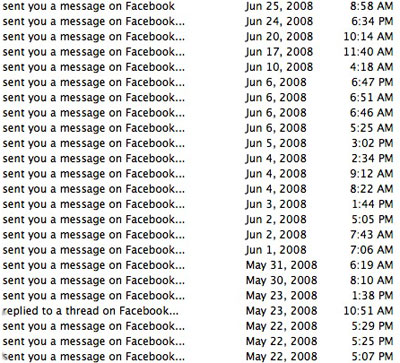
A sampling of the Facebook notes from my Mail from this person.
This, in turn, led to more daily e-mails, almost all one-sided. Some were positive, congratulating us on the arrival of twins, or responding to blog posts. And at that point, at the end of June, things seemed to dry up, as they were kicked off Facebook, for adding too many friends. You'd think that'd be the end, but they they turned to GMail, and calling my cell phone (the one on this blog), again, every day.
On July 3 via GMail:
"Louis - We're close to our financing so I may be able to bring you on full time shortly."On July 4:
"Louis - What will help you reach the next level of course you're doing well already."And then later that day:
"Louis - I'm not interested in working together anymore."I said, simply, "Alright - appreciate the update.", hoping that was the end of it.
But two weeks later:
"It was a lack of communication on your part that made me determine that we could not work together. Sometimes, as individuals, we feel that we do not wish to communicate. And there is a place for that. But we need to overcome that also, if you agree, to form higher and more successful connections."You'd think the continued notes about being done and not working together would be the end, but I started getting phone calls every day.
My cell phone history shows calls on:
- July 23rd at 12:48 p.m.
- July 25th at 11:32 a.m.
- July 26th at 10:25 a.m.
- July 29th at 10:53 a.m.
- July 30th at 9:53 a.m.
- July 31st at 9:40 a.m.
"Louis - I hope all is well. Busy, I am sure!"And again, I said I was uncomfortable with the pursuit:
"Busy for sure. I get your daily phone calls. Appreciate the attention, but I'm still feeling stalked."But then, Friday, August 1:
"Do you want to join us?"
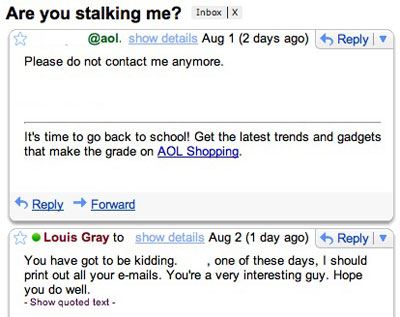 Followed by another note later that day, from them, no less:
"Are you stalking me? Please do not contact me anymore."Outstanding, I guess. In the space of about three months, this person sent at least 49 messages on Facebook, and about 20 more on GMail, and called several dozen times. Yet, somehow, despite all the clues that they were no longer interested in communicating, and the other comments complaining that I hadn't responded or responded quickly enough, that I somehow was the stalker and I was the one being asked not contact them any more. And while I could be optimistic and say that this last note means I'll never hear from them again, I have no confidence in that, as every other note saying they were done was followed by more nonsense. And if it hadn't already, I'm sure this post will fire them up again, lucky me.
I made a few mistakes in this process. First, I was open to talking, being friendly with a person who I barely knew. The world of online social networks makes this commonplace. Later, feeling bad for ignoring all their messages, and wanting to not sound like a jerk, I had offered to help on a side-project, when I should have just blocked them outright on Facebook. I should have tried to be less nice from the very beginning and made it clear that under no circumstances was I interested in their project, or joining them. But at this point, I tend to believe any rational decision I would have made would be overrun by their instability, which was made clear by the complete 180s you can see above from message to message. This wasn't an aggressive entrepreneur looking to get a strong staff. It was a individual with borderline obsessive behavior who for whatever reason thought I was a must-recruit.
I've been lucky enough that the overwhelming majority of communications and relationships I've built online have been positive, and I've met some great people. But this months-long incident and the potential for more like it have me hesitant about being too friendly too fast. I'm lucky that I haven't seen the hatred and negativity that some have encountered, and I've not been in fear of any physical harm, but this has gone on too long. Have you ever run into something like this, and how do you get out of it?
 The New York Times Magazine piece called
  As a sometimes smug Mac user for the overwhelming majority of my computer-using life, virus warnings, anti-virus software and security updates were always something "those other guys" had to deal with. Using my Mac, I would even have colleagues send me attachments from their Windows machines which they thought were viruses, so I could open them up in a text editor and see what mischief they had intended to cause. But today, I realized my laptop had somehow acquired a rare trojan that does hit Mac OS X, and the results of the bugger were actually more harmful for
 If you use