Silicon Valley Technology Commentary & Archives · Est. 2006 3,033 Posts · 2006–2026

October 12, 2008

October 12, 2008 · 4 MIN READ · BY LOUIS GRAY

The Future of Social Media Is Mobile, Unified and Transparent

The Future of Social Media Is Mobile, Unified and Transparent

This morning, I had the pleasure of taking part in a podcast with Wayne Sutton and Kipp Bodnarf for their Talk Social News program. During the conversation, we discussed how to find time to participate in multiple social networks, how today's technology luddites might some day consume information, using RSS, and what the recent economic turbulence means for today's startups and tomorrow's entrepreneurs. One of the questions I've been mulling in my head is the future, and what glimpses we have today, in regards to what tomorrow's social media tools will have, barring the true development of anything dramatic, like teleportation, or bending of the time/space continuum.

Mobile

In my opinion, the advent and adoption of mini-computers masquerading as cell phones is the first big step, and one we are seeing in a big way with the market share growth of the iPhone, the newest Blackberry models, and the potential of Google's Android platform.

Just yesterday, my wife and I brought our twins to her mother's house, and I was able to show my 80-year-old mother in law how, with my phone, I could take a photo, and e-mail it to her, wirelessly. I showed her how I could access all my e-mail accounts, how I could watch baseball playoff highlights in high quality, or access all my bookmarks, so when they were added to my laptop, they would reach the phone as well. And when I told her the iPhone started at $300, she was surprised it was so low.

As iPhones and other "true Web" capable mobile devices become a bigger part of how we consume and interact with the Web, so too will they become a greater part of how we consume and interact with social media specifically. Your social network then becomes less some thing that you interact with just when in front of a desktop or your laptop, but from anywhere, helping to bridge the gap between "following friends" and "real life friends". Consequentially, the mobile interface to sites like Facebook, Twitter, FriendFeed, Social Median, Strands and others will be just as important as the standard Web GUI.

Unified

I also believe you will really start to see a tying together of friends and profiles across the different networks. Many different sites now have ways for you to import your contacts from your many different address books and e-mail accounts, and others integrate with Facebook, so when your friends on that service sign up, you're automatically connected. But it's not as seamless as it could be, and adding the same friends over and over again can get tiresome when new services arrive - not to mention copying and pasting your personal profile and attributes repeatedly.

What should happen, and will in due time, I believe, is that groups like OpenSocial or others, will find a solution by which you gain a friends repository, identifiable by your single user name, which checks against the database and auto-populates your friend base, assuming they have given permission. Similarly, when joining a new network, I should be able to point that network to a central profile I have built, which has all my activity, from Twitter, Flickr, Google Reader and the rest, and would pull my data down from those services, rather than making me add them each one by one.

Transparent

I also believe that with growth of professional services like LinkedIn and Plaxo, and increased awareness of tools to derive a person's background, there will be greater transparency and easier discovery of a person's background. I should quickly and easily know a person's professional profile, and their external online activity, which would take the guesswork out of some initial relationships. While some might say this would be too much a breach of privacy, and that anonymity is a much-treasured aspect of the Web, the Generation Y Millennials have no such expectations, and are all too willing to put their data out there. Tomorrow's tools will capitalize on this and further blur your online persona with that you use at the office or at home.

I don't want to pontificate on smaller technology aspects, such as increased video usage, location awareness, or even real-time language translations, although each will be playing a part in these future services. Those are for the experts in their respective field. But we can see these aspects evolving. The world of social media is going to be unified, transparent and mobile (or location independent). Those that can best capitalize on the unification of data, and avoid the traditional walled garden approach will be the winners.

October 11, 2008

October 11, 2008 · 3 MIN READ · BY LOUIS GRAY

The Valley's Proponents Become Its Critics in Hard Times

The Valley's Proponents Become Its Critics in Hard Times

Friday's stock market roller coaster was one to remember. With the Dow Jones Industrial Average at one point down more than 500 points early in the session, again, a colleague and I headed to lunch just before noon with the market down more than 400. As we ate, the TV screens alerted us to a market rally that saw the market reverse course, racing beyond the break-even mark to crest at almost 200 points up, only to fall back down to a loss of more than 100. In between bites and conversation, I'd pass along a report: "Down 200. Down 100. Even. Up 50. Up 150. Even again." My latest position in Apple, created just Friday morning, at one point was up 10 percent in the space of hours - making me feel good, if just for a day.
The rise and fall euphoria and despair that we've all seen as the market rises and falls (and falls and falls in recent weeks) is not uncommon. The crowd mentality sees us piling on to negativity when things are bad, and blocking out risks when things are good. But even as things have gotten a lot more tight in our own personal financial accounts and 401ks, banks have gotten wobbly, and credit has gotten unstable, many of the major tenets that saw the Web 2.0 world lauded just a few months ago are still there - namely the ability to start a new company for much less, to attract a solid user base, and reduce burn rates to a level that wouldn't require significant funding. This means that even in times of scarcity, there's room for innovative ideas. And for those companies that already raised sufficient funds, or who have achieved profitability, their major focus should be hitting product milestones and gaining revenue, rather than worrying about keeping the doors open.

With the near extinguishing of companies entering the public markets in the last twelve months, combined with VCs saying funding will be tight going forward, and valuations lighter, the squeeze will be most noticed by companies looking to get the next series of capital, or those who find acquirers won't be offering the big numbers they had hoped. Many companies will be proposing hiring freezes to slow the burn, or letting non-essential people go.

But with that said, the technology advances that have let companies get off the ground for less mean the pressure from VCs and board members to turn thousands into millions and millions into billions is less than it was five years ago, when we saw a similar slowdown. Even Twitter, which has one of the highest profiles of "pre-revenue" companies, has only raised $15 million, a small fraction of the hundreds of millions given to Webvan, Kozmo.com and other high-profile Web 1.0 flameouts. Seesmic, which visibly laid off seven yesterday, also has raised a conservative $12 million or so in two rounds, and Silicon Valley darling, FriendFeed, has only raised $5 million in its initial round.

It has only taken a few months of bad news on Wall Street to see some of the most visible proponents of Web 2.0 startups start to pick on them and demand significant changes. But the calls for a route to revenue and product quality should have been there when times were good, not just now.

Most of today's Web companies don't need staffs of hundreds. They don't need seven-figure marketing budgets. And many are cutting costs on their technology infrastructures by turning to services like Amazon's S3. So the burn rates of years ago have lessened dramatically.

What recessions do is weed out the bad ideas from the good and move timetables. Great ideas continue to be supported and funded. During the last recession, LinkedIn was founded, in 2002. Google went from being a curiosity to a world leader, going public in 2004 after years of slowness for Web companies looking to reach the market. And in 2003, MySpace was started, following Friendster's 2002 debut.

That the economy's struggles will have far-reaching impact is not under dispute. But for Web companies that have been smart about keeping their costs low, and their revenue and profits in sight, they will power through. To prematurely call for their demise and dance on the grave of those that don't survive is not the way to go.

See also:

Dare Obasanjo: TechCrunch Turns Into F-----Company 2.0
The Inquisitr: Paging Chicken Little - The Sky Isn’t Falling
October 11, 2008 · 2 MIN READ · BY LOUIS GRAY

Microsoft and RIM? I Don't Think So.

Microsoft and RIM? I Don't Think So.

By Mona Nomura of Pixel Bits (FriendFeed/Twitter)

There's speculation of a possible Microsoft-RIM marriage. It sounds appealing, but highly unlikely. Steven Hodson points out Microsoft has never been in hardware. I agree hardware is a factor but the bigger question is: can a MSFT-RIM team compete in the Mobile Market?


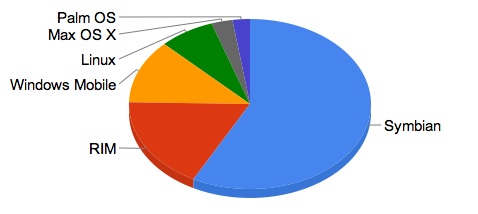
(Pie chart via jkOnTheRun. Thank You!)

In 2007, the mobile world was heavily Symbian dominated at 57.1% of the share. WinMo was 2nd with 11.5%, followed by RIM at 8.9%. Currently, the leader board is Symbian = 57.1%, RIM = 17.4%, and WinMo = 12%. In just one year, RIM shot past Microsoft with a 126.4% growth rate.

Phenomenal.

If MSFT and RIM merged, they would take 29.6% of the market, and still be only half of Symbian - with two separate platforms. RIM's number one selling point is its push mail and server. As Electronista points out, server integration would be a potential nightmare. With iPhone's increasing momentum, would Microsoft and RIM risk potential loss while the integration takes place? Not to mention, RIM's co-CEOs are heavily involved. I highly doubt they would agree to Microsoft taking over the solid system they built. And even if the merger isn't hostile, would it make sense for Microsoft to obtain two different platforms?

Then, there's the issue of software. Android is Open Source. Linux is Open Source. Max OS X is Open Platform. Symbian-Nokia announced in June they will go Open Source. I'm guessing Microsoft will eventually go Open Source. (Perhaps sooner than we all think, since Gates departed in June.)

BUT

If Microsoft joins the Open Source game too late, RIM and WinMo would most likely be left behind. Why would anyone choose devices that aren't as flexible as Open Source / Platform ones? Would it make sense for RIM to join forces with anti-Open Source Microsoft? Especially since we're seeing tremendous growth rates?

I don't think so.

What I do know is this. The mobile market is changing, and this is only the beginning. Exciting times for us geeks! So what's your current phone? Are you waiting for a particular handset?

Read more by Mona Nomura at Pixel Bits.

October 9, 2008

October 9, 2008 · 2 MIN READ · BY LOUIS GRAY

I'm Evangelizing RSS With Google Reader's E-mail Function

I'm Evangelizing RSS With Google Reader's E-mail Function

Living on the cutting edge as early adopters at times can seem like an exclusive club. The tools we use every day have funny names to the outside world - Twitter... OPML... Technorati... Plurk? But while we're hanging out in these oxygen-poor communities, and seeking out new ways to aggregate all our online activities in one place, a good deal of the people we work with, our family and our friends, have precious little to aggregate. But they get e-mail, and you can leverage e-mail as the bridge to an RSS-powered life.
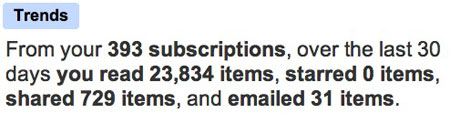

Google Reader Shows I E-mail 1 or 2 items a day

Google Reader is my starting point to consume the day's Web news. While Google Reader offers the best way to consume hundreds of RSS feeds in one place, and read them quickly, it has entrenched itself as a core element of my online activity thanks to a few social functions. The first is the ability to quickly add items to a link blog, which can be embedded on my blog, or streamed to lifestreaming sites, including Plaxo, Strands, Social Median and FriendFeed. And while that retains the geek cred, it's the second element, e-mail, which can bring in the mainstream and have a more long-term impact, in terms of expanding the conversation .


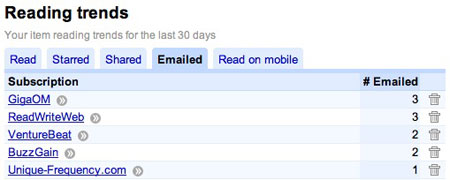
I can even track the sources I e-mail most frequently

Every single item in Google Reader can be e-mailed to anyone, most easily to those in your Google Address Book. In the last few months, I've been liberally e-mailing feed items to colleagues, to friends, and even to family, my wife and parents included. Why do this, when they are used to simply getting a link, or, better yet, a full copy of the story, which I could also do easily? Because I know that with the combination of repeated exposure and curiosity, we can help make the mysterious seem common, and each note offers recipients the opportunity to sign up for Reader and begin gathering subscriptions themselves.


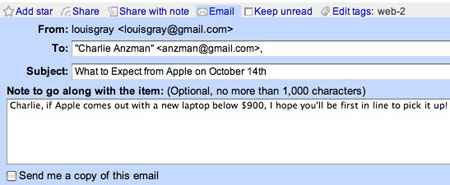
E-mailing an item pre-populates the subject line, and the message is simple

E-mail, without question, crossed the chasm to the mainstream long ago, and it sets the stage for you help spread some of the elite tech knowledge you've gained and share it with a friend. If you're already using Google Reader, or other similar tools that offer the ability to e-mail out, think of how you can be an evangelist and bring a little preview of our world to those who haven't yet seen the light. I will be.