Silicon Valley Technology Commentary & Archives · Est. 2006 3,033 Posts · 2006–2026

October 27, 2008

October 27, 2008 · 2 MIN READ · BY LOUIS GRAY

NoiseRiver Developer Ditches FriendFeed, Claims Service to Continue

NoiseRiver Developer Ditches FriendFeed, Claims Service to Continue

Editor's Note: An earlier edition of this post said NoiseRiver had shut down. But as mentioned in the comments, the site is expected to keep running at www.noiseriver.com, while the noiseriver.com domain was unresponsive. See Also: The Inquisitr: NoiseRiver developer quits FriendFeed, says LOLCats to blame.

In the A-List vs. Z-List world of social networks, the gap between those that get the lion's share of attention and those who get almost no attention can be huge. After months of participating on FriendFeed, and getting less of a response than he had hoped, one developer is leaving. Karim, known as "directeur" on FriendFeed, posted a long article on Google Docs called "Why I Quitted FriendFeed", saying that too much attention was paid to "top" users and "top" items, adding, "I'm quitting. No one will notice after all, maybe."

Also: Why I'm leaving Friendfeed, or how I surrender to the power of the ninja LOLCat

You name the service, and there will be complaints. Even those most popular, most widely adopted services have people who can't stand its features, its user interface, or the active community. Last week saw Mashable's Mark Hopkins leave FriendFeed due to what he saw as a hostile place for those who shared his political leanings. (See Rob Diana's comments here) Others have found the noise to be too much, as they couldn't find easy enough ways to filter and hide entries to get down to the items they were most likely to enjoy. And even more use the site just to aggregate their data, but don't participate, or sign up to take a look, but don't return - as many do for many other services.

Directeur's leaving FriendFeed is noteworthy because he was one of those working on a solution to the site's weaknesses, namely the ability to block specific terms, or to use your own interests to best anticipate new entries that would draw your attention. It turns out that not even his own service could prove to help him find a way through the noise and gain acceptance to a level he wanted to keep going. (Previous Coverage: New NoiseRiver App Adds Interest Filters to FriendFeed Stream)
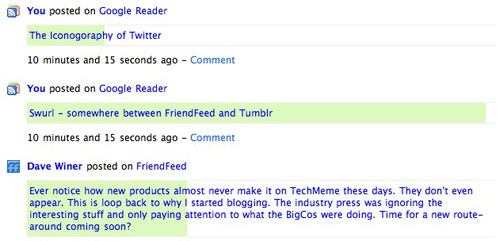

NoiseRiver Back In June

He writes: "Tina (a kind friendfeeder) once said that friendfeed is what you make it. I tried to believe, and tried to prove it to myself. It didn't worked. I strived, I really tried, and it didn't worked." (sic)

Not every service is for everyone. Those which I use, including FriendFeed, make sense to me. And there are definitely people who make very real attempts to participate on a service, only to not get much interaction, thanks to low personal brand recognition, or other factors, and it's likely there will always be a gap between those socially rich and those socially poor, so to speak.

Looking at directeur's feed doesn't seem all that quiet compared to many I've seen. Practically every item receives likes and comments, the two major actions FriendFeed users can utilize to engage. But it looks like it wasn't enough.

October 27, 2008 · 2 MIN READ · BY LOUIS GRAY

Poll Tracker '08 By Slate Brings Election Updates To Your iPhone

Poll Tracker '08 By Slate Brings Election Updates To Your iPhone

With the United States' presidential election looming next Tuesday, daily polls at the state and national levels are growing in importance, as Barack Obama looks to maintain and increase his lead over John McCain, and McCain and his team hope to repeat the Republicans' success in the last two elections, by securing votes in the swing states and holding their base. While the dual party competitiveness and strategy is not new, the fact I can track the day to day moves on my iPhone is. When not in front of the computer, checking out Electoral-Vote.com or FiveThirtyEight.com, I can see the most recent polls by using an app called Poll Tracker, which runs at only 99 cents.
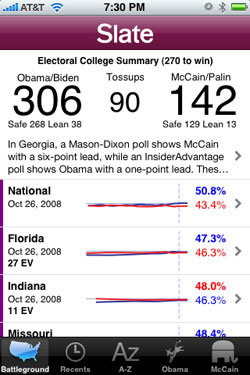


The Electoral Vote Count, If All Polls Are Accurate, Is Displayed

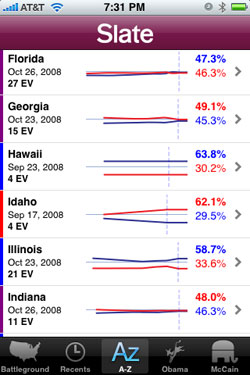
Poll Tracker '08 By Slate has five major tabs within its application, including "Battleground" for hotly contested states, as well as the national poll, "Recents", showing the most recently updated state results, "A-Z", showing all states alphabetically, and one for each of the candidates, "Obama" and "McCain", represented by their respective party mascots, donkey and elephant. Those two tabs show the states with the candidates' greatest lead differential, from highest to lowest. For Obama, that's Washington D.C., where he leads 82% to 13%, and for McCain, it's Idaho, where he leads 62.1% to 29.5%, according to the last poll.


You Can Display Trends By State Or Nationally

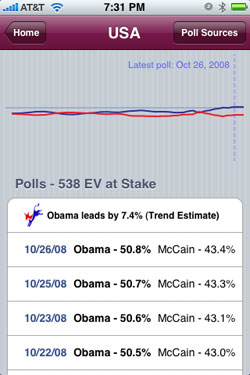
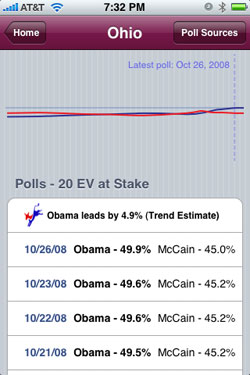
While the latest snapshot of poll numbers is the most accurate measure for how next week's election may turn out, it's the individual state graphs I find most interesting. By tapping on any state, be it Florida, Ohio, Virginia, or Missouri, you can see how the state's residents have been surveyed over time, and get a good idea as to which candidate is trending in the state. Enough blue graphs on the upswing, and you can guess Obama is doing well. But if it's red you see headed up and to the right, it's the Straight Talk Express on the move.

Poll Tracker '08 admittedly has a sort shelf life. It might get a whole lot less interesting in about 10 days, and it won't give you the minute by minute updates we'll all be biting our nails over next Tuesday, but at $.99, it will deliver good value until the last vote is counted.

You can find Poll Tracker '08 By Slate on Apple's iTunes Store.
October 27, 2008 · 2 MIN READ · BY LOUIS GRAY

Google Reader Unveils Individual RSS Consumption Statistics

Google Reader Unveils Individual RSS Consumption Statistics

Google is sitting on a goldmine of data around RSS feed reading and consumption. As most universally accept that Google Reader is the most popular feed reader, Google likely has a plurality of information showing when bloggers post, when people read, and what the most popular feeds, items, etc. are. So far, despite having all this detail, the Google Reader team has been largely reticent to reveal their knowledge, choosing instead to promote RSS as a standard, rather than setting bloggers up with yet more ways to measure one another.

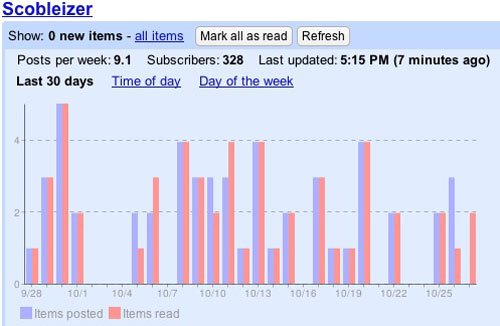
Today, a crack opened in the stone facade, as Google Reader delivered charts for every feed you are subscribed to, which shows when the feeds publish, by day, date and time, as well as how quickly you get to read the items themselves. The data, which leverages the last 30 days of activity, rather than the duration of the feed, or when you first subscribed, highlights the total posts per week, the total subscribers known to Google, and when the feed was last pinged. This part is not new.


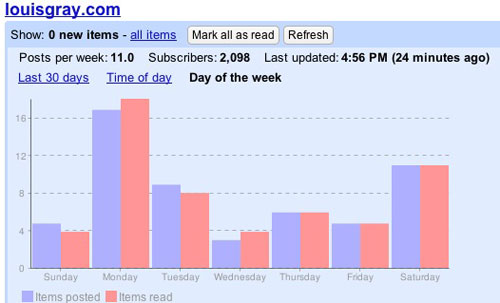
Google Reader says Mondays have been busy here.

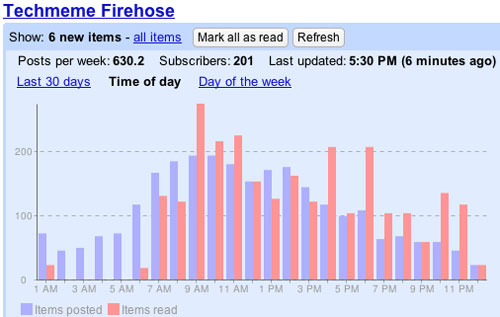
What is new are a set of bar charts showing what days bloggers post, what time of day they post, and when you read the pieces. The resulting charts can show gaps in a blogger's schedule, whether you wait hours to get a feed, or if they are filling your RSS in box overnight as you sleep.


Google Reader Shows Scoble Skips Days and then Spikes

For individual bloggers who post 1-2 items a day, you can see two or three day holes in their publishing, but for more high-volume sites, like Techmeme, TechCrunch, or Wired, for example, the resulting curve of information begins to take on a liquid form with fewer spikes. It's us individuals, who actually don't read RSS feeds 24 by 7, as much as we would like to, who have the holes in our consumption of that data.


Google Reader Shows Techmeme's Activity to be Fluid

To access this information, go to your Google Reader, click on the feed name of any item, and then click "Show Details" in the top right corner. Last 30 days will show what dates the author published (and you read it). Time of day will show the time the author published (in your time zone) and when you read it. Day of the week will show the day the author published (and when you read it).

We already had aggregate statistics, and now we have individual statistics by feed. It's tempting to guess what other mountains of data the Google Reader team is sitting on, and to wonder how we can tap in.

October 26, 2008

October 26, 2008 · 3 MIN READ · BY LOUIS GRAY

Twitter - the Portal of Web 2.0?

Twitter - the Portal of Web 2.0?

By Jesse Stay of Stay N' Alive (Twitter/FriendFeed)

A lot of discussion is going on around the blogosphere right now about whether Twitter may not be around much longer, because they have not yet implemented a business plan and have no immediate plan for enabling access to the "firehose" of data. It's a valid concern - yet at the same time, it's beginning to go "mainstream", with the adoption of sites like CNN.com and by pop figures like Britney Spears, people and businesses are really beginning to rely on this service. Will it have been in vain?

I asked on Twitter, "How many of you use Twitter as your sole update source? (e.g. you don't update Facebook with it, you're not on FriendFeed)". Surprisingly, of the responses I received, not one of them used Twitter as their sole update service. Here are the responses I received:
@bethevans: Not me. On FriendFeed.

@Bwoolley: Primarily Twitter, some Friendfeed

@shylie: I only update through twitter. I have it linked to Facebook and I have Pownce, FriendFeed, etc. accts but I rarely use them.

@jojeda: I use all, but most with effort and reluctance; only Twitter feels easy and fun.

@kenburbary: On FB, on FF, but use Twitter to update them for me. Twitter is the dashboard

@AgentJon: I use twitter to update my facebook, that is all...also when i send a twitpic i also send to facebook as well...

@erikmagraken: I use Twitter along with LinkedIn

@tatango: I have facebook also

@mclaughj: I'm on FriendFeed but the only thing I update is Twitter, not sure how that fits in...
As you can see, every single person responding was using Twitter as a gateway into some other service that they use. Some were using it to update their Facebook. Others FriendFeed. Others use Twitter, but at the same time they use a service such as LinkedIn, which has its own status feed. Not a single person was using Twitter as their sole source for networking and updating friends. No one seems to be completely reliant on Twitter, but they all seem to think they are.

Back in the late 1990's, when I was working tech support for my Uncle's Freeservers.com, at the time a fledgling startup in the back room of an old skating rink trying to compete with the likes of Geocities, it seemed that the topic of portals would come up regularly. Back in the day, before the "first bust", everyone predicted the future would be full of "portals", where people would come to one or two sites to get all the information they needed. Everyone wanted to be that site, and advertising was going to power it all. Unfortunately many of those portals did not succeed, and we saw sites like AOL.com and Netscape.com quickly fail as users wanted content from the source, through means such as search and RSS.

What this study on Twitter has made evident to me is that, whether that vision of portals ever really came true or not, Twitter itself has become one of those portals in regards to community. While each individual has their own community on Twitter, it would appear, were there a way to organize that community into groups, each individual on Twitter's network is nothing but a set of fragmented communities from other sites. Twitter has built a portal around the combined communities. No other community considered "mainstream" out there is so fragmented such as this.

It's an interesting concept, but as technology evolves around this concept will better ways of managing those communities come about? I'm worried that Twitter is in a fragile state that, while it disguises the whole community as its own, seems to really have no unified community in reality that can truly say they only care about Twitter. Having each user on Twitter belong to a subset of multiple other communities seems like a fragile state to be in.
Read more by Jesse Stay at Stay N' Alive.