Silicon Valley Technology Commentary & Archives · Est. 2006 3,033 Posts · 2006–2026

November 3, 2008

November 3, 2008 · 2 MIN READ · BY LOUIS GRAY

Forget the Bradley Effect. What About the "Get Off My Phone" Effect?

Forget the Bradley Effect. What About the "Get Off My Phone" Effect?

To say that Tuesday's election is long-awaited is a massive understatement. It's been called historic by most, and otherwise labeled the most important election in our generation by the many who take into account the controversial last few years, our economic struggles and continued challenges abroad. And while Democratic candidate Barack Obama is largely expected to end the day with enough electoral votes to ensure his capturing the White House, some are concerned the "Bradley Effect", a phenomenon showing voters are less likely to vote for a minority when in the booth in private than they professed to be when surveyed in public, will have enough impact to knock him off the pedestal. But aside from the presidential election, how many of us have lied on a survey, just to politely get it over with? I know I have, including multiple times this evening, just to get the pollster off the phone.

When a political operative somehow manages to get through our Caller ID and gets me on the line, the fastest way to get the call completed is to agree to everything. If I'm not in the "hanging up on them" mood, I always agree to every single thing they're proposing. Yes, I'll vote for that guy. Of course I am in favor of your proposition and measure. "In fact, my wife and I already voted by mail!", I told one hapless gentleman a few hours ago, much to his delight.

My underhanded evasiveness no doubt gets a checkmark on his clipboard, and with one stroke, he and his backers can put two more votes on the board, as they try to rally enough last minute support to push their person and their measures over the top. But to be honest, most of the time, I couldn't tell you one person from another, especially in the local races, and will be doing my research online.

So how often is this happening? Are pollsters around the country, and at the local levels, finding overwhelming support for just about every bill, only to see tomorrow's election results be swung the opposite way? As much as the political pundits may wonder if America is ready to have an African-American president after all, I wonder about the telemarketers hitting their numbers and wondering why things didn't actually go their way.

Don't worry about me. Tomorrow, I'll vote. And I am sure on how I'm voting for just about everything, before some last-minute cramming tonight, but if you called my house this evening, sorry if I misled you. It won't be the last time.


November 2, 2008

November 2, 2008 · 2 MIN READ · BY LOUIS GRAY

RSSMicro Adds FeedRank to RSS Search Engine

RSSMicro Adds FeedRank to RSS Search Engine


RSSMicro and FeedCamp have been out since 2006, trying to measure hot topics, popular RSS feeds and offer a broad search engine through millions of feeds. (See Search Engine Journal for a 2006 review.) In the last week, RSSMicro introduced a new measure they call FeedRank, which utilizes an algorithm they claim taps into a feed's updating frequency, quality of content, and whether the sites are "known", to deliver a numerical score, graded on a steep curve.

The new FeedRank is said to have eliminated many spam Web sites through ensuring the quality of the content on the source, and its unique information across articles. But even if you think you are a top content producer, you might be surprised at how poorly you're rated. In fact, only 1% of all feeds rate better than 7 of 10. 3% rank as a 6, 6% as a 5, and 9% garnered a score of 4. The vast majority of blogs (including this one) get a score of 3/10 or less.

Given the preponderance of low scores, I'd be surprised if most bloggers would want to display their FeedRank.

But outside of that single measurement, RSSMicro, and its companion site, FeedCamp, could give the much more popular Google News and Google Trends a run for their money - if anybody knew about them, or if they worked harder to make their site look current.


Today's Top News and Images are Political, Of Course

The main RSSMicro page highlights top news, videos and images from almost 6,000 different news sources, on top of the more than 4 million RSS feeds they say they scour with their search engine.

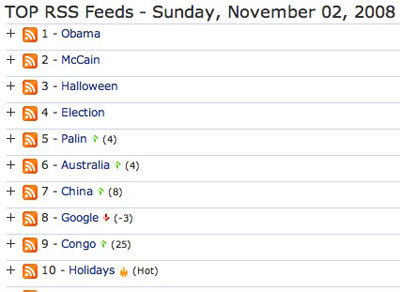
The FeedCamp site, powered by RSSMicro, shows the top terms across the many feeds they cover. Unsurprisingly, you see terms like Obama, McCain, Election, Palin and Voters atop today's list. You can also delve into the archive to find out what terms were popular at any date, starting with June 9th of 2007. At that time, Bush and Iraq were top topics, but today's presidential candidates were nowhere to be seen. Flash forward to November 1, 2007, and Clinton ranked as the #7 topic, with Obama as #43. McCain didn't crack the top 100.

The sites are worth checking out, especially for trends, assuming somebody can crack the code and track keywords over time.

If you are interested in seeing where your feed sits in FeedRank, use the FeedRank Checker on this page. And if you crack a 4 out of 10 or higher, consider yourself privileged.
November 2, 2008 · 3 MIN READ · BY LOUIS GRAY

Netflix Edges Closer to Making the Perfect Web Video Site

Netflix Edges Closer to Making the Perfect Web Video Site

It seems when it comes to the world of Web video, there is as much discussion of the limits saying what you can't do as there are the discussion of the features themselves. If you get your movies via iTunes, you hear about how it can play on one device at a time, for a limited time. If you opt for Amazon Unbox, there is a different set of restrictions. Meanwhile, Netflix is still mostly known for its DVD distribution, and until lately, it has been restricted to Windows computers - locking out Mac and Linux users. As MG Siegler of VentureBeat noted yesterday, Mac users can finally get their hands on instant streaming via the Web, as we move ever closer to that "anytime, anywhere, any movie" panacea that we're all seeking.
My personal preference, especially since the introduction of movie rentals, has been to use iTunes. Downloading films via iTunes makes them available to my laptop, my iPhone, and, using the Apple TV, to my living room. But iTunes doesn't have every film. In fact, none of these services do. Often, if there's a movie I really want to see, but don't want to pay full price for, I have to check iTunes, Amazon and Netflix to see who is serving it up. But if the answer is that only Netflix offers it for rental, I'm quite hesitant to put the movie in my queue, and wait the better part of a week to get the physical copy in the mail. We've reached the point where near instant is the only acceptable speed.

With the advent of Netlfix offering instant streaming of films via the Web, I gain yet another instant entertainment source - and I don't have to pay per film, like I do with iTunes or Amazon Unbox, as the instant streaming is part of our family's monthly fee.


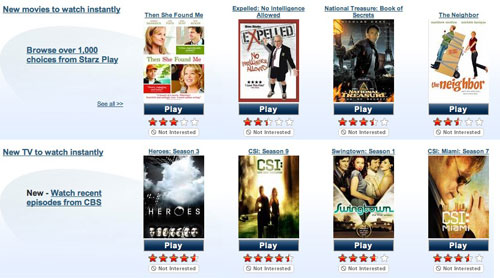
Netflix Offers Many Videos for Instant Viewing, but Not All

Per VentureBeat's article, I headed to http://www.netflix.com/silverlightoptin and, after agreeing to be part of the beta program, I updated the Microsoft Silverlight software on my computer. One restart of Safari later, and I could add any of the available instant movies or TV shows to my Instant Queue. The offerings were slim, to be sure, but I would expect Netflix to work hard to migrate the rest of their library to offer the same capability.


I Could Add a Video to My Instant Queue

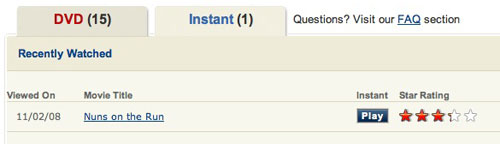
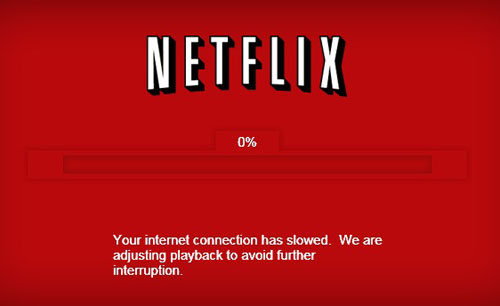
In a silly mood, I was able to add "Nuns on the Run" to my instant queue, and a minute later, I was seeing Eric Idle debate his role as a thief amid increasing violence in his line of work. Netflix measured my bandwidth capabilities, and set the video quality so that my connection wouldn't be overwhelmed and stuck buffering. Only once did I find the Web connection slowed to a speed that the movie stopped, but a simple refresh of the browser caught the movie up to where I left off, and we kept going.


The Nuns Were On the Run In Minutes


Internet Connectivity Issues Will Always Be There

I appreciate iTunes' per-movie pricing and instant downloads to the Apple TV. If I can find the film there first, and plan on being home to watch it, that will be default for our home videos. But if I want to watch a film solo, on the laptop, and Netflix offers it, this option will be a great backup.

Yet, as with the other services, questions still are there. Can I take the video with me? No. Can I play them on my iPhone? No. So for each situation, I probably will find myself bouncing from service to service, without one reigning supreme.

November 1, 2008

November 1, 2008 · 3 MIN READ · BY LOUIS GRAY

Twitter Planning to Implement OpenMicroblogging Standard

Twitter Planning to Implement OpenMicroblogging Standard

By Jesse Stay of Stay N' Alive (Twitter/FriendFeed)

For those that follow me here or on my personal blog, you know I'm a big fan of open standards for microblogging.  I even left Twitter for Identi.ca and FriendFeed for a short time partly because of this.  The concept of "OpenMicroblogging" is simple - if your microblogging service supports it, I can then subscribe to any user on any other microblogging service that supports it, and then follow those users right on the microblogging service I'm most familiar with.  It is a protocol, similar to TCP/IP, the same protocol websites use to communicate with your browser over the internet.

Currently, Microblogging is a very closed model.  It can be likened to the days of AOL and Compuserve, where we have multiple networks, like Twitter, and Plurk, and Yammer, and many other "Twitter-clones" which all essentially do the same thing.  Each network is closed, can't talk to the other networks, and they're doing so in hopes that it will make it hard for users to switch networks.  (And I even argue you see this to some extent in the major networks like Facebook, LinkedIn, and Myspace)

We all know what happened to AOL and Compuserve.  Some guys invented this thing called the web, based on open standards such as TCP/IP, allowing multiple nodes on the network to all talk to each other.  So long as your software spoke this open standard, you could be a part of the network, and the great thing about it is the standard was really owned by no one - it was a community agreement, something everyone was working together to live by, and because of this, soon the "World Wide Web" outgrew AOL and Compuserve in numbers to the point that AOL and Compuserve were forced to open up their networks to allow their users to access the Web.  While no individual "website" was as big as AOL or Compuserve, the World Wide Web as a whole grew to become much, much bigger than even the two combined.

Enter Twitter

Twitter is at risk of the same fate AOL and Compuserve met.  As a closed network, they may be big, but as smaller open networks come about that can all communicate with each other, there is a chance that those networks as a whole could outgrow Twitter itself.

It appears Twitter may just be learning from AOL's mistakes however.  In a bug report posted last July in the Twitter Development Bug tracking system there is an issue titled "OpenMicroblogging Support".  The user, "4braham", posted it, suggesting "Support for the OpenMicroBlogging specification would allow for Twitter
users to follow users of other microblogging services."  Alex Payne, API Lead for Twitter, responded, saying, "Sure, someday, after it sees some adoption."  Then, in August, he added, "Changing this to 'Accepted' just so it doesn't jump out at me when I'm scanning for new issues. It's going to be
some time before work on this begins, though."  So it would appear that Twitter very much has plans and interest to join the OpenMicroblogging effort.  You can login and click the "star" for the issue here to vote for it if you think this is something important for them to integrate.

Twitter implementing the OpenMicroblogging protocol would be a wise choice, and put them at a leadership position in this space, currently dominated by the likes of Identi.ca, OpenMicroblogger, and Leo Laporte's Twit Army.  Not just that, but it would immediately empower them as the largest site of what has the potential to be a much larger network of users of interconnected sites in the future.  With their lead API developer writing a book, and seemingly being short staffed as they write a new version of the API while at the same time trying to address issues with the existing API, I agree with Alex - it may be awhile before we see this.  Let's hope they get things in order and we can see this some time soon.


Read more by Jesse Stay at Stay N' Alive.