Silicon Valley Technology Commentary & Archives · Est. 2006 3,033 Posts · 2006–2026

November 27, 2008

November 27, 2008 · 7 MIN READ · BY LOUIS GRAY

Ten Tech Things I'm Thankful For

Ten Tech Things I'm Thankful For

I don't know about you, but some of the technology we take for granted still seems exciting and mysterious to me. Ever stop in the middle of your laptop and say - wow... I'm seeing streaming video, live, wirelessly in high quality? Ever stop when on a cell phone and realize you're talking to someone thousands of miles away and hearing them respond in real time? It may seem like we take these things for granted, and only speak up when there are problems, but that's far from the truth. On this Thanksgiving holiday, I thought I'd highlight ten things I'm grateful for that impact us in a positive way.

1) I'm Thankful for a Competitive Culture of Curiosity

Without curiosity and aggressive competition, innovation would be at a near stand-still. Experimentation, testing and looking for new markets or way to improve existing markets or products enables new ideas to develop, and new approaches to be found for existing products and activity. In Silicon Valley, entrepreneurialism is encouraged and celebrated, and it's actually okay to fail or work at a failed company multiple times in one's career, so long as you keep trying.

2) I'm Thankful for Expanding Bandwidth and Data Storage

Any of us can look backward at our first computers, and modems, and laugh at how many megabytes of RAM or hard disk space we had, or how we might have tried to get to the Internet at 4-digit baud speeds. Over the decades, you've seen a move on the network side from 10 megabit to 100 megabit, through 10 gigabit on the corporate side, and to high-speed broadband for consumers, not to mention 3G for iPhones and other wireless gadgets. Hard disks have grown from megabytes to gigabytes and now terabytes, enabling higher quality images, video, music and other data exchanges to take place quickly and be stored longer. The growth of bandwidth and data storage has essentially paved the way for the online software repositories, iTunes, YouTube and many other intensive Web apps that are powering today's digital economy.

3) I'm Thankful for The Removal of Geographic Barriers

We may have to get a passport to travel from country to country, but online, I'm talking and engaging with people from around the globe every day. While places like the Silicon Valley still maintain a lead in terms of available networking opportunities, the Web lets me connect with entrepreneurs in Europe, bloggers in Australia, India, and Canada, or around the world. In fact, just a few weeks ago I managed to reach Robert Scoble by cell phone when he was traveling in China, as I'd mistakenly thought he'd already come home. While it would take a day of travel to see him, I could get him live with a few taps on the iPhone. Also, I've befriended people from a wide variety of countries and places around the United States on the myriad of social networks.

4) I'm Thankful for the Ease of Publishing

The Web has dramatically increased the potential to publish in real-time over the last few years. For free, I can register to send short updates to Twitter, or full-length blog posts to Blogger, WordPress or TypePad. There is no application to fill out, or editorial board to approve content. The ease of publishing lets anyone with a voice or something to share get out there quickly to all interested to see.

5) I'm Thankful for the Ease of Discovery

There's a reason Google is thought of as the most successful company of our generation. They focused on the ease of searching and discovery of all the world's information - starting with the World Wide Web at large, and expanding to images, videos, books, news, and trying to ease discovery across different languages with translation tools. Google, and others, expanded to desktop search and discovery to let you find even your own documents. This ease of discovery speeds academia and business, and lets even the most obscure opinions or publications be found, assuming you're on topic and the searcher uses the right keywords.

6) I'm Thankful for the Ease of Data Mobility

Yesterday, I saw a road sign saying "5 1/4 miles" to our destination, and it reminded me of the old 5 1/4" floppy disks, which gave way to 3 1/2" floppy disks, Zip drives, USB keys, and of course, attachments by e-mail, which negated the need for much of the portable physical media. Now, I know that my data is accessible from the Web on essentially any computer or mobile device, no matter where I am. All my e-mail accounts flow to the iPhone. All my bookmarks are synched from my home computer to the iPhone, and I can log into any of my online accounts from any computer to pull down my data or get my personal experience.

7) I'm Thankful for the Ease of Access to People

The combination of the ease of publication and discovery makes it easier than ever to find ways to contact people, by phone, by e-mail, or through social networks where they are active. The old days of the Yellow Pages and White Pages and Blue Pages that you needed to thumb through to find local businesses or your neighborhood directory are gone, replaced by personal address books that stay on your computer and cell phone, and online directories that are searchable. Additionally, those who publish are often easily reachable, even if just through comment pages on their site, giving you a platform for conversation and exchange.

8) I'm Thankful for the Opportunity to Exchange Ideas

Nobody is an expert on everything, but just about everyone is an expert on something. Where I have weaknesses, or limited understanding, it is fairly easy now to find resources or individuals who have strength, and who are open to discussion. Combined with the ease of discovery and publication, rather than posting items here and waiting for people to answer, I can go to these sources and engage with them where they want to engage at their point of comfort - be it on their preferred social network, their blog, their user forum or bulletin board.

9) I'm Thankful for the Acceptance and Promotion of Standards

As technology consumers, we have our idiosyncrasies. I may prefer to use Mac OS X computers, and use the Safari Web browser. You may prefer Windows Vista, and like Internet Explorer or Firefox. But, in theory, our Web experience should be the same. While there was a time when Mac documents and PC documents or Mac formatted disks and PC formatted disks were wildly different and non-transferrable, both platforms have practically unified so documents and applications are largely equivalent on all platforms and an experience can be universal. The acceptance of standards for all things on the Web, from the GIF and JPEG standards to those for HTML, Java, CSS and PHP, ensure that Web sites and applications can increasingly behave appropriately and within guidelines, regardless of the consumer's setup and geography. While I know things could still improve, the community has made incredible strides in pursuing unity.

10) I'm Thankful for Never Accepting the Status Quo as Good Enough

Where much is given, much is expected. As Web bandwidths increase, as disk storage increases, as ease of access increases, and the number of people getting on the Web and using it for all aspects of commerce, friendship, and communication increases, the capability of each site and application gains the potential for improvement. And I've yet to meet a site or an application that simply stops working, saying they have stopped all bugs, and that the experience could not possibly get any better. Google is constantly improving and experimenting with their search index and results. Microsoft and Apple are constantly rolling out new iterations to their operating systems, their applications and their Web browsers. And startups are always coming and going, not just in an effort to make the people working there some money, but because they want to make a real difference through leveraging the cutting edge of technology.

As a consumer and as someone who for more than a decade has worked in Silicon Valley, looking to help develop and distribute differentiated products that aid customers, I know I will never accept what we have as good enough. But I appreciate the opportunity to exchange ideas, to reach new people, to discover new content and to publish where I can. That's part of what's enabled exchanges such as this. What are you thankful for in the world of technology and what do you believe I left out?

November 26, 2008

November 26, 2008 · 1 MIN READ · BY LOUIS GRAY

Semantic Gifts Mines Social Profiles for the Perfect Present

Semantic Gifts Mines Social Profiles for the Perfect Present

If your online friends haven't already pointed you to their Amazon Wish Lists (as many did last year), but you are thinking of getting them a gift this holiday season, guessing what they would like can be a lost cause, as you try and figure how their online persona and offline persona connect. Semantic Gifts, a new site launched in alpha in time for this year's Black Friday, tries to bridge that gap by perusing your friends' social network accounts, combined with clues you provide, and returning gift recommendations.
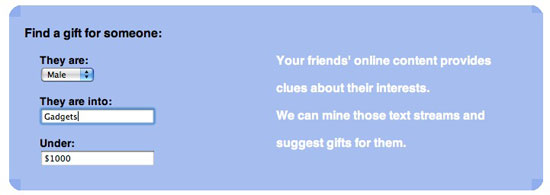
As the site's author, Adam Seever of The Wantrepreneur, writes, "Your friends' online content provides clues about their interests. We can mine those text streams and suggest gifts for them."


First, define what you think your friend likes...


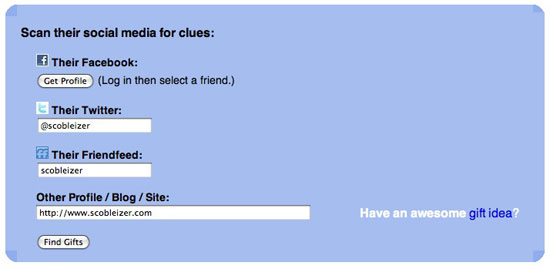
The service, in its alpha stage, is very simple. First provide the recipient's gender, what you believe they are into, and the price bracket, and then provide their social media accounts. Potential entries are Facebook, Twitter, FriendFeed, and a blog or other online profile.


Second, point to their online profiles...


Hit "Find Gifts", and Semantic Gifts, in the background, returns recommendations.

In my testing, using friends like Cyndy Aleo-Carreira, Jesse Stay, Kevin Fox and Robert Scoble, I found the site to be weighted toward offerings from Think Geek (which may say something about me and my friends), but also saw offerings from Urban Outfitters, Toys R Us, and others.

You're provided with three options, and can click "More please" to refresh and get three more. If you are completely at a loss as to what to get your friends this holiday, give Semantic Gifts a trial run. You just might be surprised. And if you think there are no good matches you want to buy, just get something for yourself instead.
November 26, 2008 · 7 MIN READ · BY LOUIS GRAY

Not Everyone Reads Your Tweets, and That's Okay!

Not Everyone Reads Your Tweets, and That's Okay!

By Jesse Stay of Stay N' Alive (Twitter/FriendFeed)

As founder of SocialToo, a startup that has a Twitter auto-follow feature, I've heard my share of comments on why automatically following those that follow you on Twitter or elsewhere is or isn't a bad thing. Some people feel it is less genuine if you use a script to follow those that follow you, while others think that as your network grows it is hard to manually pick and choose those that should or shouldn't be followed.

A script makes this easier, and while it has the potential to introduce more spammers into those you follow, services like my own SocialToo.com provide tools to prevent that through manual and intelligent blacklisting of individuals you don't want it to follow. The "genuine" relationship issue is a concern that makes sense though, and it begs the question on whether following absolutely everyone can actually reduce the strength of relationships you have with those you follow. I think with that issue people are missing the point.

It's About Relationships

Twitter, FriendFeed, Facebook, and other networks similar are all about relationships. Building and fortifying those relationships are important on each of the networks you belong to. Relationships are what define an individual. I remember working at a small Genealogy startup, OneGreatFamily.com, where we were able to identify exactly who an individual was by their relationship to those around them. If we could identify their grandparents, parents, children, spouse, and other aspects of those around the individual, we could then match those in the network with similar relationships and guarantee with near certainty that 2 individuals in the database were indeed the same individual.

Therefore it's important to be able to identify yourself by those you connect with to further establish your identity on the internet. In this case we're doing it by those you associate with in different ways. For the most part, when people "follow" you on one of these networks, they are showing interest in you. For one reason or another, they came across your profile and have established some perception of who you are. They are interested in you.

Therefore, when they put forth that effort to follow you, the polite thing would be to pay back the courtesy and show interest back to them. I think the issue we're all running into here is that as our networks grow, it becomes more and more difficult to pay attention to each and every individual. Therefore, does it really help solidify that relationship if you can't pay attention to everything they post?

You can have the best of both worlds!

I find the more new followers I get, and the harder it gets to manage each and every potential relationship. I only have 2,000 followers - imagine if you are Robert Scoble or Guy Kawasaki with 20,000+ followers! Therefore, for me, automation has become necessary where possible. The secret which I have come to realize is that it's okay to miss things your friends say! I'd venture to say that every person has at least 1,000 real-life friends, so it's a very real possibility this will become necessary for you as well.

Here's the thing though - most of my friends don't even realize that I can't pay attention to everything they say because I've developed a way to ensure the important posts come to my attention. Therefore, if I can be sure I can catch the things they want me to hear, and I get the opportunity to talk back to them when that happens, I now have the best of both worlds. I am following them, and I'm able to pay attention to what they want me to hear as well. That doesn't necessarily mean I pay attention to every word they say. It's okay to skim, or even miss posts!

Here's how you can do it:

It's taken me a couple years to master this technique, and I'm constantly discovering new ways to manage it better. It's important you find a way that works best for you, but here are some sure tools to allow you to follow those that follow you, and get the information that both they, and you need to obtain to ensure the best relationship between all those you follow:
  • TweetDeck - TweetDeck is an essential for any Twitterer. I only recently started embracing this 100%, but boy am I glad I did! TweetDeck has enabled me to create a "favorites" group that ensures the most important people I follow I can track every single one of their Tweets from. This now becomes the equivalent to only following those people who are most important to you. Through TweetDeck you not only are enabled to follow everyone that follows you (through services like SocialToo.com), but also track those people that are most important to you at the same time.
  • Twitter Search - Also available in TweetDeck (You can create custom windows that only return Tweets that match terms you specify. Not only that, but you can filter by keyword amongst your friends and even exclude terms!), Twitter Search is essential for finding the information, especially amongst your friends, that you need to hear about. You can search for a particular user's name, your own brand, your competitors, particular interests you have, and more, and all results get returned with a link to add to your RSS Reader. This means that every new Tweet with that term in it gets sent as a new item in your RSS Reader.
  • TwitScoop - TweetDeck also integrates Twitter Search with TwitScoop, which will give you the top trending topics at a given time, letting you know the hot topics before even the news hears about them. TwitScoop's website will then show you all the people talking about that subject at a given time. Today I was reminded of Charlie Brown Thanksgiving on TV because people on the East Coast were talking about it before it came on in my area.
  • RSS - Use RSS religiously. With TweetDeck this becomes much less necessary, but through both Twitter Search and FriendFeed, all your results come back with an RSS link. Be sure to add the searches you must not miss out on to your RSS Reader and you won't miss anything.
  • FriendFeed IM - I use this to have replies to my posts on FriendFeed delivered straight to me, as they happen. This keeps me from having to keep checking back on FriendFeed for new replies. I can even reply back right in my IM window! See our previous article on this.
  • FriendFeed Lists - FriendFeed has provided a "group" functionality, which they call Lists, similar to what TweetDeck provides for Twitter enabling you to track and organize the individuals you follow on FriendFeed. Each list is available real-time, so you can have a window open, and refer back to that list regularly. Again, skimming is okay - if you have your search and alerts set up you won't miss anything through this method.
  • Treat @replies and DMs religiously! - This is important. If someone really wants to get in touch with you they will send you a message, either publicly or privately. It's important to note that in Twitter, you can't privately send a message to anyone if they aren't following you back. This is why it is so important to try and follow those that follow you - it gives your followers just one more way to get in touch with you, and gives you one more way you can talk with your followers. Pay attention regularly to those that reply to you or direct message you. I try to make it a habit to reply to each one, whether it be a short, "can you e-mail me?" statement, or a more personal message. This is your closest opportunity to one-on-one communication on these networks, so take advantage of it.
In the end, tracking all those that follow you is simply a matter of organization. Automation is necessary for this, and there will constantly be new tools to enable this. While it's important to not be offended if people miss your posts, messages, or Tweets, it's also equally important to do everything you can to catch those messages that people want you to hear. In the end, it's okay if you miss a Tweet or two of those you follow. It's also all about hearing the things people want you to hear.

(Jesse Stay is CEO and Chief Architect ofSocialToo.com, a startup that enables relationship management for those you follow on the Social Web)

Read more by Jesse Stay at Stay N' Alive.

November 25, 2008

November 25, 2008 · 1 MIN READ · BY LOUIS GRAY

Babysitting 2.0: Matthew and Sarah to Be Livestreaming Tonight

Babysitting 2.0: Matthew and Sarah to Be Livestreaming Tonight

Online friends who make the transition to real life friends can be a lot of fun, especially if they retain the elite level of geekiness that made us find each other on any variety of networks. In the last few months, I've gotten to know Drew Olanoff (of ReadBurner and Strands, pictured on the left) quite well, and found him amusing, sharp and optimistic - all very good things. Tonight, we're going to put Drew in a rare, elite, class of friends by handing our five month old twins, Matthew and Sarah, to him and his girlfriend, Jeannine Schafer, tonight, as my wife and I step out for a rare evening alone.

And the best part of this babysitting gig is that you can follow along. Drew has always had a flair for podcasting and lifestreaming, so tonight's babyfest should be no different. (as he promised last night on Twitter)

Tonight, he'll be broadcasting the babysitting 2.0 event via Qik, and liveblogging it on Strands, where he is the community manager.

Since I won't be watching, I'll have to trust you let us know if things go awry.

You can follow along here, starting at 7 p.m. Pacific:
http://qik.com/strands

Drew's Strands account can be found here:
http://www.strands.com/drew

Should be fun! Enjoy all the bobbing, crying and feeding. We know Drew will!