Silicon Valley Technology Commentary & Archives · Est. 2006 3,033 Posts · 2006–2026

December 11, 2008

December 11, 2008 · 1 MIN READ · BY LOUIS GRAY

The Zune Phone Is Not Pink

The Zune Phone Is Not Pink

By Mona Nomura of Pixel Bits (FriendFeed/Twitter)

The Zune phone is not pink, and I am not talking about the actual color.

"Pink" is the code name of Microsoft's latest secret project that has everyone buzzing. There is speculation "Pink" is the new Zune phone. Or is it simply software? Only Microsoft knows the answer, and the rest of us can only guess.

I am a Zune phone nay-sayer, especially at this time. Back in October, I expressed how a Zune phone would not make sense for two major reasons:

Licensees

It would make a lot of WinMo hardware partners unhappy if a Zune phone was launched in January - unless WinMo 7 is ready to launch January 7th (CES). Which means there should already be WinMo 7 mock-ups and demo phones. If so, where are the rumors and leaks?

PlayReady (DRM)

Microsoft has yet to move its own DRM system PlayReady into the Zune. Can Microsoft's mobile team...
  1. Implement PlayReady
  2. Integrate the PlayReady Zune prototype into a phone
  3. Successfully integrate the Danger OS and the Zune
  4. Launch WinMo 7 simultaneously as the Zune phone
... in less than a month?

Perhaps I am completely off the mark and Microsoft: is simply going to forget PlayReady existed (PlayReady has been hibernating since its announcement in 2007), is planning to disregard licensees, roll-out WinMo 7, all for a... phone.

Yeah, sure. And Steve Ballmer is monkey dancing, live, three feet away from me.

Read more by Mona Nomura at Pixel Bits

December 10, 2008

December 10, 2008 · 2 MIN READ · BY LOUIS GRAY

Five Ways OpenID Can Be Embraced

Five Ways OpenID Can Be Embraced

By Mona Nomura of Pixel Bits (FriendFeed/Twitter)

Attempting to learn OpenID for the upteenth time, I ended right where I started: Confused. So I reached out to the community for help and received tremendous feedback that helped me better understand what OpenID is about. People left thoughtful, thorough comments on how to actually use OpenID and someone even left step by step directions. That made me realize: OpenID is still irrelevant for the average user.

However, the discussions held on FriendFeed and my personal blog opened an avenue to great (rational) exchanges of ideas, which got me thinking about how OpenID can be relevant to us.

  • Verifying needs to be simpler
    Technicalities aside, verifying, signing up, claiming, or whatever the "correct" term is, one thing is clear: The steps need to be simpler. Right now, the process is a nightmare requiring many steps. Users should be able to go to OpenID provider sites, and with one step - two at the most, be able to verify.
  • Email providers need to get involved
    With password storage managers the norm, URL log-ons should not be a burden - in theory. And that is the problem: in theory. Realistically, non-technical users are intimidated by using something other than their usernames, e-mails, or handles (nicknames) to log on. Since usernames and handles, without the URL, would be difficult to use as an OpenID log-on, Gmail, Hotmail, Yahoo et al joining the movement makes perfect sense.
  • Partner with consumer sites
    One word: incentive. Imagine if OpenID were to be accepted by Amazon, eBay, PayPal and financial institutions. Why wouldn't everyone use OpenID?
  • Update the site and Wiki with clearer instructions. I did not know that being logged into a provider site omits the verification process and log-on using OpenID without verification is possible - did you? That information is not readily available on the OpenID site, why? Or why isn't that on their Wiki? Almost every person with Internet access can go in an edit a Wiki. Will someone go in an update OpenID's Wiki page, please?
  • Create a Need
    Either I am missing something or it is still unclear why OpenID is so important - and most of it is due to all the technical jargon that is on the site. OpenID / OAuth, privacy, owning information, decentralizing, centralizing, user-centric, SSL, profiling, identity, and other stuff (for a lack of a better term) - it would be helpful if it were re-written in English anyone can understand.
If OpenID were to implement at least three of the above five, even my mother would be able to understand and use OpenID. Are you a part of the movement? If not, what would make you use OpenID? Or do you even care about OpenID?

Read more by Mona Nomura at Pixel Bits
December 10, 2008 · 4 MIN READ · BY LOUIS GRAY

Never Leave Your E-mail Again

Never Leave Your E-mail Again

By Rob Diana of Regular Geek (Twitter/FriendFeed)

A lot of bloggers are talking about the new GMail Tasks feature. I even had a mini rant on it as well. My opinion was that Google should have partnered or purchased a leader in the task management space, like Remember The Milk. However, comments in several forums have pointed out that RTM may be a bit heavy for people. In addition to that, the GMail Tasks feature is very simple. In my haste, I forgot about the power of simple.

In addition to simple, I overlooked something that could be big. I am not sure how I missed it, because it has even been a news item this week. Google has been preparing GMail to be your new home. Personalized homepages like iGoogle and MyYahoo are useful, but typically they are just another place that the user needs to go to. e-mail is something that people use all day and every day. We have seen the movement slowly with the integration of other frequently used items like GTalk and Google Calendar. The main reason I am shocked that I missed this is because Om Malik reported on this very same thing for Yahoo. In his report, he states that Yahoo is turning their mail application into a platform:
The program is expected to launch in beta relatively soon with half a dozen small applications running in a sidebar inside the Yahoo mail client (Evite is one of the services that is said to be building a nano-app for this new Yahoo Mail-as-a-platform). Users’ address books would act as a social graph, essentially turning Yahoo Mail into the basis of a whole new social networking experience.
Obviously, the GMail Tasks announcement was very timely given the earlier reporting of the Yahoo plans. However, both plans point to something bigger. GMail now has contacts, chat, calendar and task integration. Yahoo has had contacts, chat, calendar and task integration for a while as well. Both Yahoo and Google are planning to ensure that you never have to leave your e-mail client. The key to both platforms is that they allow widgets for additional functionality. So, if there is some favorite application that you are missing, there is the possibility for getting application integration without using something like a GreaseMonkey script. However, third party integration is not the real goal of either platform. The real goal is for each provider to easily integration whatever functionality they want as easily as possible.

So, can you spend your entire digital life in your e-mail client? What are the required applications needed for your constant attention?
  • E-mail (duh)
  • Contact management and extended profiles
  • Integrated Calendar and scheduling
  • Multi-provider chat client
  • Task and To Do list integration
  • RSS Reading or a good configurable news interface
  • Extensible platform for third party applications like social networks
Obviously, your entire digital life would never fit into one interface without getting cluttered and overwhelming. I did not include applications like FriendFeed, socialmedian or Twitter. Other social media applications like Digg, Mixx and Reddit also do not fit very well. But everything else mentioned is already integrated into either GMail or Yahoo Mail.

So thinking about best of breed tools, what would this all-in-one application look like? First, the GMail interface for e-mail, including the filters and tagging. Neither GMail or Yahoo have good contact management capabilities, so we should look to something like Microsoft Outlooks contacts. All of the calendar offerings are reasonable enough but there does need to be a reliable way to get alarm notifications. For multi-provider chat functionality, just look to Meebo which is the best online service available. For tasks and to do list integration, I prefer Remember The Milk, though many people mentioned they would prefer something more lightweight. RTM does have a GMail widget which probably fits the "lightweight" concerns. Given my technical roots, I would prefer an RSS reader like GReader, while other more normal people may prefer an interface like MyYahoo with selectable news sources in a simple readable interface. The selection of RSS reading or a news interface should be configurable. Lastly, we should not have to depend on GreaseMonkey for extensions to the interface. A simple plugin architecture similar to what MyYahoo or NetVibes have done would suffice.

The real question is, would you actually use something like this? Many companies have been targeting your "one digital home", but nothing has really dominated the space. Do you think Google or Yahoo can pull this together?

Read more by Rob Diana at RegularGeek.com.
December 10, 2008 · 1 MIN READ · BY LOUIS GRAY

Sarah Palin Dominates Google's Year-End Zeitgeist

Sarah Palin Dominates Google's Year-End Zeitgeist

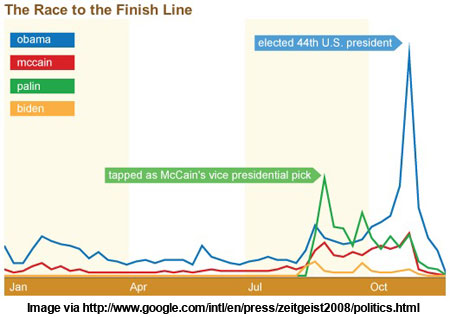
Google's annual year-end zeitgeist gives us a picture of what the United States, and the world at large, was searching for in the past 12 months. This year, Google, in a first for the global search engine, broke out their search results among 30 separate countries, but here at home, there was one individual who clearly had people looking for more: McCain's vice presidential candidate, Sarah Palin. Palin's plucking from relative obscurity and continued oddities throughout the campaign following the Republican National Convention kept her atop Google's lists in almost every category. Even her being an attractive woman, to many, kept her atop the image search zeitgeist, a claim that none of her counterparts could manage.

The 2008 results (found here) show "palin" as the #7 overall fastest rising term in the US, "Sarah palin" as the #1 fastest rising term in Google News domestically, and also #1 fastest rising in Image Search. You would think that with all that searching, the GOP would have vetted her a bit more before the election, but that of course is a different story.


In fact, in a year when we had the 2008 Beijing olympics, the election of Barack Obama, a financial crisis, and a stock market meltdown, Mrs. Palin was the fastest rising in all the world. (See the global results)

Following Palin's selection as VP candidate just prior to the Republican convention, searches for her outweighted those for Obama, her running mate, McCain, and Joe Biden, the opposing VP candidate. In fact, it wasn't until October when the eventual presidential pick overtook her on the site. (See the politics page)

Outside of politics, Google shows also that Facebook outpulled MySpace, Hi5, Orkut and LinkedIn in terms of social networking interest, and that hybrid car interest peaked when gas was $4 a gallon, and fell by fall as prices dropped by half. (See: Trendsetters)

The full report is here.