Silicon Valley Technology Commentary & Archives · Est. 2006 3,033 Posts · 2006–2026

December 13, 2008

December 13, 2008 · 4 MIN READ · BY LOUIS GRAY

Is There a Get Out of MobileMe Free Card?

Is There a Get Out of MobileMe Free Card?

Like any good Apple fanboy, I was among the first to sign up and get a mac.com e-mail address way back in January of 2000. At the time, a person's e-mail address was determined largely by which ISP they were using. I was using @Home broadband, so my e-mail address was [email protected]. Prior to that, I had used Earthlink, AOL, Prodigy, and of course, my Berkeley account when I was in college. While I had also signed up and gotten e-mail addresses with Yahoo!, Netscape and Excite, it was Apple's iTools offering that finally switched me over to a hosted service, and I've been using that address almost exclusively for personal mail, for nearly nine years.

But as we are approaching the annual ritual of renewal, I'm considering the effort needed to pull the plug and jump to GMail. It could be huge.

When Apple's iTools debuted, it was a free service. It was the same kind of e-mail offered by Yahoo! and others, but it, to me, meant something more. With every e-mail I sent, I was telling people my computer platform choice. And when my home.com e-mail disappeared with the evaporation of Excite@Home, I was more than happy to make [email protected] my permanent address of record.

Of course, as you know, much has changed since 2000.

By 2002, Apple changed its mind about free e-mail, ditching iTools for .Mac, and making users pay $99 for the privilege of keeping the address. I was frustrated, but was able to get in for only $49 as an existing user, and I hoped the iDisk, iCards, iSync and other tools would become valuable. They've pretty much been a dud.

By 2003, I even got my fiancee a .Mac e-mail address. I registered her new e-mail address with my last name as a geeky way to show I was serious. So both of us are @mac.com people. While we were paying for something that was free elsewhere, we knew it stood for more than the basic Hotmail, Yahoo! Mail or what have you. Free e-mail usually represented the unwashed masses who would forward chain letters and were plagued with spam.

In 2004, Google set the e-mail world upside down when they launched GMail on April Fool's Day. GMail offered a difference - a free e-mail account that had something like credibility, scads more storage, filters, labels and all sorts of coolness. But even though I have a GMail account (and actually bought it on eBay when invites were scarce), I usually use it for e-mail lists and news monitoring, not much else - still using my Mac.com account for virtually everything.

In 2008, Apple revamped its .Mac service once again, to MobileMe. And the result has been disappointing across the board. I don't even want to touch the Webmail version of the site, which I've seen gobble up sent e-mails, send them multiple times, or even fail to load. The quality is far from what I've grown to expect from Apple, and it's really turned me off to the service. Combined with the availability of GMail and other free services, and I'm strongly considering making the move.

But here's what's stopping me:

Address Books - My e-mail address is in the address books of many people including friends and family and Web connections. I have friends who still call a cell phone number from two years ago and family members for whom just understanding e-mail is a big hurdle.

Services - It's no secret I'm registered on a bajillion networks, from the silly to the professional. I get my financial updates from Wells Fargo, credit cards and Mint.com to the Mac.com account. When Web sites want a e-mail and not a user name, it's the Mac.com account that I use. I don't even want to think about going to every single one of those sites and making a change.

Archives and Search - Virtually all the e-mails with friends, family, acquaintances and services are stored locally on my computer under the Mac account. In fact, Apple's Mail reports I have more than 35,000 messages that have [email protected] as the main recipient, and nearly 9,000 from me sitting in sent boxes or other folders. If I move to another e-mail service, can I still pipe it in to the same box and not lose a beat? Not sure.

It has gotten to the point that my e-mail address is more difficult to move than a phone number. I know there are better services out there, and Apple's changes in the last year have not installed confidence. I know my wife and I are paying when we don't necessarily have to, but barring some drop-dead simple migration tools, auto-forwarding and some real work across the Web to make changes, I won't be changing any time soon.

Where is my "Get Out of Email Jail Free" card?

December 12, 2008

December 12, 2008 · 6 MIN READ · BY LOUIS GRAY

Social Media and Your Friends: Oil and Water?

Social Media and Your Friends: Oil and Water?

By Phil Glockner of Scribkin (FriendFeed/Twitter)

I have to admit to being 'in the closet'. But my closet is huge. In fact, it may be bigger than my whole house!

How is that possible? Well, in real life, not many of my friends and associates know that I am addicted to social media and social networks. And therefore, there are many more of you here in my closet, with me, than there are people out there.

Oil and Water

So here is my dichotomy. I'm an introvert. The Myers-Briggs Type Indicator test pegs me as an ISTP: Introversion, Sensing, Thinking, Perceiving. What this translates to, realistically, is me being an IT guy that has a small circle of friends and a moderate number of acquaintances that I am always forgetting to mail birthday cards to.

On the flip side, I am part of a large and exciting social network society via blogs like this one, FriendFeed, Twitter, Facebook, and the like. I definitely spend more time with my online friends, but less time actually building individual relationships.

And in fact, that is part of the problem.

In essence I have close friends who may not be that impressed or interested in social networks and social media. But, I also have a lot of acquaintances all over the country that I enjoy interacting with, but it's up in the air if any of them will become a good friend of mine.

Should They Mix?

Of course, the easiest path is to allow the oil and water to keep what they are doing, which is to say, not mixing. After all, is there any compelling reasons why they should meet? I think that may actually be the more interesting question. After much thought, I think (at least for me) that the answer is yes, there are compelling reasons. Let me lay them out for you.

Starting The Mixture

Literally and figuratively, there are solutions you can use to 'solve' these issues. You would most likely start with your immediate circle of friends. Think about why they would care about your interest in social networks. If they had an academic interest, they probably would have broached the subject with you already, asked you questions about it. If they haven't its probably because they either don't know or they have already decided they aren't interested.

However, nobody is ever uninterested in a better job, or more income. Use this as your way of ringing the front door. Ask your friends, have they ever gotten a better job through a job hunting service like Monster or HotJobs? Probably not. You usually have to have a perfect resume and superlative phone interview skills to even occasionally get a job that way. Differentiate social networks from job listing services.. one deals with job openings, the other with people who work at companies and businesses.

In the long run, social networks are actually better at landing a job, and its easy to say why: People get people hired. If you know someone, have a working relationship or a shared background with them, they feel confident recommending you for a job. A listing service only tells you what jobs a company has had trouble filling. It doesn't say anything about the people you are going to be working with, or how great the company is to work for.

In fact you can think of monster.com as a roadmap, giving you an indication of where a new job may be the most promising, but the real work should be done on LinkedIn, Facebook or Plaxo and other social networks. These services give you access to the people. The people on these services can answer questions, open doors, drop your name.

Apply Tweet .. I Mean Heat

Ok, so now you have your friends' interest. There's something in it for them. LinkedIn and Plaxo are sold.. but what about Twitter? Here's an easy way to present Twitter: It is the 21st century word-of-mouth. It's water cooler taken to a whole new level. Is it essential to building a brand or conducting business? No, in my opinion, no.. at least not yet. But the potential upside is great: It is a huge, globe-spanning even playing field where people can see how you work, and you can easily keep people up-to-date on any aspect of your work or personal life you feel is important to communicate.

Most likely your life isn't going to change by using Twitter or FriendFeed. If you are a realtor, you aren't going to be selling houses directly off these services. However, if you are looking for a realtor and you like two people (all else being equal), one who is nice and another one who is also plus gives great advice about house-hunting and hot properties on their Twitter, who are you going to choose? I know I'd pick the guy on Twitter.

Distill

At this point your friends have a personal interest, and they can see the potential for long-term interest. But if you want to bring home why using a social network all the time isn't necessarily a bad thing, you can present this argument:

Spending all day using FriendFeed and Twitter could be seen as a colossal waste of time. To most people, it makes about as much business sense as playing video games. However, I don't view social media (or even video games) that way. I see it as undergoing a constant process of self-education on powerful social tools that have a lot of potential to be very important to business and marketing in the future.

Actually, video games are a very good example to present this alternative point of view. The video game industry is bigger than Hollywood. It's not only not rare, but not even particularly uncommon to hear that someone who spent years immersed with video games getting a lucrative job in the industry as a writer, designer or producer. In other words, social media is not a 'waste of time.' Sure, if you view it as a learning course, it would definitely be self-paced. But the skills learned are ultimately beneficial.

Make It Personal

So, you have said your schtick. Your friends see you in a new light. At this point, you can't go back to treating them the way you did before, in the dark until you talk to them on the phone or in person. Now, you need to show them that you have mastered using these tools to improve or at least maintain your business relationships. Here are some things you can do to get them drawn in to the social media framework:
  • Send them interesting news clippings via e-mail from Google Reader or BlogLines. Or use another tool that lets you e-mail web pages, like Diigo.
  • Bookmark good Twitter or FriendFeed conversations and e-mail those with your thoughts.
  • In person, always be thinking of ways you can point people to solutions using social media. Like the realtor suggestion above.
  • Make sure you have a lifestream page. Try to pare down the nonessentials so that it just shows the highlights of your work during the day, and some linked pages where they can go to get more information.
There is one more step you can do to make this process personal: You can involve your social media friends into your life. Think of meetup ideas (for Twitter folks, use 'tweetup'): Sunday breakfast. Thursday evening coffee. Get local.. find twitterers in your city. Find or plan get-togethers with locals who are also social media savvy and compare notes. Bring a friend along.

The bottom line is that people are people. They like to be introduced to each other, usually, but they find it hard to make these connections themselves. Become a connector. Social media is all about making you the connector, and you will reap the benefits.

Read more by Phil Glockner at Scribkin.com.

December 12, 2008 · 3 MIN READ · BY LOUIS GRAY

5 Questions and Answers to Better Understand Blu-ray

5 Questions and Answers to Better Understand Blu-ray

By Mona Nomura of Pixel Bits (FriendFeed/Twitter)

I am the odd ball. The nerdy go-to person for my friends' and family's geeky needs. This Black Friday, before Christmas, et al sale holiday season, the most frequently asked question is: Should I buy a Blu-ray player? Since half of my guy friends are non-techies and my girl friends? PLEASE do not get me started. Their tech cred is limited to owning beauty gadgets and high end mobile phones. It is a challenge (and pressure) to simply explain what Blu-ray is and if it is truly a right choice for them; especially since they know where I live.

This is the list of FAQs I e-mail to them (I am too impatient to verbally explain). If any of you (the readers) are considering Blu-ray, hopefully it will be helpful to you, too. Oh - but please do not tell anyone this version of the list is way more thorough with technical explanations.

1. Do you have an HDTV?

Short answer: If no, don't bother.

Long answer: HDTV is not a requirement, but to fully enjoy what you are paying for; the quality and widescreen effect, a Hi-Def TV is highly recommended. As for the resolutions, Blu-ray players connect to a TV by an HDMI cable and sends HD signals to 720p, 1080i, and 1080p HDTVs, respectively, so formats is not a concern. But, if you do not have an HDTV and not planning to purchase one, check the outputs of your current set, since some older televisions are not Blu-ray compatible.

2. Do you have surround sound speakers?

Short answer: No? Are you sure you want to pay more for Blu-ray discs? Part of the pricing is for enhanced sounds.

Long answer: A single layer DVD holds 10 gigs. Both ROM and RW Blu-ray discs nearly double DVD's capacities - which basically means Blu-ray discs holds more data. Aside from bonus DVD features (commentaries, deleted scenes, etc., etc.), the extra storage capacities enable enhanced sound formats (Dolby TrueHD and DTS-HD Master Audio) and up to seven speaker channels and a sub - depending on your audio set up. Blu-ray discs are pricey, because we (the consumers) are paying for the production of the technology which enables Blu-ray to be Blu-ray, and sound is included in the package.

3. Can you really tell the difference between Blu-ray and regular DVDs?

Short answer: Just like a fast food burger and restaurant burger, you really do get what you pay for.

Long answer: Blu-ray discs holds double the video, and up to six times the resolution of DVDs. A picture with 1,080 lines consisting of 1,920 pixels redrawn progressively across the screen will clearly be different from a regular DVD's. Distinguishing 720p and 1080p may be a little difficult (screen size 40" + is ideal, viewing distance, etc.) but you better believe you will see the difference.

4. Do I need to repurchase my DVD library?

Short answer: No.

Long answer: Blu-ray players play regular DVDs and some will even boost resolution.

5. So why not HD downloads?

Short answer: Do you really want to wait two hours?

Long answer: I am going to quote Bill Hunt from thedigitalbits.com who said it best: "Blu-ray is going to give you to the best-looking high-definition video quality you'll see anywhere — better than video-on-demand or downloading, or HD cable, or even HD satellite," He also says: "Blu-ray simply offers the best video and audio quality available, with the most advanced bonus features."

Since Blu-ray discs have more data = more room to pack enhanced features aside from bonus features = better picture and sound. That said, if you're willing to pay extra for HD downloads, why not pay a little more for Blu-ray. It's worth it.

That, and Dark Knight on Blu-ray is totally worth the investment. Kidding, folks!

Sources: Engadget, CNET, and Blu-ray's site.

Read more by Mona Nomura at Pixel Bits

December 11, 2008

December 11, 2008 · 3 MIN READ · BY LOUIS GRAY

Twitter Followers Spiking As Service Increases Momentum

Twitter Followers Spiking As Service Increases Momentum

This holiday season, there's a little something in just about everyone's stockings, it seems. A buttload of Twitter followers. Whether it's due to the microblogging service's increasing visibility, its adoption by some famous users, or new utilities like Mr. Tweet that recommend new followers, it looks like users are seeing an ever-increasing number of followers per day - in the hundreds per day for the most visible accounts, and rates approximately 3-10 times the average growth for many smaller accounts, as tracked by Twitter statistics site, TwitterCounter.
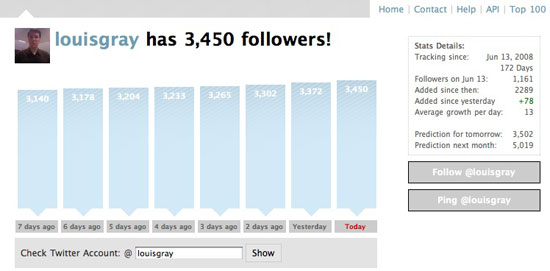
TwitterCounter is a simple service that tabulates your number of followers, and shows how that number has changed over the last 7 days, but more revealing is the site's details box, which shows how many followers the user had when first tracked, their average growth, and how many they had in the last 24 hours. In almost every single case, of those I checked, from household name A-listers to random followers I see on the site, statistics are up, way up. And the rate has only been increasing over the last seven days.
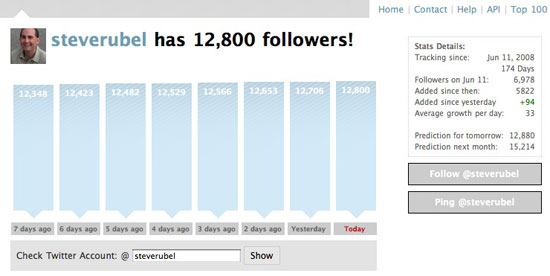
Steve Rubel, a week or so ago, noticed the spike, saying, “Twitter is on fire. I am adding 200 followers per day.” A member of TwitterCounter for almost six months, Rubel has added about 33 followers per day, but has seen activity on his feed accelerate. According to his stats page, he has added nearly 500 followers in the last week, including almost 100 yesterday. And his growth is not alone.

For example, my own data had about 13 followers per day opting in to my feed, according to the last six months worth of information at TwitterCounter. But in the last week, I too have spiked up, adding more than 300, including almost 80 yesterday, and 70 the previous day, well ahead of normal. It's made the confirmations that fill up my e-mail each morning to be pretty close to overwhelming.

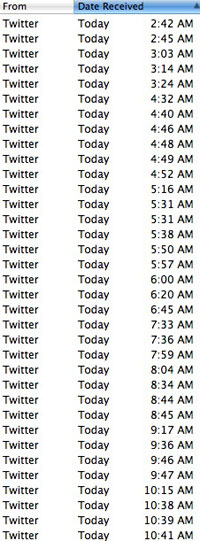
In May, I wrote that Web Service Notifications Outnumber Live Bodies In My E-Mail. But with a continued explosion of services, and so many of them getting even greater adoption rates, the percentage of automated notes is driving ever higher - Twitter being the most notable. So while I get my daily updates from FriendFeed, BlogRize, Strands, Socialmedian, Facebook and all the other networks, it's Twitter that is booming and driving the highest aggregate activity.


Take a look at how some others are seeing similar spikes in Twitter following activity:

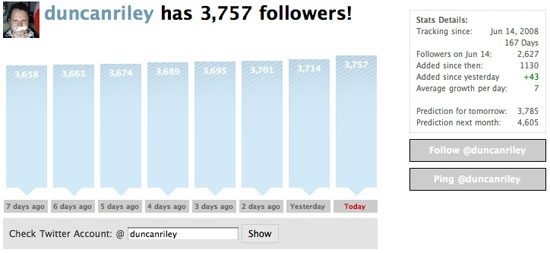
Duncan Riley: Average Growth: 7 Yesterday: 43 Weekly: 99


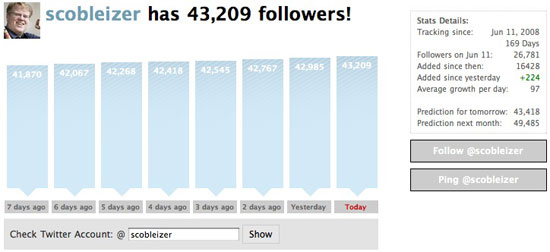
Robert Scoble: Average Growth: 97 Yesterday: 224 Weekly: 1,339


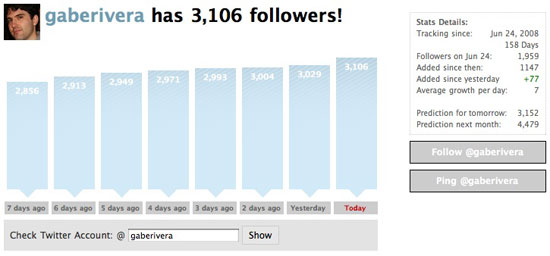
Gabe Rivera: Average Growth: 7 Yesterday: 77 Weekly: 250


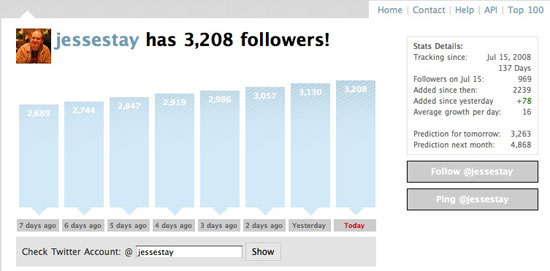
Jesse Stay: Average Growth: 16 Yesterday: 78 Weekly: 519


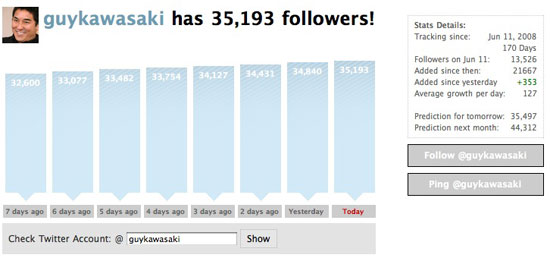
Guy Kawasaki: Average Growth: 127 Yesterday: 353 Weekly: 2,593


Steve Rubel: Average Growth: 33 Yesterday: 94 Weekly: 452


All statistics and images are via TwitterCounter.com

As mentioned, this rise could be due to many things. Maybe people are growing increasingly comfortable with following a higher number of Twitter users. Maybe this is due to automation and matching utilities. Could be a combination of all these things. But I would be willing to bet that Twitter is stepping on the gas in terms of going viral. With the service's troubling summer and downtime issues largely behind it, users are finding it's safe again and inviting others to come join the real-time blabberfest.

Are you seeing a spike in your in box as well or is this a false positive? What do you think is driving the surge?