Silicon Valley Technology Commentary & Archives · Est. 2006 3,033 Posts · 2006–2026

February 20, 2009

February 20, 2009 · 2 MIN READ · BY LOUIS GRAY

Adult Party Games On the iPhone? Get Penalized.

Adult Party Games On the iPhone? Get Penalized.

Usually we keep the blog on the safe side of PG, but it's late on a Friday night, and we're bending the rules a little. In the months I've had my iPhone, we have profiled a good number of innocent games, from jumping frogs to falling blocks, but not all the fun comes for kids with cartoon animation. Apparently, adults want to have fun too - and now the iPhone can be involved, with a silly game called Penalized that offers challenges, with the penalties being what you desire - be it loss of money, loss of sobriety, or loss of clothing.

The game, which requires two or more players, of course, displays unmarked cards which when revealed can display categories such as "I Never", "Impersonation", "Trivia", "Rhyme", "Physical Challenge" and "Penalty".

Penalized: I've Never Done What Now?

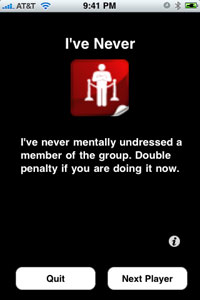
Each card reveals a statement, such as: "I've never mentally undressed a member of the group. Double penalty if you are doing it now." or "All virgins receive a penalty (and everyones pity)."

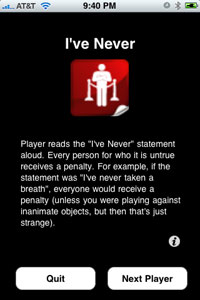
As you can guess, the hope is that everybody else gets a penalty, and you don't. If your impersonation isn't successful, according to the group, it's a penalty. Get the trivia wrong? Penalty. Can't do a physical challenge? Penalty.


Penalized: Trivia and Penalties for All

The game itself presents an odd mix - the silliness of Strip Poker and Truth or Dare with the geekiness and isolation of iPhone Apps. So in order for this to work, you need to find someone geeky enough to download the app, but popular enough to get a group together and play the silly game. And before your sensibilities come into play, not all the items are PG-13 and above in nature. For every virgin-related or fantasy-type card, there are ones as casual as impersonating Ray Charles, or stating if you have never broken a bone.

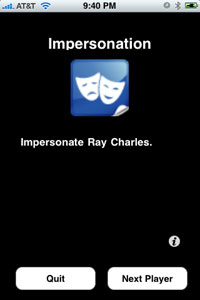
Penalized: Challenges and Impersonations

The author, Scott Goldie, who you might remember as the author of FriendFeedMachine, knows the game isn't exactly aimed at my demographic, saying, "It's a fairly off-the-wall party game best enjoyed after a few drinks and with a group of friends... probably best suited to single college students rather than fathers like you and I."

But even if you're not a single college student, you still might want to check out Penalized and have a little fun. It'll set you back all of $3.99. And yes, iTunes rates it 12+ for suggestive themes, mild sexual content and mild profanity or crude humor.

February 20, 2009 · 3 MIN READ · BY LOUIS GRAY

Which Companies Will Blink First and Lead Us Out of The Depths?

Which Companies Will Blink First and Lead Us Out of The Depths?


Graphic via Dreamstime.com

One of the scariest things about the type of economic slowdown we are in today is that it breeds yet more slowdown. If you see the headlines, you can read that as companies anticipate lower revenues and diminished profits, or expanded losses, they are turning to layoffs, and in parallel, reducing their own spending, from program and infrastructure costs, to employee costs. Just this week, for example, HP announced 5 percent pay cuts for its massive salaried employee base, across the board, and the Mercury News reports more than 100 public companies in all industries have reported executive pay cuts since the recession began.

While this helps the company in the immediate term, the ripple effects downstream are quantifiable - which, in my opinion, could make the problems worse.

Assuming lower revenues is one thing. Lowering spending costs impacts all the company's vendors, in reducing their own revenues, spreading the pain around. And of course, reducing the number of paid employees, and reducing the pay to those employees who are left, impacts them such that they are less willing to spend.

It's a high-stakes game of chicken, for if companies expect the market to turn around, and want dollars to flow again, they have to contribute to the economy themselves, and all actions we have recently seen in the press point to companies simply trying to survive what for many is the deepest downturn in memory. But there cannot be survival if every company reduces its spend so that every company downstream, and its employees, fails as well.

During the 2001 to 2003 recession, there were a few bright spots of hope and prosperity here in the Valley, from Google, who rocketed to market-share nirvana in the face of strong competition, to Apple, who rebuilt themselves from a PC company to one built around electronic gadgets and digital sales, following the introduction of the iPod in 2001, and later, the iTunes Music Store, in 2003.

Also during the 2001 to 2003 downturn, government leaders told consumers that the patriotic thing to do would be to open up their wallets and shop - to help keep the economy humming - even as spirits were broken. Of course, the resulting debts and the issues that surround people spending above their means were main contributors to the stark realities we see today, from credit crunches to home foreclosures. But this time, consumers have (hopefully) wisened up, and they are likely more reluctant to spend their way out of this deep recession, especially if they are one of the unfortunate millions who are drawing unemployment benefits or see their bi-weekly paystub reduced.

On this blog, many of the companies and services we talk about have very little to do with capital creation and distribution. Some of the products are fun widgets or sites that enable people to connect in new ways, not so much finding new places to spend money or even have revenue themselves. We recognize that - and hold to the line that for the most part, this blog caters toward early adopters, and it is not necessarily our role to gauge every company's business acumen and prospects - best left to others. But surrounding those people are real businesses with real, tangible products and a real-life balance sheet - and many entrepreneurs and fellow bloggers work for these companies that have been impacted - including some of my peers who write on this site.

Silicon Valley is not immune to this financial crisis. Companies big and small have reduced forecasts and results. Companies big and small have reduced headcount, and many more have reduced their operating expenses, without drawing headlines. Down the food chain, many start-ups have found the VC well to be dry, and will either be shutting down or changing their prospects. But as 90 percent of start-ups fail, this shakeout could violently separate the good ideas from the bad - faster than they had ever desired.

So as practically every business has reacted to the downturn and closed the spigot on spending, which ones will be the first to reverse the trend and say, 'Enough!', instead, taking advantage of competitive weaknesses to seize market share, and approach a more-wary consumer base? We can't sit on our hands and expect Google and Apple to be the names that rise to the top again.

February 19, 2009

February 19, 2009 · 3 MIN READ · BY LOUIS GRAY

Will The Crowdsourced Novel AirBorne Take Flight?

Will The Crowdsourced Novel AirBorne Take Flight?

By Eric Berlin of Online Media Cultist (FriendFeed/Twitter)

It's always fun to watch new creative experiments on the Internet play out. When it comes to novelists dabbling in the electronic realm, I fondly recall Stephen King's The Plant, "a serial novel published in 2000 as an e-book."
King wanted to see if people would voluntarily pay $1.00 for each installment versus the option to download for free. Perhaps an early sign of things to come, many people chose not to pay, resulting in the story -- a rather fascinating one if you're interested in how the publishing world worked in the New York City of the 1980s, before the age of the Internet -- never being completed in full.

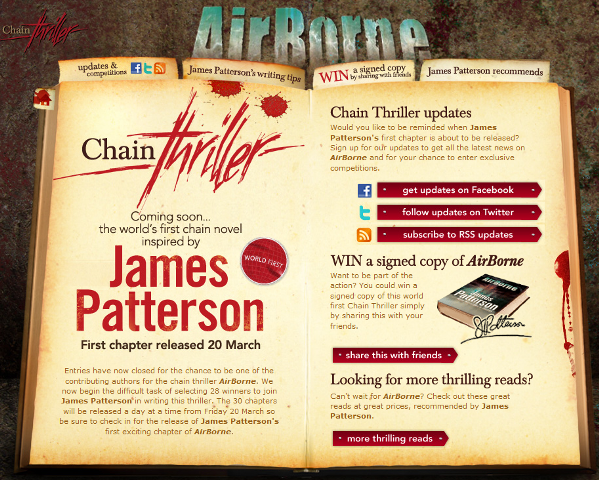
Now we have AirBorne, "the world's first chain novel inspired by James Patterson." The concept is that best selling thriller writer Patterson will write the first and last chapter of this "crowdsourced" novel. The 28 of 30 "middle chapters" will be written by selected writers, who get the honor of writing one chapter apiece. Presumably, the writer of chapter 14 has to wait until the first 13 chapters are completed, or have a strong idea of what's going on in the story, to pick things up. That fact alone must have made this project a logistically challenging one.


In the 2000 online world that The Plant was released into, distribution options were relatively limited (a Web site destination and viral means limited to things like e-mail and IM), whereas AirBorne will be rolled out a chapter per day starting on March 20th through such "web 2.0" channels as Facebook, Twitter, and RSS.

It will be interesting to see how viral and popular (and airborne?) a project such as AirBorne can get. While chapters are limited to a lean 750 words a pop, will people be keen to churn through it for 30 straight days -- a lifetime in the online realm? And that's to say nothing for the editorial challenge of maintaining some form of stylistic and storytelling consistency through a cavalcade of 29 writers (including one battle-hardened pro) telling one tale.

More than anything, the concept behind AirBorne reminds me of a game that my friends and I used to play. A person would start a story by stating one sentence aloud (usually it was as goofy and bizarre as possible, of course). Then the next person would pick up the thread, and around the circle we'd go. I'm sure that many others have done the same, and I can infer that collaborative storytelling is a tradition that many people can appreciate and potentially participate in, as reader or author.

And as ReadWriteWeb notes:
The roots of the collaborative writing movement can be found in many web startups, including those like Novlet, Potrayl, Ficlets, Unblokt, Protagonize, and others we profiled here. A popular activity for creative writers, these communities offer various takes on how a co-written story should be developed, some focused more on "choose your own adventure"-style stories while others focus more on linear narratives.
I like the idea behind AirBorne, and think it's a worthy project for a well known author to participate in. That said, I think things could have been made really interesting if the non-author part of the crowd -- the online public -- were let into the process somehow. Or what if the group of authors were entitled to vote to move the story in one direction or another after each chapter was finished. For example, maybe after Chapter 15 was completed, the author of Chapter 15 asks a question, such as: Do you think Mike should drop the gun and give himself up, take a hostage and hole up in the control room, or start shooting and try to make a break for it? And the group of authors vote and dictate where Chapter 16 begins.

And, finally, speaking of AirBorne, I'm pounding the medicinal variety today to fight off the onslaught of a cold!

Read more by Eric Berlin at Online Media Cultist

February 18, 2009

February 18, 2009 · 2 MIN READ · BY LOUIS GRAY

Outbrain Unveils Revenue Plan With Advertising That's Not Evil

Outbrain Unveils Revenue Plan With Advertising That's Not Evil

When Outbrain announced it had raised $12 million in its latest round of funding, I openly speculated that the team and its VC partners had wind of a revenue plan that the blogosphere at large hadn't been alerted to. Sure enough, just a week later, that secret has been revealed, as Outbrain, today, rolled out a new program that will display sponsored related links, attached to blog posts from its network of users, myself included. They call it "sponsored but good", and it represents an attempt to find a solution that is beneficial for readers, publishers and advertisers, which has proven very difficult for many vendors.

Outbrain is well-known for its rating widget that sits below users' posts, and tries to find related stories, both on the blogger's site and the service's network. Starting today, some posts will also feature a sponsored link - not to a paid-for blog article, but instead, to an organic article selected by the advertiser which will put their product in a good light.


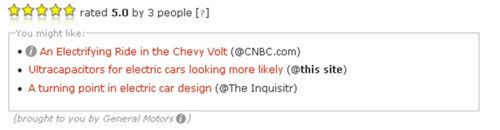
An example sponsored ad, via Outbrain

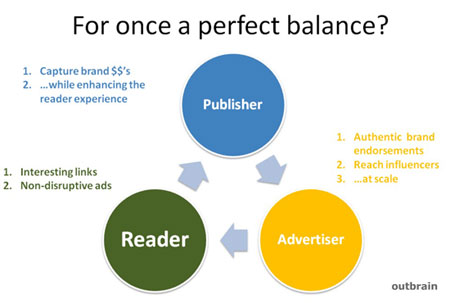
I spoke with John LoGioco, the company's vice president of business development, yesterday, and he said he hoped the new program delivered a "perfect balance," as readers would find new and interesting content that was non-disruptive, advertisers would put sponsored content on trusted sites, and publishers could gain revenue.

The benefit package delivers a good share of revenue to the blogger in today's announcement, LoGioco said, adding he hoped the program would be one that be trusted and adopted by bloggers looking to add another incremental revenue stream along the more typical display ads, dominated by Google.


The hope? An advertising plan that works for all

"Advertisers are excited so far, because they know the power of trusted voices driving demand creation if people are considering a product but are in the discovery phase," LoGioco said. "They haven't really had a chance to take a piece of the conversation that has been positive about them and amplify it. We can reach the influencer audience, and it is scalable."

With Outbrain's growth in popularity, serving an ever-increasing number of recommendations from sites in the network, the company has reached the point where advertisers are looking to reach readers - ones that are tired of seeing pop-up ads and other tricks that get in the way of their information browsing.

"We have all seen how platforms can be good for the advertiser or the publisher, but rarely for the reader," LoGioco said. "The advertising is in a non-disruptive format, and it leverages authentic brand endorsements. We are being very honest and open with bloggers and publishers."

The target for the "Sponsored but good" program won't be for direct marketers, and it won't be self-serve. Bloggers can opt in to receiving revenue from the program, and can remove specific sponsored links, once registered with Outbrain, and use what they call a link zapper to zap live sponsored recommendations. And if you think you're share of the revenue pie isn't going to impact your life, you can even choose to pass it off to charity.

See Also: Coverage from CenterNetworks, Mashable and VentureBeat.