Silicon Valley Technology Commentary & Archives · Est. 2006 3,032 Posts · 2006–2026

March 15, 2009

March 15, 2009 · 3 MIN READ · BY LOUIS GRAY

Is the Valley Too Expensive for Normal People to Launch Startups?

Is the Valley Too Expensive for Normal People to Launch Startups?

At a morning panel today at the SXSW Interactive conference, titled "Ditch the Valley, Run for the Hills", a great debate was struck between Penelope Trunk of Brazen Careerist and others on the panel, as she argued the high cost of living demanded by Silicon Valley and San Francisco pretty much excluded anybody from starting companies, unless they were 20-something single males. She argued the Valley's "coolness" and access to capital might not deliver enough benefits for shoestring startups trying to get off the ground. The issue of Valley costs was compounded by comments from Mike Maples of Hyper 9, who added his concerns that the state's financial struggles could see dramatic impact the standard of living many of us have taken for granted.

There is no question that over the last few decades, the Valley has gotten a disproportionate share of venture capital. In fact, Maples quoted a recent study that showed 90 percent of venture returns in the last 30 years went to companies founded within 10 miles of either Stanford University or MIT in Massachusetts. And panelist Robert Scoble, now of Rackspace, said the contributing reasons that the Valley attracted startups were three major factors, namely:
  1. Access to Capital (Drive Sandhill Road, see 10 VC firms and get your money)
  2. Scalability of Web sites (Access to people who have done it before)
  3. Tech press (From Mike Arrington and TechCrunch to other tech blogs)
But with the economy changing, and initial rounds for startups dropping from the tens of millions to only two or three million each, the panel said day to day challenges for start-ups could be even more acute, given the reduced access to capital.

Trunk, who is based in the Un-Valley, in Wisconsin, most directly said the process simply isn't doable for people who can't accept risk to their foundation, be it food or rent:
"There is an elephant in the room, about startups," she said. "You are starving and it is super scary, unless you have a trust fund or a previous successful company. In this economy it is very scary. We would have gone under in Silicon Valley because rents are high and there is no safety net in the Valley. Thunk how you can sustain yourself with food and rent before getting your business model."
She later added that only eight percent of companies seeking venture funding are from women, but most are from 20-something men who are single.

Maples, based in Austin, said he recently has been investing in local startups nearby Austin, partly because he would prefer not to travel, but he also voiced concerns about the viability of the Valley, given state budget problems.
"There is also the growing problem of local government," he said. There's a good chance the California government will go bankrupt. The services you take for granted now may not be there two to three years from now, be it education for kids, highways, police and fire support. The nice things you want could progressively change, and that's not true in Texas."
Issues in the Valley don't mean that the San Francisco Bay Area isn't attractive to new companies, of course. The Valley, offering access to capital, people, press and experience, can be an incredible pull. Scoble mentioned Loic LeMeur's Seesmic as one example of a company that moved from Europe to San Francisco and embraced the culture that enabled you to take risks, and fail. Noting that he himself had participated in three startups that have experienced failure, Scoble said Europe entrepreneurs aren't celebrated for their attempted success, but only for their actual success. And many of the panelists cited statistics showing that the venture capital-funded startup was a rarity, and the exception.
"In the valley, failure is accepted, and almost celebrated," Scoble said.
As with most topics here at the conference, the conversation also turned to Twitter. Could Twitter have been started or funded if it hadn't started in San Francisco? Almost universally, the answer was no. Maples even reminded us, "Twitter was a mistake."

March 15, 2009 · 2 MIN READ · BY LOUIS GRAY

Can Microblogging Power A Blog Community?

Can Microblogging Power A Blog Community?

By Rob Diana of Regular Geek (Twitter/FriendFeed)

With the growing popularity of Twitter, people are looking at ways to use Twitter-like applications for different purposes. There are the corporate Twitters, like Yammer. There are open source Twitters, like Laconica. Now, Dave Winer is trying to find a way to "shrink wrap" a Twitter install. He is basing his efforts on the open source Laconica, and he is documenting things as he makes progress. Dave feels that it is time we break out of Twitter. It is not that there are problems with Twitter, but he has an interesting idea:
"It might mean lots of little Twitters. I'm starting one here on scripting.com, and in the first few hours of use it's already interesting. It wouldn't in any way be a replacement for Twitter. But it offers an alternative. Sort of like the difference between a blog and a big website, when blogs were just booting up in 1999 or so."
Why is this an interesting idea? Mainly because there is minimal discussion on most blogs and websites. In some cases, a website expands by creating forums or message boards. People can ask questions, get advice and respond to some of these same questions. So, does it make sense to have a local Laconica installation for a website? And what do we call these things? Dave has wondered whether Twitter will become the term for what techies are calling microblogging. That is not the real question. If we call it a Twitter install like we used to with Xerox and copiers, who really cares. That is a simplification of the question.

The real question is one of benefits. Forums are really useful in large communities due to the number of people that can ask and answer questions. However, there is a critical mass of members that must be reached before there is enough traffic in a forum for it to be useful. With a microblogging installation, you can interact directly with your readers and keep the conversation local to the blog. The sense of community could increase greatly. Events could be based on the use of the microblogging stream. Live blogging for events like SXSW could be covered through the microblogging stream.

The big issue with using microblogging is the ease of installation, maintenance and use. If Dave could accomplish his goal of a shrink-wrap Laconica installation, this would be significantly easier. Forums have significantly more overhead in terms of maintenance and use. Microblogging could be a simple baby step in forming more of a community around a blog.

If you really want to name this idea, you can call it a micro-community. Or to be simple, let's just call it a community, because that is what it really is.

Read more by Rob Diana at RegularGeek.com.

March 14, 2009

March 14, 2009 · 3 MIN READ · BY LOUIS GRAY

Charlene Li Predicts Social Networking Will Be Ubiquitous, "Like Air"

Charlene Li Predicts Social Networking Will Be Ubiquitous, "Like Air"

Charlene Li, formerly of Forrester, and now plugging away at the Altimeter Group, spoke to a packed house at the SXSW conference today on the topic of the future of social networks. And if her predictions are to come true, we will some day wonder why we ever needed to go to dedicated networks to be social, as more social elements are weaved into everything we do - from news consumption and advertising to e-commerce sites and television. Her prediction? "Social networks will be like air - everywhere around us."

Charlene's presentation featured example mock-ups of how Amazon.com could show you reviews from just your friends, and not the world at large, and another with the New York Times, assuming that if you were trusted and knew influencers, you could attract a higher CPM from advertisers, thanks to your own individual value.

But don't expect this to happen right away. As Charlene reminded us, it took 20 years from Tim Berners-Lee writing up the foundation of the World Wide Web to the intricate social networks we have today, and while we now live in a place where "the tools are so powerful, you can fill out a form to connect to anyone in the world", as she relayed, there's still a tremendous amount of work to do. She adds, "It is very early, so patience is needed."

In her presentation, Charlene said that in order for social networks to become "like air", you would need three major elements, namely:
  1. Indentity - Who you are
  2. Contacts - Who you know
  3. Activities - What you do (in the context of those relationships)
Assuming social networking can become transparent and invisible and everywhere, like air, the next steps, according to Charlene, are to:
  1. Evaluate where social makes sense. When can data and content be integrated in the experience? Leverage existing identity and social graphs where your audience already is, and get permission policies aligned with an open strategy.
  2. Get your back-end data in order. Remove multiple sign-ins, registration and profiles for people. Have a single identity for customers and prospects.
  3. Prepare to integrate social networks into your organization.
Charlene recommended rethinking the way we approach social networks and social gatherings. As she accurately pointed out, conferences like SXSW feature many people with very similar interests, but the likelihood that we knew these people by name, or as friends, would be very low. She suggested being able to find out - in advance - who would be attending such events. How could social networks make life events better than they already are today?

Today's many announcements from Facebook and their Connect platform signify a big move of how social networking can become like air. The service is trying to deliver single-login sign-on to all sites. Of course, Facebook Connect is running head to head with the Open Stack platform in parallel, supported by practically everyone else, including MySpace ID, Google FriendConnect, LinkedIn and the OpenSocial movement. But while the two are not yet compatible, there is a shared vision to simplify today what are complex issues, including separating a person's multiple identities, like that of the personal life and business life (primarily broken out by e-mail address), and how you can avoid befriending the same people over and over again on each new network. She called this process "laborious".

In time, she speculated that social data on the social graph could help make privacy and permissions easier to manage, adding "context makes content privacy easier, and social signals provide a shorthand for our mental map of relationships." And while these elements are not yet pervasive, her conclusions had no doubts - as she said, "It is inevitable. It will happen. But it is going to take time."
March 14, 2009 · 2 MIN READ · BY LOUIS GRAY

Seesmic Launches First Dedicated Client for Facebook Updates

Seesmic Launches First Dedicated Client for Facebook Updates

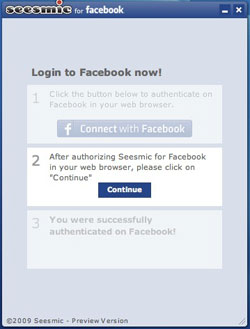
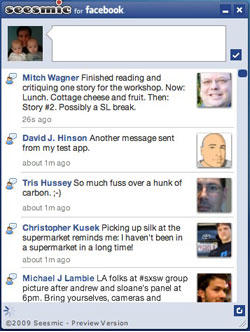
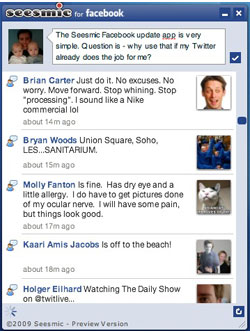
One of the introductions displayed during Facebook's Dave Morin's panel at the South by Southwest conference today was that of a new desktop client for Facebook status updates, delivered by Seesmic's Loic LeMeur. The new app, available for both PC and Macintosh, running on the Adobe AIR platform, lets users view updates from friends and post new status updates to the popular social network, much like the myriad of applications built for Twitter, from TweetDeck and Posty to LeMeur's own, Twhirl.
During the debut of the application, Loic was keen to try and help redefine Seesmic. He said simply, "Seesmic is more than video now, it is about sharing with friends."


Connecting to Facebook With the Seesmic Desktop Tool

I currently update my Facebook status with my updates I send to Twitter, so for those people who use Twitter and synchronize the two, there may be little need for the new tool, but there are many others who have made Facebook their home for social networking with friends and family. With some now 50,000 applications running on the Facebook platform, as Morin mentioned today, the new Seesmic application both has the option to be seen by very many users, but also the chance it could be overlooked, unless Facebook also chooses to push its visibility.


Updates from My Friends and Updating Myself

There is some curiosity as to why Twhirl was not made the conduit for these updates. The product, primarily focused on Twitter, also enables updates to FriendFeed and, of course, Seesmic. It could be that Facebook wanted a native app dedicated to their site, or it could be that Loic wanted to gain the market visibility by building a new category of desktop utilities. (Of course, you could see CenterNetworks' video to learn more)

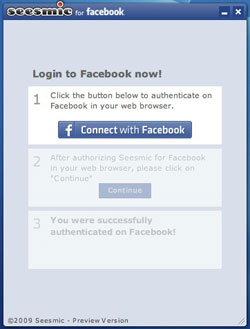
You can find the new Seesmic Facebook updater at http://www.seesmic.com/facebook. From there, you'll be taken to the Facebook site, upon getting connected, and you can download the AIR application. Loic officially announced it on his blog here.