Silicon Valley Technology Commentary & Archives · Est. 2006 3,032 Posts · 2006–2026

April 24, 2009

April 24, 2009 · 2 MIN READ · BY LOUIS GRAY

You Have Entered a No Retweeting Zone, Please Proceed

You Have Entered a No Retweeting Zone, Please Proceed

As we've said many times over the last few years, there is no one right way to use social media and blogging tools. Different people use Twitter, FriendFeed, Facebook, LinkedIn, and every Web service in their own way in a style the benefits them - be it for conversation, information discovery, news consumption, or broadcasting.

Within each of these sites there lies a certain amount of peer pressure... sign up for this... link to that... forward this... comment there. One of the more visible trends/fads I've tried to avoid is the phenomenon of retweeting. Even though retweeting has become so much a practice that widgets exist to show how often a blog post has been redistributed and people are begging to "Please RT", we're saying no. We don't expect you to retweet our articles, and we won't be retweeting yours.

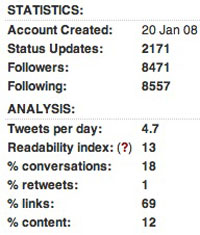
Given much of my own activity on Twitter is to distribute links to this site, or to highlight others' work, with the occasional comments replying to other Twitter users, we have a high level of linking over conversation. It's enough that some services, like Twanalyst, even call us "spammy", given our high link to retweet ratio.
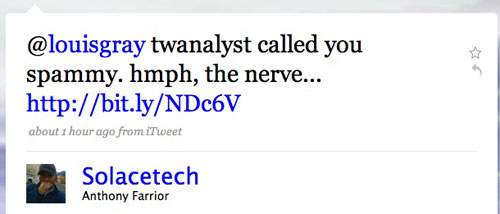
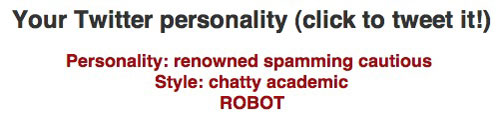
Twanalyst says I am spammy and don't retweet
But in my opinion, begging for retweets, and retweeting is simply lazy, just like live tweeting a conference panel is lazy blogging. It's the equivalent of forwarding e-mail, or copying and pasting someone else's blog post to your site and adding a short link. If Twitter is truly conversational, as many argue, then repeating what someone else has said doesn't do much to add to the conversation. Want to highlight their work? Write up a blog post and add your comments. Share their items in Google Reader. But do it in your words, not somebody else's.

Twitter is a land where 140 characters is all you've got to express yourself. If you think you don't have enough interesting data to share 140 characters of your own, but instead need to piggyback on someone else's tweet, then maybe you should rethink why you're using the service.

April 24, 2009 · 1 MIN READ · BY LOUIS GRAY

Conquer Information Overload at the Inbound Marketing Summit

Conquer Information Overload at the Inbound Marketing Summit


Earlier this week, I mentioned I am scheduled to speak at the Inbound Marketing Summit, featuring Chris Brogan, Tim O'Reilly, Tim Ferris, John Battelle, Loic Le Meur, Brian Solis, Charlene Li, and others. But it turned out that O'Reilly and I actually were on so close a wavelength that we practically submitted the same speaking topics. Aiming to be flexible, and let O'Reilly close strong, I thought we would revisit one of our favorite topics - how to avoid proverbial information overload, and find the right data at the right time, no matter where it is.

On Wednesday at 4:25 p.m. in San Francisco, just before O'Reilly finishes up, I'll be speaking on the topic, "There Is No Information Overload. Finding a Signal in the Noise".

The topic description leaves you with a little tip on what's coming:
"With a nearly constant stream of information related to you, your product and company from all corners, it can at times seem overwhelming. How can you break through the noise and find out all you need to, without being overwhelmed with a data tsunami? Don't just look to a chief information officer. Look to be a chief signal officer, by selectively finding where to listen, when to listen, how to listen, and if you should engage."
I've talked before about tackling information overload, and I'm looking forward to participating at the conference.

I do have a pair of VIP tickets available if you want to go, so send me an e-mail if you're interested.

April 22, 2009

April 22, 2009 · 1 MIN READ · BY LOUIS GRAY

Google Reader Limits Your RSS Article Spam Potential

Google Reader Limits Your RSS Article Spam Potential

As Google Reader is my main jumping off point to gather all the news of the day, it's no secret the RSS reader also plays a major role in how I help distribute the news, be it through hitting share to add items to my link blog, or by e-mailing articles out to others. In October I mentioned how e-mailing RSS pieces can help to evangelize the service, and I've continued to make it something I do, for friends or for colleagues. But of late, I've found more restrictions being added that make it seem people have maliciously mass distributed articles out of Reader, so more safeguards have been added to slow me down.


Captcha me if you can

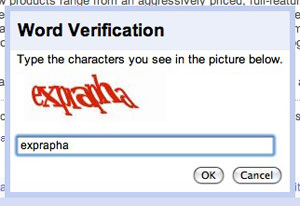
The first and most noticeable addition is that of a captcha, which requires you to fill it out each time you e-mail an article out of Google Reader. The minor annoyance didn't use to be there until recently, and presents the opportunity to test how well you read words that are slanted and blurred every which way.


Thou shalt not e-mail your entire address book this article

The second addition, which I just ran into today, is a cap to the number of people you can send an article to. While at the office it's no rarity to forward news to a dozen or more people, Google Reader now stops you once you pass ten recipients. This means that I will have to be more selective for whom I choose to send updates, and just maybe those left off will feel left out.

Having said limits in Google Reader won't dramatically change the way I use the service, with the exception of being more picky about my recipient lists, but I have to wonder who was violating protocol so much that this became a necessity. What robots do you think were mass e-mailing articles to all of their cyber buddies?
April 22, 2009 · 2 MIN READ · BY LOUIS GRAY

Facebook Getting Ready to Charge for Vanity Nicknames?

Facebook Getting Ready to Charge for Vanity Nicknames?

By Jesse Stay of Stay N' Alive (Facebook/FriendFeed)

My friend, Jason McGowan, sent me a screenshot that, if it is what it appears to be, suggests Facebook may be getting ready to add a new strategy to its business plan. It appears that select users are seeing polls in Facebook, asking if they would pay to be able to have their own vanity nickname on the network.

The vanity id is currently in beta for a select group of users such as TechCrunch, Loic Lemuer, AllFacebook, and others, and allows you to have http://facebook.com/yournick point to your Facebook Page. In addition, from their mobile phones, users can send "fan nickname" to Facebook and become
fans of your Page from wherever they are. This would be useful, for instance, in a Baseball or Football stadium during a game to enter people into a contest or become fans of the team. It would appear with these polls that Facebook also intends to allow this to point to individual user profiles as well.

Currently services like my own SocialToo and others provide short, easy-to-remember URLs that redirect to your Facebook profile. Having such a vanity URL would enable users to have an even easier to rememb
er URL, based on the Facebook.com domain that you could pass out to your friends. I personally would pay for this - it's worth both the brand recognition, and SEO it would give any brand.

The vanity URLs also come with even more pressure from Google, who just recently launched their own short URL and user profile system. Google's user profiles are 100% free, and rely on your Google account username by default. (See mine here)

Having asked Facebook for entrance into the vanity URL program for both myself and SocialToo and received no response (hint, hint), I would assume Facebook is just waiting for the right time to launch this to all. I'm excited to see this program come forth and hope Facebook can soon allow many more into the program.

You can add yourself as a Fan to my Page at http://www.facebook.com/pages/Jesse-Stay/12327140265

Read more by Jesse Stay at Stay N' Alive.