Silicon Valley Technology Commentary & Archives · Est. 2006 3,032 Posts · 2006–2026

June 28, 2009

June 28, 2009 · 3 MIN READ · BY LOUIS GRAY

Blogging Is Still the Foundation In A World of Streams

Blogging Is Still the Foundation In A World of Streams


Last week, Edelman's Steve Rubel made an aggressive jump - away from traditional blogging, turning over his site to a lifestream, which captures all of his activity from around the Web. His move, he reported, was due to a feeling that blogging "feels old" and that the new reality is about the flow of information. This followed on to a conversation he, Steve Gillmor and I had a month or so ago, which led to my post saying that RSS felt slow. But while I see some of the same issues Steve has, I haven't made a full move away from the blog, don't ever plan to do so, and for any company I give advice to, I tell them to do so would be a mistake.

The blog is the foundation and center for who you are - either as an individual, or a brand. While I believe the best bloggers in the world are participating outside of their blog, on Twitter, FriendFeed, Facebook and everywhere else, to only participate in those areas leaves a gaping hole. The world of lifestreaming and real-time is fun, but it can be as deep as a soap opera in a world that still demands insightful documentaries and news reporting.

In August of 2007, I said there was a new reality and that "Your Blog Is Your Brand". Most of you weren't reading me back then, but it holds as true now as it did two years ago.

Fellow blogger Jeremiah Owyang added his thoughts on the issue last week, asking, Is Blogging Evolving Into Life Streams? Interestingly, he noticed that Robert Scoble and Shel Israel, who were the authors of Naked Conversations, were now more focused on micromedia (FriendFeed and Twitter) than they were on their own blogs. It's a big reason why Mike Arrington told Robert he needed an intervention at the end of 2008. (Amusingly, Robert is going 'blog only' this week...)


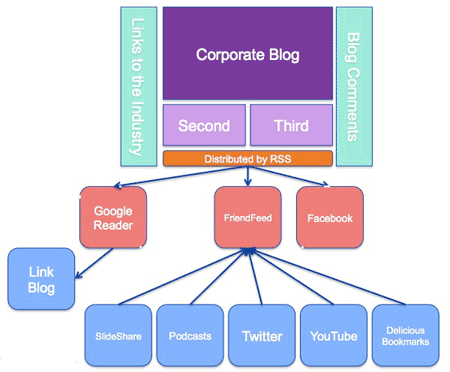
In the last two years, the rise of microblogging tools and lifestreaming services has given blogging a less-prominent role on everyone's tongues, but it, in my opinion, is as important as ever. One just needs to make a conscious decision as to what type of data is most appropriate where. Longer, more thoughtful pieces with graphics and type style should go on blogs. Maybe a few photos and text go to FriendFeed or Facebook, and short status updates go to Twitter. The addition of more options shouldn't mean the elimination of the original.


The Blog Is Still the Foundation

In a presentation I gave to one company this week, I stated the same - I said the corporate blog is the foundation of your entire social media strategy. It may make sense to have secondary and tertiary blogs, but if you tried to just use Twitter and other services and neglect the blog, you would a failure from the beginning.

Blogging is not for everyone or every company. Blasphemy, I know. But it is work, and it can never be stopped. Once you start, there is no finish line, until you drop and become a 24 hour trending topic on Twitter. But blogs are your public whiteboard - extending your voice to your peers, your family, friends, or in the business world, your customers, prospects, partners, competition, press and analysts, and of course, your own employees. 140 characters just isn't enough.

June 27, 2009

June 27, 2009 · 1 MIN READ · BY LOUIS GRAY

ClaimMyName Mines My Social Media Identities

ClaimMyName Mines My Social Media Identities

By Ken Stewart of ChangeForge (Twitter/FriendFeed)

With the proliferation of so many social media services, identity management has become a full time job. What sites do I participate in? What sites do I stake my claim so someone doesn’t swipe my name?

DandyID just announced their new automated identity mining service, ClaimMyName, allowing you to select your vanity ID and up to 3 alternates to search across all of DandyID’s listed services. Choose to purchase a Starter Pack allowing you to choose 20 services or opt for the Pro Pack with 300 services. The automated engine will run behind the scenes and send you a digest e-mail within 3 business days.

Watch as Sara demonstrates how it works:


The Starter Pack starts at a robust $79.99, and may well be worth it for those seriously interested in protecting their brand across most of the major social media services. For those who live and die by use of their name, the Pro Pack has been made available at $699.99, or just over $2.00 per service.

Clearly the equation here is whether the time it would take the serious social media maven to manually and individually sign up for each service would be worth this entry fee. As the world of social media matures, more and more services will have to turn to various for-pay models. However, with so many social media services having trained their legions of users that free is the admission price, even the starter pack will seem a steep price, in my opinion.


Ken Stewart’s website, ChangeForge, focuses on the collision between the constantly changing worlds of business and technology in an information-centric world. He is always interested in connecting; To discover the many ways you may connect with him, visit him at DandyID.


June 27, 2009 · 6 MIN READ · BY LOUIS GRAY

Ten Year TiVo Veteran Talks History, Hacking and Partnerships

Ten Year TiVo Veteran Talks History, Hacking and Partnerships

About two years ago, I had my first visit to TiVo's headquarters in Alviso, just outside of San Jose. That visit only lasted a few minutes, and gained me a new remote control, replacing an original that had passed on. But on Friday, I had the privilege to stay quite a bit longer, as a guest of Stephen Mack, Director of TiVoCast Operations, as he took me on a quick tour of the company's offices, and we caught lunch, talking about his decade at the DVR pioneer and providing insight into one of Silicon Valley's arguably most interesting companies, sporting an incredibly loyal fan base, which includes me as a member.

Mack joined TiVo from SGI in March of 1999, less than a month before the company's first digital video recorder units were scheduled to ship. As he told me, co-founder Mike Ramsay had made the promise that the units would ship by the end of the first quarter of 1999, pushing the company to practically work around the clock, including nights and weekends, to meet the aggressive goal, making their offering first to market, just ahead of then-rival ReplayTV. This episode of Silicon Valley folklore came despite the fact the company, as he put it, had no working software, no working hardware, and no way to sell the products only weeks before the impending launch. Just squeaking in under the wire, the first units shipped on March 31st of 1999, on a blue moon - which is commemorated on the last Friday of each March each year at TiVo, as "Blue Moon Day" - an official company holiday.


Stephen Mack In His Busy Cubicle at TiVo

In the ensuing decade, TiVo set the gold standard for digital video recorders in an extremely competitive market that saw the term DVR genericized by a stream of copycat providers, including the local cable companies, DISH Network, and an on-again off-again relationship with DirecTV, who helped provide the bulk of TiVo's initial subscriber base, even as the company gained more dollars per subscriber with its native sales. In the most recent year, the company turned a profit of more than $100 million, after years of red ink, that had some declaring a TiVo Deathwatch, not unlike the struggles of Apple Computer just ten years prior.

The linkage of TiVo and Apple is more than just in their role as pioneers, but the pair also feature some of the most loyal customers in technology. The pair is also known for two other facets which gain alternate praise and scorn - including its penchant for secrecy and an adherence to NIH syndrome, well known in the Valley as "Not Invented Here".
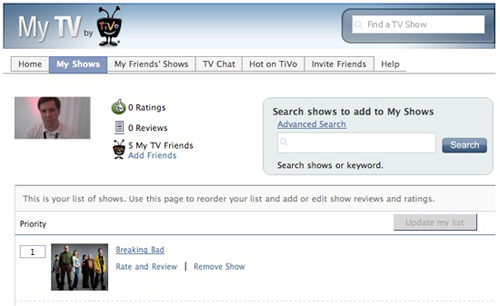

TiVo's New Facebook Application, "My TV"

In June of the last year, I openly railed on TiVo to work on creating a social network to try and take advantage of its strong brand and to connect users. (See: TiVo Is a Zero On the Social Web. It's Time They Fast Forward.) And while they still have yet to follow on to my suggestions word for word, they are making strong progress in terms of showing they are actively listening and participating in the social space. The company has launched a little-known Facebook application called "My TV", which invites you to share your favorite shows, see friends' favorites, rate shows and comment on recent episodes. So it's close.

And yes, like all other good marketing companies, they are on Twitter, here: http://twitter.com/tivo. Meanwhile, although Mack doesn't consider himself a TiVo spokesperson, he has responded to blog posts of mine in the past that mention TiVo, and he is active on FriendFeed. In fact, in light of changed television programming in the last few days following the celebrity deaths of Michael Jackson and Farrah Fawcett, he posted official word from the networks there, in case you needed to make edits to your recording schedule.

Working to grow TiVo is a very interesting business. Steven walked me through the company's need to colocate in highly secure data centers in multiple geographic locations - which would ensure the service's survival, even if the state of California were to off and fall into the ocean. We also talked about the struggles that are common to most OEM businesses, where large partners see every proposed change as a potential for compromise. In particular, he recounted to me the challenge of having DirecTV's huge services team trained when TiVo started to enable broadband updates to their DVRs, in addition to standard phones - and getting the staff ready for practically any kind of modem or broadband issue.
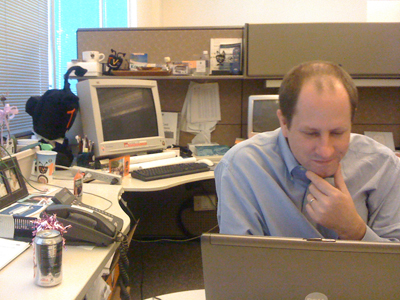

Stephen Mack Checks Potential Issues While at TiVo

The issue of DirecTV came up a few times from others on the Web who knew we were to meet today. First, it is public knowledge that the new DirecTV TiVo boxes are scheduled for the first quarter of 2010. Secondly, the hope that DirecTV units would attain feature parity with the go to market offerings from TiVo just isn't going to happen. Units sold through TiVo will always be the first to support the latest updates, especially as partners will remain conservative.

I also talked with Stephen about the visible hacking community around TiVo's units. My first box, a hand me down, had come with a larger after-market hard drive, a common upgrade. Such modifications violate the company's user agreement of course, but the company knows such activities go on, and some smaller "garage" firms have even built up side businesses to upgrade units, which TiVo has no interest in shutting down. Most of the time, the hacks are harmless, although it was not uncommon in the DVR provider's early days to see customers load Phillips software on Sony boxes and vice versa, introducing issues.

What was shut down, however, at least for now, was the company's Rewards program, that gave TiVo ambassadors points for signing up friends and family, which could be exchanged for TiVo gear and other equipment. It turned out that rather than the program's generating a waterfall of referrals from excited fans, it turned into something of a side business for a handful of individuals, who would buy used units from garage sales, sell them to new buyers and gain activation codes, exchanging them for goods through TiVo. Mack said one such entrepreneur was making enough action that they earned themselves 500 iPods in a year (which they no doubt sold).

In the fast pace of Silicon Valley, a ten year tenure at any one company, especially one that has seen such peaks and valleys as TiVo is a rarity. But Mack says as many as a quarter of the initial 80 people at the company who were there when he joined remain, acting as historians among the company's nearly 500 employees.

The company's offices, tucked away off to the side of Highway 237, neighboring Foundry Networks, Brocade and others, feature the interior bright colors of a typical Valley startup. Its meeting rooms are all named after TV shows, and Mack offered up that he had the bright idea to name one of them, optimistically, "60 Minutes". Meanwhile, outside, even in today's heat, a vigorous basketball game was being played, featuring many of the company's system engineers, who battled in a fullcourt contest of Shirts and Skins. The scene was idyllic enough to want to take out the TiVo remote and hit pause, but I'm just as eager to hit Fast Forward and see what the next several years will bring for the technology pioneer.


June 26, 2009

June 26, 2009 · 2 MIN READ · BY LOUIS GRAY

Ignoring Rationality, I Subscribed to Sirius Radio Yesterday

Ignoring Rationality, I Subscribed to Sirius Radio Yesterday


Last week, I told you that the new iPhone application from Sirius Radio solved a problem I didn't have, namely gaining access to good music - which I can get from numerous sources, including my bulging iTunes library, Last.fm, Pandora, or even streaming radio sources built into iTunes itself, like those from Digitally Imported. But despite my protests, I gave in yesterday and paid up, making Sirius' foray into iPhone applications already responsible for at least one net new customer.

As I mentioned last week, I always had hoped to have streaming high quality satellite radio in my next car, but missed the boat when I bought a used 2006 model and didn't get the chance to configure it myself.

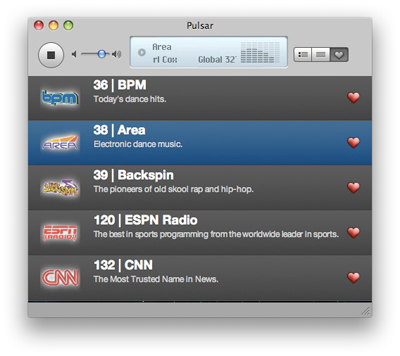
After initial struggles getting the app to work in the car, the application has worked beautifully for the remainder of the seven day free trial that came alongside the iPhone app. I have made turning on Sirius Radio (and primarily the station Area) part of the process of my turning the car on. And if you're a diehard electronic music and techno fan, I can tell you there is just no substitute for Sirius' set of stations on any network I have ever tried.


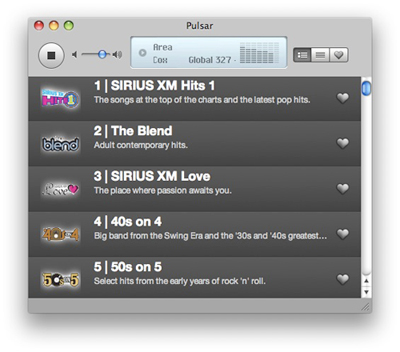
The Sirius Lineup on Pulsar

But if I were only using Sirius in the car, I still would have passed. Instead, I have also been playing my Sirius stations on my laptop, using an application called Pulsar, from Rogue Amoeba, that makes getting the music on my desktop very easy indeed. Now, I can listen to Area, and get shows from Robbie Rivera, Bennie Benasi, Paul Van Dyk, John Digweed, Carl Cox and Paul Oakenfold any time I am near the computer or the iPhone (which as you can assume is darn near all the time).


My Favorite Sirius Stations on Pulsar

And it's not just the unmatched content on the channel that had me convert. It's also the complete lack of commercials on Sirius, and of course, elimination of static. Pure satellite sound pumping through my BMW speakers on 280 is just amazing, as you can probably imagine.

Last week, when I was first talking about possibly buying Sirius Radio, Thomas Hawk repeatedly said "music wants to be free". But I will always pay for quality - and Sirius Radio has it. I cannot wait until the next long trip when I can charge up the iPhone, hook up to the dash and hit the gas, with perfect music flowing alongside. So don't tell me it was an irrational move, one that was a waste of money, or that I had better alternatives elsewhere. Music, like art, is emotional, and I have no qualms about reversing my position.