Silicon Valley Technology Commentary & Archives · Est. 2006 3,031 Posts · 2006–2026

September 9, 2009

September 9, 2009 · 3 MIN READ · BY LOUIS GRAY

Apple's Biggest Product Announcement Today: Steve Jobs

Apple's Biggest Product Announcement Today: Steve Jobs

Apple is in a unique position whereby they can cobble together an array of product features, introduce them in flashy way, and call the result a media event. Today, the company made relatively minor upgrades to one of its product lines, while also introducing a simple firmware upgrade and application version release to one of its software programs. This being Apple, their product line was the iPod, the firmware upgrade was for the iPhone OS, and the version release was for iTunes. The company also got to beat the drum and demonstrate once again that they have significant market momentum. But really, truly, the only thing that mattered about today was the person delivering the message: Apple CEO Steve Jobs.

As much as the words coming from his mouth, or the Keynote slides being projected behind him, Jobs' demeanor and pure physicality were on display today, after months of near invisibility as he recovered from a life-threatening battle which included a much-publicized liver transplant in Tennessee, following his battle with a rare, curable form of pancreatic cancer just a few years ago.

My obsession with all things Mac and the rumors which sway the Cupertino-worshiping community to and fro has waxed and waned over the last decade or so. Right now, I know what smartphone I prefer and which OS I prefer, but I don't drool over software version numbers, gigabyte counts, or whether or not some band my parents used to listen to will ever make it online. But I do care about Steve Jobs - because of who he is, what he represents to Silicon Valley, and his ability to execute consistently in an amazingly challenging industry.

In December, when it was first announced Jobs would not be participating in Macworld San Francisco, I told you that I would teach my children about Steve. A month later, I told you I thought he should be immortal. And as silly as it may sound, I am already teaching my one year-olds about Steve Jobs.

Every night, when I read to my twins as they settle to bed, I am not picking up Dr. Seuss or Goodnight Moon. I have been reading to Matthew and Sarah from the insightful book, Inside Steve's Brain. As I tell these illiterate toddlers about Steve's successes and failures, even my wife listens in as she gets to know this Silicon Valley icon's history just a little bit better. And I am not just excited that Steve Jobs looks to be back in charge at Apple, but relieved.

Even as we kept hearing his state was improving, the rumor mill has not been kind to Steve. Outside the blog, friends of mine who know his family and acquaintances have told me of him putting his affairs in order, or reducing his traveling to keep his health up. They have speculated he won't stay CEO of Apple long, and have been concerned that he might not fully recover from his illnesses. But today's event put an end to much of that. I don't need to see Steve Jobs perform a physical, or have his medical records posted on Apple.com for all to see. It's his brain that needs to work, and even if he is skinny, his mind is ever so sharp. He rightfully has ascended to his position atop Apple. Even if you were underwhelmed by Apple's actual announcements today - if you wanted to do more than rearrange your iPhone apps from iTunes, or you were waiting for the unreleased tablet, you have to be happy that one of the industry's real thought leaders, a man for whom much of us owe a great deal, is back with us.

Welcome back, Steve.

September 9, 2009 · 3 MIN READ · BY LOUIS GRAY

TweetDeck Intros Twitter Directory, Expands Social Network Support

TweetDeck Intros Twitter Directory, Expands Social Network Support

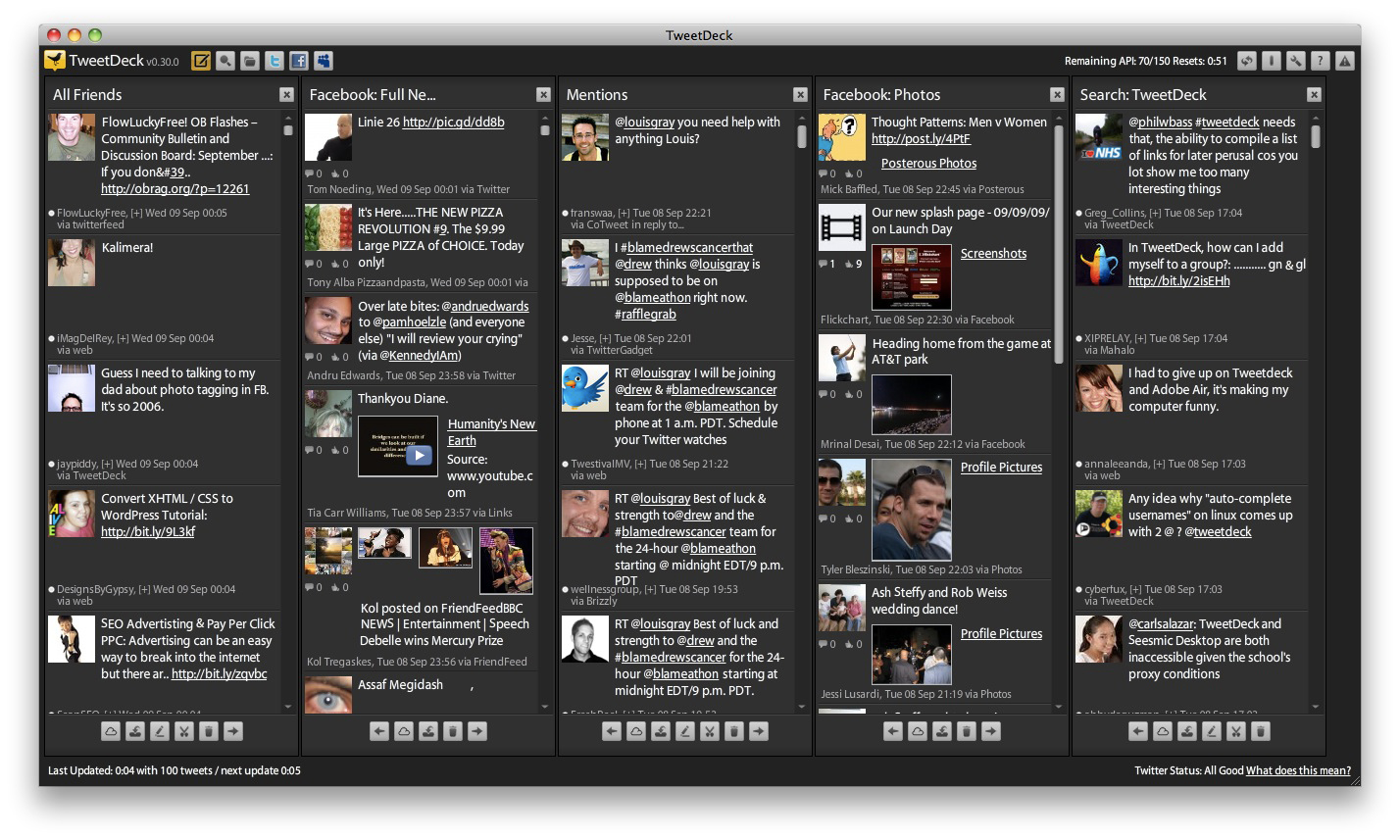
When TweetDeck first debuted more than fourteen months ago, it changed the game in terms of what users expected from a Twitter client. Iain Dodsworth's creation took Twitter out of the Web and onto the desktop, and introduced concepts such as Groups and integrated search (then done with Summize). Following the product's one year anniversary in July, Dodsworth is expanding the vision of TweetDeck to be more than just a Twitter client, instead acting as a "browser for the real-time Web". Today, TweetDeck moved further in this direction by adding MySpace support, expanding its integration with Facebook, and interestingly, starting a hand-selected Twitter directory that sits in between Twitter's controversial Suggested User List and the anarchy of WeFollow.


The New TweetDeck (Click for Full Size)

For diehard TweetDeck addicts, the changes are obvious. Instead of a string of third-party integrated services, like 12 seconds or StockTwits, you see only the major social networks - including Twitter, Facebook and MySpace. Each has sub-buttons when you select the top level site, and you can select an action below. The additions now mean you can view your entire Facebook stream in TweetDeck, including videos, photos and other social activity, including, yes, status updates. From within TweetDeck, you can also organize Facebook friends into groups and see photo albums without opening the Web browser.

While we may turn our nose up at TweetDeck's MySpace integration, Iain and team are trying to make the application a single destination for the Web's most popular networks. Facebook and Twitter are clearly growing like weeds, and Dodsworth's pet project is positioned to capitalize on that growth - with or without the "real time Web" buzzword.


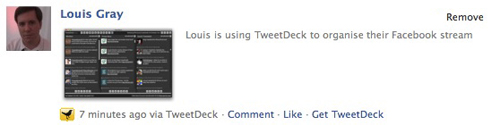
The New TweetDeck Can Manage Your Facebook (From My Wall)


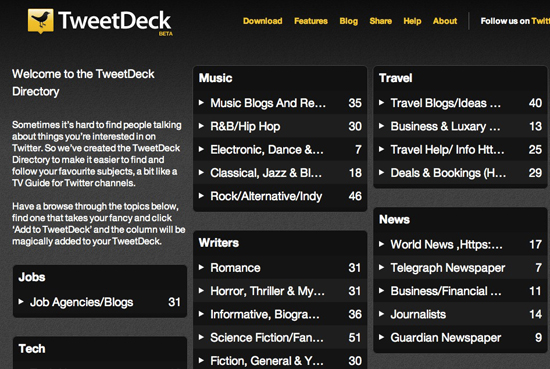
The New TweetDeck Directory

Meanwhile, the TweetDeck directory is a clear improvement over Twitter's unexplained Suggested User List (SUL), but looks like it's at the beginning stages. From http://tweetdeck.com/beta/directory/, you can see Twitter users, organized by topic, along with the number of users included. Should you find a group of users you like, click "Add column", and their tweets will be displayed alongside those groups you have already configured. No group in the directory has more than 50 accounts, but some can be quite small, such as "EU Politics", which sports only three. The idea? The site says: "Sometimes it’s hard to find people talking about things you’re interested in on Twitter. So we’ve created the TweetDeck Directory to make it easier to find and follow your favourite subjects, a bit like a TV Guide for Twitter channels." This is similar to WeFollow, where people can tag themselves and be included (although the site is extremely high-follower centric).


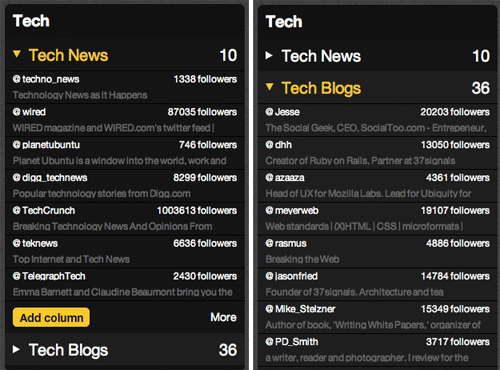
Selections from The New TweetDeck Directory

Clear benefits to the new TweetDeck, slugged with version number 0.3 include the ability to browse Facebook and Twitter together in parallel. Should you be one of the odd users who also manages an active MySpace profile, then the story gets even better.

In an e-mail introducing today's changes, Iain clarified the goals, saying that with today's Internet being as much about streams as active Web pages, that " people need a new way to filter and interact with the current generation of online properties." He is clearly trying to take TweetDeck beyond Twitter - becoming what could be the future of social browsing.

Editor's Note: This story was intended to come out in a few hours, when the software was available, but other publications have released early as well - so the proverbial cat is out of the bag.

September 8, 2009

September 8, 2009 · 2 MIN READ · BY LOUIS GRAY

College Football's Debut Makes ESPN ScoreCenter an iPhone Must

College Football's Debut Makes ESPN ScoreCenter an iPhone Must

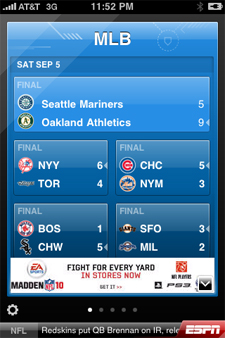
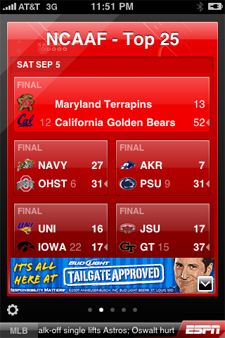
This last weekend marked the beginning of the college football season at universities across the country. My Cal Bears managed to wallop the visiting Maryland Terrapins by a 52-13 margin, avenging last year's ugly loss at College Park. As I couldn't watch the game, traveling to Southern California, I kept tabs, using my iPhone, by using ESPN's ScoreCenter, a low-frills app from the self-proclaimed "Worldwide Leader in Sports" designed to get me the data I want quickly - with a clear focus on real-time game results, instead the more fluffy features you can find with just about any sports media.


ESPN ScoreCenter on the iPhone: Scores from Any League

ESPN has a long history of experimenting with its Web site - being among the first to embrace Java in the mid-1990s, and streaming video earlier this decade. (See also: ESPN.com Launches New Beta Site, Reduces Ads, Integrates Video from December 2008) It has similarly moved its tech leadership to the mobile Web, with a dedicated site for old-school cell phones and the iPhone, including fun games, like ESPN Cameraman, and ScoreCenter - a cute play on its famous franchise, SportsCenter.

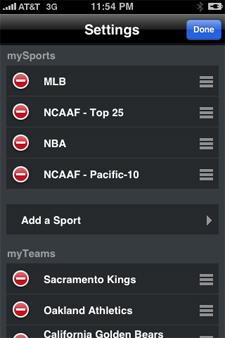
ScoreCenter, like the ESPN Web site, separates out the day's scores by sport. MLB is separate from the NBA, which is separate from College Football, the NFL and so on. But what displays on your iPhone is up to your own preferences. You pick the sports you want updates from, and you pick your favorite teams. You can even select which sports appear first when you open the application, and you never have to see updates from sports you don't care about. These selections are helpfully titled "mySports" and "myTeams", as part of the company's My ESPN push.


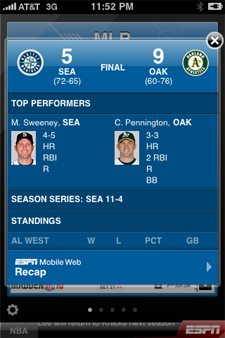
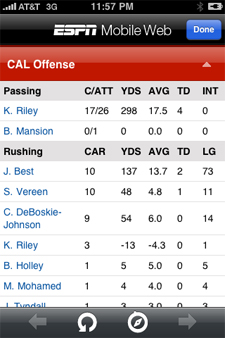
Drilling Down on Top Teams' Games on ScoreCenter

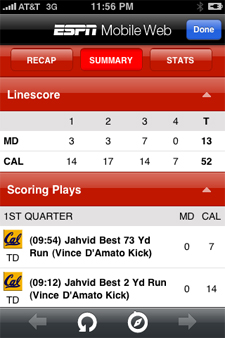
Sports already plays a big role on my iPhone. There are dedicated applications out there for MLB, NFL scores or College Football scores, each of which I've previously covered. And yes, you can get updates on sports news from many media apps. But ESPN's ScoreCenter gives me a customized cut of all the information, providing me the top level answer I need in terms of current scores from all my leagues, and with a few clicks, I can see the boxscores or even live gameday action. And for those of us raised on the ESPN franchise through TV, you should be happy to see they even have the familiar "Bottom Line" bringing headlines from around the sports world.


ScoreCenter, Customized For Me, Also Goes Deep Into Data

The app is a welcome alternative to other non-custom apps that give me way too much information about things I don't care about. With college football kicking off last weekend, I know I'll be checking in to ESPN's ScoreCenter to see what every team in the Pac-10 conference is doing, or browsing the Top 25, and getting updates on every game as they roll from East to West. The application, supported by ads, which display alongside the scores, is free. Find it here.

September 5, 2009

September 5, 2009 · 5 MIN READ · BY LOUIS GRAY

Ev and Biz Discuss Early Days of Blogger After 10th Anniversary

Ev and Biz Discuss Early Days of Blogger After 10th Anniversary

Today, the Web is lit up with reports of vulnerabilities in the geeky Web blogging platform, WordPress. Meanwhile, quietly, its predecessor, sporting 300 million active readers (measured on a 30-day basis), with nearly 400 million words added per day, Blogger, the platform I use, continues to chug away. Often seen as a blogging platform for the less technical Web user, Blogger, recently achieved its 10th anniversary, and invited its founders back to the fold to commemorate the milestone - including Evan Williams and Biz Stone, now better known for their work on Twitter, which has introduced a new form of Web communication to the world, commonly known as microblogging.

On a panel held this Tuesday at the San Francisco office of Google, who owns Blogger after its 2003 acquisition from Pyra Labs, the pair, along with a pair of Blogger representatives, and a few power users of the platform (myself included), looked back on the previous decade and how the world has changed over the years.

When Pyra Labs launched Blogger as a side-project, it was widely perceived that bloggers were "crazy", Ev said. "Who are you to think anybody cares about what you have to say?" he recounted. "It was blasphemy in a lot of ways, and now it is an accepted thing. All that has happened and created freedom of speech in areas and countries that never had them. What now?"

Not surprisingly, the same comments about "who cares" are now often thrown at those pushing their status updates through Twitter and Facebook multiple times a day. While others had doubts, Ev, Biz and others saw opportunity.

"It is just a realization of the potential of the Web - democratized media where everybody has a voice," Ev said Tuesday. "Like most mediums, it takes a while to figure out what to do with them. For years, technically anybody could put things on the Web, but we didn't know what the form was."

Ev's idea is something that is standard practice now, but broke the mold of publishing that had preceded it by decades, if not centuries. "The newest stuff goes to the top, and it doesn't need to fill a page," he recounted. "Now, we work at Twitter, and it is an extension of the same thing. It is very complementary to Blogger and the Web in general."

According to stats released by Blogger this week, the number of active contributors, numbering in the millions, has more than doubled in the last two years, and about a quarter trillion words have been written on Blogger since it launched in 1999. This move is a fulfillment of the vision seen by Ev, and Biz, who worked with Xanga and Pyra Labs before co-founding Twitter.

Biz, taking a longer-term view said, "Over the last ten years, it's like we have been watching a shift in how people communicate. They are moving into new realms, and Blogger was at the beginning of this." He added, "What we are all doing is experimenting. We are finding new ways to add nuance. I have an optimistic view of it, in that we are trying something new. If a user pisses off enough people, it's not going to work."

While Biz and Ev may have been ahead of the game in creating and promoting Blogger (and now Twitter), they don't consider themselves visionaries, only that they were able to capitalize on a new medium, seizing trends and making them easier to achieve.

"A year or two in (to working at Pyra Labs), we said blogging was going to be a big deal," said Ev. "People could publish to the Web whenever they wanted."

Ten years in, the team at Google sees that Blogger is more than just a publishing platform, but also, a great way for them to expand the visibility and evangelize the ever-increasing family of Google products. Rick Klau, product manager for Blogger, who arrived at Google following the FeedBurner acquisition, explained:

"We are a big distribution platform for a lot of other Google products," Rick said. "The minute something is launched for Blogger, you can scale to millions of users and hundreds of millions of interactions, per day. If you think narrowly of Blogger as a publishing platform for individuals, how can we make it easier to fix the other pieces of the puzzle?"

The early days of Blogger ran into some of the same perception issues many people have around Twitter, particularly when it comes to the level of spam on the service. But the Google team has been working to dramatically lower the amount of junk blogs (or 'splogs') on Blogger.

"If you dial back the clock two to three years, Blogspot had a lot of spam," Rick said. "That could have limited adoption, or contributed to people moving. We talk every week at our team meetings, what percentage of page views do we believe to spam in the last seven days. That's in the low single digits now, and has consistently gone down."

Amusingly, prior to Google's acquisition of Blogger, Biz and Ev pioneered the integration of AdSense on all blogs on the service, but on Tuesday, they admitted they actually made more money from customers paying to opt out of ads than they ever did from ad revenue. Now, of course, Blogger has introduced a "Monetize" tab, so users can easily integrate AdSense and make money for Google, which Rick Klau said led to adoption that wasn't just "hockey stick" growth, but like "a cliff".

With time, blogs became less about egos, or even in driving ad dollars, but instead, play a role much like journalism, where many are taken very seriously, Ev observed.

"The tone changed from this being drivel from egocentric people, to something being powerful to share their voice with the world," Ev said. Everything would have been surprising to view it from the 1999-2000 perspective. We started Blogger as a side project, which we wanted to draw attention to our real product. It took me a year to shake that notion and kill the other product. The idea that it would shape the lives of millions of people was out of the realm of possibility. There were more people able to publish more things more quickly, which was very powerful."

This empowerment of the user led to a number of small changes at Blogger, including one where Biz said they altered buttons to say "I Power Blogger" from the previous "Powered By Blogger".

"We realized that it's not your technology making this happen, but everyone using it and the decisions you are making. It's doing its own thing now," Biz said.

As I have said a few times, as much as we may enjoy the technology required to get our conversations and observations online, it is more about what is delivered than how it happens. Twitter, Blogger and all these tools are infrastructure, and often, the community can help drive a product as much as the product can drive the community. Ev and Biz look to have struck gold twice, and ten years in, despite fierce competition from Wordpress, TypePad and other services, Blogger continues to grow.